
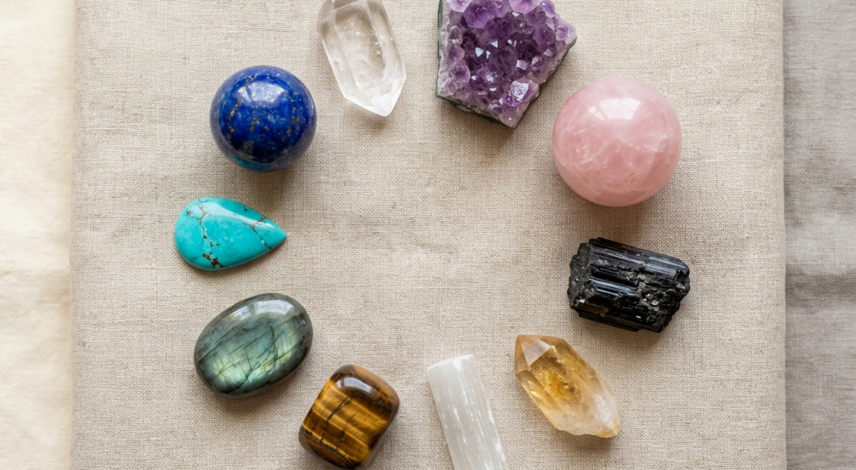

Starting your first crystal collection is exciting — and overwhelming. Walk into any crystal shop and you’ll face hundreds of options, each promising something different. Here’s the short answer: the 10 best healing crystals for beginners are Clear Quartz, Amethyst, Rose Quartz, Black Tourmaline, Citrine, Selenite, Tiger’s Eye, Labradorite, Turquoise, and Lapis Lazuli. Each earns its place for a specific, grounded reason — not wellness marketing.
At Potala Store, we’ve spent over a decade working alongside artisans and monastery communities in Nepal and Tibet, where stones like Turquoise and Lapis Lazuli carry spiritual meaning that predates modern crystal culture by thousands of years. That tradition — combined with conversations with thousands of customers beginning their crystal journey — shaped this list. We’ve kept it honest: what works, why, and exactly how to use each stone in meditation or daily life.
You’ll also find something no other beginner’s guide offers: a complete at-a-glance comparison table covering all 10 crystals, their chakra, care requirements, and best use — so you can make a confident choice without reading every word (though we think you’ll want to).
⚠️ Wellness note: Crystal properties described here reflect traditional spiritual beliefs and historical practices. They are not medical advice and are not intended to diagnose, treat, or cure any condition. Always seek professional medical guidance for health concerns.
🔮 Ready to start building your collection? Explore Potala Store’s handpicked crystal collection — each piece sourced with care from trusted Himalayan artisans and ethically traded partners.
At-a-Glance: All 10 Beginner Crystals Compared
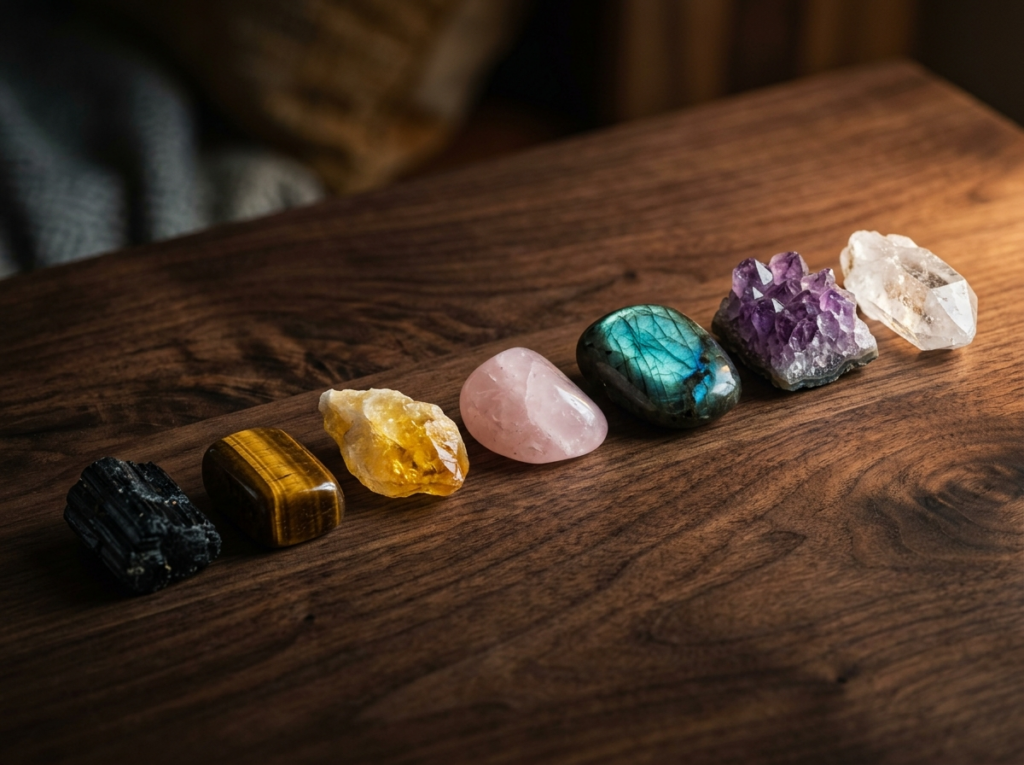
Before we go deep on each stone, here’s your full reference table — everything you need to choose, use, and care for your starter collection at a glance.
| Crystal | Primary Benefit | Chakra | Best Use | Care Note |
|---|---|---|---|---|
| Clear Quartz | Amplification, clarity | Crown (all chakras) | Meditation, intention-setting | Safe in water; avoid prolonged sunlight |
| Amethyst | Calm, intuition, sleep | Third Eye, Crown | Sleep support, stress relief | Fades in direct sunlight — charge by moonlight |
| Rose Quartz | Self-love, compassion | Heart | Relationships, emotional healing | Safe in water; handle gently |
| Black Tourmaline | Protection, grounding | Root | EMF protection, energetic boundaries | Avoid salt water; can be brittle |
| Citrine | Abundance, positivity | Solar Plexus | Workspace, confidence, creativity | Fades in sunlight; self-cleansing |
| Selenite | Cleansing, clarity | Crown | Charging other crystals, sacred space | NEVER in water — dissolves |
| Tiger’s Eye | Courage, confidence | Solar Plexus, Sacral | Decision-making, motivation | Safe in water; avoid salt |
| Labradorite | Transformation, intuition | Third Eye, Crown | Change, spiritual growth | Avoid salt water; check for cracks |
| Turquoise | Protection, wisdom, healing | Throat | Wear as jewelry, travel talisman | Porous — no water, oils, or chemicals |
| Lapis Lazuli | Wisdom, clarity, truth | Third Eye, Throat | Meditation, study, self-awareness | Avoid prolonged water exposure |
The 10 Best Healing Crystals for Beginners
Each crystal below was chosen using three criteria: beginner-friendliness (affordable, widely available, and safe to handle), breadth of benefit (each serves a meaningfully different purpose), and historical and cultural depth (each carries a tradition worth knowing, not just a wellness hashtag). The result is a collection that works together as a complete energetic toolkit.
1. Clear Quartz — The Master Amplifier
Clear Quartz is the single most versatile healing crystal a beginner can own — and the one we recommend above all others if you’re starting with just one stone. Traditionally called the “master healer,” it’s believed to amplify the energy of any intention you set and enhance the properties of crystals placed near it. Its Mohs hardness of 7 makes it durable for daily carry, and it’s safe in water for basic cleansing.
- Primary property: Amplification — strengthens intentions and pairs with any other crystal
- Chakra: Crown (resonates with all chakras)
- How to use: Hold during meditation while setting a specific intention; place near other crystals to amplify their energy; keep on your desk for mental clarity
- Beginner tip: If you feel overwhelmed choosing crystals, start here — its universality means it never goes to waste
In Tibetan Buddhist visualization practices, clear quartz points are sometimes used to direct prana (life energy) during mandala creation, channeling focused intention toward a specific aspiration.
2. Amethyst — The Calming Companion
Amethyst is one of the most recognized spiritual crystals for good reason. Associated with the Third Eye and Crown chakras, it’s traditionally used to quiet mental chatter, support restful sleep, and deepen intuition during meditation. Its color — violet from iron and natural irradiation during formation — ranges from pale lilac to deep purple.
- Primary property: Calm and intuitive clarity — traditional support for stress relief and sleep
- Chakra: Third Eye, Crown
- How to use: Place on your nightstand for sleep support; hold during breathwork or meditation; wear as a pendant throughout the day
- Care: Amethyst fades with prolonged sunlight — cleanse and charge it under full moonlight instead
The Greek root amethystos means “not intoxicated” — the stone was worn as a protective amulet against excess in ancient Mediterranean cultures. For modern beginners, its greatest value is simpler: it reliably calms an overactive mind.
3. Rose Quartz — The Stone of Self-Love
Rose Quartz is universally associated with the Heart Chakra and the energy of compassion — toward others and toward yourself. It’s the most commonly recommended crystal for emotional healing, building self-worth, and opening to deeper connections. There’s a meaningful parallel between Rose Quartz’s traditional purpose and Buddhist metta (loving-kindness) practice: both cultivate warmth without conditions, beginning with oneself.
- Primary property: Heart Chakra activation — associated with self-love and compassion in meditation
- Chakra: Heart
- How to use: Hold over your heart during meditation; place on your bedside table; carry as a tumbled pocket stone
- Pairs well with: Clear Quartz (amplifies its loving energy), Amethyst (adds emotional calm)
4. Black Tourmaline — Your Protective Shield
Black Tourmaline is the grounding and protection crystal most practitioners reach for first — and it earns that reputation. It’s traditionally placed near the front door or at room corners to create an energetic boundary, and in contemporary use it’s frequently recommended near computers and routers for protection against electromagnetic field (EMF) exposure. Its Root Chakra association makes it exceptionally stabilizing during stress or transition.
- Primary property: Energetic protection and grounding — forms a boundary between personal energy and external disruptions
- Chakra: Root
- How to use: Place near your front door or at your workspace; carry when entering draining environments; hold during anxiety or overwhelm
- Care note: Black Tourmaline can be fragile — avoid dropping it on hard surfaces. Avoid salt-water cleansing
In Tibetan homes and monastery entrances, dark stones have long served as protective boundary markers — a tradition that speaks to a universal human instinct connecting grounded dark earth-tones with safety and stability.
5. Citrine — The Abundance Stone
Citrine is one of only a handful of crystals traditionally considered self-cleansing — meaning it doesn’t require regular external cleansing the way most stones do. Known as the “merchant’s stone,” it’s been kept in cash registers, wallets, and the southeast wealth corner of rooms in feng shui practice for generations. Its warm golden hue is associated with solar energy, optimism, and creative confidence.
- Primary property: Abundance activation — traditionally associated with prosperity, confidence, and creative momentum
- Chakra: Solar Plexus
- How to use: Place in your workspace or southeast home corner; carry in your wallet; use during affirmation or goal-setting practice
- Buying note: Much commercial “Citrine” is heat-treated Amethyst — it turns orange-brown rather than pale golden yellow. Both are fine for beginners, but natural Citrine (light honey-gold) is the rarer, more traditional stone
6. Selenite — The Energetic Cleanser
Selenite is the overlooked practical anchor of any beginner collection — not for its own energy work, but for what it does for your other stones. A Selenite charging plate placed beneath your crystals overnight is one of the most widely used and lowest-risk cleansing methods, and unlike most stones, Selenite is believed to never require cleansing itself. Think of it as the maintenance tool that keeps everything else running.
- Primary property: Cleansing and charging other crystals; clearing stagnant energy from spaces
- Chakra: Crown
- How to use: Place all your other crystals on a Selenite plate overnight; use a Selenite wand to sweep your energy field; place in room corners to keep the energy of your space clear
⚠️ Critical care: Selenite is water-soluble — it will dissolve with any water exposure, even briefly. Never rinse, soak, or leave it in humidity. Cleanse with moonlight, sound, or breath only.
7. Tiger’s Eye — The Confidence Builder
Tiger’s Eye is for action. Where Amethyst calms the mind and Rose Quartz opens the heart, Tiger’s Eye connects to the Solar Plexus and Sacral chakras — the energy centers of willpower, motivation, and courage. Its chatoyancy (the silky, shifting light effect that moves across the surface) is one of the most striking optical phenomena in the mineral world, and it has been used as a protective amulet since ancient Rome and Egypt.
- Primary property: Courage and decisiveness — traditionally used to strengthen confidence and follow-through
- Chakra: Solar Plexus, Sacral
- How to use: Wear as a bracelet when facing a challenge; hold during journaling about a decision; keep on your desk during focused work
- Pairs well with: Black Tourmaline (grounded confidence), Citrine (confidence + abundance)
8. Labradorite — The Stone of Transformation
Labradorite is the most underrepresented stone in beginner guides — and that’s precisely why it earns a spot here. Its defining feature is labradorescence: a dramatic iridescent flash of blue, teal, green, and gold that shifts as you turn the stone. Beyond its visual drama, Labradorite is associated with transformation, strengthening intuition, and protecting the aura during periods of rapid change — making it ideal for anyone in a meaningful life transition.
- Primary property: Transformation support — associated with navigating change while keeping your sense of self intact
- Chakra: Third Eye, Crown
- How to use: Hold during meditation when you’re processing a major decision or transition; place on your altar; wear as jewelry
- What makes it different: Unlike most protection stones (which ground downward), Labradorite is believed to protect by strengthening your inner perception — making it distinct and valuable alongside a grounding stone like Black Tourmaline
9. Turquoise — Tibet’s Most Sacred Gemstone
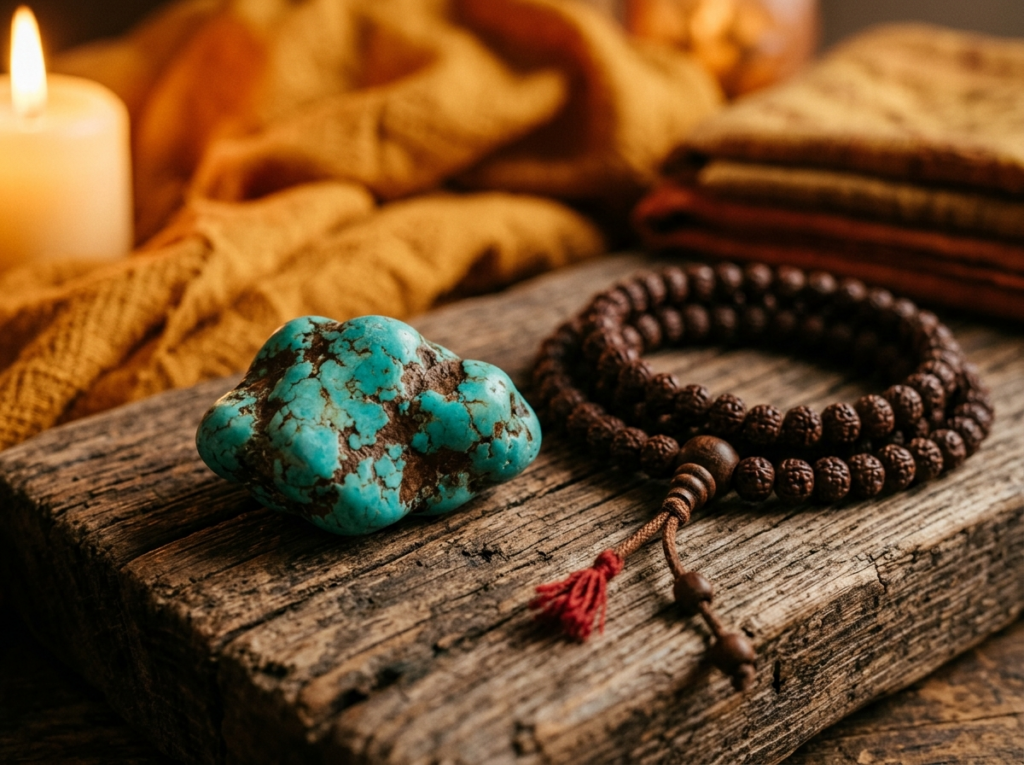
Turquoise is the stone most beginner guides overlook entirely — and it may be the most historically significant crystal on this list. Known in Tibetan as gyu (གཡུ), turquoise has been Tibet’s most sacred and widely used gemstone for over 3,000 years. It adorns monastery walls, frames thangka paintings, and appears in the prayer beads of Tibetan monks. It was traded along the ancient Silk Road as both currency and spiritual object. For Potala Store, turquoise isn’t a trend — it’s the living tradition our store is built on.
🕌 Tibetan Buddhist significance: In Tibetan medicine and spiritual practice, turquoise is associated with protection during travel, healing of the throat and voice, and cultivating wisdom. Tibetan medicine practitioners have used it in healing rituals alongside mantra and visualization for centuries. The sky-blue color represents the boundless quality of awakened mind.
- Primary property: Protection, communication, and wisdom — Tibet’s traditional talisman for travelers and practitioners
- Chakra: Throat
- How to use: Wear as jewelry (the most authentic traditional form); place on the Throat chakra during meditation; carry as a travel talisman
- Buying authentic turquoise: Much sold as “turquoise” is dyed howlite or stabilized material. Genuine natural turquoise has slight color variation and visible matrix (the veining pattern). It should never be perfectly uniform in color
⚠️ Care: Turquoise is porous — keep it away from water, body oils, perfumes, sunscreen, and cleaning chemicals. Store separately from other crystals to prevent scratching.
🧿 Authentic Himalayan turquoise: Potala Store works directly with artisans in Nepal and Tibet to source genuine turquoise jewelry — from simple tumbled stones to hand-set monastery-quality pieces. Explore our turquoise collection →
10. Lapis Lazuli — The Wisdom Stone
Lapis Lazuli is where ancient history and living Buddhist tradition converge. In Tibetan Buddhism, Lapis Lazuli is one of the Seven Precious Substances (saptaratna), and its deep celestial blue is the defining color of the Medicine Buddha (Sangye Menla) — the Buddha of healing and wisdom, depicted in the color of lapis to represent the sky-like, limitless quality of an awakened mind. Ancient Egyptians ground it into pigment for sacred paintings; Mesopotamians used it in royal seals dating back 6,500 years. For a beginner who wants depth alongside beauty, Lapis Lazuli is unmatched.
- Primary property: Mental clarity, wisdom, and truth — one of Buddhism’s seven sacred materials
- Chakra: Third Eye, Throat
- How to use: Place on your forehead (Third Eye position) during meditation; keep at your desk during study or writing; carry when you need to speak or act with clarity and honesty
- Pairs well with: Clear Quartz (amplifies clarity), Amethyst (deepens intuition during meditation)
- Care: Avoid prolonged water exposure — Lapis contains calcite and pyrite, both of which can be damaged by moisture
How to Choose Your First Crystal
The best beginner crystal is the one that meets your most immediate real need — not necessarily the most popular one. Here’s a practical, four-step framework for choosing without overwhelm:
- Start with your intention, not the aesthetics. Before browsing, ask yourself: What do I need most right now? Calm → Amethyst. Protection → Black Tourmaline. Confidence → Tiger’s Eye. Clarity → Clear Quartz. Let the answer guide your choice.
- Limit your starter collection to 3–5 stones. A small, intentional collection you actually use is far more valuable than 30 crystals on a shelf you never connect with. Quality and consistency beat quantity.
- Trust a physical response. In Tibetan Buddhist tradition — and across many crystal practices — the warmth, tingling, or sense of calm you notice when holding a stone is considered meaningful. It’s not superstition; it’s embodied attention. Trust it.
- Build a balanced kit. For broad coverage: one amplifier (Clear Quartz) + one calming stone (Amethyst or Rose Quartz) + one protection stone (Black Tourmaline) + one intention-specific stone based on your personal goal. Four stones that work together covers almost every situation a beginner will encounter.
Looking for a curated starting point? Explore Potala Store’s crystal starter sets — each assembled to pair stones that complement each other energetically, with guidance on how to use them together.
Building Your Crystal Practice: 3 Simple Steps
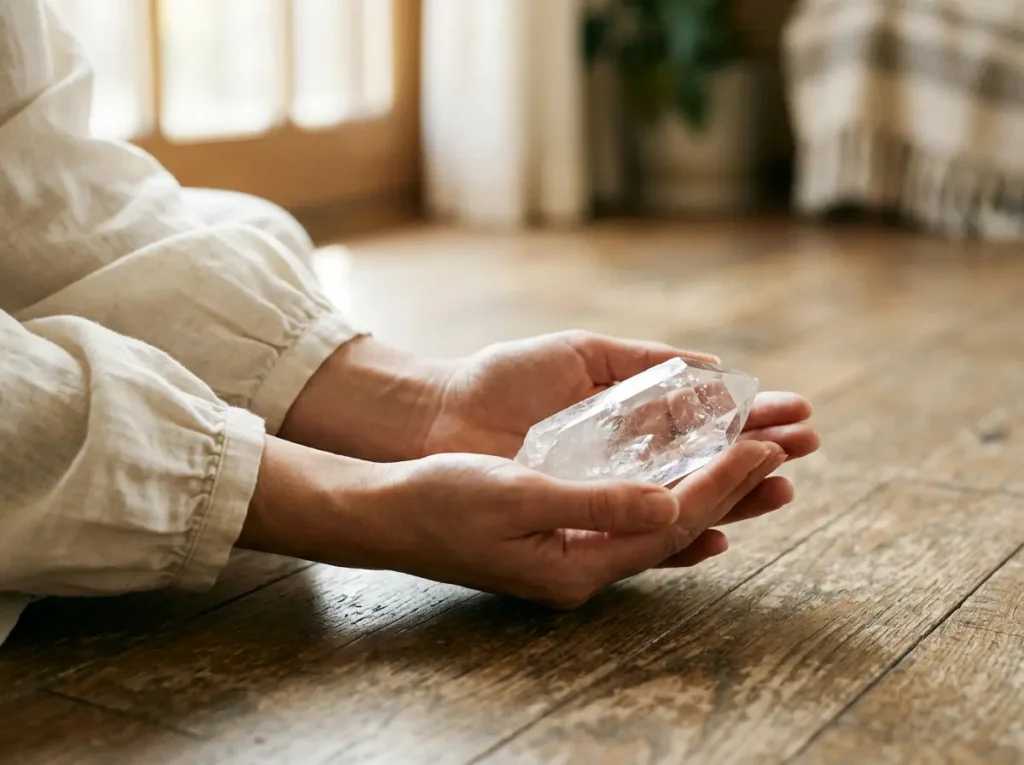
Owning crystals is just the beginning. The real value comes from consistent, intentional use. Here’s how to build a practice that sticks — without overcomplicating it.
Step 1: Cleanse Before First Use
Before working with any new crystal, cleanse it to clear energy absorbed during mining, transport, or handling. The safest universal method:
- Moonlight (safest, works for all stones): Leave crystals on a windowsill or outside overnight during or around a full moon — this works even for water-sensitive stones like Selenite, Turquoise, and Lapis Lazuli
- Smoke (sage or Palo Santo): Pass the crystal through smoke for 30–60 seconds
- Sound (Tibetan singing bowl or tuning fork): Place crystals near the bowl and let the vibration cleanse — no water, no fading risk, works for every stone type
- Selenite plate: Place all your stones on a Selenite plate for 4–6 hours
⚠️ Do NOT use salt water for Black Tourmaline, Labradorite, Turquoise, Selenite, or Lapis Lazuli. It causes dissolving, surface damage, or color loss.
Step 2: Set a Specific Intention
Hold the cleansed crystal in both hands, close your eyes, and set a concrete intention — not “I want to be happy” but “I want to feel grounded during difficult conversations at work.” In Tibetan Buddhist practice, this act of conscious dedication is called offering merit toward an aspiration: a simple but powerful alignment of object and mind. You don’t need to follow any tradition for this to be meaningful. The act of deliberate, focused intention is the practice.
Step 3: Use It Consistently — Not Ceremonially
The most common beginner mistake: buying crystals, displaying them beautifully, and forgetting they exist. Integrate them into what you already do:
- Place your intention stone on your desk while you work
- Hold your calming stone (Amethyst or Rose Quartz) during 5 minutes of morning breathing
- Keep your protection stone near your front door or computer
- Pair any crystal with a mala bead practice — counting beads while holding your stone creates a focused, structured meditation session that deepens your connection to both
Frequently Asked Questions About Beginner Crystals
Clear Quartz is the best single crystal for a beginner because it’s the most versatile stone in any collection — it amplifies any intention, works with any other crystal, and serves virtually every purpose from clarity to protection. If you could start with only one stone, make it Clear Quartz. Amethyst is the best second choice for anyone who specifically needs calm, stress relief, or better sleep.
Start with 3 to 5 crystals. A small, well-chosen collection you actively engage with is significantly more valuable than a large one you’re overwhelmed by. A practical beginner set covers four roles: one amplifier (Clear Quartz), one calming or love stone (Amethyst or Rose Quartz), one protection stone (Black Tourmaline), and one stone tied to your specific personal intention right now.
Crystals with strongly opposing energy types can cancel each other’s effects when used together toward a single intention — for example, high-energy Carnelian (fire, activating) with calming Amethyst (water, settling) may feel contradictory if you’re trying to focus both on the same goal. More practically: never cleanse Selenite, Turquoise, Malachite, or Lapis Lazuli together using water — their different mineral compositions and water sensitivities require separate care. When in doubt, trust your experience: if a combination feels scattered or overwhelming, separate them and work with each individually until you’re comfortable.
There is no peer-reviewed scientific evidence that crystals directly affect physical health. What research does suggest is that the ritual of using crystals — holding a meaningful object, setting a conscious intention, practicing mindfulness with a physical anchor — can support focused attention and emotional regulation. Tibetan Buddhist tradition has used stones as meditative anchors and intention objects for thousands of years — not as magic, but as tools for directed human practice. The most honest frame for beginners: approach crystals as powerful symbols and intention tools, not medical treatments. Use them alongside, not instead of, professional care.
Build Your Essential Crystal Collection
Potala Store offers a curated selection of beginner-friendly crystals and starter sets, sourced from Himalayan artisans and ethically traded partners — including authentic Tibetan Turquoise and Lapis Lazuli you won’t find in most crystal shops.Shop Crystal Starter Sets →
📚 References
- Tibetan Buddhist Art and Material Culture: Historical context for the use of turquoise, lapis lazuli, and precious stones in Himalayan Buddhist tradition, including thangka production and monastery ornamentation. Source: The Metropolitan Museum of Art — Tibetan Buddhist Art (metmuseum.org)
- Lapis Lazuli — Gemstone Overview: Mineralogical data, historical use from ancient Mesopotamia through Buddhist iconography, Mohs hardness (5–6), and care guidelines. Source: Gemological Institute of America — Lapis Lazuli (gia.edu)
- Turquoise — Gemstone Overview: Mineralogical properties, historical significance across cultures including Tibetan, Native American, and ancient Persian traditions, and authentication guidance. Source: Gemological Institute of America — Turquoise (gia.edu)
- Crystal Healing and the Placebo Effect: Academic review of psychological mechanisms underlying object-based belief systems and their measurable effects on attention and emotional regulation. Source: French, C.C. et al. (2001). Paranormal Belief, Personality and Practice. Referenced in Personality and Individual Differences (PubMed)