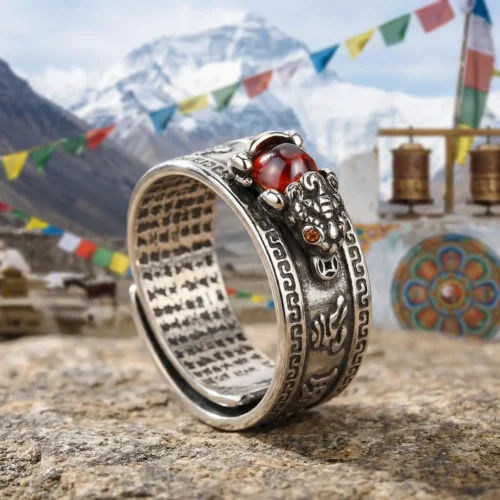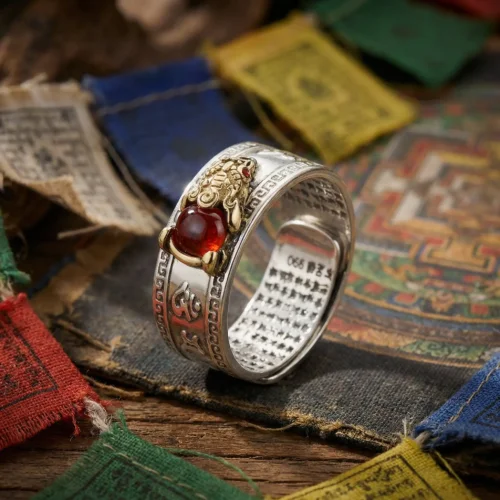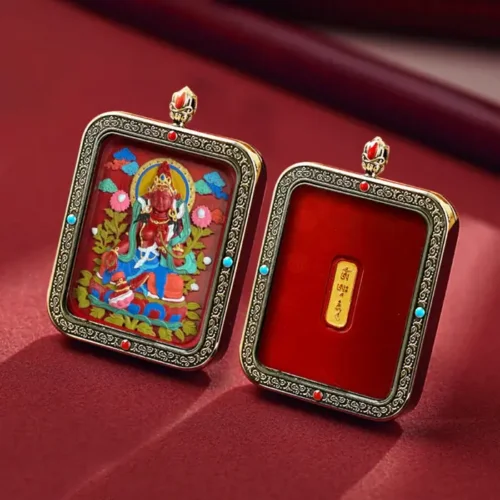

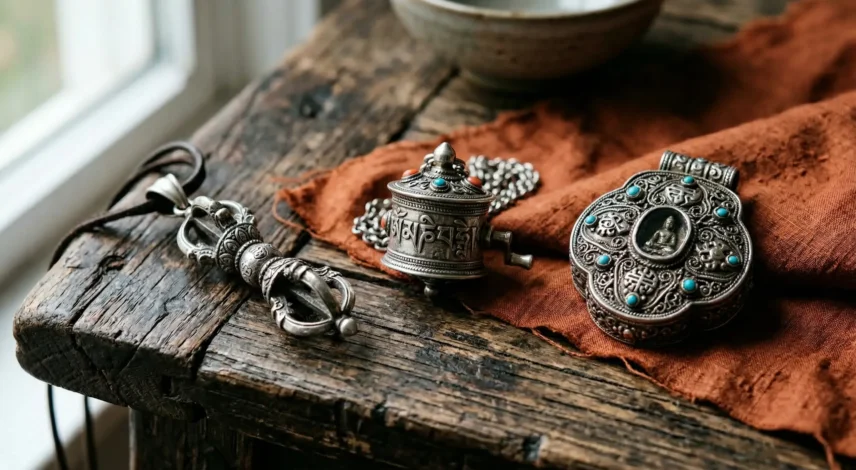

Three sacred symbols. Three completely different spiritual intentions. If you’re drawn to Tibetan Buddhist jewelry but aren’t sure whether a dorje, a prayer wheel pendant, or a vajra is the right talisman for you — this guide cuts through the confusion.
At PotalaStore, we work directly with monks at Sera Jhe Monastery in Lhasa and Kopan Monastery in Nepal. That relationship has given us a perspective you won’t find in most online guides: what these symbols actually mean to the practitioners who use them every day, and why the choice between them isn’t arbitrary.
The short answer: Dorje and vajra are two names for the same indestructible symbol of enlightened wisdom. A prayer wheel pendant is a distinct object — a portable vessel for the mantra of compassion, Om Mani Padme Hum. The right talisman depends on your spiritual intention: cutting through obstacles (dorje/vajra), accumulating compassionate merit (prayer wheel), or seeking comprehensive protection (gau box amulet).
What Are Dorje, Vajra, and Prayer Wheel Pendants?
Dorje, vajra, and prayer wheel pendants are wearable forms of three of the most revered ritual objects in Vajrayana Buddhism, each carrying centuries of symbolic meaning from the Tibetan and Himalayan Buddhist traditions. Worn as necklaces or bracelets, they allow practitioners — and those drawn to their symbolism — to carry sacred intention throughout the day.
All three originate in Vajrayana Buddhism (the “Diamond Vehicle”), the tantric branch practiced across Tibet, Nepal, Bhutan, and parts of India. Each object plays a different role in practice:
- The Dorje / Vajra — a double-ended ritual scepter representing indestructible wisdom and the power to cut through ignorance. It is the defining symbol of Vajrayana itself.
- The Prayer Wheel Pendant — a miniature spinning cylinder containing written mantras, traditionally turned clockwise to accumulate merit and radiate the blessings of compassion.
- The Gau Box (Ghau) — a protective locket-style amulet that holds consecrated substances, sacred images, and mantras. Often paired with a dorje or worn alongside mala beads.
In Tibetan Buddhist communities, these are not merely decorative. They are considered supports for practice — objects that, when properly consecrated, carry the blessing of the deity or teaching they embody.
Dorje and Vajra: Two Names, One Indestructible Symbol
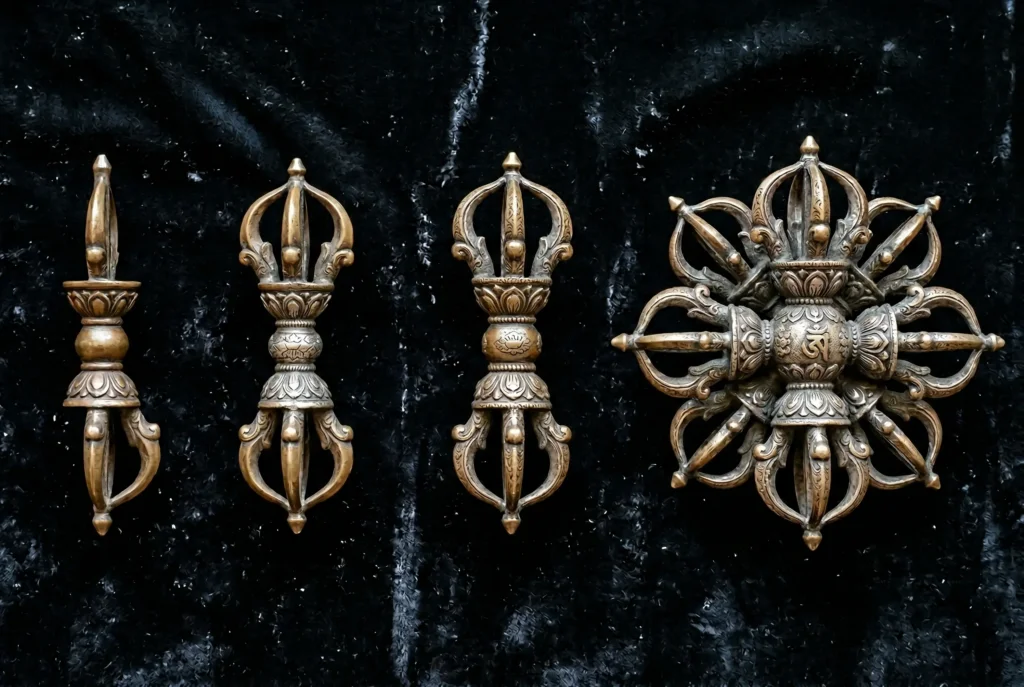
Dorje and vajra refer to the same sacred object — the word “dorje” (རྡོ་རྗེ་) is simply the Tibetan translation of the Sanskrit “vajra.” Both mean something between “thunderbolt” and “diamond”: an object so powerful it can destroy anything, yet so pure nothing can destroy it. In practice, Tibetan teachers use “dorje” and Nepali or pan-Buddhist contexts tend to use “vajra,” but they describe identical ritual implements and the same symbolic meaning.
The symbol originated in ancient Indian Vedic mythology as the weapon of Indra, king of the gods — a thunderbolt that could shatter mountains. When Vajrayana Buddhism adopted it around the 7th century CE, its meaning transformed from external weapon to internal wisdom tool: a symbol of the indestructible nature of enlightened mind, and the power of compassionate action to cut through the “five poisons” of delusion, anger, pride, desire, and jealousy.
What the Prong Count Actually Means
This is one of the most overlooked aspects of dorje symbolism — and the detail most sellers never explain. The number of prongs on a vajra isn’t decorative variation. Each configuration carries specific doctrinal meaning, and different Tibetan Buddhist schools have traditional preferences:
| Prong Count | Symbolic Meaning | Associated School |
|---|---|---|
| 1-pronged | Undivided, absolute nature of reality; unity of all dharmas | General / early Vajrayana |
| 3-pronged | The Three Jewels (Buddha, Dharma, Sangha); Three Kayas | Various traditions |
| 5-pronged | Five Dhyani Buddhas; transformation of the Five Poisons into Five Wisdoms; Four Immeasurables + center | Gelug, Kagyu, Sakya (most common in Tibetan practice) |
| 9-pronged | Nine yanas (vehicles) of practice; Nine Levels of Consciousness | Nyingma (oldest Tibetan school) |
The 5-pronged vajra — by far the most common style in jewelry — maps directly onto the Five Dhyani Buddhas: Vairochana (center), Akshobhya (east), Ratnasambhava (south), Amitabha (west), and Amoghasiddhi (north). In Gelug tradition, which is the lineage of Sera Jhe Monastery, this five-fold symbolism is foundational to tantric practice. The outer four prongs further represent the Four Immeasurables (loving-kindness, compassion, empathetic joy, equanimity), the Four Activities, and the four purified elements.
💡 Practical note: When shopping for a dorje pendant, check whether the prong count is specified. A 5-pronged dorje in sterling silver ($35–$75 USD) is the most versatile choice for practitioners of any Tibetan tradition. A 9-pronged dorje is especially meaningful if you are connected to a Nyingma lineage or teacher.
Who is the dorje/vajra pendant for? Those who feel called to clarity, decisiveness, and the dissolution of mental confusion. Practitioners who work with wrathful deity practices (Vajrapani, Vajrasattva, Vajrakilaya) often wear this symbol as a reminder of the ultimate indestructibility of awareness itself.
The Prayer Wheel Pendant: A Moving Vessel of Compassion
A prayer wheel pendant is a miniature version of the large spinning cylinders seen outside Tibetan monasteries — a portable capsule containing the mantra Om Mani Padme Hum, worn around the neck so that every movement of your body becomes an act of merit accumulation.
The tradition of the prayer wheel is attributed to the Indian master Nagarjuna and was brought to Tibet during the first propagation of Buddhism (7th–9th century CE). The core principle comes from a teaching by Avalokiteshvara (Chenrezig in Tibetan) — the bodhisattva of compassion — that spinning a mantra wheel is equivalent to reciting that mantra the same number of times.
Most quality prayer wheel pendants contain a tightly rolled scroll printed with 108 million repetitions of Om Mani Padme Hum on microfilm or fine lokta paper. The pendant is designed to be spun clockwise — following the path of the sun, which mirrors the direction of reading Tibetan script and circumambulating sacred sites. Each clockwise rotation is believed to release those millions of mantra recitations into the world.
Who is the prayer wheel pendant for? Those whose practice centers on compassion, devotion, and the aspiration to benefit all beings. It is particularly associated with practitioners of the Avalokiteshvara sadhana and anyone who feels a deep connection to the six-syllable mantra. It is also one of the most accessible Tibetan Buddhist objects for people new to the tradition, since its function — reciting the mantra of compassion — requires no initiation.
Browse our prayer wheel pendant collection, crafted in sterling silver with functioning scroll inserts, sourced from Kathmandu workshops with Kopan Monastery blessing partnerships.
Choosing the Right Talisman: A Symbol-by-Symbol Comparison
Here is a direct comparison of the three most common Tibetan Buddhist protective pendants, to help you identify which one aligns with your intention:
| Symbol | Core Meaning | Best For | Tradition | Typical Price (USD) |
|---|---|---|---|---|
| Dorje / Vajra | Indestructible wisdom; power to cut through ignorance and the five mental poisons | Clarity, inner strength, tantric practice, protection from delusion | All Tibetan schools (Gelug: 5-prong; Nyingma: 9-prong) | $25–$85 |
| Prayer Wheel | Compassionate merit accumulation; each spin = reciting Om Mani Padme Hum | Devotion, compassion practice, blessing for self and others | All Tibetan traditions; especially Kagyu and Gelug | $30–$90 |
| Gau Box (Ghau) | Wearable sanctuary; sealed protection from negative influences | Comprehensive protection, travel, those wanting a personal shrine on the body | Tibetan folk tradition + monastic blessing | $45–$150 |
| Dorje + Bell Pair | Unity of wisdom (dorje) and compassion (bell/ghanta); method and emptiness | Active practitioners of Vajrayana rituals; those seeking symbolic completeness | All Vajrayana traditions (especially Gelug ritual) | $55–$140 (set) |
Choosing by Intention
- “I want to cultivate clarity and cut through mental obstacles” → Choose a dorje or vajra pendant, ideally 5-pronged sterling silver.
- “I want to accumulate merit and connect with the energy of compassion” → A prayer wheel pendant, worn and occasionally spun clockwise, is your natural companion.
- “I want broad protective energy, like a sacred space I carry with me” → A gau box, preferably filled with blessed substances by a lama, offers the most comprehensive protection.
- “I practice active Vajrayana rituals or visualizations” → A dorje-and-bell set pendant captures the complete symbolic grammar of Vajrayana: the union of wisdom (dorje, masculine) and compassion (bell/ghanta, feminine).
If you’re choosing a talisman as a gift, the prayer wheel pendant tends to be the most universally appreciated — its meaning (compassion for all beings) resonates across backgrounds, and it requires no prior Buddhist initiation to be worn respectfully. For someone with an established meditation practice, a 5-pronged dorje in sterling silver is a deeply meaningful offering.
Why Monastery Blessing Matters — And How to Recognize It
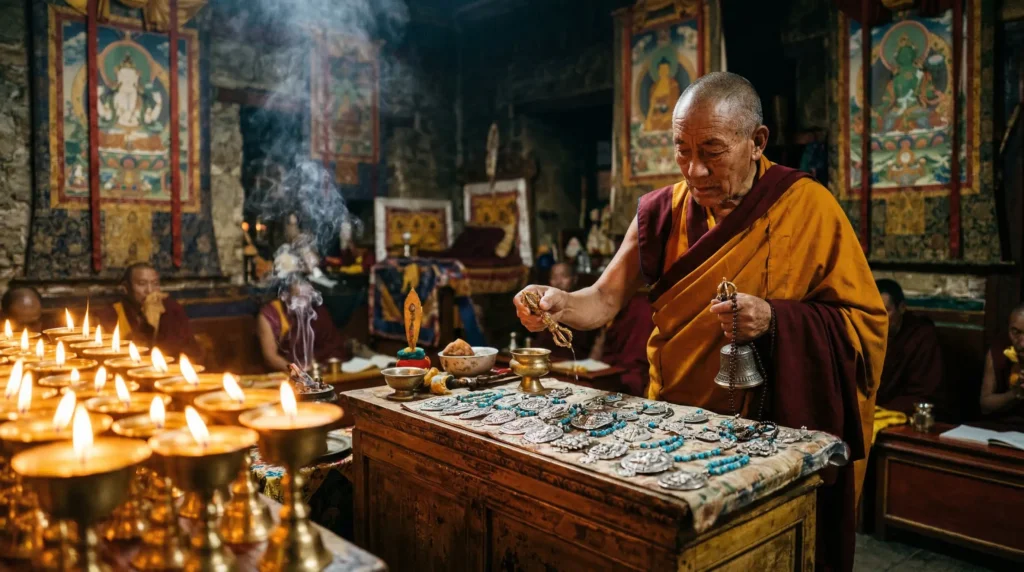
In Tibetan Buddhist understanding, a beautiful dorje pendant and a consecrated dorje pendant are fundamentally different objects. The physical form may be identical — same silver, same prong count. What changes is whether the object has been transformed through the rabné ceremony (བྲབ་གནས་), a formal consecration rite performed by qualified monks or lamas.
🏔️ The Rabné Consecration Ceremony
During rabné, monks recite specific deity mantras and visualizations to “invite” the mind of the associated deity or teaching into the object. The ceremony typically involves:
- Invocation: Calling upon the deity associated with the object (for a dorje, this is often Vajrasattva or Vajrapani)
- Mantra recitation: Hundreds to thousands of repetitions of the root mantra, often across multiple days for significant items
- Visualization: Monks visualize the object as the body, speech, and mind of the deity
- Dedication of merit: The accumulated blessing is dedicated to all beings
After rabné, the object is considered an actual support for practice — not just a symbol of a deity, but a vessel for their blessing energy.
Working directly with the monastic community at Sera Jhe Monastery — one of the Three Great Seats of the Gelug tradition, home to over 3,000 monks — and at Kopan Monastery (an FPMT center near Kathmandu that has trained thousands of Western students since the 1970s), we came to understand something most jewelry retailers miss: the monks themselves take great care about which objects receive formal consecration, and under which conditions. A mass-produced pendant blessed in a rushed ceremony is treated very differently from an object that receives extended ritual attention.
When we first began sourcing directly through our monastery partnerships, we assumed that “blessed” simply meant a monk had said a prayer over a batch of items. What we discovered was a far more rigorous system — specific texts are required for specific objects, and not every monk is authorized to perform every consecration. A Dorje Sempa (Vajrasattva) blessing, for example, is considered especially powerful for purification, and the monks at Sera Jhe conduct it according to the Gelug tradition’s detailed liturgical protocols.
How to Tell if a Pendant Has Been Properly Blessed
- Provenance documentation: Legitimate monastery-sourced items often come with a blessing certificate or can be traced to a specific ceremony. At PotalaStore, each monastery-blessed piece includes documentation of the blessing source.
- Seller transparency: Be cautious of vague language like “spiritually charged” or “energy-infused” without naming the monastery, lama, or specific ritual involved.
- Craftsmanship alignment: Traditional Tibetan ritual objects follow iconographic standards. A vajra with incorrect proportions or reversed symbolism may indicate a purely decorative reproduction.
- Material: Traditionally, dorjes are cast in brass, bronze, or silver — not plastic or lightweight alloys. Quality sterling silver (925) is the most common choice for wearable jewelry.
How to Wear and Honor Your Buddhist Talisman
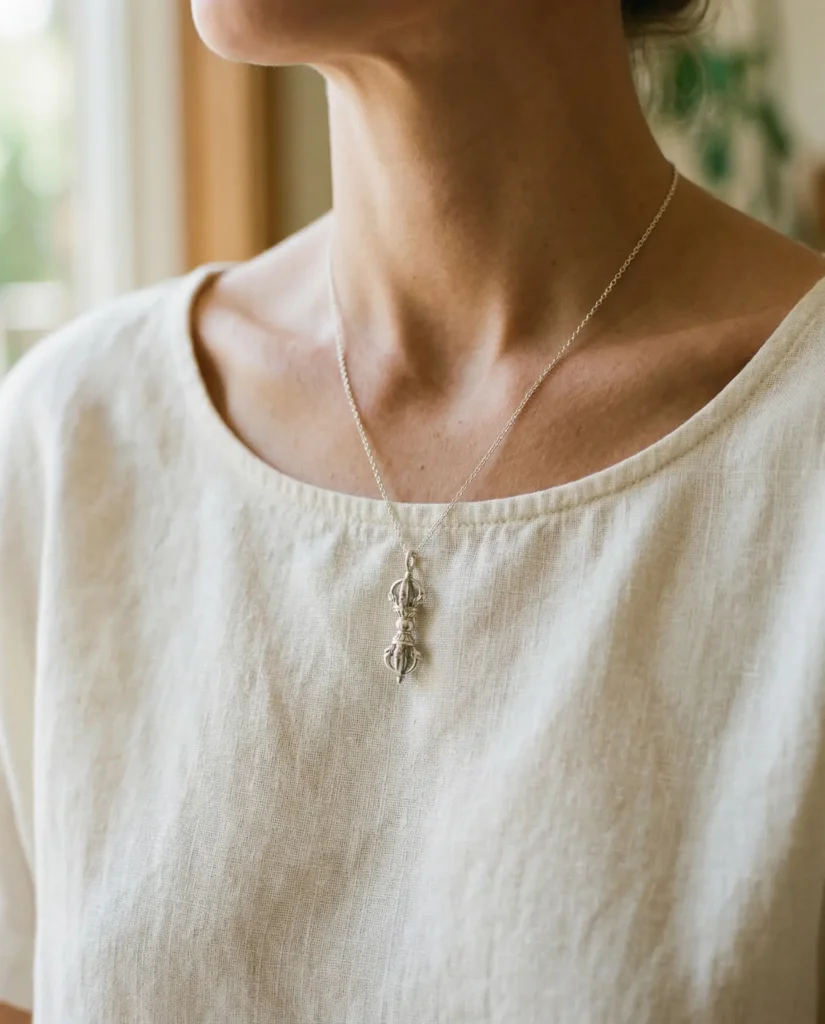
There is no single prescribed rule in Tibetan Buddhism about how to wear a talisman pendant — practices vary by school, teacher, and individual lineage. The following guidance reflects general principles shared across traditions.
- Placement: Pendants are typically worn close to the heart, resting on the chest. This is considered the most respectful position — near the seat of compassionate intention. Avoid wearing sacred objects below the waist.
- Prayer wheel rotation: When wearing a prayer wheel pendant, you can spin it clockwise (when viewed from above) any time you think of it — while walking, during a commute, or in moments of stress. Each clockwise revolution is equivalent to reciting the inscribed mantra.
- Sleeping and bathing: Many practitioners choose to remove sacred objects before sleep or bathing. This is not strictly required, but removing them is a mark of respect and helps preserve the metal finish.
- Cleaning: Use a soft cloth dampened with water to clean sterling silver pendants. Avoid chemical silver cleaners on pieces with colored inlays (turquoise, coral) or on brass/bronze items, as these can damage the finish or remove intentional patina. A dry, gentle polish is sufficient for regular maintenance.
- Storage: Store in a clean cloth pouch, away from other metal objects that may scratch the surface. Many Tibetan practitioners place their sacred objects on a clean cloth at a household altar when not wearing them.
⚠️ Important Note: The spiritual and protective properties described in this article reflect traditional Tibetan Buddhist beliefs and the lived experience of practitioners within those traditions. These are not scientifically verified claims. PotalaStore presents this information for educational and cultural purposes. These items are spiritual supports, not substitutes for medical, psychological, or professional guidance.
Explore PotalaStore’s pendant collection: Every piece in our Tibetan Buddhist pendant collection is individually sourced through our verified monastery partnerships. Our team can advise on the right symbol for your practice — reach out via our contact page for personalized guidance.
Frequently Asked Questions
Yes — dorje (Tibetan: རྡོ་རྗེ་) and vajra (Sanskrit) are two different language names for the same ritual object. Both translate to something between “thunderbolt” and “diamond,” describing an indestructible implement of enlightened wisdom. In Tibetan cultural and monastic contexts you will hear “dorje”; in broader Buddhist and Nepali contexts you will encounter “vajra.” The symbolism, iconography, and ritual use are identical.
Most Tibetan Buddhist teachers welcome sincere interest in these symbols from people of any background. The guiding principle across traditions is one of respectful intent: wearing a sacred object as a reminder of positive qualities — compassion, clarity, protection — is considered appropriate. Wearing it purely as a fashion accessory without any understanding of its meaning is generally seen as disrespectful. If you are drawn to these symbols, learning even a small amount about their cultural context — as you are doing now — reflects exactly the kind of respectful engagement practitioners appreciate.
According to Tibetan Buddhist teaching, a prayer wheel pendant functions as a merit-accumulation device. The scroll inside typically contains 108 million printed repetitions of the mantra Om Mani Padme Hum — the mantra of Avalokiteshvara, the bodhisattva of compassion. Each clockwise rotation of the pendant is traditionally understood to release those mantra recitations and their associated blessings, benefiting both the wearer and all beings within their sphere of influence. Whether you approach this as literal spiritual mechanics or as a beautifully embodied intention practice, the pendant serves as a constant reminder to orient toward compassion.
The most reliable indicators are: (1) verifiable provenance — a named monastery or lama, not vague claims about “energy charging”; (2) a blessing certificate or documentation from the ceremony; (3) seller transparency about when and where the consecration took place; and (4) iconographic accuracy — the object should conform to traditional Tibetan artistic standards. PotalaStore provides provenance documentation for all monastery-blessed pieces, linked to our partnerships with Sera Jhe Monastery (Lhasa, Gelug tradition) and Kopan Monastery (Kathmandu, FPMT/Gelug tradition).
Find Your Monastery-Blessed Talisman
Every pendant in our collection is sourced through our partnerships with Sera Jhe and Kopan monasteries — with provenance documentation included. Browse dorje pendants, prayer wheel necklaces, gau boxes, and more.Shop Pendants → Our Monastery Partnerships
📚 References & Further Reading
- Vajra — New World Encyclopedia: Comprehensive overview of vajra symbolism across Hindu, Buddhist, and Jain traditions, including the Five Poisons ↔ Five Wisdoms correspondence. newworldencyclopedia.org
- “What’s in a Symbol? Vajra” — Tricycle Buddhist Review: Analysis by Jeff Watt (former chief curator, Rubin Museum of Art / Himalayan Art Resources), covering school-specific prong-count traditions and iconographic standards. tricycle.org
- Himalayan Art Resources — Ritual Objects: Searchable museum-grade database of Tibetan Buddhist ritual implements and their iconographic specifications, maintained by scholars and curators. himalayanart.org
- “The Vajra (Dorje) as a Symbol in Buddhism” — Learn Religions: Accessible overview by Barbara O’Brien covering the transformation of the vajra from Vedic weapon to Buddhist symbol of enlightened mind. learnreligions.com