


You’ve probably seen it everywhere—on celebrity wrists, hanging in boutique windows, or dangling from a friend’s rearview mirror. That striking blue eye symbol isn’t just a trendy accessory. It’s one of the world’s oldest protection traditions, dating back over 5,000 years.
Whether you’re curious about its meaning or ready to add one to your collection, this guide covers everything you need to know. From ancient origins to modern styling tips, let’s explore why millions of people still trust the evil eye for protection today.
What Is the Evil Eye?
Here’s the thing: “evil eye” actually means two different things. First, it’s a curse—the belief that jealous or envious glances can bring bad luck or harm. Second, it’s the amulet designed to protect you from that curse.
Think of it like this: the evil eye charm acts as a spiritual bodyguard. It “watches back” at the world, deflecting negative energy before it reaches you. According to Britannica, this belief appears in ancient Greek, Roman, Jewish, Islamic, Buddhist, and Hindu traditions.
The protection works through a simple principle: like repels like. An eye image can deflect an envious gaze. That’s why the amulet features a bold eye design—it’s literally staring back at negativity on your behalf.

Where Did the Evil Eye Come From?
The evil eye isn’t new. Archaeological evidence traces protective eye symbols to ancient Mesopotamia around 3000 BCE. From there, the belief spread through the Mediterranean, the Middle East, and beyond.
Different cultures gave it different names:
- Mati (Greek) — meaning “eye”
- Nazar (Turkish) — meaning “sight” or “gaze”
- Mal de Ojo (Spanish) — meaning “evil eye”
- Ayin Hara (Hebrew) — meaning “the evil eye”
Today, Turkey and Greece remain the heart of evil eye tradition. Walk through Istanbul’s Grand Bazaar or a Greek island village, and you’ll see the blue eye symbol everywhere—on jewelry, doorways, boats, and even babies’ clothing.
“The evil eye is one of the most widespread superstitions in the world, found on every continent and across most major religions.” — Encyclopedia Britannica
How Does Evil Eye Protection Work?
The mechanics are simple, yet powerful. The amulet serves as a reflective shield. When someone looks at you with envy, jealousy, or ill intent, the charm absorbs or bounces back that negative energy.
Three elements make the protection effective:
- The Eye Design: An eye watching outward deflects harmful gazes
- The Blue Color: Traditionally associated with the sky and water, blue symbolizes calm and spiritual protection
- Your Intention: Many believe your mindset amplifies the charm’s power
Whether you see it as spiritual energy or a meaningful reminder to stay positive, the evil eye serves as a daily symbol of protection and self-care.
Nazar vs. Hamsa: What’s the Difference?
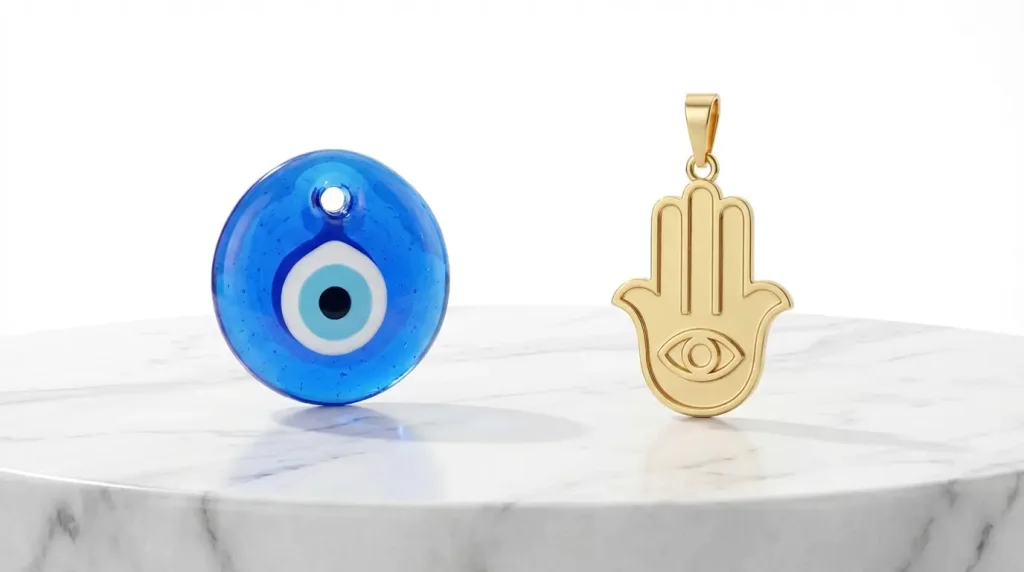
You’ll often see these two symbols together, but they have distinct origins and meanings.
| Feature | Nazar (Evil Eye) | Hamsa (Hand) |
|---|---|---|
| Shape | Concentric circles forming an eye | Open palm with five fingers |
| Origin | Turkey, Greece, Mediterranean | Middle East, North Africa |
| Function | Deflects and reflects negative energy | Invokes divine blessing and protection |
| Also Known As | Turkish Eye, Greek Mati | Hand of Fatima, Hand of Miriam |
The good news? You can wear both together. Many people combine a nazar with a hamsa for layered protection—the eye deflects while the hand blesses.
Evil Eye Colors and What They Mean
Blue is the classic choice, but today’s evil eye jewelry comes in many colors. Each shade carries its own meaning:
Blue — The Traditional Choice
- Dark Blue: Karma protection, calm, open communication
- Light Blue: General protection, peace, broadened perspective
Other Popular Colors
- Red: Courage, energy, protection from fear and anxiety
- Black: Power, grounding, absorbs negative energy
- Green: Growth, balance, new beginnings
- White: Purity, focus, fresh starts
- Yellow/Gold: Health, mental clarity, concentration
- Pink: Friendship, love, emotional calm
Pro tip: Choose the color that matches your current intention. Need courage for a big presentation? Try red. Seeking calm during a stressful period? Stick with blue.

How to Wear Evil Eye Jewelry
There’s no strict rulebook here, but tradition offers some guidance.
Which Hand for Bracelets?
Left hand: Protects your emotions, inner self, and personal relationships. Since it’s closer to your heart, many believe it shields your emotional life.
Right hand: Protects your career, material success, and external world. This side governs action and logic.
Honestly? Wear it wherever feels right. Your intention matters more than placement.
Best Practices for All Jewelry Types
- Bracelets: Most popular choice; layer with other pieces for a modern look
- Necklaces: Wear close to your heart; great for layering
- Rings: Index finger for confidence, ring finger for love
- Multiple pieces: Absolutely okay—more coverage, same protection
Where to Place the Evil Eye at Home
Evil eye protection isn’t just for jewelry. Placing amulets around your home creates a protective environment for everyone inside.
Best Placement Spots
- Front Door: Hang above or beside the entrance to filter incoming energy before it enters
- Living Room: Place on a central wall to protect family gatherings and conversations
- Bedroom: Position near the bed (not directly above) for calm sleep and emotional balance
- Home Office: Put on your desk or facing the entrance to shield against workplace negativity
- Kitchen: Near the stove or dining area to protect family meals and nourishment
The general rule: place the evil eye where it can “see” incoming energy—entrances, windows, and gathering spaces.
Signs You May Need Evil Eye Protection
Wondering if you’re affected by negative energy? Traditional beliefs point to several common signs:
- Sudden, unexplained fatigue or headaches
- A streak of bad luck after receiving praise or attention
- Feeling “off” after meeting certain people
- Emotional heaviness without clear cause
- Things going wrong right after a compliment
Important note: These symptoms can have many causes. Evil eye protection is about energy awareness, not fear. Think of it as spiritual self-care.
What Happens When Your Evil Eye Breaks?
Don’t panic—this is usually a good sign. Most traditions believe a broken evil eye means it did its job.
The amulet absorbed too much negative energy and sacrificed itself to protect you. It reached capacity, cracked, and released that negativity away from your life.
What to do when it breaks:
- Thank the charm for its protection
- Dispose of it respectfully (bury it or simply discard it with gratitude)
- Replace it promptly to continue your protection
Don’t continue wearing a broken piece. Its protective power has been used up.
How to Care for Your Evil Eye Jewelry
Like any meaningful piece, your evil eye jewelry deserves proper care.
- Cleansing: Leave under moonlight, pass through sage smoke, or rinse under running water
- Storing: Keep in a soft pouch or jewelry box to prevent scratches
- Recharging: Hold in sunlight while setting a positive intention
- When to replace: If broken, cracked, or it just feels “heavy”
Treat it with respect—it’s working for you every day.
Is It OK to Wear the Evil Eye?
Short answer: Yes, anyone can wear it.
The evil eye spans cultures, religions, and continents. It’s not owned by any single tradition. Jews, Muslims, Christians, Hindus, and Buddhists have all embraced this symbol for centuries.
The key is appreciation, not appropriation. Learn its history. Understand its meaning. Wear it with respect rather than treating it as a meaningless trend.
When you know the story behind the symbol, it becomes more than fashion—it becomes a meaningful connection to ancient wisdom.
Final Thoughts
The evil eye has protected people for over 5,000 years. From ancient Mesopotamia to modern jewelry boxes, this simple symbol continues to offer comfort, protection, and style.
Whether you’re drawn to its spiritual significance or simply love the iconic blue design, wearing the evil eye connects you to one of humanity’s oldest traditions. It’s a reminder that you’re watched over, protected, and shielded from negativity.
In a world full of unseen energy, a little extra protection never hurts. And looking good while you’re at it? That’s just a bonus.
📚 References
- Evil Eye History & Cultural Beliefs: For a scholarly overview of the evil eye across cultures and religions, Encyclopedia Britannica provides comprehensive historical and anthropological context.
- Ancient Protective Amulets: The Metropolitan Museum of Art’s Essay on Ancient Egyptian Amulets explores how ancient civilizations used eye symbols and amulets for protection, including the Eye of Horus tradition.
- Global Good Luck Charms: National Geographic offers an engaging look at evil eyes and other protective talismans as cultural symbols found across world traditions.
- Evil Eye Cultural Journey: The Archaeologist provides in-depth analysis of the evil eye’s evolution from ancient Sumeria through Greek, Roman, and modern cultures.
- Evil Eye in Art History: Artsy examines why people have worn evil eye charms for millennia, with insights from museum collections and cultural anthropologists.