
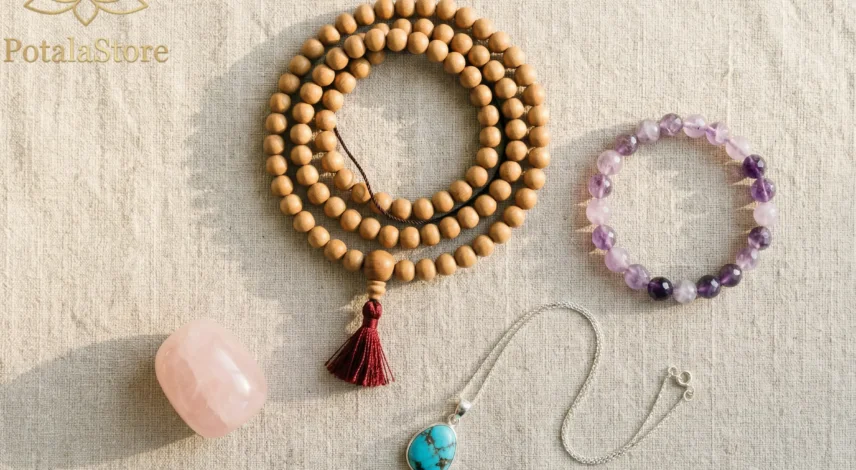
How to Choose Spiritual Jewelry for Inner Peace and Positive Energy: Expert Guidance from PotalaStore
 by Yang Tso
0 comments
by Yang Tso
0 comments
If you’ve spent time scrolling through dozens of crystals, mala beads, and sacred symbols wondering which one is actually right for you — you’re making the same mistake most people do: starting with the stone instead of the intention.
Choosing spiritual jewelry that genuinely supports inner peace and positive energy comes down to four decisions: your intention, the jewelry category, the right material, and authenticity. Skip any one of these and you’re likely to end up with something beautiful but not particularly meaningful.
At PotalaStore, we’ve worked directly with Tibetan artisans and Himalayan monasteries for years, and we’ve helped thousands of customers navigate exactly this. Most guides online give you a list of crystals and call it a day. This one goes deeper.
⚠️ A quick note: The spiritual and energetic properties described in this guide are based on traditional beliefs and the experiences of practitioners — not scientific claims. Think of spiritual jewelry as a meaningful support tool for your mindfulness practice, not a substitute for professional medical or mental health care.
Step 1: Define Your Intention Before You Browse

The single most important step in choosing spiritual jewelry is deciding what you actually want it to support — and most people skip it entirely. Intention determines everything: which stone, which symbol, which tradition, which form.
Here are the four most common intentions, and what they point toward:
- Inner peace and calm: You want something to help quiet mental noise, reduce anxiety, or create a sense of stillness. → Look toward amethyst, moonstone, aquamarine, and mala beads.
- Positive energy and uplift: You want to shift your mood, increase motivation, or attract good circumstances. → Look toward citrine, clear quartz, carnelian, and yellow jasper.
- Protection: You feel drained by other people’s energy, or want a sense of psychic shielding. → Look toward black tourmaline, obsidian, evil eye amulets, and Tibetan Dzi beads.
- Spiritual growth and deepening practice: You’re an active meditator or exploring Buddhist/Hindu traditions more seriously. → Look toward mala beads (108-bead), Tibetan sacred symbols, and chakra jewelry.
💡 Practical tip: If you’re drawn to multiple intentions, start with the one that feels most urgent. You can always add pieces over time. Wearing five different “healing” pieces at once often means you’re not intentionally working with any of them.
The 5 Main Categories of Spiritual Jewelry
Spiritual jewelry spans five distinct categories, each with different traditions, materials, and uses. Knowing which category matches your intention saves you a lot of confused browsing.
- Crystal and gemstone jewelry: Rings, bracelets, necklaces, and pendants set with natural stones. Each stone is traditionally associated with specific energies — amethyst for calm, rose quartz for heart-opening, black tourmaline for protection. Price range: $20–$80 USD for most pieces.
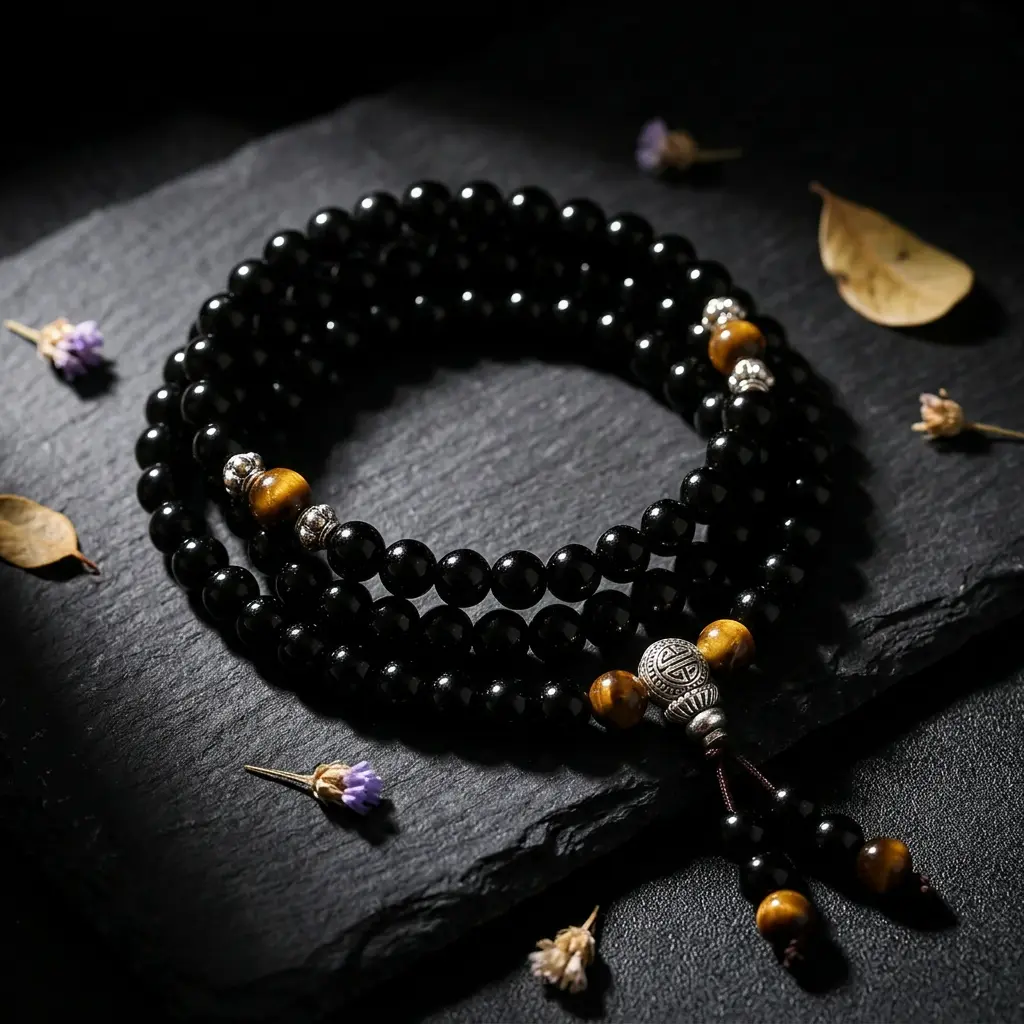
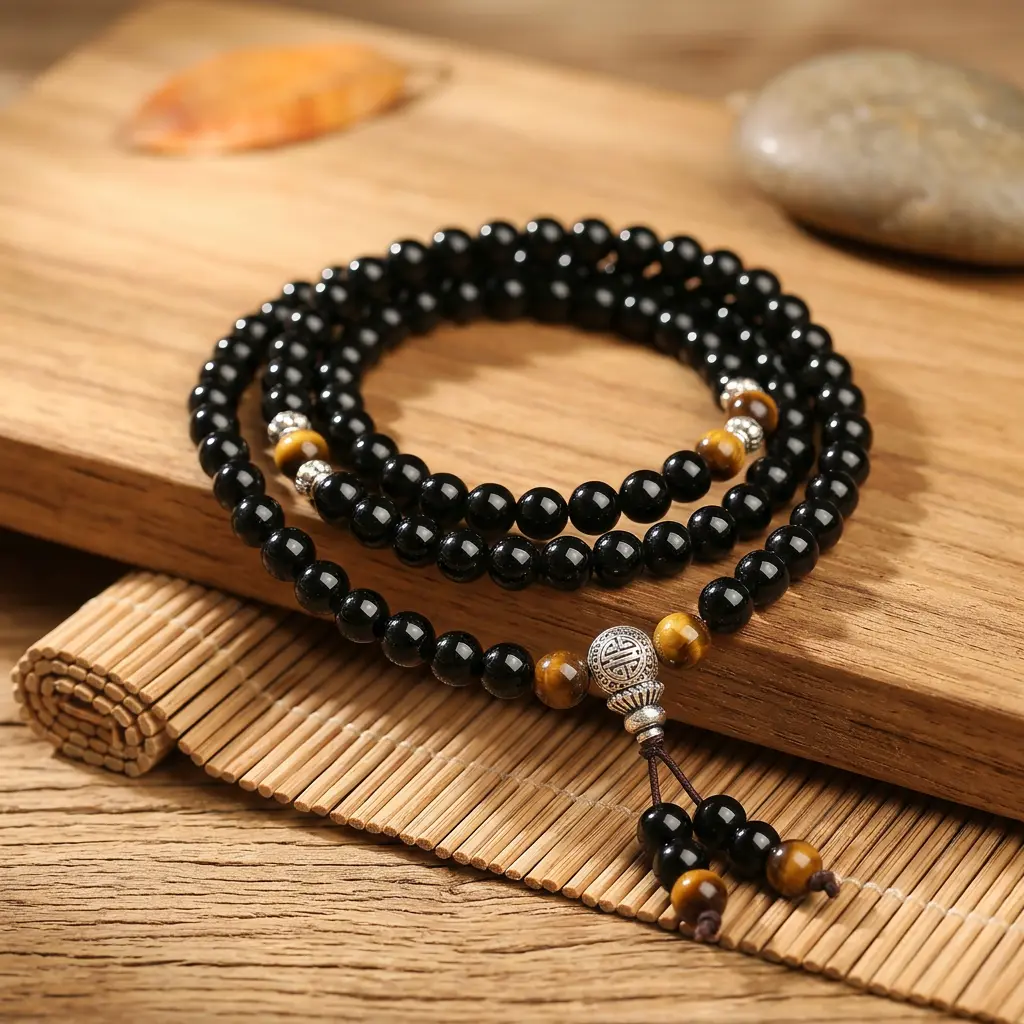
- Mala beads and prayer beads: Strings of 108 beads used in Buddhist and Hindu meditation for counting mantras. Also available as wrist malas (18–27 beads) for daily wear. Materials range from sandalwood to lapis lazuli.
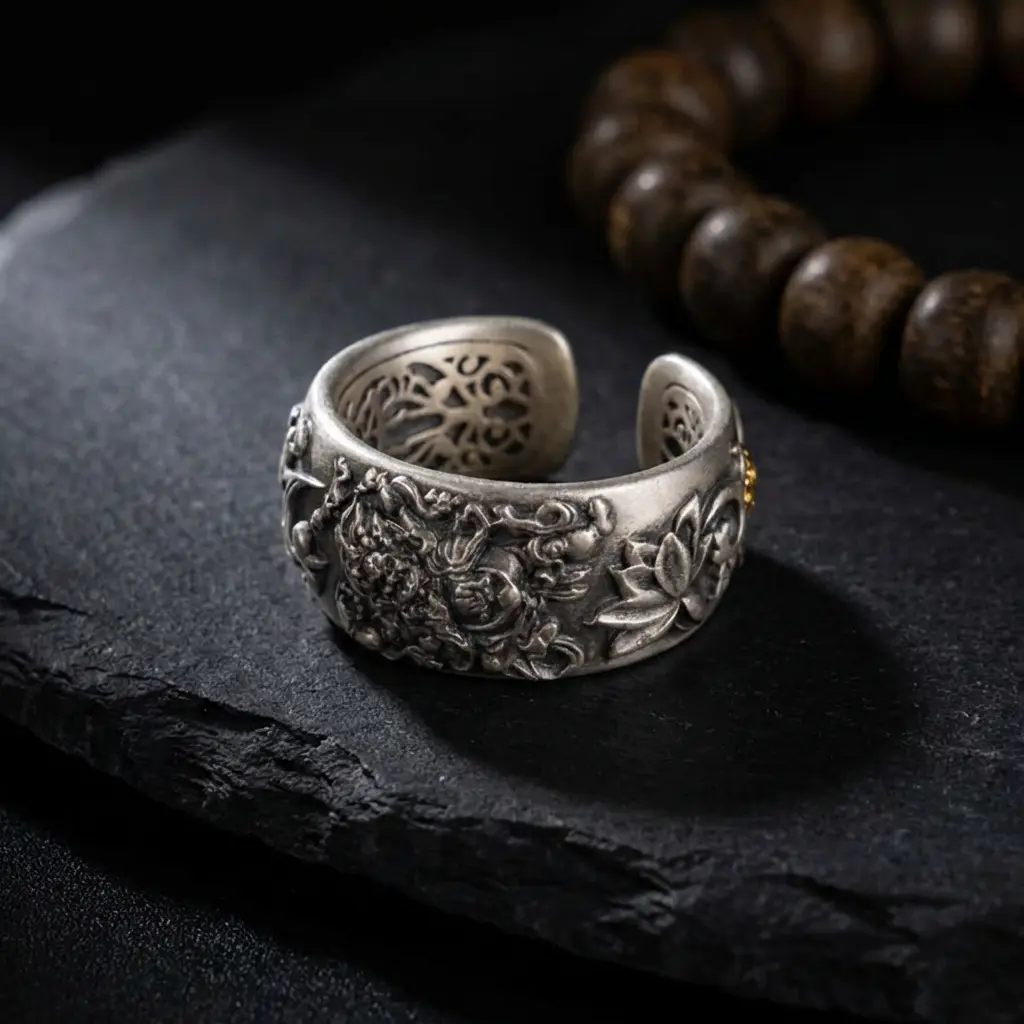
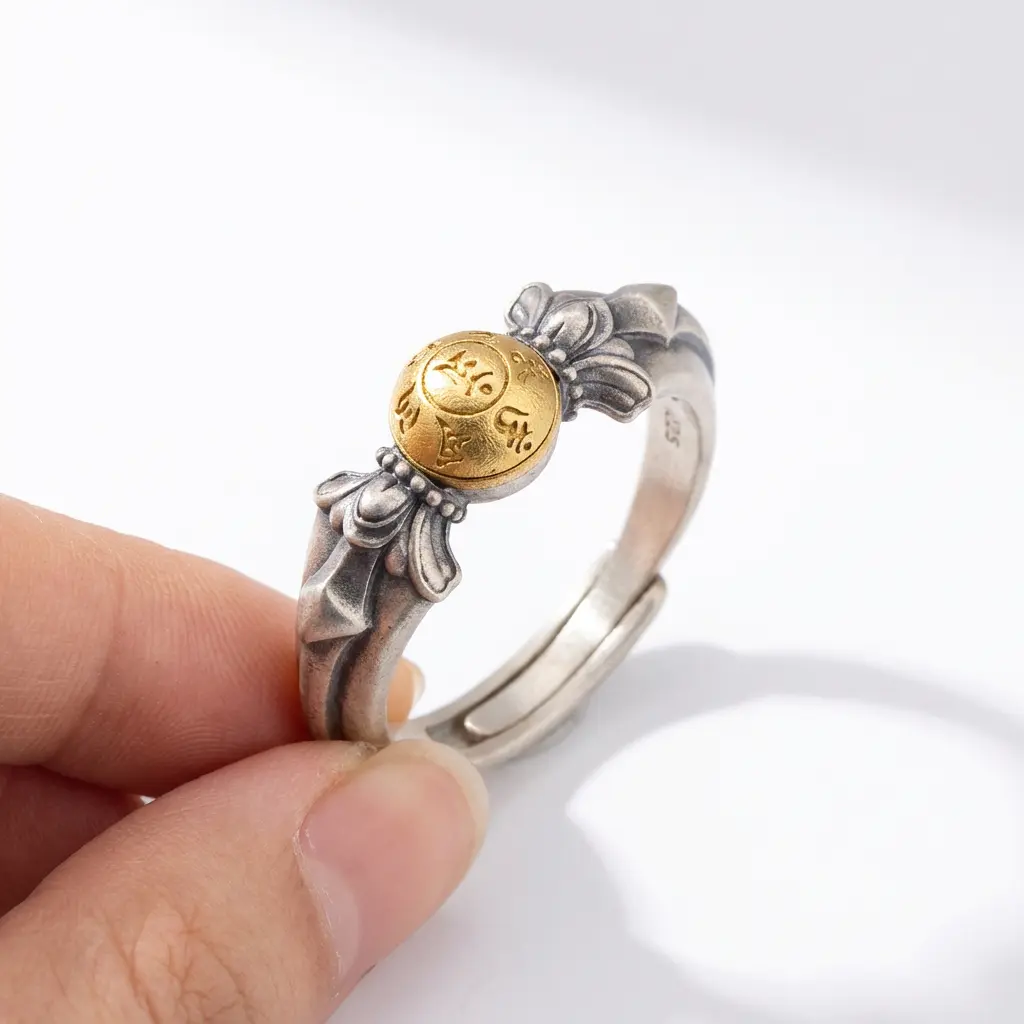
- Symbol jewelry: Pendants and rings featuring sacred symbols — the Om (AUM), lotus flower, Hamsa hand, Tree of Life, or Tibetan endless knot. The symbol carries meaning regardless of material.
- Chakra jewelry: Designed to represent or support the 7 chakras (energy centers of the body), usually featuring a sequence of seven stones: red jasper, carnelian, citrine, rose quartz, aquamarine, lapis lazuli, and amethyst.
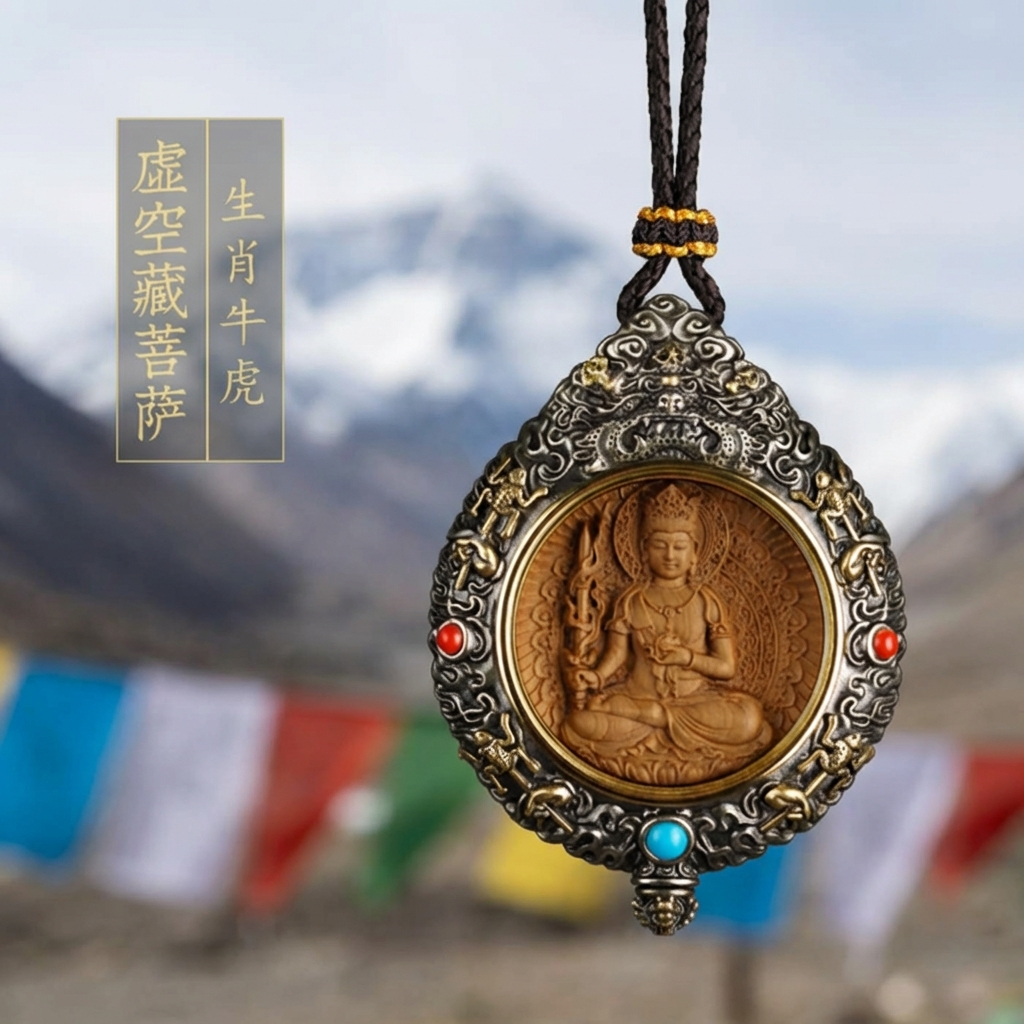
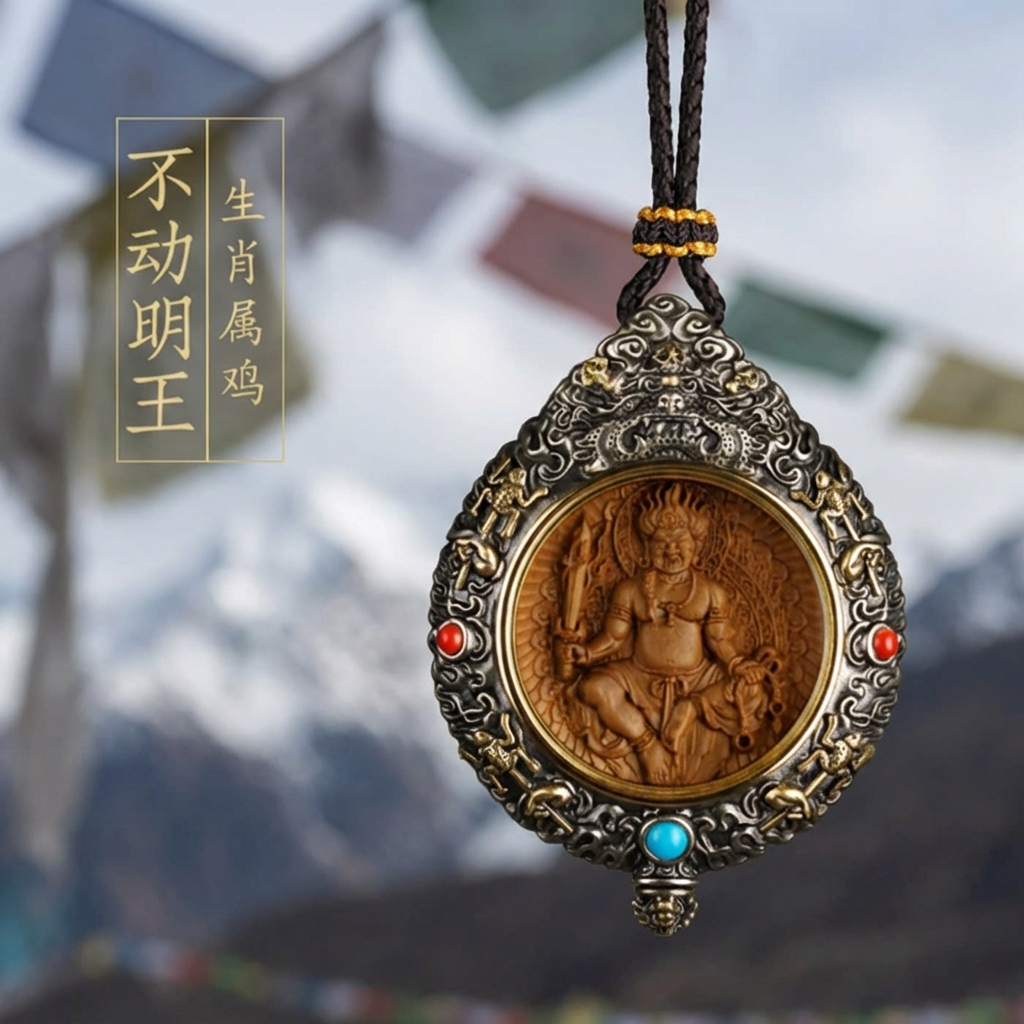
- Tibetan amulets and talismans: Pieces with deep cultural roots — Dzi beads (ancient striped agate with protective tradition), Gau boxes (portable shrine pendants), and Thogcha (iron amulets from meteorite material). These are the most specific to Tibetan Buddhist tradition and deserve a closer look (see below).
How to Match the Material to Your Goal
Once you’ve identified your intention and category, the material is your next decision. The table below covers the most common options with their traditional associations, practical characteristics, and price benchmarks.
| Material | Traditional Association | Best For | Typical Price Range |
|---|---|---|---|
| Amethyst | Calm, crown chakra, spiritual clarity | Anxiety relief, meditation, sleep support | $25–$65 USD |
| Rose Quartz | Heart chakra, self-love, emotional healing | Grief, relationship harmony, self-compassion | $20–$55 USD |
| Black Tourmaline | Root chakra, grounding, energetic protection | Feeling drained, overstimulation, energetic boundaries | $25–$60 USD |
| Clear Quartz | “Master healer,” energy amplifier | Amplifying intentions, clarity, focus | $20–$50 USD |
| Natural Sandalwood | Tibetan Buddhist tradition, grounding, calm | Mala beads for meditation, daily wear | $30–$75 USD |
| Turquoise | Sky energy, spiritual protection (Tibetan tradition) | Wisdom, communication, throat chakra | $35–$120 USD |
| Tibetan Dzi Bead | Ancient protective amulet, highly prized in Tibet | Protection, longevity, spiritual practice | $45–$150+ USD |
“One thing we initially got wrong at PotalaStore — we assumed most new customers wanted crystals. What we found was that a meaningful percentage were looking for something rooted in an actual practice. For them, a natural sandalwood mala with 108 beads turned out to be far more useful than a rose quartz bracelet, because they could use it actively during meditation rather than just wearing it passively. Don’t assume crystals are the default choice.”
🪬 Not sure where to start? Browse PotalaStore’s full spiritual jewelry collection — each piece includes guidance on its traditional use and the right intention to pair with it.
How to Spot Authentic Spiritual Jewelry (What Most Guides Skip)
Most spiritual jewelry guides never tell you how to verify what you’re actually buying — and in a market flooded with dyed howlite sold as turquoise and plastic beads sold as natural stone, this matters. Here’s how to check.
For Crystal and Gemstone Jewelry
- Temperature test: Natural crystals stay cooler to the touch longer than glass or plastic. Hold the piece in your palm for 10–15 seconds. Genuine amethyst will feel noticeably cool; plastic warms almost immediately.
- Weight: Natural stones are denser than glass replicas. A genuine black tourmaline bracelet feels heavier than it looks. A suspiciously light piece usually signals synthetic material.
- Surface imperfections: Real stones have minor natural inclusions, small color variations, and faint internal patterns. Perfect uniformity often indicates dyed synthetic stone or glass.
- Price reality check: Genuine spiritual jewelry from natural materials typically runs $25–$150 USD for most wearable pieces. If a “genuine amethyst bracelet” costs $5, it isn’t genuine amethyst.
For Tibetan Mala Beads
- Natural sandalwood malas weigh between 15–20 grams for a wrist mala and have a faint, warm woody scent — not a perfumed chemical smell. Plastic “sandalwood” malas have no scent at all or smell synthetic.
- Hand-knotted thread: Genuine malas are knotted between each bead. This takes time. Machine-strung beads without knots are a sign of mass production, not traditional craft.
- Genuine turquoise vs stabilized/dyed howlite: Real turquoise has a matrix (dark veining pattern) that varies across the stone. Dyed howlite has an unnaturally uniform color. Stabilized turquoise is acceptable and common, but “genuine turquoise” should be disclosed honestly.
“We’ve had customers bring us purchases from other sellers that turned out to be dyed howlite, pressed powder beads, or even painted plastic. One piece — sold as a ‘9-eye Dzi bead with Tibetan monastery blessing’ — was a glass bead with painted stripes. We understand the frustration. When buying from any seller, ask directly: what is the material, where does it come from, and is there any documentation of its origin?”
The Tibetan Buddhist Tradition: What Most Western Guides Miss
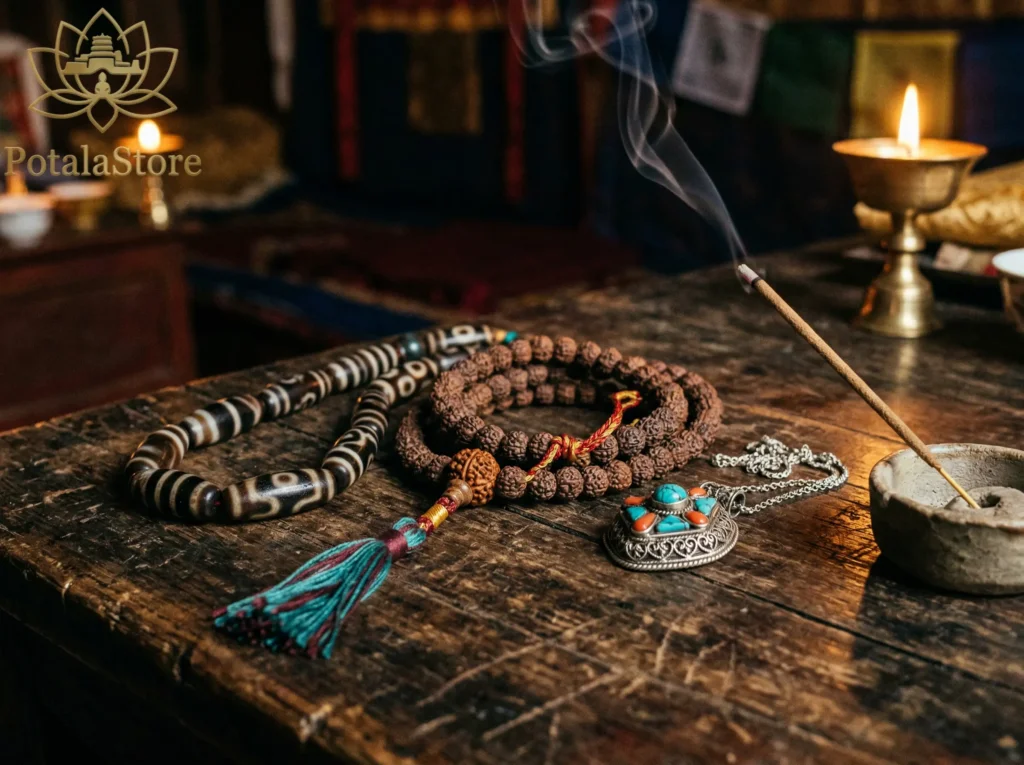
Tibetan Buddhist spiritual jewelry has a depth and specificity that most guides — focused on Western crystal healing — barely touch on. If you’re drawn to this tradition, here’s what’s worth understanding before you shop.
Jin Lab: Why “Blessed” Jewelry Is Different
In Tibetan practice, objects can undergo jin lab — an empowerment or blessing ceremony in which a lama or qualified teacher recites specific mantras and performs ritual prayers over the piece. This isn’t a marketing term; it’s a formal practice with a lineage. Pieces that have been genuinely blessed carry intentional energy from an active practice, not just symbolic meaning. When PotalaStore sources pieces from Himalayan monasteries, we verify that this process has taken place.
Dzi Beads: Ancient Amulets With Specific Meanings
Dzi beads are ancient striped agate beads from the Tibetan plateau, believed to provide protection and attract positive circumstances. The number of “eyes” (circular markings on the bead) carries specific meaning:
- 1-eye Dzi: Clarity, focus, and wisdom — traditionally associated with spiritual progress.
- 3-eye Dzi: Wealth, health, and longevity — one of the most sought-after patterns.
- 9-eye Dzi: Protection against negative forces and accumulation of merit — considered among the most powerful.
Genuine antique Dzi beads are extremely rare and expensive (hundreds to thousands of dollars). Modern Dzi made from natural agate with traditional patterns are widely available and carry the same symbolic meaning for most practitioners.
Color Symbolism in Tibetan Jewelry
In the Tibetan tradition, the colors of materials are not incidental:
- Turquoise represents the sky — open awareness, spiritual clarity, and the mind’s natural state.
- Red coral is associated with the life force, vitality, and long life. It’s one of the most traditionally prized materials alongside turquoise and gold.
- Amber is believed to support mental clarity and purification.
The Three-Metal Bracelet
A traditional Tibetan wellness bracelet combines copper, brass, and iron. Each metal is believed to correspond to different elemental and energetic properties. Copper supports circulation and grounding; brass relates to solar energy; iron is associated with protection and strength. Together, they’re believed to create a balancing effect. This is a distinctly Tibetan piece with no direct equivalent in Western crystal healing traditions.
🏔️ Explore PotalaStore’s collection of authentic Tibetan Buddhist jewelry — sourced directly from artisans and monasteries in the Himalayan region, with full material and origin disclosure.
How to Activate and Care for Your Spiritual Jewelry
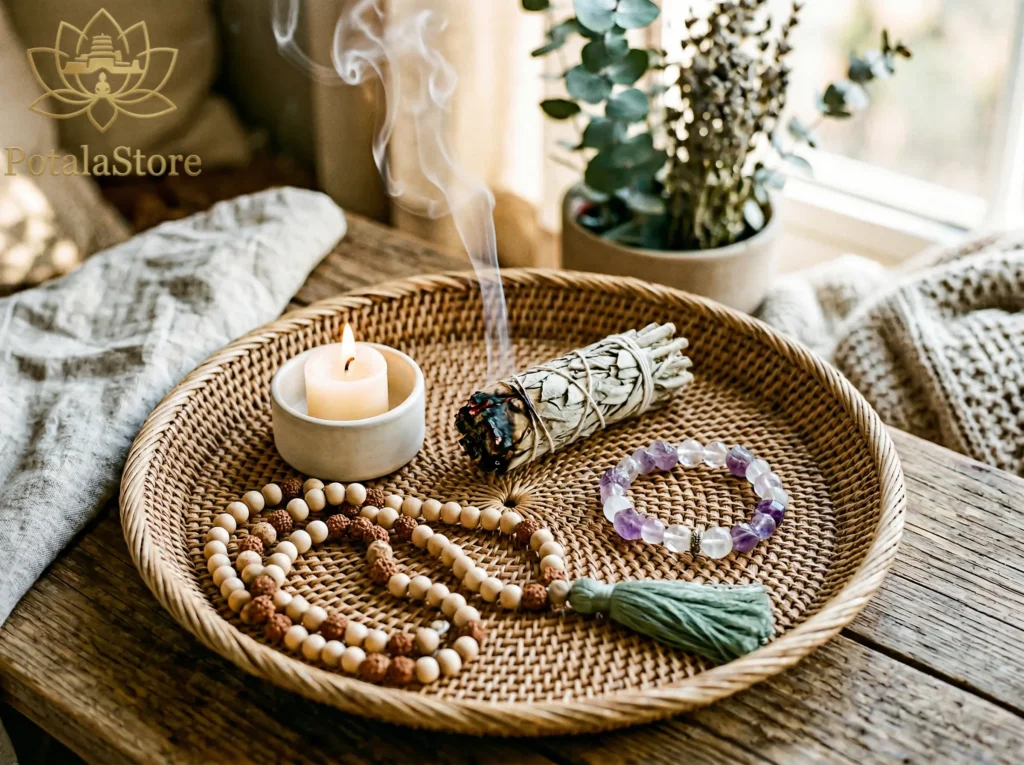
Before you wear a new piece for the first time, two simple steps significantly increase how meaningful it becomes: intention-setting and initial cleansing.
Setting Your Intention
Hold the piece in both hands, close your eyes, and clearly state — aloud or silently — what you want it to support. This isn’t mystical; it’s a mindfulness practice. Research on intention and attention shows that consciously directing your focus changes how your brain processes associated stimuli. Your jewelry becomes a physical anchor for a mental state you’ve deliberately chosen.
Cleansing Methods
Most practitioners cleanse new pieces and then repeat the process every 2–4 weeks, or whenever the jewelry has been through something emotionally intense. Here are four reliable methods:
- Sage smudging: Pass the piece through white sage smoke for 20–30 seconds. Suitable for most materials including crystals, wood, and metal.
- Moonlight charging: Place the piece on a windowsill under a full or new moon for 4–8 hours. Gentle and suitable for all materials.
- Sound cleansing: Hold the piece near a Tibetan singing bowl and strike the bowl. The vibration is believed to clear stagnant energy. Takes 1–2 minutes.
- Running water: Hold the piece under cool running water for 30–60 seconds. Note: not suitable for salt-sensitive stones (selenite, malachite, pyrite) or untreated wood malas.
Ongoing Care by Material
| Material | Safe Cleaning Method | Avoid |
|---|---|---|
| Crystal bracelets | Soft cloth, mild soap rinse | Ultrasonic cleaners, harsh chemicals |
| Natural sandalwood mala | Dry cloth only; rub with a small amount of sandalwood oil every few months | Water (causes cracking), direct sunlight for extended periods |
| Turquoise | Dry cloth only | Water, perfume, lotion contact |
| Silver settings | Silver polishing cloth | Chlorine (swimming pools), household cleaners |
Ready to Find Your Perfect Piece?
Browse PotalaStore’s collection of authentic Tibetan spiritual jewelry — handcrafted by Himalayan artisans, with full material transparency and traditional blessing practices.Explore the Collection →
Frequently Asked Questions
Amethyst, moonstone, and aquamarine are traditionally associated with calm and emotional balance. For a wearable meditation tool, a sandalwood mala used with a simple breathing practice is one of the most effective options — the physical act of moving through the beads anchors your attention more reliably than a passive piece of jewelry.
Yes — but be intentional about it. Wearing one or two pieces with a clear purpose tends to be more meaningful than stacking five. If you’re wearing a mala for meditation and a protective amulet for daily wear, they complement each other well. When pieces pile up without distinct purposes, the intentional quality diminishes.
This depends on what “work” means. There is no scientific evidence that crystals emit measurable healing frequencies. What is well-supported is that intention-setting, mindful attention, and meaningful objects genuinely affect mood, focus, and behavior — this is basic cognitive science. Spiritual jewelry functions as a physical anchor for these practices. In that sense, yes — if you engage with it deliberately, it works.
A practical schedule is every 2–4 weeks for regular wear, or immediately after emotionally intense situations (conflict, illness, high-stress environments). If you’re using a mala for daily meditation, a monthly moonlight charging is sufficient for most practitioners.
📚 References
- Buddhist Prayer Beads and Their Traditions: Overview of mala bead traditions across Tibetan, Hindu, and East Asian Buddhist cultures. Frommer, K. (Smithsonian National Museum of Asian Art — available via si.edu)
- Mindfulness and Intention-Setting: Research on how deliberate attentional focus changes behavioral and emotional outcomes. Mindful.org — What Is Mindfulness
- Gemstone Properties and Identification: Comprehensive education on natural gemstone characteristics, including hardness, density, and visual identification. Gemological Institute of America (GIA) — Gem Encyclopedia
- Turquoise — History and Cultural Significance: Historical and cultural overview of turquoise use across Tibetan, Native American, and Persian traditions. Encyclopædia Britannica — Turquoise
Written by the PotalaStore editorial team, in collaboration with Tibetan artisan partners in the Himalayan region. For questions about specific pieces, contact us directly.