
Is It Bad Luck to Buy Yourself a Spiritual Bracelet? The Truth Behind This Common Belief — PotalaStore
 by Yang Tso
0 comments
by Yang Tso
0 comments
The short answer: No — buying yourself a spiritual bracelet is not bad luck. Across most traditions, including Tibetan Buddhism, crystal healing, and chakra practice, choosing your own bracelet is considered an act of personal intention and spiritual empowerment, not a curse.
If you’ve been holding off on buying that evil eye bracelet or crystal mala because someone told you it only “works” as a gift, you’re not alone. We hear this question from customers every week. The good news is that the belief is largely a misunderstanding — one rooted in a few very specific cultural traditions that don’t apply to most spiritual bracelets at all.
At PotalaStore, we’ve worked closely with Tibetan Buddhist artisans and monasteries for years. In that time, we’ve seen thousands of people choose their own bracelets and form profound, lasting connections with them. What we’ve learned is that the real power lies in intention — not in who handed you the bracelet.
In this guide, you’ll find out where the superstition comes from, how different traditions actually view self-purchase, and how to properly activate any bracelet you buy for yourself — so it can do what it’s meant to do.
⚠️ Note: The spiritual and energy properties described in this article reflect traditional beliefs and cultural practices, not scientific claims. This content is for educational purposes only and is not a substitute for professional medical or psychological advice.
Where Does This Superstition Actually Come From?

This belief didn’t come from nowhere. It’s rooted in centuries-old gift-giving customs across Mediterranean, Middle Eastern, and Jewish cultures — places where protective amulets were traditionally passed down through families or given by someone who deeply cared about your safety.
The most direct source is the evil eye (Nazar) tradition. In ancient Greek, Turkish, and Levantine cultures, the evil eye amulet was believed to gain its protective power from the bond between giver and receiver. When a mother pressed a Nazar pendant into her child’s hand before a journey, the love behind that act was thought to charge the amulet with extra energy. The idea that you couldn’t buy one for yourself grew naturally from this thinking.
A similar idea exists in the Kabbalah red string tradition. In this practice, the red string is specifically tied around the wrist by someone else — ideally by a rabbi after being wound seven times around Rachel’s Tomb in Israel. The ritual is about receiving protection through another person’s care and prayer.
There’s a parallel in Chinese jade culture too. Traditionally, jade jewelry was considered most auspicious when received as a family heirloom or given by someone who loves you. Choosing your own piece was seen as less charged with relational meaning.
What’s important to understand is this: these are culturally specific customs attached to specific objects in specific contexts. None of them is a universal law governing all spiritual bracelets. The idea that “any spiritual bracelet you buy yourself is bad luck” is a modern overgeneralization — one that blends together completely different traditions into a single, inaccurate rule.
What Different Traditions Actually Say About Self-Purchase
Here’s what most articles won’t tell you: the “don’t buy it yourself” rule applies specifically to evil eye bracelets in select Mediterranean traditions — and even then, most modern practitioners actively disagree with it. For crystal bracelets, Buddhist malas, chakra bracelets, and Feng Shui jewelry, no such taboo exists at all.
The table below shows where each major tradition actually stands:
| Bracelet Type | Self-Purchase OK? | What the Tradition Says | Key Consideration |
|---|---|---|---|
| Evil Eye (Nazar) | ✅ Yes — modern consensus | Some Mediterranean traditions prefer gifting; most practitioners today say self-purchase is fine | Intention and belief matter more than the source |
| Crystal / Gemstone | ✅ Absolutely | No buying taboo exists in any crystal healing tradition | Choosing a crystal that resonates with you is the spiritual act |
| Buddhist Mala Beads | ✅ Yes — encouraged | Practitioners choose their own mala as part of their practice | In Tibetan tradition, “the bracelet chooses its wearer” |
| Chakra Bracelet | ✅ Yes | No restrictions of any kind | Focus on matching the stones to the chakra you want to balance |
| Kabbalah Red String | ⚠️ Varies by tradition | Kabbalah: tied by another person; Buddhist / Hindu versions: self-purchase is fine | Depends entirely on which tradition you follow |
| Feng Shui / Pixiu | ✅ Yes | No gifting requirement; self-purchase is standard | Post-purchase consecration (开光) is what activates the bracelet — not how you received it |
Notice the pattern: the more a tradition is rooted in relationship (like Nazar or Kabbalah), the more it values gifting. The more a tradition is rooted in personal practice (like Buddhism or crystal healing), the more it values intentional self-selection.
For Tibetan Buddhist bracelets specifically — our area of deepest expertise — there is no concept of self-purchase being unlucky. A practitioner chooses their mala beads or prayer bracelet the way a meditator chooses a cushion: with care, attention, and a sense that the right object “calls” to them. In that tradition, resonance is the point.
How to Activate a Spiritual Bracelet You Bought Yourself

Whether your bracelet was gifted or self-purchased, the activation process is what transforms it from a piece of jewelry into a genuine spiritual tool. This is where intention — not origin — becomes everything.
One honest note from experience: when we first started helping customers with this, we assumed a quick cleanse was enough. What we found is that people who took time with the intention-setting step reported a noticeably stronger sense of connection to their bracelet. The cleansing prepares the vessel; the intention fills it. Both matter.
Here are the three steps we recommend, drawn from Tibetan Buddhist practice and adapted for everyday use:
- 1Cleanse: Remove residual energy (5–10 minutes)New bracelets carry the energy of everyone who handled them during manufacturing and shipping. Before you set your own intention, clear the slate. Three methods work well:
- Sage or Palo Santo smudging— pass the bracelet through the smoke for 30–60 seconds. Best for most stone and bead types.
- Singing bowl sound cleansing— rest the bracelet inside a Tibetan singing bowl and strike it 3–7 times. The vibration clears stagnant energy.
- Full moon bathing— place the bracelet on a windowsill or outside on the night of a full moon for 3–4 hours. Avoid prolonged direct sunlight for softer stones like amethyst, rose quartz, or turquoise.
- 2Set your intention (2–5 minutes)Hold the bracelet between both palms. Close your eyes. Take three slow, deep breaths. Then, either aloud or silently, state your intention clearly and specifically. Not “I want good luck” — something like: “I wear this bracelet as a reminder to stay grounded when I feel anxious” or “May this protect me from negative energy and help me stay focused on what matters.”In Tibetan Buddhist practice, you can recite the mantra Om Mani Padme Hum (ཨོཾ་མ་ཎི་པདྨེ་ཧཱུྃ) 9, 21, or 108 times while holding the bracelet. Visualize white light flowing from your breath into each bead.
- 3Wear with awarenessIn Tibetan and many other Asian traditions, theleft wristis the receiving side — closer to the heart, better for bracelets focused on protection, healing, and emotional balance. Theright wristprojects energy outward, better for bracelets meant to attract abundance or amplify confidence.Re-cleanse your bracelet monthly — or whenever it’s been handled by others or exposed to a high-stress environment. Think of cleansing the way you’d think of washing your face: not because something is wrong, but as regular maintenance.
💡 PotalaStore Tip
Every bracelet from PotalaStore ships with a printed intention-setting card based on Tibetan Buddhist practice — including the appropriate mantras and wear-side guidance for that specific bracelet’s purpose. Read our full activation guide →
When a Gifted Bracelet Does Carry Extra Meaning
Let’s be honest about this: a bracelet chosen for you by someone who loves you does carry something extra. Not supernatural power — but an additional layer of emotional intention that sits alongside the bracelet’s own energy. That’s worth acknowledging.
Across most traditions, gifting is especially meaningful in these moments:
- Welcoming a newborn — in many cultures, a protective bracelet given to a new baby carries the family’s collective love and prayers.
- Marking a major life transition — a new marriage, a move abroad, starting a business. The gesture acknowledges the change and the support behind it.
- Recovering from illness or hardship — a bracelet given during a difficult time becomes a tangible reminder that someone held you in their thoughts.
A practical middle ground: If you love the idea of receiving a spiritual bracelet as a gift but want to choose your own, consider adding your preference to a wish list and letting a loved one complete the act of giving. You get the resonance of personal choice; they get the meaning of the gesture. Alternatively, ask a close friend to help you put on the bracelet for the first time and offer a simple blessing — a small ritual that layers relational intention onto your own choice.
The core point remains: self-purchased bracelets carry your intention — and for a tool meant to support your personal spiritual practice, that is exactly what you want.
🎁 Gift Collection
Spiritual bracelets make deeply meaningful gifts too. Explore our gifting collection — each piece includes a handwritten intention card and gift-ready packaging.
How to Choose the Right Spiritual Bracelet for Yourself
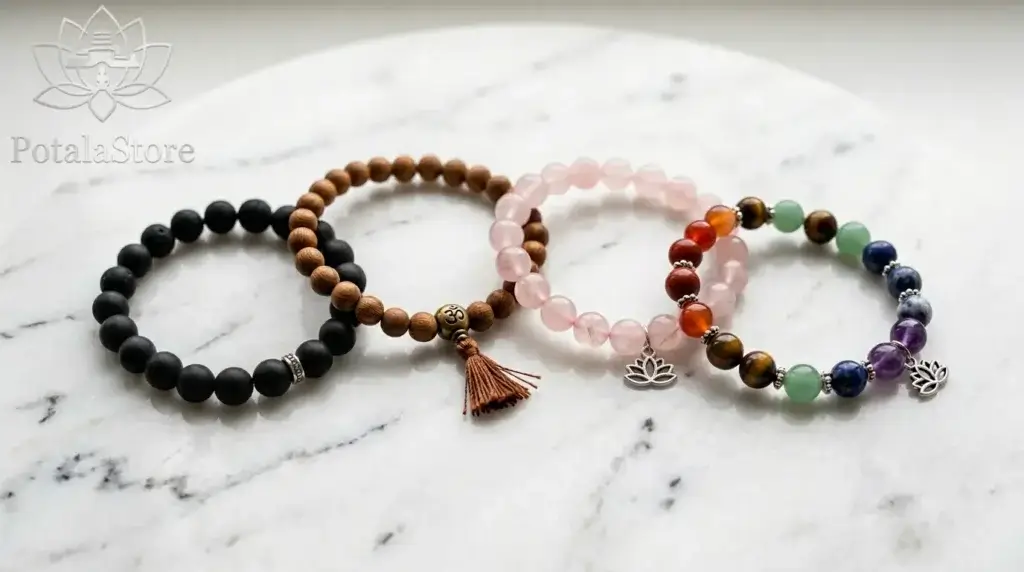
The right bracelet isn’t about luck — it’s about alignment between your intention, the bracelet’s energy properties, and what resonates with you intuitively. Here’s a practical guide by need:
🛡️ Protection & Grounding
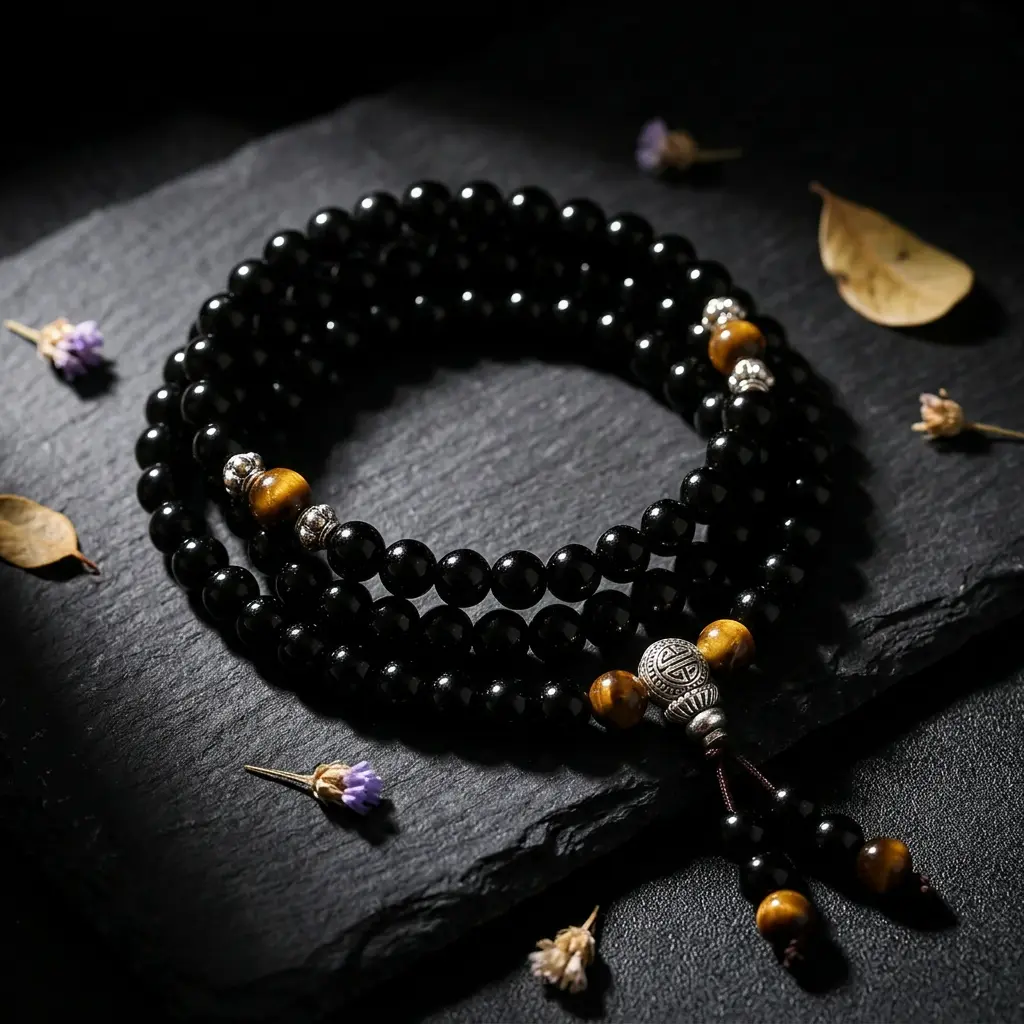
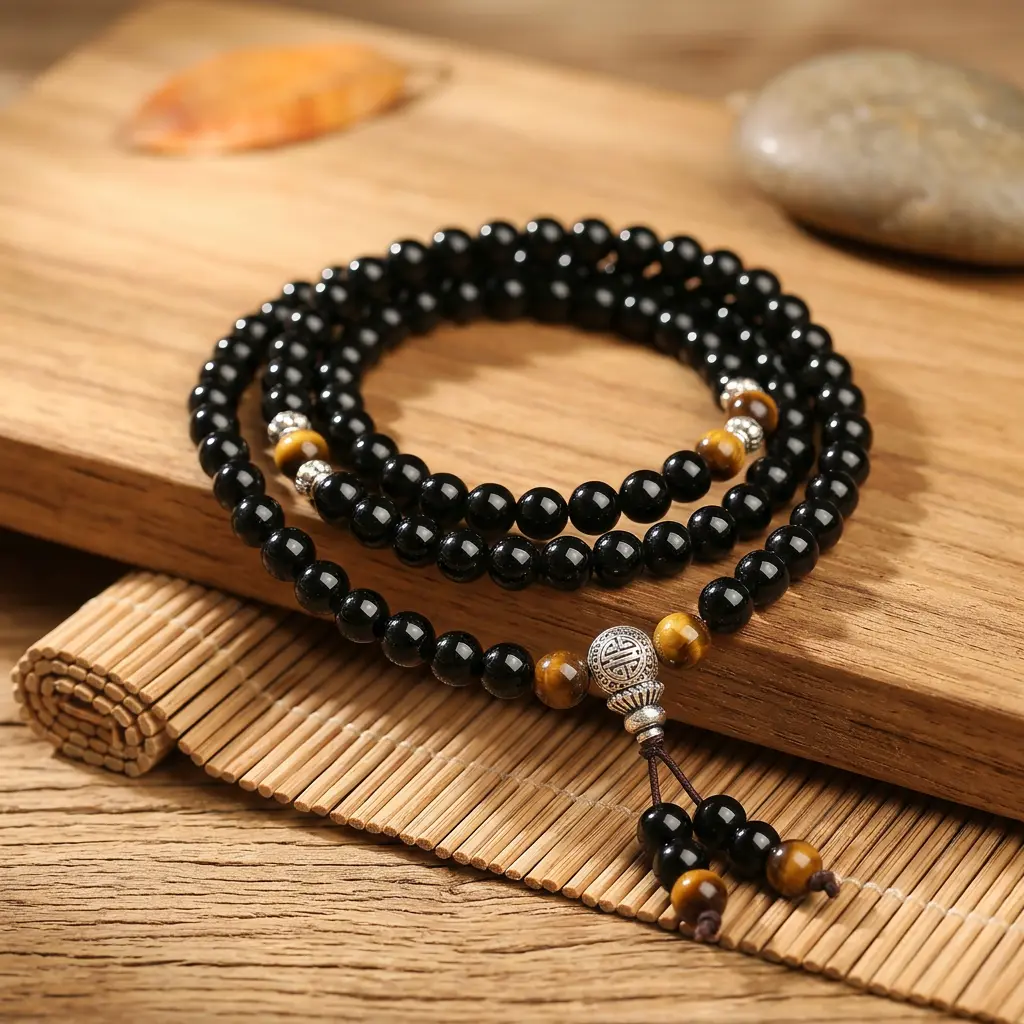
Black tourmaline is the strongest known protective stone, traditionally used to create an energetic boundary against negativity. Obsidian works similarly, with added grounding properties. Price range: $25–$55 USD.
🧘 Meditation & Mindfulness
Tibetan mala bracelets with Bodhi seed or sandalwood beads (typically 18 or 21 beads) are traditional tools for mantra counting. Sandalwood has a naturally calming scent that enhances focus during practice. Price range: $30–$75 USD.Shop mala bracelets →
💜 Emotional Healing
Amethyst is traditionally associated with spiritual awareness and emotional calm. Rose quartz is linked to self-love and compassion. Both are gentle enough for everyday wear and ideal for those processing stress or grief.Shop crystal bracelets →
🌈 Chakra Balancing
A 7-stone chakra bracelet contains one stone for each energy center — from root (red jasper) to crown (clear quartz or amethyst). Wearing all seven supports overall balance. Best for those beginning an energy-work or yoga practice.Shop chakra bracelets →
One consistent observation from years of working with customers: the bracelets people feel most drawn to are almost always the right ones for them in that moment. Trust that pull. In Tibetan tradition, this isn’t coincidence — it’s recognition.
Ready to Choose Your Own?
Browse our full collection of authentic Tibetan spiritual bracelets — handcrafted by artisans working within living Buddhist traditions and shipped worldwide with intention-setting guides.Shop Spiritual Bracelets →
Frequently Asked Questions
Yes. While some Mediterranean traditions hold that an evil eye bracelet is more powerful when given as a gift, the overwhelming modern consensus among spiritual practitioners — and 9 out of 10 sources in current SERP results — is that self-purchase works just as well. What makes an evil eye bracelet effective is the wearer’s belief and intention, not the method of acquisition.
In most spiritual traditions, a bracelet breaking is interpreted as a positive sign: the bracelet absorbed as much negative energy as it could and has completed its protective work. It should be replaced, not repaired — and the old bracelet should be respectfully returned to nature (buried in soil or placed in flowing water) rather than thrown away.
Wear it on your left wrist if your goal is to receive energy — protection, healing, emotional balance. Wear it on your right wrist if your goal is to project or share energy — confidence, strength, or shielding others. In Tibetan Buddhist tradition, the left wrist is generally preferred because it’s on the same side as the heart.
Yes — it’s strongly recommended. New bracelets carry residual energy from the manufacturing and shipping process. Cleansing for 5–10 minutes using sage smoke, a singing bowl, or moonlight removes that energy and prepares the bracelet to hold your own intention. Think of it as clearing a canvas before you paint on it.
The Bottom Line
The only thing that can truly make a spiritual bracelet “bad luck” is the belief that it is. If you spend every day worrying that your self-purchased bracelet is cursed, that anxiety will color your experience with it — not because of any supernatural rule, but because of where your attention goes.
What every genuine spiritual tradition ultimately agrees on is this: the power in a sacred object is co-created between the object and the person who wears it, through intention, consistency, and awareness. Whether a bracelet came from someone who loves you or from a deliberate choice you made for yourself, that relationship is built over time — starting with the moment you first hold it in your hands and decide what it means to you.
Choose the one that resonates. Set your intention with care. Wear it with awareness. That’s the full practice.
Browse PotalaStore’s collection of authentic Tibetan spiritual bracelets and find the piece that speaks to where you are right now.
📚 References
- Evil Eye Symbolism & History: Scholarly overview of the evil eye amulet across Mediterranean, Middle Eastern, and South Asian cultures, including origins in Mesopotamia circa 3000 BCE. Smithsonian Magazine
- Buddhist Prayer Beads — Mala Tradition: Historical and cultural context of mala beads in Tibetan Buddhist practice, including bead count significance and mantra use. Buddhistdoor Global
- Kabbalah Red String Tradition: Overview of the red string practice at Rachel’s Tomb and its contemporary interpretations. Jewish Virtual Library
- Crystal Healing Practices: General reference on gemstone use in alternative wellness traditions, their cultural origins, and appropriate use disclaimers. Gemological Institute of America (GIA) — Gem Encyclopedia