

St. Patrick’s Day has always been, at its heart, a day of profound spiritual energy — and in 2026, that energy reaches a rare peak. March 17 falls just one day before a New Moon in Pisces on March 18, creating a natural 48-hour threshold that spiritual traditions across cultures identify as the ideal window to release stagnant energy and consciously call in new luck and good fortune.
At PotalaStore, working directly with Tibetan Buddhist monasteries in Nepal and the Himalayas for over a decade, we’ve learned something that neither the party guides nor the generic manifestation blogs will tell you: the deepest luck is not stumbled upon — it is activated through intention, symbol, and practice. This guide draws on both Irish Celtic wisdom and Tibetan Buddhist traditions to give you 7 actionable rituals for March 17, 2026, along with the spiritual meaning behind the shamrock, the best green crystals for fortune, and a cross-cultural connection between Celtic and Buddhist lucky symbols that no other guide covers.
⚠️ Important Note: The spiritual and energy properties described in this guide reflect traditional beliefs and practitioner experience across multiple cultures — they are not scientific claims. This content is educational in nature and should not replace professional advice of any kind. Individual experiences with spiritual practices vary.
Why March 17, 2026 Carries Rare Spiritual Energy for Fortune-Seekers
St. Patrick’s Day 2026 falls on Tuesday, March 17 — just 24 hours before the New Moon in Pisces on March 18, making this one of the most spiritually charged St. Patrick’s Days in recent years.
In traditions that work with lunar cycles, the final day of the Waning Crescent phase — which is exactly where March 17 sits — is a natural moment of completion and clearing. Pisces, the last sign of the zodiac, governs intuition, spiritual sensitivity, and the dissolution of old patterns. Practitioners deliberately use this window to release what has been blocking abundance before the New Moon plants fresh intentions.
The pre-Christian Irish understood threshold moments with similar depth. Their calendar recognized March, the transition from winter into spring, as a liminal season — a time when the boundary between the ordinary world and the sacred thins, and when actions taken with clear intention carry unusual force. St. Patrick’s Day inherited that energetic character even as it transformed over centuries.
| Date | Event | Spiritual Significance |
|---|---|---|
| March 17, 2026 | St. Patrick’s Day (Tuesday) | Waning Crescent in Pisces — release old patterns, prepare fertile ground |
| March 18, 2026 | New Moon in Pisces | Plant clear intentions for luck, abundance, and new beginnings |
The key takeaway: any spiritual practice you begin on March 17 is positioned to carry forward into the New Moon cycle — amplifying its momentum across the coming weeks, not just the day itself.
The Real Meaning Behind St. Patrick’s Day and Good Luck
The spiritual core of St. Patrick’s Day is transformation, not chance — and understanding that reframes the entire day as an opportunity rather than a passive hope.
St. Patrick (born Maewyn Succat, c. 385 AD) was kidnapped from Britain at age 16 and enslaved in Ireland for six years before escaping. He returned not with resentment but with a calling to serve the very people who had imprisoned him. The shamrock — three leaves on a single stem — was reportedly used by Patrick to explain the Holy Trinity to Druidic priests: three distinct expressions of one sacred reality. The number three already carried deep spiritual weight in the Celtic world, making the shamrock a perfect bridge between traditions.
The rarer four-leaf clover — found in roughly 1 in every 5,000 three-leaf shamrocks — came to represent a divine moment of attention: the sense of being specifically noticed by something sacred. Its four leaves are traditionally associated with faith, hope, love, and luck.
Perhaps the most surprising origin in this story: “the luck of the Irish” was originally an ironic, condescending phrase. During the American Gold Rush of the mid-19th century, many successful miners were Irish or Irish-American. Other miners dismissed their achievements as accidental, calling it “luck” rather than earned skill or resilience. Over time, the Irish community reclaimed the phrase entirely. True Irish luck, then, was always a story of intentional perseverance turning adversity into fortune — a lesson with direct spiritual application today.
Where Celtic Tradition and Buddhist Wisdom Share the Same Language of Fortune
One of the most striking insights from our work bridging Tibetan Buddhist artisan communities with Western audiences is how profoundly the Celtic and Buddhist spiritual traditions share the same symbolic language for luck and protection. No other St. Patrick’s Day guide explores this connection — and it offers some of the deepest understanding of why certain practices carry real force across cultures and centuries.
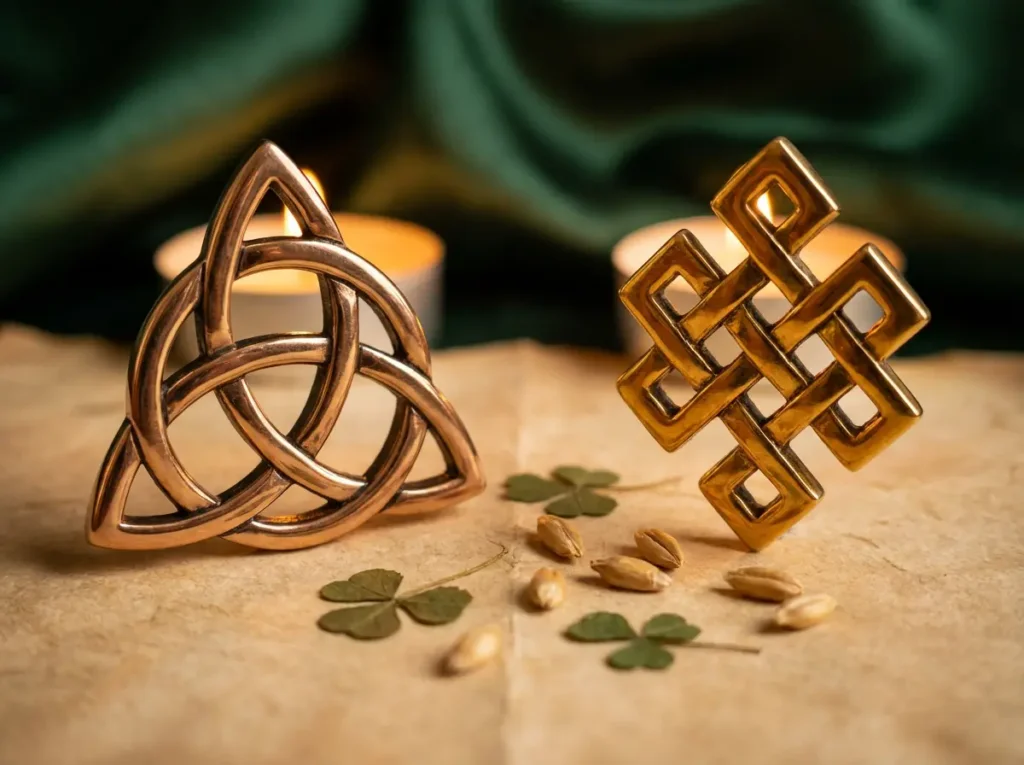
The Celtic Knot and the Endless Knot are the clearest example. The Celtic Knot — the interlocking, never-ending loops found throughout Irish jewelry and stonework — represents eternity, the continuity of life, and the interconnection of all beings. In Tibetan Buddhism, the Endless Knot (Shrivatsa) is one of the Eight Auspicious Symbols, the Ashtamangala. It carries an almost identical meaning: the interweaving of wisdom and compassion, the continuity of dependent arising, and the unbroken flow of good fortune. Two traditions separated by thousands of miles independently arrived at the same geometric form to express the same truth about how luck moves through existence.
The number three holds sacred weight in both lineages as well. The shamrock’s three leaves have a direct parallel in Buddhism’s Three Jewels — the Buddha, the Dharma, and the Sangha — which form the foundational triple refuge of Buddhist practice. Three is the number of dynamic balance, the structure that holds energy in living motion.
Most powerfully: the color green itself bridges both worlds. Ireland’s association with green — the Emerald Isle — reflects the vitality, renewal, and fortune of the natural world. In Tibetan Buddhism, Green Tara (Sgrol-ljang, or Tara Dölma) is the female Buddha of compassionate swift action. Depicted in radiant emerald green, she is invoked specifically for removing obstacles and opening pathways to good fortune. Her mantra — Om Tare Tuttare Ture Soha — is among the most widely chanted in the Tibetan world for precisely this purpose. Green, across both traditions, is the color of luck made active, not merely hoped for.
“The Endless Knot has no beginning and no end. Luck, in the Tibetan view, is not a prize to be won — it is a current you learn to align yourself with.”— Traditional teaching from Kopan Monastery, Kathmandu
7 Spiritual Rituals to Activate Luck on St. Patrick’s Day 2026
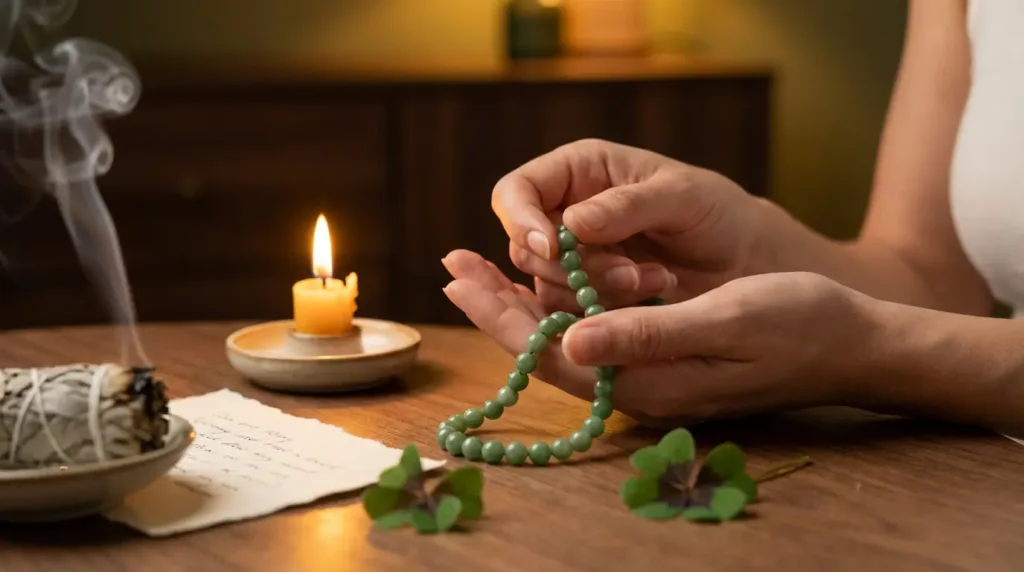
Here are 7 practices — drawn from both Celtic and Tibetan Buddhist traditions — to consciously activate luck and good fortune on March 17, 2026:
- Set a Morning Intention with Mala Beads: Begin the day with a focused intention using mala beads — the 108-bead Buddhist prayer tool traditionally used for mantra counting and intention-setting. Hold each bead between your fingers and repeat your specific intention for abundance, opportunity, or protection 108 times. The physical repetition anchors intention into the nervous system in a way that passive visualization alone cannot. Customers who establish a regular mala practice — even a 5-minute morning session — consistently tell us the shift from passive wishing to active expectation is almost immediate.
- Wear Green to Align with Prosperity Energy: Wearing green on St. Patrick’s Day is more than tradition — it actively aligns your energetic field with the heart chakra, the center associated with abundance, compassion, and receptivity in both Western and Eastern spiritual frameworks. A green crystal worn directly against the skin — Green Jade or Green Aventurine — amplifies this effect throughout the day.
- Cleanse Your Space with Sage or Tibetan Juniper: Both Irish Celtic practice (burning sacred herbs to clear negative spirits before calling in good energy) and Tibetan Buddhist tradition (burning juniper sang incense for purification before practice) recognize smoke cleansing as a preparation for inviting fortune. Spend 3–5 minutes moving through your home with burning sage or juniper, first counterclockwise to release, then clockwise to invite. This clears the energetic atmosphere before you plant new intentions.
- Chant the Green Tara Mantra for Swift Fortune: Om Tare Tuttare Ture Soha is traditionally chanted to remove obstacles and open the path to good fortune with exceptional speed — Green Tara is specifically known as the “swift liberator.” A traditional practice involves 21 repetitions for a specific wish. Even a 5-minute session of quiet repetition creates a measurable internal shift from anxious hoping to calm, receptive confidence.
- Create a Simple Luck Altar: Place a green crystal, a symbol of the Endless Knot or a Buddhist amulet, and a written statement of your specific intention on a clean surface in the wealth corner of your home (the far left corner as seen from your front door, per Feng Shui tradition). This physical anchor point keeps your intention active in your environment throughout the day and beyond.
- Practice Gratitude as an Active Merit Practice: In Tibetan Buddhist teaching, gratitude is not a passive emotion — it is an active accumulation of merit (Punya), the positive karmic momentum that draws fortune toward you. The Celtic concept of luck building on itself through generous acknowledgment maps directly onto this. Write three specific things you are genuinely grateful for before noon on March 17. Be concrete — gratitude for specifics generates far more energetic force than generic thankfulness.
- Prepare New Moon Intentions for March 18: Because the New Moon arrives just one day after St. Patrick’s Day, spend the evening of March 17 writing your intentions for the next lunar cycle. What specific form of good fortune are you calling in — financial opportunity, a new relationship, creative momentum, improved health? The more precisely defined your intention, the more specifically the energetic machinery of change can organize around it. Vague wishes produce vague results.
💡 Start your mala practice this St. Patrick’s Day. Browse PotalaStore’s handcrafted mala bead collection — each piece hand-selected from Tibetan and Nepali artisan workshops, available in materials matched to your intention.
Green Crystals That Amplify Good Fortune on St. Patrick’s Day
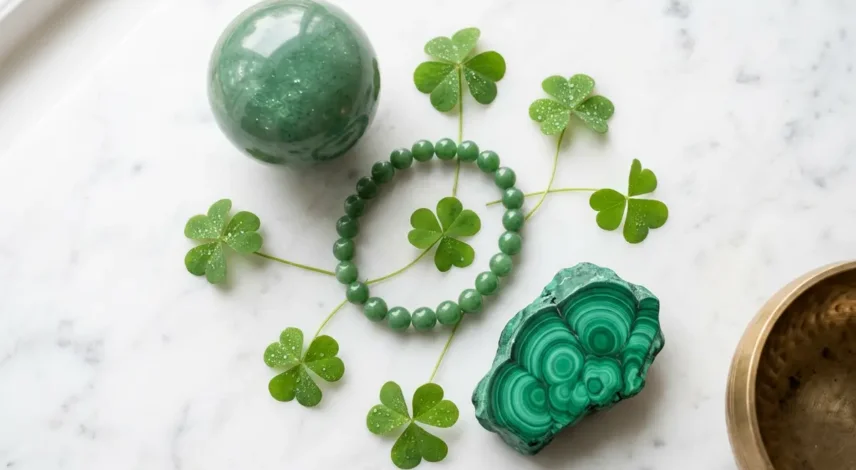
Green crystals are among the most widely used spiritual tools for attracting luck, and their connection to St. Patrick’s Day goes well beyond color coordination. In both Western crystal traditions and Tibetan Buddhist practice, green stones are believed to open the heart chakra and clear the energetic pathways through which prosperity flows naturally.
Here are the three most effective green stones to work with on March 17, 2026:
| Crystal | Known For | Best Use on St. Patrick’s Day |
|---|---|---|
| Green Aventurine | “Stone of Opportunity” — heart chakra activation, luck in new ventures and unexpected openings | Wear during morning intention ritual; keep in pocket or wallet throughout the day |
| Green Jade | Harmony, wisdom, and Divine protection; used in Chinese and Tibetan traditions for over 5,000 years for its association with prosperity and longevity | Wear as a bracelet or pendant for ongoing protective prosperity energy; ideal for Tibetan Buddhist-style luck activation |
| Malachite | Transformation and protection; absorbs negative energy and electromagnetic interference; associated with Green Tara’s protective aspect | Place in the home altar or wealth corner to absorb stagnant luck-blocking energy and support transformation |
One important note from our experience with customers new to crystal practice: the most common mistake is treating crystals as passive talismans — objects that work independently of your participation. The traditions that produced these practices, both Celtic gemstone lore and Tibetan Buddhist crystal work, consistently emphasize that crystals are amplifiers of intention, not substitutes for it. Wear your green stone with a clear, specific focus on what you are opening yourself to receive. The stone amplifies the signal you generate; you still need to generate it.
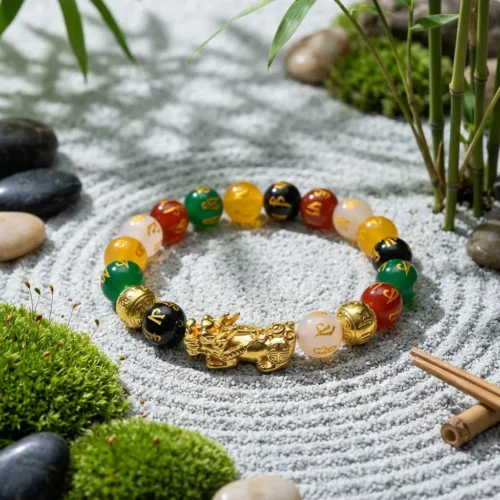
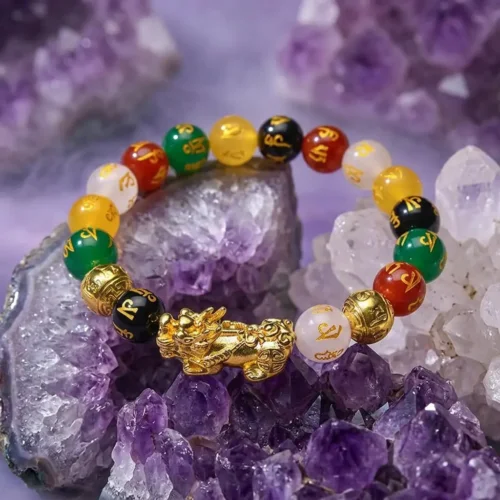
Green Jade holds a particularly significant place in Tibetan Buddhist tradition. Associated with the protective qualities of Green Tara, it is believed to create a subtle field of protection that deflects obstacles before they fully manifest — not by magically removing difficulty, but by keeping the wearer’s awareness clear and receptive enough to navigate around it. Authentic jade bracelets carved with the Endless Knot or other Auspicious Symbols are among our most sought-after pieces for customers seeking both beauty and genuine spiritual function.
🍀 Explore PotalaStore’s Green Jade and Lucky Stone collection — crafted by Tibetan artisans and available in styles from simple everyday bracelets to ceremonially blessed pieces sourced directly from Himalayan workshops.
FAQ: St. Patrick’s Day 2026 Luck and Spiritual Meaning
St. Patrick’s Day 2026 falls on Tuesday, March 17, 2026. The New Moon in Pisces follows on March 18, making this a particularly potent 48-hour window for spiritual intention-setting, energy clearing, and luck activation. Starting your practice on March 17 positions it to carry momentum into the entire New Moon cycle.
The shamrock was traditionally used by St. Patrick to explain the Holy Trinity — three distinct expressions of one sacred whole. Spiritually, it represents the dynamic balance of three forces in harmony, a concept that appears across traditions worldwide (including Buddhism’s Three Jewels). The rarer four-leaf clover, found in approximately 1 in every 5,000 three-leaf shamrocks, adds a fourth element — luck itself — to the trio of faith, hope, and love, and was historically understood as a sign of divine attention.
Green Aventurine is widely considered the luckiest crystal, known as the “Stone of Opportunity” and associated with the heart chakra. Green Jade has been used in Chinese and Tibetan traditions for over 5,000 years for prosperity and Divine protection. Citrine is recommended for financial abundance and manifestation energy. On St. Patrick’s Day specifically, any green crystal worn with clear intention aligns your energy with the seasonal themes of renewal, luck, and fortune. For a Tibetan Buddhist approach, jade or malachite associated with Green Tara’s protective energy is especially meaningful.
Mala beads — Buddhist prayer beads traditionally made with 108 beads — are ideal for luck intention-setting. Hold one bead at a time and repeat your specific intention or a mantra such as Om Tare Tuttare Ture Soha (Green Tara’s mantra for removing obstacles and opening fortune) for each of the 108 beads. Completing one full round typically takes 5–10 minutes. The physical repetition anchors your intention into the body in a way that visualization alone cannot replicate. Explore PotalaStore’s mala bead collection to find a piece matched to your intention and practice.
🍀 Activate Your Luck This St. Patrick’s Day
Explore authentic Tibetan Buddhist lucky jewelry — Green Jade bracelets, Endless Knot amulets, and hand-blessed mala beads sourced directly from Himalayan artisan workshops and monastery communities.Shop Tibetan Lucky Jewelry →
📚 References
- St. Patrick’s Day — Spiritual Meaning and History: Historical overview of St. Patrick’s Day origins, the transformation narrative, and its evolution as a feast day. HISTORY.com — St. Patrick’s Day Spiritual Meaning
- Luck of the Irish: Folklore and Fairies in Rural Ireland: Yale academic anthropological research on Irish luck traditions, the Fairy-Faith (Creideamh Sí), and the cultural systems through which luck was understood and practiced. Yale Human Relations Area Files (HRAF)
- Ashtamangala — The Eight Auspicious Symbols of Buddhism: Overview of the Endless Knot (Shrivatsa), its meaning within Tibetan Buddhist iconography, and its use as a symbol of fortune and interdependence. Wikipedia — Ashtamangala
- Green Tara — Buddhist Goddess of Compassionate Action: Background on Green Tara’s role in Tibetan Buddhist practice, her mantra, and her traditional association with removing obstacles and opening pathways to good fortune. Source: Rigpa Shedra / Traditional Tibetan Buddhist scholarship (Search “Green Tara Rigpawiki” for current academic resources)