

If you’ve ever visited a Tibetan Buddhist temple or browsed spiritual jewelry, you’ve likely encountered a mysterious symmetrical object with prongs curving from both ends. This sacred implement is called a dorje in Tibetan or vajra in Sanskrit—and it represents one of the most powerful symbols in Buddhist tradition.
At PotalaStore, we’ve spent over a decade working directly with Tibetan artisans who craft these ritual objects using techniques passed down through generations. Through countless conversations with practitioners and teachers, we’ve come to appreciate why the dorje holds such profound meaning for those on the spiritual path.
In this guide, you’ll discover what the dorje truly symbolizes, the significance of its different forms, and how it’s used in Buddhist practice. Whether you’re a meditation practitioner, spiritual seeker, or simply curious about Tibetan Buddhist symbols, understanding the dorje opens a window into ancient wisdom about the nature of enlightenment itself.

What Is a Dorje (Vajra)? Definition and Etymology
A dorje (Tibetan: rdo rje) or vajra (Sanskrit) is a ritual implement in Tibetan Buddhism symbolizing the indestructible, diamond-like quality of enlightenment and the unstoppable thunderbolt force that cuts through ignorance. This dual meaning—diamond and thunderbolt—captures the essence of what the dorje represents.
The Sanskrit word vajra translates to “the hard or mighty one” and carries meanings of both “diamond” and “thunderbolt.” In Tibetan, dorje means “lord of stones”—a poetic reference to the diamond’s supreme hardness. Just as a diamond can cut through any material yet cannot itself be scratched, the awakened mind penetrates all illusions while remaining unaffected by them.
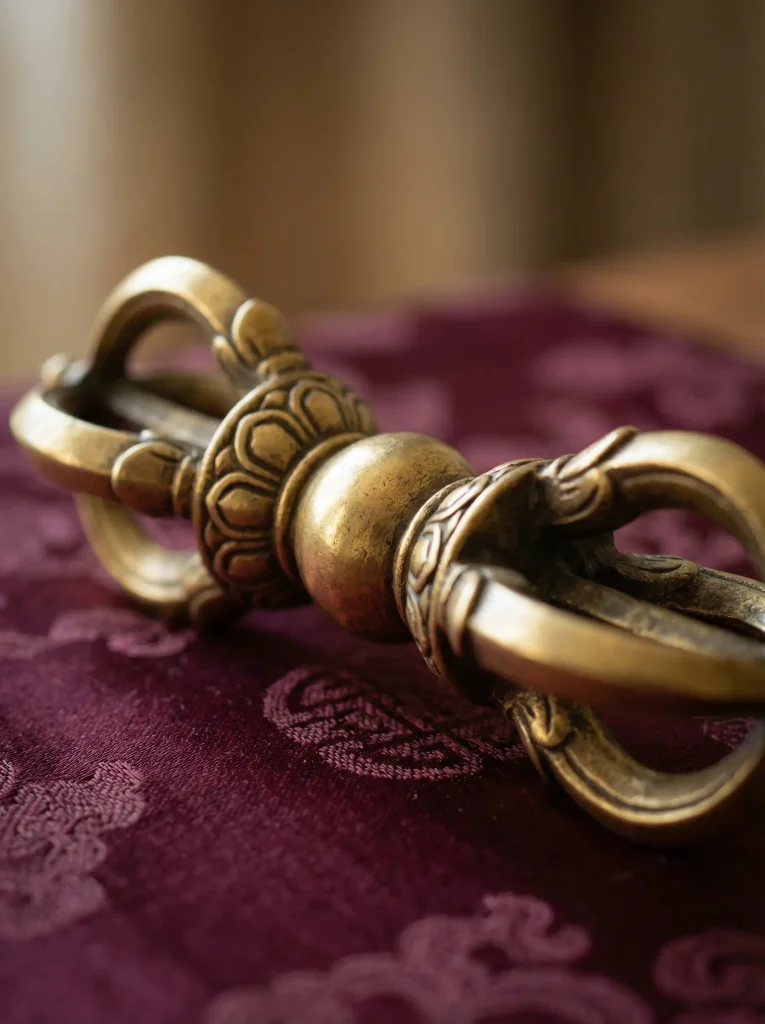
Physically, a dorje is a symmetrical metal scepter with a central sphere and sets of prongs extending from both ends. The prongs typically curve inward, meeting at points on each side. Traditional dorjes are crafted from bronze, brass, copper, or occasionally precious metals like silver and gold.
The term vajra also gives its name to Vajrayana Buddhism—the “Diamond Vehicle” or “Thunderbolt Vehicle”—which is the dominant form of Buddhism in Tibet, Nepal, Bhutan, and Mongolia. This entire school of practice is named after this sacred object, reflecting how central the dorje is to Tibetan Buddhist identity and practice.
The Ancient Origins: From Hindu Mythology to Buddhist Practice
The vajra’s origins trace back thousands of years to ancient Vedic India, where the thunder god Indra wielded it as his signature weapon—a divine thunderbolt that no enemy could withstand and no force could destroy.
According to Hindu mythology, the original vajra was crafted from the bones of the sage Dadhichi, who sacrificed his life so that the gods could defeat a powerful demon. This origin story establishes the vajra as a symbol of ultimate sacrifice for the greater good—a theme that resonates deeply with Buddhist ideals of compassion.
When Buddhism emerged in India and later spread to Tibet, the vajra was transformed from a weapon of the gods into a spiritual symbol. In the 8th century CE, the legendary master Padmasambhava (also known as Guru Rinpoche) brought tantric Buddhism to Tibet. According to tradition, he used the power of the vajra to subdue the local spirits and establish Buddhism in the Himalayan region.
Padmasambhava is credited with founding the Nyingma school—the oldest school of Tibetan Buddhism—and he is almost always depicted holding a golden vajra. His mastery of this sacred implement symbolizes his ability to transform obstacles into opportunities for awakening.
What Does the Dorje Symbolize? Core Spiritual Meanings
The dorje represents the vajra mind—the enlightened state that is impenetrable, immovable, and absolutely indestructible, like a diamond that cuts through everything yet cannot itself be cut. This is the ultimate goal of Buddhist practice: to realize this unshakeable awareness.
At its core, the dorje embodies two complementary qualities:
- Diamond nature: Indestructible, pure, and capable of cutting through ignorance and delusion. The awakened mind, like a diamond, is spotlessly clear and eternally unchanging.
- Thunderbolt force: Irresistible power, sudden awakening, and the lightning-flash of insight that shatters all obstacles. Enlightenment can strike in an instant, transforming everything.
The central sphere of the dorje represents sunyata—emptiness, the ultimate nature of reality. This sphere is often sealed with the Sanskrit syllable HUM, representing freedom from conceptual limitations.
In Vajrayana Buddhism, the dorje also represents the male principle—specifically upaya, meaning “skillful means” or compassionate action. It is always paired with a bell (ghanta), which represents the female principle of prajna or wisdom. Together, they symbolize the union of wisdom and compassion that defines the complete path to enlightenment.
Many practitioners also understand the dorje as a spiritual “weapon” against negativity. It doesn’t destroy in a violent sense but rather transforms ignorance, anger, and attachment into clarity, patience, and freedom.
Seeking an authentic dorje for your practice? Explore PotalaStore’s collection of handcrafted Tibetan dorjes, made by skilled artisans using traditional techniques.
Types of Dorje: Understanding the Different Prong Configurations
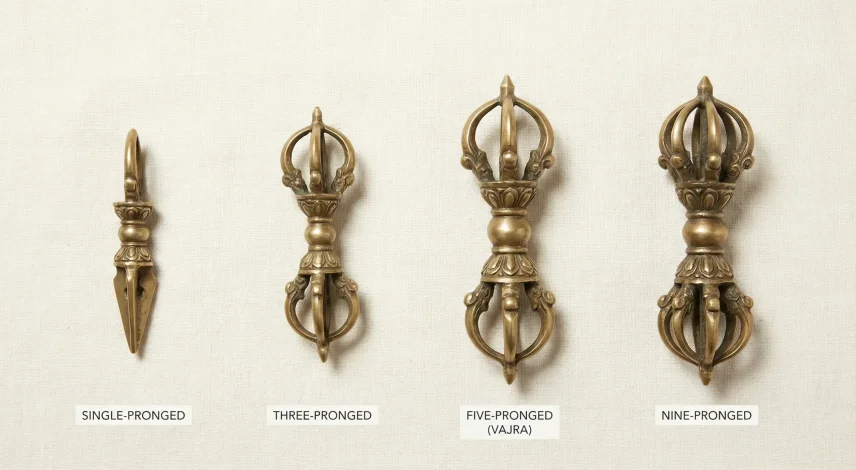
Dorjes vary in the number of prongs extending from each end—most commonly one, three, five, or nine—with each configuration carrying distinct spiritual significance. Understanding these differences helps practitioners choose a dorje aligned with their practice.
| Prong Type | Symbolism | Best For |
|---|---|---|
| Single (1) Prong | Unity of ultimate truth, union of all dualities | Focused meditation on non-duality |
| Three (3) Prongs | Three Jewels (Buddha, Dharma, Sangha); body, speech, and mind | Devotional practice, blessing rituals |
| Five (5) Prongs | Five Dhyani Buddhas, Five Wisdoms, transformation of five poisons | General practice (most common) |
| Nine (9) Prongs | Nine Yanas (spiritual vehicles), advanced tantric teachings | Advanced tantric practitioners |
| Double Dorje (Vishvavajra) | Absolute stability, foundation of the physical world | Altar placement, protection, mandala bases |
The Five-Pronged Dorje: Most Common Form
The five-pronged dorje is by far the most widely used. Its five prongs represent the Five Dhyani Buddhas—Vairochana, Akshobhya, Ratnasambhava, Amitabha, and Amoghasiddhi—each embodying a different aspect of enlightened consciousness.
The five prongs also symbolize the transformation of the five poisons (ignorance, anger, pride, desire, and jealousy) into the Five Wisdoms. This transformation is central to tantric practice—the poisons themselves become fuel for awakening when properly understood.
The Double Dorje (Vishvavajra)
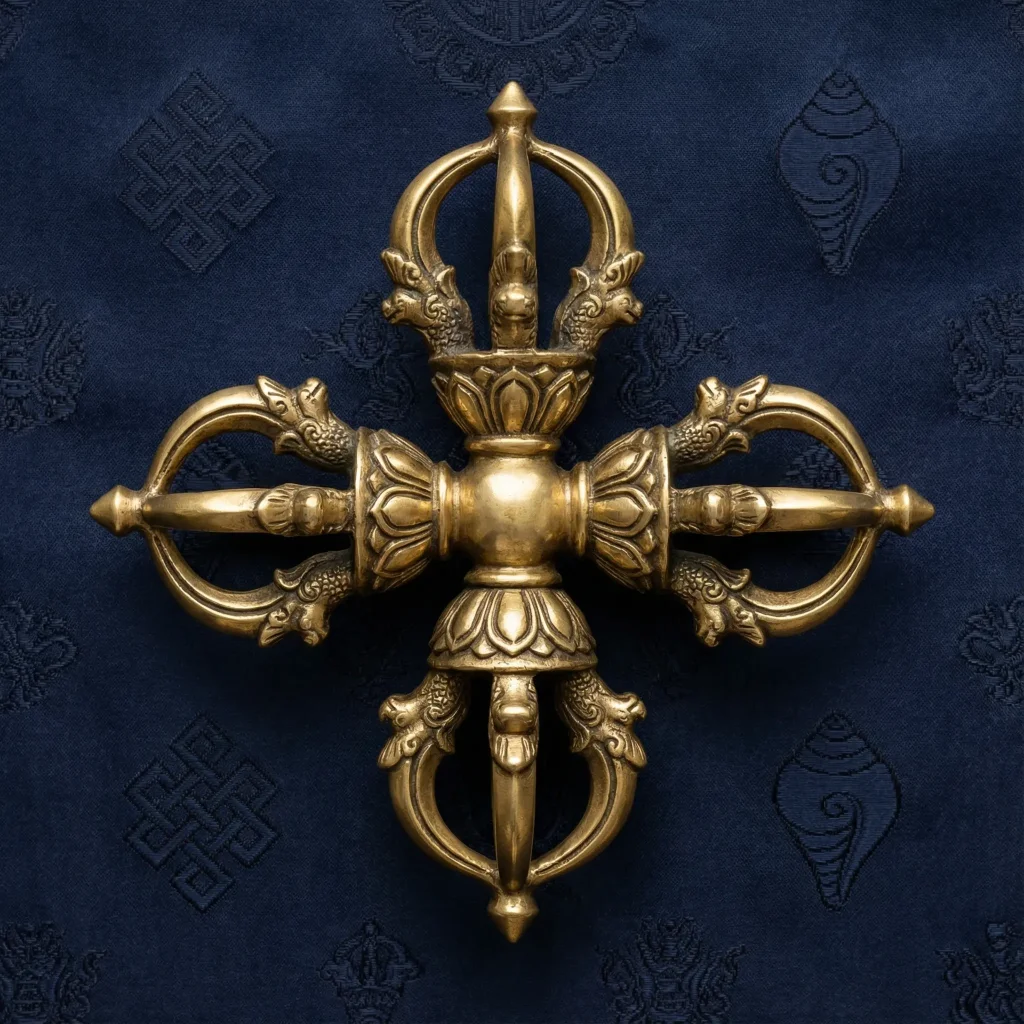
The vishvavajra or double dorje consists of two vajras crossed at their centers, forming a powerful cross shape. This configuration represents absolute stability—the unshakeable foundation of the universe, often associated with Mount Meru, the cosmic axis in Buddhist cosmology.
The double dorje is linked to Amoghasiddhi, the Buddha of the Karma family, whose name means “Unfailing Accomplishment.” Practitioners often place a vishvavajra beneath statues or at the center of mandalas to establish a stable spiritual foundation.
Find Your Perfect Dorje
Whether you’re drawn to the classic five-pronged design or the protective power of the double dorje, PotalaStore offers authentic options crafted by Tibetan artisans.Shop Authentic Dorjes →
The Sacred Pairing: Dorje and Bell (Ghanta) Together
In Vajrayana Buddhism, the dorje and bell are considered inseparable—they are never sold separately and should never be placed apart, because together they represent the complete path to enlightenment.
The pairing works like this:
- Dorje (right hand): Represents compassion, method, skillful means (upaya), and the masculine principle
- Bell (left hand): Represents wisdom, emptiness (sunyata), and the feminine principle (prajna)
The sound of the bell is understood as the voice of emptiness—the reverberating tone that eventually fades into silence mirrors how all phenomena arise from and return to the void. Meanwhile, the dorje represents the active expression of compassion in the world.
When a practitioner holds both implements during ritual, they are literally embodying the union of wisdom and compassion. This union is not just philosophical—it is the very definition of enlightenment in Vajrayana Buddhism. Neither wisdom without compassion nor compassion without wisdom can lead to full awakening.
When not in use, the bell and dorje should be placed side by side, touching, with the dorje to the left of the bell (from the practitioner’s seated position). This arrangement honors their inseparable nature.
Looking to begin your practice with a complete set? Our bell and dorje sets are crafted as matching pairs and blessed according to traditional methods.
Deities Who Wield the Dorje: Vajrapani, Vajrasattva, and Padmasambhava
Several enlightened beings in Tibetan Buddhist iconography are depicted holding the dorje, each representing different aspects of the awakened mind’s power. Recognizing these deities helps practitioners understand the dorje’s spiritual significance.
Vajrapani: The Wrathful Protector
Vajrapani—whose name literally means “vajra in hand”—is one of the three primary bodhisattvas protecting the Buddha. He appears in a fierce, wrathful form, brandishing the dorje above his head like a weapon ready to strike down ignorance. Vajrapani embodies the power of all the Buddhas and is invoked for spiritual strength and protection.
Vajrasattva: The Purifier
Vajrasattva (meaning “vajra being”) appears in a peaceful form, holding the dorje at his heart in his right hand. He represents primordial purity and is central to purification practices. Practitioners recite his hundred-syllable mantra to cleanse negative karma and mental obscurations.
Padmasambhava: The Lotus-Born Master
Padmasambhava, the 8th-century master who established Buddhism in Tibet, is typically shown holding a golden dorje in his right hand. His mastery of the vajra symbolizes his ability to transform obstacles and subdue harmful forces through the power of enlightened wisdom.
The prefix “vajra-“ appears throughout Tibetan Buddhism—in deity names, practice terms, and sacred places. Vajrasana is the location where Buddha attained enlightenment. This linguistic pattern reflects how deeply the vajra concept permeates Buddhist thought.
❓ Frequently Asked Questions
Anyone can respectfully use a dorje for general meditation, as a mindfulness reminder, or as a meaningful spiritual symbol—no formal empowerment is required for these purposes. However, certain advanced tantric practices involving the dorje may require initiation from a qualified teacher. When in doubt, approach with respect and sincere intention. Wearing dorje jewelry is also appropriate for anyone seeking a connection to its protective energy.
Dorje and vajra refer to the same sacred object. “Dorje” (རྡོ་རྗེ, rdo rje) is the Tibetan term meaning “lord of stones,” while “vajra” is the Sanskrit term meaning “thunderbolt” or “diamond.” You may see either term used depending on the source’s cultural context—Tibetan Buddhist sources typically use “dorje,” while texts drawing on Indian traditions use “vajra.”
Hold the dorje in your right hand at chest or heart level, with the prongs pointing outward. The right hand represents compassion and active method in Buddhist practice. If using both bell and dorje, the bell is held in the left hand (representing wisdom). You can also simply hold the dorje as a grounding tool, visualizing its qualities of clarity and indestructibility at your heart center.
Place your dorje to the left of the bell when viewed from your seated position—they should be touching or nearly touching, honoring their inseparable nature. A double dorje (vishvavajra) can be placed beneath sacred statues or at the center of your altar to establish spiritual stability. Always treat your dorje with respect as a sacred object, keeping it clean and elevated rather than on the floor.
Embrace the Diamond Path
The dorje is far more than a beautiful ritual object—it is a physical reminder of the mind’s potential for unshakeable clarity and boundless compassion. Each time you see or hold a dorje, you’re connecting with thousands of years of spiritual wisdom about the nature of awakening.
Whether you’re drawn to the dorje for meditation practice, altar decoration, or simply as a meaningful symbol of your spiritual journey, understanding its rich symbolism deepens your connection to Tibetan Buddhist tradition.
In summary, the dorje represents the enlightened mind that is indestructible like a diamond and powerful like a thunderbolt. Its various forms—from the common five-pronged design to the stabilizing double dorje—each carry specific meanings. Paired with the bell, it symbolizes the complete union of wisdom and compassion that defines the path to awakening.
Ready to Find Your Dorje?
Each PotalaStore dorje is handcrafted by Tibetan artisans using traditional techniques passed down through generations. Begin your connection to this powerful Buddhist symbol today.Explore Our Dorje Collection →
Note: Spiritual objects like the dorje are intended for meditation, ritual practice, and personal spiritual development. The benefits and meanings described are based on traditional Tibetan Buddhist beliefs and the experiences of practitioners over centuries. This information is cultural and spiritual in nature, not a substitute for professional medical or mental health advice.
📚 References
- Dorje in Tibetan Buddhist Ritual: Scholarly examination of the dorje’s role as a sacred object and its discovery traditions in Himalayan Buddhism. Rubin Museum of Art – Project Himalayan Art
- Vajra History and Symbolism: Comprehensive overview of the vajra’s origins in Vedic tradition, its Buddhist adaptation, and iconographic significance. Wikipedia – Vajra
- Bell and Dorje in Practice: Detailed explanation of how practitioners use the bell and dorje together in Vajrayana Buddhist ritual and meditation. Buddha Weekly
- Tibetan Buddhist Encyclopedia: Reference material on the vishvavajra (double dorje) and its significance in Buddhist cosmology and ritual. Tibetan Buddhist Encyclopedia