
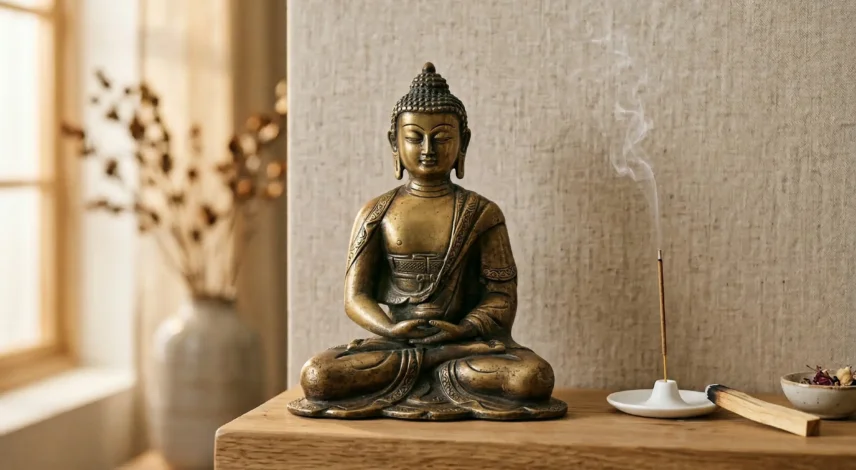

Buddha statues attract more questions than almost any other item we carry at Potala Store — and also the most genuine anxieties. Where exactly should it go? Does the material carry spiritual meaning? Is it acceptable to give one as a gift? And perhaps most pressing for many readers: is it disrespectful to display one if you’re not Buddhist? Through our direct sourcing partnerships with Sera Jhe Monastery in South India and Kopan Monastery in Nepal, we encounter every version of these questions. This guide answers the most important ones clearly, drawing on both traditional Buddhist teaching and practical experience handling hundreds of pieces.
⚠️ Note on spiritual content: Information about spiritual associations and symbolic meanings reflects traditional Buddhist beliefs and cultural practice. It is not presented as scientific fact and should not replace professional guidance on religious or spiritual matters.
1. What Do Different Buddha Statues Actually Represent?
Each Buddha statue type communicates a specific spiritual quality through its posture and hand gesture, known as a mudra. The posture shows the Buddha’s inner state; the mudra names what he is actively offering to the viewer — whether that is protection, teaching, or enlightenment. Knowing this helps you choose a figure whose meaning aligns with your intention.
Here are the most common types and their significance:
| Statue Type | Mudra (Hand Gesture) | What It Communicates | Best Suited For |
|---|---|---|---|
| Meditating Buddha (Dhyana) | Both hands resting in lap, palms facing up | Deep inner stillness; turning inward | Meditation room, altar, yoga space |
| Earth-Touching Buddha (Bhumisparsha) | Right hand reaching to touch the earth, left in lap | The moment of Siddhartha’s enlightenment beneath the Bodhi Tree | Living room, study, entryway |
| Protection Buddha (Abhaya) | Right hand raised with palm facing outward | Fearlessness; offering protection and reassurance | Entryway, home office, gift for anxiety |
| Teaching Buddha (Dharmachakra) | Both hands at chest, fingers turning a wheel gesture | Active transmission of dharma; compassion in action | Study, library, learning environment |
| Reclining Buddha | Lying on right side, right hand supporting the head | The Buddha’s final entry into parinirvana — peace in the moment of passing | Bedroom, contemplative space; avoid as a gift |
One distinction that deserves its own paragraph: the Laughing Buddha is not Siddhartha Gautama. The round, cheerful figure that most people picture when they hear “Buddha statue” is actually Budai (布袋, also called Hotei in Japan) — a Chinese folkloric monk from around the 10th century, associated with contentment, abundance, and good fortune. Budai is venerated in Chinese folk religion and is a genuinely beloved figure, but he is completely separate from the historical Buddha of Buddhist teaching. Conflating the two is the most common misunderstanding we encounter — and it matters when choosing a gift or a piece with spiritual significance.

Explore our full Buddha statue collection with detailed descriptions of each figure’s symbolic meaning.
2. Where Should You Place a Buddha Statue? A Room-by-Room Guide
The two universal placement principles across traditions are elevation and intentionality: a Buddha statue should always be placed at or above eye level, and never on the floor. Beyond that, the guidelines vary by room and differ depending on which tradition you’re drawing from.
The Core Placement Rules
- Height: The base of the statue should sit at a minimum of 3 feet (36 inches) from the floor — a practical floor for “eye level or above” in most homes.
- Living room: A dedicated shelf, mantel, or console table works well. Keep the area uncluttered and avoid placing the statue directly beside or below a television.
- Entryway / front door area: A widely practiced placement, particularly in Feng Shui tradition. The statue greets incoming energy and visitors with calm presence.
- Meditation or prayer room: The most naturally appropriate environment for any statue type. An altar arrangement with incense and an offering bowl is suitable here.
- Bedroom: Accepted in some Buddhist traditions, avoided in others. If having a sacred figure in that space feels uncomfortable, trust that instinct and place it elsewhere.
- Bathroom or kitchen: Avoided across virtually all Buddhist and Feng Shui sources without exception.
Which Direction Should It Face? Reconciling Three Conflicting Systems
If you’ve researched directional placement and come away confused, you’re not alone — the advice online reflects three distinct knowledge systems that don’t always agree:
| Tradition | Recommended Direction | Reasoning |
|---|---|---|
| Feng Shui | Face toward the front door or main room entrance | The statue interacts with incoming chi; it greets energy as it enters the home |
| Vastu Shastra | Face east or northeast | Alignment with the sunrise direction, associated with spiritual awakening |
| Traditional Buddhist Practice | No fixed directional requirement | Directional orientation is a cultural overlay, not a doctrinal teaching; the statue’s meaning is in the figure itself |
In practice: if east-facing is natural within your room layout, that is a fine choice. If orienting the statue toward your main entrance makes more compositional sense, that works equally well. The most important factor is that the placement feels deliberate and respectful — not squeezed between unrelated objects or positioned without thought.
3. Which Material Is Right for Your Buddha Statue?
Material choice affects both the statue’s longevity and its symbolic resonance — bronze and brass last the longest in most indoor settings, while wood carries a warmth that metal cannot replicate, and stone conveys solidity and permanence.

Here is a full comparison based on the pieces we handle and source directly:
| Material | Symbolic Association | Durability | Care Notes | Price Range (USD) |
|---|---|---|---|---|
| Bronze | Permanence, wisdom, historical continuity | 100+ years with occasional cleaning | Dust regularly with soft cloth; keep dry; avoid harsh chemicals | $150 – $3,000+ |
| Brass | Purity, warmth, traditional craftsmanship | Decades; develops rich patina over time | Soft cloth dusting; occasional light polish if desired | $50 – $800 |
| Wood | Natural simplicity, groundedness, organic warmth | Decades in stable indoor environments | Maintain 40–60% relative humidity to prevent cracking; avoid direct sunlight | $80 – $1,200 |
| Stone / Marble | Stability, solidity, elemental permanence | Centuries; not suitable for freeze-thaw outdoor cycles | Wipe with dry cloth; avoid acidic cleaners | $120 – $5,000+ |
| Jade | Purity, good fortune (particularly in Chinese tradition) | Extremely durable if protected from impact | Wipe gently; avoid sharp impacts | $200 – $2,000+ |
| Resin | No traditional symbolic association; primarily decorative | Moderate; can chip or discolor over years | Minimal; avoid prolonged UV exposure | $20 – $150 |
One observation from our sourcing work: the statues most consistently described as having a “living quality” by practitioners are lost-wax cast brass pieces hand-finished by Nepali artisans. The weight and density of cast metal creates a sense of presence and permanence that lighter resin pieces — however detailed their surface — rarely achieve. This is not a doctrinal claim; it is simply what we have observed consistently across thousands of customer conversations and the artisan workshops we visit in Kathmandu.
Looking for a hand-cast brass or bronze Buddha statue? Our collection is sourced directly from Kathmandu workshops with monastery oversight — each piece includes information on its craftsmanship and symbolic meaning. Browse Buddhist statues at Potala Store →
4. Can You Give a Buddha Statue as a Gift — and Who Should You Give It To?
Yes, giving a Buddha statue as a gift is generally appropriate — but the choice of figure matters significantly more than most gift-givers realize. The two most important considerations are the recipient’s cultural and religious background and your intention in giving it.
If your recipient practices Buddhism: the Meditating Buddha (Dhyana mudra) is almost universally well-received. The Earth-Touching Buddha, representing the moment of enlightenment, is equally regarded. One figure to avoid as a gift is the Reclining Buddha — in several Buddhist traditions it is associated with the final moment of passing, and even practitioners who understand its deeper peace may find it an awkward choice as a gift.
If your recipient is not Buddhist: a Laughing Buddha (Budai) is a genuinely warm and culturally accessible choice, particularly for a housewarming or new-beginning celebration. Because Budai belongs to Chinese folk tradition rather than core Buddhist doctrine, his presence in non-Buddhist homes carries fewer cultural expectations attached to it.
You want this gift to feel thoughtful and culturally aware — not accidentally presumptuous about someone’s spiritual life. Including a brief handwritten note that explains the figure’s meaning often transforms a beautiful object into a genuinely memorable gesture.

One widely circulated belief worth addressing: many people have heard that you should never buy a Buddha statue for yourself — that it must be received as a gift to bring good fortune. This belief has no basis in any Buddhist teaching and appears to be a modern folk superstition. Purchasing a statue for your own home, altar, or meditation practice is entirely appropriate.
5. How to Display a Buddha Statue Respectfully If You’re Not Buddhist
Displaying a Buddha statue respectfully as a non-Buddhist comes down to one distinction: cultural appreciation versus cultural appropriation — and that line is drawn by awareness and treatment, not by religious identity.
The Buddhist teachers and monastic communities we work with are far less uniformly concerned about non-Buddhist ownership than many online sources suggest. The consistent message we hear is that intention and how you treat the figure matter significantly more than whether you hold Buddhist beliefs. What constitutes genuine disrespect is specific and consistent across traditions:
- Placing the statue on the floor, or lower than other objects in the room
- Using it in an ironic or humorous context that undermines its dignity
- Placing it in a bathroom, near a toilet, or in any space associated with waste
- Positioning it near alcohol, party decorations, or as a surface for unrelated objects
- Displaying a Buddha head alone as a purely decorative object — in Thai, Cambodian, and several Southeast Asian Buddhist traditions, a severed head carries strongly negative associations rooted in colonial-era destruction of temple statues. If culturally respectful display matters to you, a complete figure is the unambiguous choice.
If you’re new to Buddhist culture and uncertain, a straightforward practical test applies: would you feel comfortable explaining your placement and intention to a Buddhist monk? If the answer is yes — and the answer usually is — you are almost certainly in the clear. The fact that you are asking the question already indicates the awareness that distinguishes appreciation from appropriation.
At Potala Store, we believe that understanding the meaning behind what you display is what separates meaningful engagement from casual decoration. Our guide to Tibetan Buddhist symbols offers deeper context on the objects in our collection for those who want to explore further.
Find the Right Buddha Statue for Your Home
Each piece in our collection is sourced directly from Himalayan monastery partners and comes with a full explanation of its symbolic meaning, mudra, and traditional use.Shop Buddha Statues at Potala Store →
Frequently Asked Questions
Is it bad luck to buy a Buddha statue for yourself?
No. The idea that a Buddha statue must be received as a gift to bring good fortune has no basis in Buddhist teaching. It appears to be a relatively recent folk belief with no doctrinal support in any Buddhist tradition. Purchasing a statue for your own home, altar, or meditation practice is entirely appropriate.
What is the most respectful height for a Buddha statue?
The base of the statue should be positioned at a minimum of 3 feet (36 inches) from the floor — approximately eye level for a seated adult. The guiding principle across traditions is that the figure should never be lower than the people in the room. A dedicated shelf, mantel, or altar table satisfies this in most home environments.
Are Buddha head statues disrespectful?
This is a genuinely contested question. In mainstream Western design, Buddha heads are commonly sold and displayed without controversy. However, in Thai, Cambodian, and several other Southeast Asian Buddhist traditions, a severed Buddha head carries strong associations with colonial-era looting and the destruction of temple statues. For unambiguously respectful display, a complete figure — seated, standing, or reclining — is the safer and more culturally considered choice.
Can I place a Buddha statue in my bedroom?
There is no universal Buddhist prohibition on bedroom placement. Some practitioners maintain bedside altars as part of their daily practice; others feel that the intimate nature of the bedroom makes it an inappropriate space for a sacred figure. Your own sense of respect is a reliable guide: if the placement feels comfortable and intentional, it is likely appropriate.
📚 References
- Buddhist Iconography and Mudras: Detailed documentation of hand gestures and their significance across Theravada, Mahayana, and Vajrayana traditions. Source: The Metropolitan Museum of Art — Heilbrunn Timeline of Art History. (Search metmuseum.org for “Buddhist sculpture mudra” for current resources.)
- Budai / Hotei (Laughing Buddha): Historical and cultural context distinguishing Budai from Siddhartha Gautama. Encyclopædia Britannica — Budai
- Buddhist Art and Material Culture: Comprehensive overview of Buddhist sculptural traditions across Asia, including iconographic standards and regional variations. Source: Smithsonian National Museum of Asian Art — freer.si.edu. (Search “Buddhist sculpture” in the collection database.)
- Cultural Appropriation and Buddhist Practice: Scholarly and practitioner perspectives on cross-cultural engagement with Buddhist material culture. Tricycle: The Buddhist Review — “When Is a Buddha Statue Appropriate or Offensive?”