

If your Buddhist bracelet just broke — especially after only one day — the mix of worry and confusion you’re feeling right now is completely natural.
In Tibetan Buddhist tradition, a bracelet breaking is understood as a sign that the piece has completed its protective cycle — absorbing negative energy and fulfilling its spiritual purpose. This is widely regarded as a positive, meaningful event, not a bad omen. The moment carries a specific message, and knowing what it means can turn anxiety into clarity.
At PotalaStore, we’ve worked alongside monks at Sera Jhe Monastery in South India and Kopan Monastery in Kathmandu for over a decade. This is one of the most common questions we hear from customers — particularly when a bracelet breaks in the first day or two. Below, we share what traditional Tibetan Buddhist teaching says about this moment, why “breaking quickly” may actually be significant, and the respectful steps you can take next.
What Does It Mean Spiritually When a Buddhist Bracelet Breaks?

When a Buddhist bracelet breaks, Tibetan tradition generally points to three overlapping interpretations — and none of them are cause for alarm.
1. The bracelet has completed its protective cycle
The most widely held view in both Tibetan and yogic traditions is that a mala bracelet or blessing cord absorbs negative energy as you wear it. When that energy reaches a threshold, the bracelet releases — completing its purpose, much the way a candle burns out after giving all its light. In this reading, the breaking is the bracelet’s final act of service.
2. A teaching on impermanence (Anicca)
Anicca — the Pali term for impermanence — is one of the Three Marks of Existence in Buddhist philosophy. It teaches that all conditioned phenomena are temporary by nature. A broken bracelet becomes a quiet, tangible reminder of this truth: attachment to objects, people, or outcomes is a root source of suffering. Many practitioners find that a broken bracelet deepens their practice precisely because it invites this reflection.
3. Karmic release and spiritual breakthrough
Some Tibetan and Vajrayana practitioners traditionally understand a bracelet breaking as a sign of karmic release — the closing of a cycle of accumulated karma. Rather than something being “taken away,” it can signal that a cycle of spiritual growth has been completed and a new one is ready to begin.
When we asked monks at our partner monasteries how they interpret a broken mala or blessing bracelet, the response was remarkably consistent across both communities: “It has done its work. Honor it, and continue your practice.” Their perspective was matter-of-fact — not alarming, but not dismissive either.

| Interpretation | Tradition | Meaning |
|---|---|---|
| Cycle completion | Tibetan Buddhist | Bracelet has absorbed enough negative energy and fulfilled its purpose |
| Impermanence (Anicca) | Theravāda & Tibetan Buddhist | All conditioned things are temporary — a reminder to release attachment |
| Karmic release | Vajrayana / yogic tradition | A cycle of karma has closed; spiritual growth is marked |
Note: Spiritual interpretations vary across Buddhist traditions. The perspectives above reflect views commonly held within the Tibetan Buddhist communities we work with at Sera Jhe and Kopan monasteries.
Does It Matter That Your Bracelet Broke After Just One Day?
If your Buddhist bracelet snapped spiritual meaning-wise after a single day, you may be wondering: does the timing make this worse? From a traditional Buddhist perspective, the short answer is no — and in some views, breaking quickly may carry its own significance.
Many practitioners in the Tibetan tradition believe that a fast break can indicate the bracelet encountered a concentrated charge of negative energy — and responded to it swiftly. In this reading, a bracelet that lasts one day before breaking may have been working especially hard on your behalf.
We’ve heard from customers who felt deep worry about this exact scenario. One customer reached out after their newly arrived blessing bracelet broke the evening they first wore it. After reflecting with them on the traditional view, she found the reframe genuinely comforting — the bracelet, consecrated through a 3-day puja ceremony at one of our monastery partners, had done its work from the moment she put it on.
That said, it’s fair to also consider the physical dimension. Elastic cord bracelets have a typical lifespan of 6 to 18 months under daily wear, depending on material quality, moisture exposure, and physical activity. If your bracelet broke immediately upon arrival — before any wear — that’s a different situation worth raising with us directly. But if it broke during or after wearing, the traditional spiritual reading almost certainly applies.
The key distinction: a monastery-blessed bracelet carries consecrated energy from the start. Its breaking is always understood within the context of that blessing — not as a manufacturing failure, but as part of its spiritual lifecycle.
What Should You Do After Your Buddhist Bracelet Breaks?

Tibetan Buddhist tradition offers a clear, respectful path for what to do when a blessed bracelet breaks — and it begins with simply pausing to reflect. Here are the steps practiced within the communities we work with:
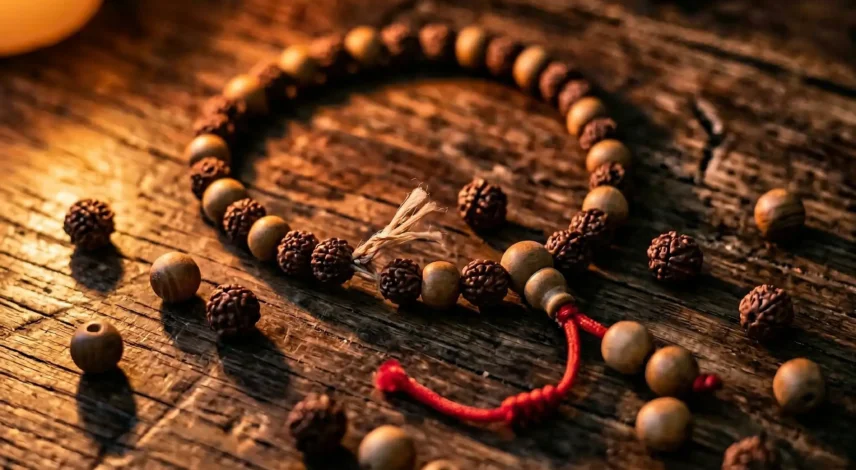
- Gather the beads or pieces. In Tibetan Buddhism, sacred items retain their blessing energy even after breaking. The individual beads of a wrist mala — typically 21 or 27 beads (both divisors of 108, the number representing the 108 human afflictions in Buddhist teaching) — are not simply discarded.
- Take a moment of acknowledgment. Before deciding what to do with the pieces, pause briefly. Reflect on your intention when you first received the bracelet and on what the wearing period meant to you.
- Dispose of it respectfully — as “dharma waste.” Damaged sacred objects in Tibetan Buddhism are classified as dharma waste — items that still hold blessing energy and must be handled with care. Traditional options include: wrapping the pieces in clean cloth and burying them in a natural outdoor place (earth, not trash), placing them at a home altar or shrine, or returning them to a monastery for offering.
- Set a new intention. The breaking marks the end of one spiritual cycle and the opening of another. When you feel ready, this is a meaningful moment to reflect on what you’d like to carry forward in the next chapter of your practice.
- Consider a new bracelet — when the time feels right. There’s no prescribed timeline. Some practitioners wait days; others weeks. What matters is that the new piece is chosen with intention, not urgency.
Continue your spiritual journey
When you feel ready to set new intentions, explore our collection of monastery-blessed Tibetan bracelets — each consecrated through a 3-day puja ceremony at Sera Jhe or Kopan Monastery, two of the most respected Gelugpa institutions in the Himalayan tradition.
Frequently Asked Questions
No — in most Buddhist traditions, a bracelet breaking is considered a positive sign, not bad luck. It traditionally signals that the bracelet has fulfilled its protective purpose or that a cycle of spiritual growth has been completed. Some traditions do advise using the moment for deeper reflection and renewed practice, but the predominant view is one of completion, not misfortune.
Traditional Tibetan Buddhist practice generally encourages honoring the bracelet’s completed cycle rather than restringing it. In this tradition, damaged sacred items — called dharma waste — are typically buried at a clean natural site or placed at a shrine, rather than repaired. That said, restringing is a personal choice many practitioners make, especially when a bracelet holds deep sentimental meaning. There’s no strict rule; intention and respect matter most.
In Tibetan Buddhist tradition, a red string blessed by a lama is traditionally worn until it naturally falls off — typically within 3 to 12 months of daily wear. When it does, this is understood as a sign that its protective blessing has been fully absorbed and its purpose complete. The natural falling-off is generally viewed as a positive conclusion, not a loss.
A broken Buddhist bracelet — even one that lasted only a day — is not a sign that something has gone wrong. In Tibetan Buddhist tradition, it marks the close of one chapter and the quiet invitation to begin another. The bracelet has done its work. You can honor it and move forward.
Continue Your Spiritual Journey
Explore Potala Store’s collection of authentic Tibetan bracelets and mala beads — each blessed through a traditional puja ceremony with our monastery partners in the Himalayas.Explore Blessed Bracelets →
Want to learn more about the spiritual significance of what you wear? Read our guide: Tibetan Bracelet Meaning: Colors, Symbols & Spiritual Benefits.
⚠️ A Note on Spiritual Interpretation: The perspectives shared in this article reflect traditional Tibetan Buddhist views informed by our partnerships with Sera Jhe and Kopan monasteries. Spiritual interpretations vary across Buddhist traditions and individual practice. This content is offered for educational and reflective purposes. For personalized spiritual guidance, we encourage consulting a qualified Buddhist teacher or lama.
📚 References
- Anicca (Impermanence) in Theravāda Buddhism: Overview of the Three Marks of Existence, including impermanence as a foundational principle of Buddhist philosophy. Access to Insight — Readings in Theravāda Buddhism accesstoinsight.org
- Kopan Monastery — Foundation for the Preservation of the Mahayana Tradition (FPMT): One of the founding institutions of FPMT, established by Lama Thubten Yeshe and Lama Zopa Rinpoche, Kathmandu, Nepal. kopanmonastery.com
- Sera Jhe Monastery — Gelugpa Monastic Institution: Re-established in Bylakuppe, South India; one of the three great seats of Mahayana Buddhist learning in the Gelugpa tradition. serajemonastery.org