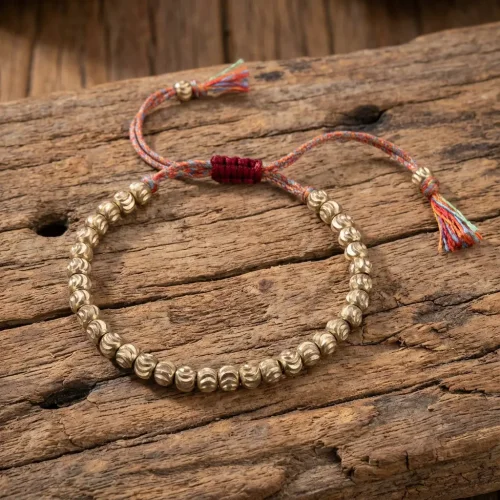

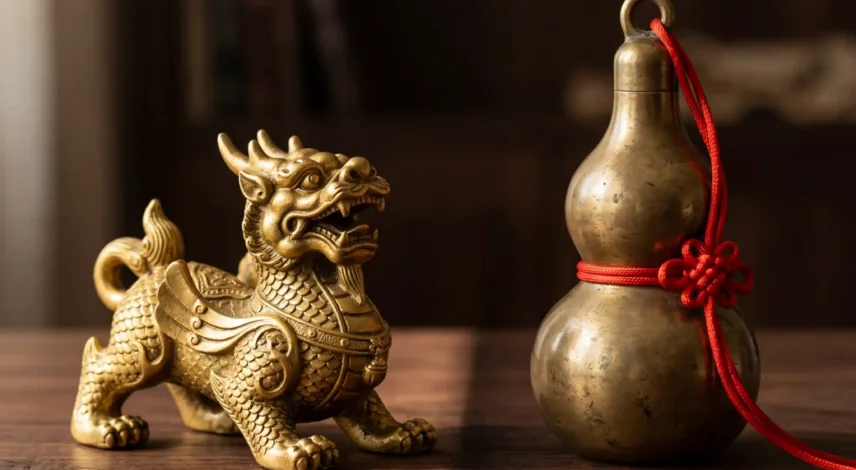

Still deciding between a Pixiu and a Wu Lou? Here’s the honest answer: they’re not competing for the same job. Pixiu is a mythical creature that draws wealth and protects your finances. Wu Lou is a sacred gourd symbol that shields your health and promotes longevity. Pick based on what you need most right now — not which one looks cooler.
At Potala Store, we’ve guided thousands of customers through this exact question over the past decade, sourcing both Pixiu pieces and Wu Lou items directly from artisan workshops across Asia. The most common mistake we see? People choose the more well-known symbol without thinking about their actual goal. This guide will make that choice simple.
⚠️ Important Note: The information about spiritual and energy properties in this article is rooted in traditional Chinese cultural beliefs and feng shui practice. These descriptions reflect centuries of tradition and user experience, not clinically verified claims. Feng shui symbols are not substitutes for professional medical or financial advice.
What Is Pixiu? The Legendary Wealth Beast of Chinese Feng Shui
Pixiu (also called Pi Yao or Pi Xiu) is a mythical creature from Chinese legend — and one of the most powerful wealth-attracting symbols in feng shui. It has the head of a dragon and the body of a lion, and it has been used as a prosperity talisman for over 2,000 years, dating back to the Han Dynasty (206 BC–220 AD), when Emperor Wu of Han formally declared it the “Treasure of the Emperor.”
The mythology behind Pixiu explains everything about its function. According to legend, Pixiu is the ninth son of the Dragon King. As punishment for defying the Jade Emperor, its rectum was permanently sealed — meaning it can devour enormous amounts of gold and treasure but can never release them. Think of it as a one-way wealth magnet: it pulls money toward you and refuses to let it go. That’s why feng shui practitioners believe Pixiu helps attract windfall luck, protect existing finances, and block financial loss.
There are technically two types: Tiānlù (male, one antler), believed to seek out and draw in wealth; and Bìxié (female, two antlers), believed to ward off evil and negative energy. Most commercial Pixiu items today represent the male type.

Pixiu is also commonly used as a Tai Sui remedy — a cure for the “Grand Duke Jupiter” affliction in annual Flying Star feng shui. If your birth year zodiac is in conflict with Tai Sui in a given year, wearing a Pixiu bracelet is believed to offer protection.
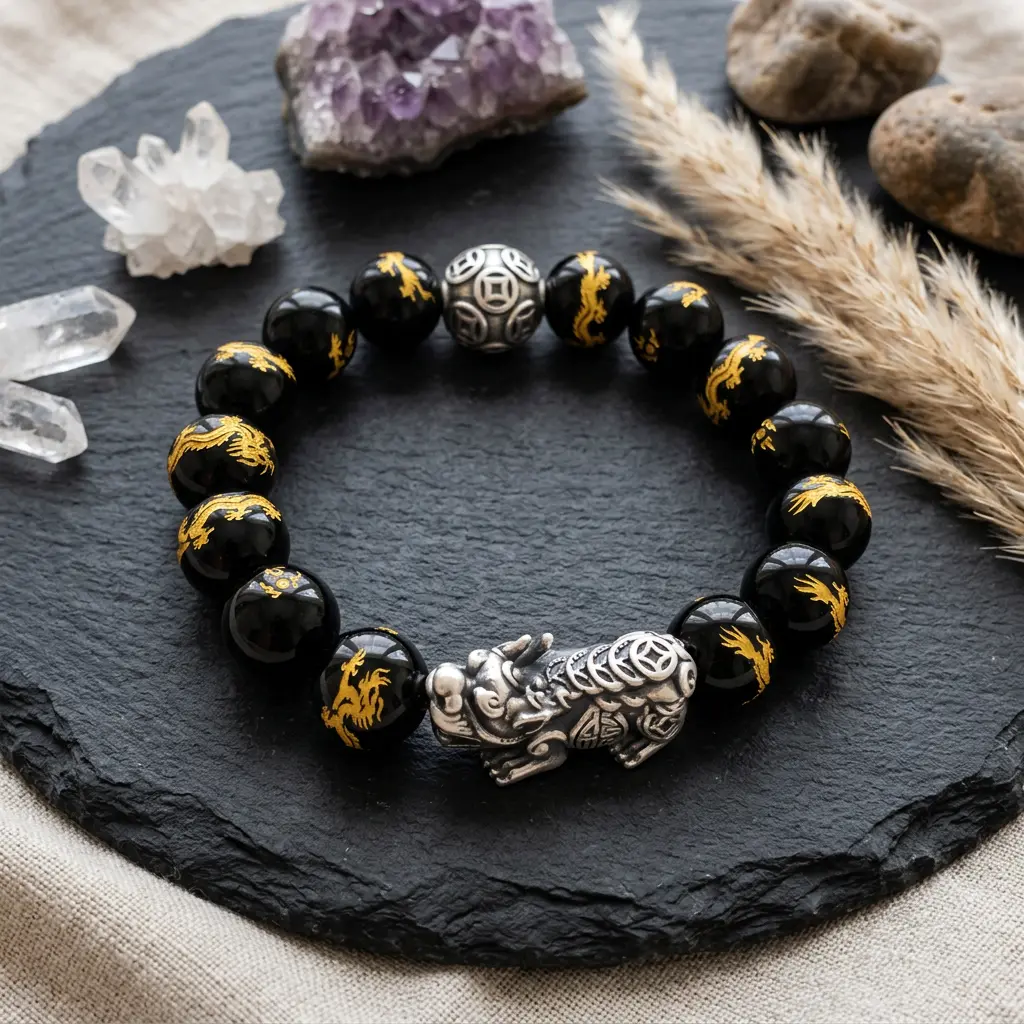
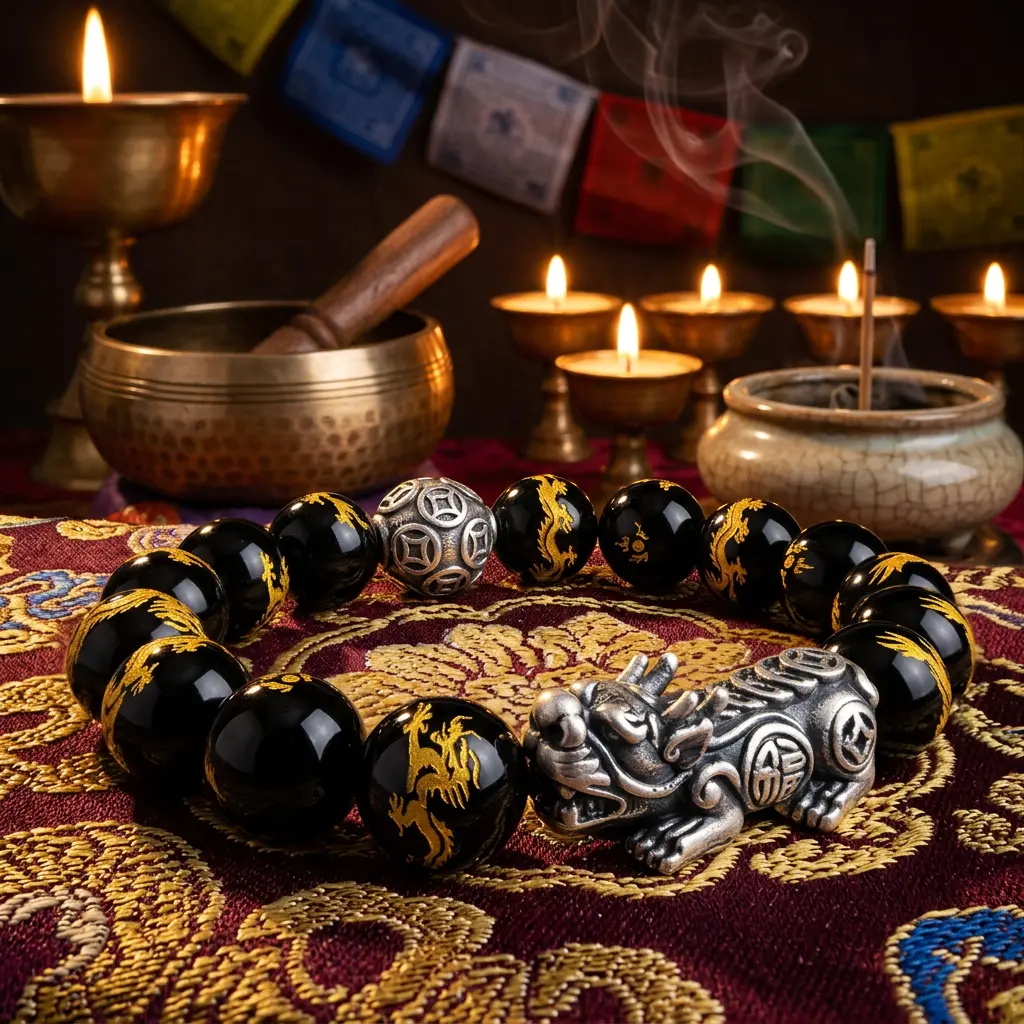
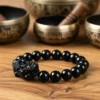
Important restriction: Traditional feng shui guidance advises that children under 16, adults over 70, and pregnant women should not wear Pixiu, as its fierce energy is believed to be too strong. The black obsidian Pixiu bracelet is especially popular because obsidian naturally absorbs negative energy while the Pixiu adds active wealth attraction.
💰 Looking for an authentic Pixiu piece? Our Pixiu Mantra Ring and Black Obsidian Pixiu Bracelet are sourced directly from artisan workshops and blessed before shipping. Shop Pixiu Collection →
Wu Lou Explained — The Ancient Gourd That Guards Your Health
Wu Lou (also written as Hu Lu, and sometimes called the calabash gourd or bottle gourd) is feng shui’s go-to symbol for health, healing, and longevity. Unlike Pixiu, Wu Lou is not a mythical creature — it’s an elevation of a real-world object to sacred status, thanks to thousands of years of Taoist tradition.
Taoist monks historically carried dried calabash gourds to store medicine and, according to legend, to imprison evil spirits they had captured. The God of Longevity (Shou Xing) is almost always depicted holding a Wu Lou containing the elixir of life. Several of the Eight Immortals are also associated with the gourd as a container of power and healing.
The shape itself is deeply symbolic. The figure-eight silhouette represents heaven (top chamber) unified with earth (bottom chamber). The S-curve between the two chambers mirrors the dividing line of the Yin-Yang symbol. The small mouth at the top absorbs good energy in; the large belly at the bottom traps and contains negative chi that could otherwise cause illness.

In practical feng shui, the Wu Lou is one of the most effective cures for the Flying Star #2 (Illness Star) and Flying Star #5 (Misfortune Star). For this specific cure, the Wu Lou must be made of brass or metal — because in Five Elements theory, metal energy weakens the earth element associated with these affliction stars. A jade or crystal Wu Lou is beautiful, but it won’t work for Flying Star cures the way a brass one does.
Unlike Pixiu, Wu Lou carries no age or gender restrictions. It is universally welcoming and is especially beneficial for the elderly, anyone in recovery, or families with young children. In our experience at Potala Store, it’s often the safer starting recommendation for someone brand new to feng shui — there are no rules about which hand to wear it on, and virtually no taboos around placement.
🏥 Ready to bring health protection into your home? Our Wu Lou Bracelet combines traditional symbolism with everyday wearability — no complicated rules required. Browse Wu Lou Items →
Side by Side — How Pixiu and Wu Lou Actually Compare
Here’s the core difference: Pixiu is your wealth guardian; Wu Lou is your health protector. They operate in different domains of your life, and understanding this distinction makes choosing between them simple. Below is a direct comparison across eight key dimensions.
| Dimension | 🐉 Pixiu (Pi Yao) | 🍶 Wu Lou (Hu Lu) |
|---|---|---|
| Primary Function | Wealth attraction & financial protection | Health protection & longevity |
| Nature & Energy | Fierce — requires respect & rules | Gentle — universally welcoming |
| Origin | Mythical creature (Dragon King’s son) | Sacred object (Taoist gourd tradition) |
| Age Restrictions | Not for children under 16, adults over 70, or pregnant women | None — suitable for all ages |
| Best Material | Black obsidian, jade, gold | Brass/metal (for Flying Star cures); jade or crystal for general use |
| Wearing Rules | Left hand only (receiving hand) | No specific hand requirement |
| Feng Shui Cure Application | Tai Sui (Grand Duke Jupiter); Five Yellow Star | Flying Star #2 (Illness Star); Flying Star #5 (Misfortune Star) |
| Most Popular Form | Bracelet, ring, figurine | Home figurine, pendant, bracelet |
One useful way to think about it: Pixiu plays offense — it goes out and finds prosperity for you. Wu Lou plays defense — it quietly absorbs illness energy and keeps negative chi from taking root. Both absorb negative energy in their respective domains, and both are rooted in Taoist tradition. They’re different tools for different jobs, not rivals.
Material matters more than most people realize. For the strongest wealth-attraction energy, a black obsidian Pixiu bracelet is considered especially effective because the obsidian simultaneously absorbs negative energy while the Pixiu actively draws in cai qi (wealth energy). For Flying Star illness cures, a brass Wu Lou is non-negotiable — ceramic or crystal versions look beautiful but don’t deliver the metal element needed to counteract the Illness Star.
Which Feng Shui Symbol Should You Choose? A Guide by Goal
The right choice depends entirely on what you need most right now. Use the guide below to match each symbol with specific life situations. In most cases, the answer is clear once you name your primary concern.
🐉 Choose Pixiu if you want to:
- Attract wealth and new income streams
- Protect against financial loss or theft
- Support a new business or career launch
- Boost investment or gambling luck
- Counter the annual Tai Sui affliction
- Gift someone starting a new professional chapter
🍶 Choose Wu Lou if you want to:
- Support health recovery or prevent illness
- Protect an elderly parent or family member
- Neutralize the annual Illness Star (#2) or Misfortune Star (#5)
- Gift someone dealing with health challenges
- Start feng shui practice with no restrictions
- Place a cure in a bedroom, hospital, or care home
A customer once shared a situation we hear often: she wanted two feng shui items — one for her mother recovering from surgery, and one for her brother launching a new business. We recommended the Wu Lou bracelet for her mother (no restrictions, health focus) and the Pixiu Mantra Ring for her brother (wealth attraction, career energy). Same family, same price range — different needs, different symbols.
💡 Beginner tip: If you’re completely new to feng shui and unsure where to start, Wu Lou is the gentler entry point. It has no wearing restrictions, no placement taboos, and its protective health energy benefits virtually everyone. You can always add a Pixiu later once you’re comfortable with the basics.
For gifting, the decision often comes down to the recipient’s current life phase: Pixiu makes a meaningful gift for career milestones, new business launches, or New Year intention-setting. Wu Lou is a thoughtful choice for someone facing health challenges, an older family member, or anyone who would appreciate the “protective” energy without the rules that come with Pixiu. For a feng shui bracelet that works as a general blessing — choose Wu Lou.
Can You Use Pixiu and Wu Lou Together?
Yes — and many feng shui practitioners actually recommend using both Pixiu and Wu Lou together for complete life coverage. Because they address entirely different energy domains (wealth and health), they complement rather than conflict with each other. In Chinese cultural philosophy, true prosperity requires both financial success (富, fù) and good health (康, kāng). Using only one symbol is like covering only half the base.
For home placement, a common setup is: Pixiu figurine in the living room facing the main entrance (to attract wealth energy as it enters), and a brass Wu Lou in the bedroom on the nightstand (to absorb illness energy overnight). Giving each symbol its own dedicated space respects their distinct functions and avoids cluttering one area.
For wearable feng shui, many practitioners wear a Pixiu bracelet on the left wrist (the receiving hand, per traditional placement rules) alongside a Wu Lou pendant around the neck. This setup layers active wealth attraction with passive health protection — two complementary channels working simultaneously.
One practical note from our experience: don’t pile both symbols into the same small corner of your home out of a belief that “more is better.” Each symbol benefits from space and intentional placement. If you’re using a brass Wu Lou as a Flying Star cure for the annual Illness Star, check the 2026 Flying Star chart to confirm the exact sector before placing it. Pixiu, meanwhile, should always face outward — never toward a wall or toward your bed.
Placement & Activation Tips for Pixiu and Wu Lou

Getting the most from either symbol starts with intentional placement and a simple activation ritual. Neither requires elaborate ceremony — but a few basic rules apply.
Pixiu Placement Rules
- Face it outward: Pixiu should face the main entrance or a window. It’s meant to “look out” for incoming wealth energy. Never position it facing a wall or pointing toward your bed.
- Southeast sector (wealth corner): The Southeast sector of your home is the traditional wealth area in classical feng shui. A Pixiu figurine here supports long-term prosperity.
- Not in the bedroom: Pixiu’s fierce yang energy is considered too strong for a sleeping space. Keep it in the living room or office.
- Wear on the left hand: The left hand is the receiving hand in Chinese tradition. Wearing your Pixiu bracelet on the left wrist maximizes its wealth-attraction energy.
Wu Lou Placement Rules
- Bedside table: For health protection and longevity, placing a Wu Lou on your nightstand is one of the most traditional placements — it absorbs illness energy while you sleep.
- East sector (family health): The East sector governs family health in classical feng shui. A Wu Lou here protects the household’s overall well-being year-round.
- Annual Flying Star sectors: In 2026, place a brass Wu Lou in the Northwest (Flying Star #2) and South (Flying Star #5) sectors to neutralize those affliction energies. Check the annual flying star chart each year as the affliction sectors change.
- Tie a red string: A red string around the neck of the Wu Lou activates its energy and symbolizes binding good health to the space.
Basic Activation for Both
For Pixiu: cleanse first (pass through sage smoke or leave under full moonlight overnight), then set your intention clearly — “I welcome wealth and abundance.” Touch your Pixiu bracelet regularly; practitioners believe engagement activates its energy.
For Wu Lou: tie a red string, place in the correct sector, and refresh annually by replacing it at the Chinese New Year if you’re using it as a Flying Star cure. If your Wu Lou cracks or breaks, replace it immediately — it’s believed to have absorbed a negative event on your behalf.
We always tell customers: feng shui isn’t about perfection — it’s about intention. Even placing a symbol thoughtfully in the right direction, with a clear purpose in mind, is meaningful. For a full step-by-step Pixiu activation guide, see our Pixiu bracelet activation guide.
Frequently Asked Questions
No — Pixiu itself does not cause bad luck. Wearing it on the wrong hand or placing it in the bedroom may reduce its effectiveness, but it won’t actively harm you. The key rules are: wear on the left hand, keep it out of the bedroom, and face figurines toward an entrance or window. Follow these basics and your Pixiu will work as intended.
Traditional feng shui guidance advises that children under 16, adults over 70, and pregnant women avoid wearing Pixiu, as its fierce, active energy may be too strong for these groups. Wu Lou makes an excellent alternative — it carries no age or condition restrictions and offers universally gentle, protective energy. If you’re in one of these groups and want a feng shui symbol, Wu Lou is the safer choice.
In 2026, the Illness Star (#2) occupies the Northwest sector and the Misfortune Star (#5) sits in the South. Place a brass Wu Lou in each of these sectors to neutralize their negative influence. For year-round health protection independent of Flying Stars, keep one on your bedside table in the East sector (family health area). Replace Flying Star cures after Chinese New Year as the star positions shift annually.
Both approaches are effective — they serve different purposes. Wearing a Pixiu bracelet or Wu Lou pendant keeps protective and attracting energy with you throughout the day, which is ideal for wealth and career intentions. Placing a figurine at home anchors feng shui energy to a specific space or sector, which is ideal for Flying Star cures and household-level protection. For maximum coverage, many practitioners do both — wearable amulet plus home placement.
Not Sure Which Symbol Is Right for You?
Browse Potala Store’s complete feng shui collection — authentic Pixiu bracelets, Wu Lou charms, and more. Every piece is sourced directly from artisan workshops and blessed before it ships.Explore the Feng Shui Collection →
📚 References
- Pixiu in Chinese History and Mythology: Encyclopedic overview of Pixiu’s origins, types, and historical significance in Chinese culture. Wikipedia — Pixiu
- Wu Lou (Calabash Gourd) in Feng Shui: Detailed reference on the Wu Lou’s cultural origins, Taoist associations, and traditional feng shui applications. Source: Smithsonian National Museum of Asian Art (Readers may search the institution’s website for current resources on Chinese decorative arts and Taoist symbolism.)
- Flying Stars Feng Shui (Xuan Kong): Academic overview of the Flying Star system, including annual star afflictions and traditional cures. Wikipedia — Flying Star Feng Shui
- Five Elements Theory (Wu Xing) in Chinese Philosophy: Background on the Five Elements system underpinning feng shui cure selection (including why metal weakens earth-element affliction stars). Wikipedia — Wu Xing