

Nákup a Buddhist altar usually goes wrong in three ways: the cabinet is too small for the Buddha statue, the table sits too low, or the lamp ends up next to a curtain. You can avoid all three by working in the right order. Choose your tradition and main image first, then size the home shrine so the image sits above your head height when you are seated, then plan a safe spot for flames.
At Obchod v Potále, we work with Tibetan artisan communities and answer altar questions from customers all year. The six checks below come from those conversations, from guidance by Tibetan Buddhist teachers, and from U.S. fire-safety data. Our focus here is buying decisions, not ritual instructions.
If you have not picked your statue yet, start with our guide on Jak vybrat sochu Buddhy podle velikosti, materiálu a pózy. Then come back and fit the altar around it.
Důležité upozornění: Altar customs vary by lineage, temple, and family. The traditional guidelines here are general, and your own teacher or temple has the final word. The safety guidance comes from the National Fire Protection Association (NFPA) and applies to every home, whatever your tradition.
Obsah
What Is a Buddhist Altar For, and Which Tradition Are You Buying For?
A Buddhist altar is a raised, dedicated surface that holds reminders of the Buddha’s body, speech, and mind: traditionally a statue, a scripture, and a stupa. Because of that, your tradition should decide what you buy before the furniture does. Tibetan teachers describe the altar as a support for remembering the qualities you want to develop, so what sits on it matters more than how big it is.
The most common mix-up we see is buying the cabinet first and the statue second. The result is either a tiny figure lost inside a large cabinet or a statue too tall to fit through the doors. Pick the image first and let it set every measurement that follows.
Tibetan, Japanese, or Chinese: How Does Tradition Change the Altar?
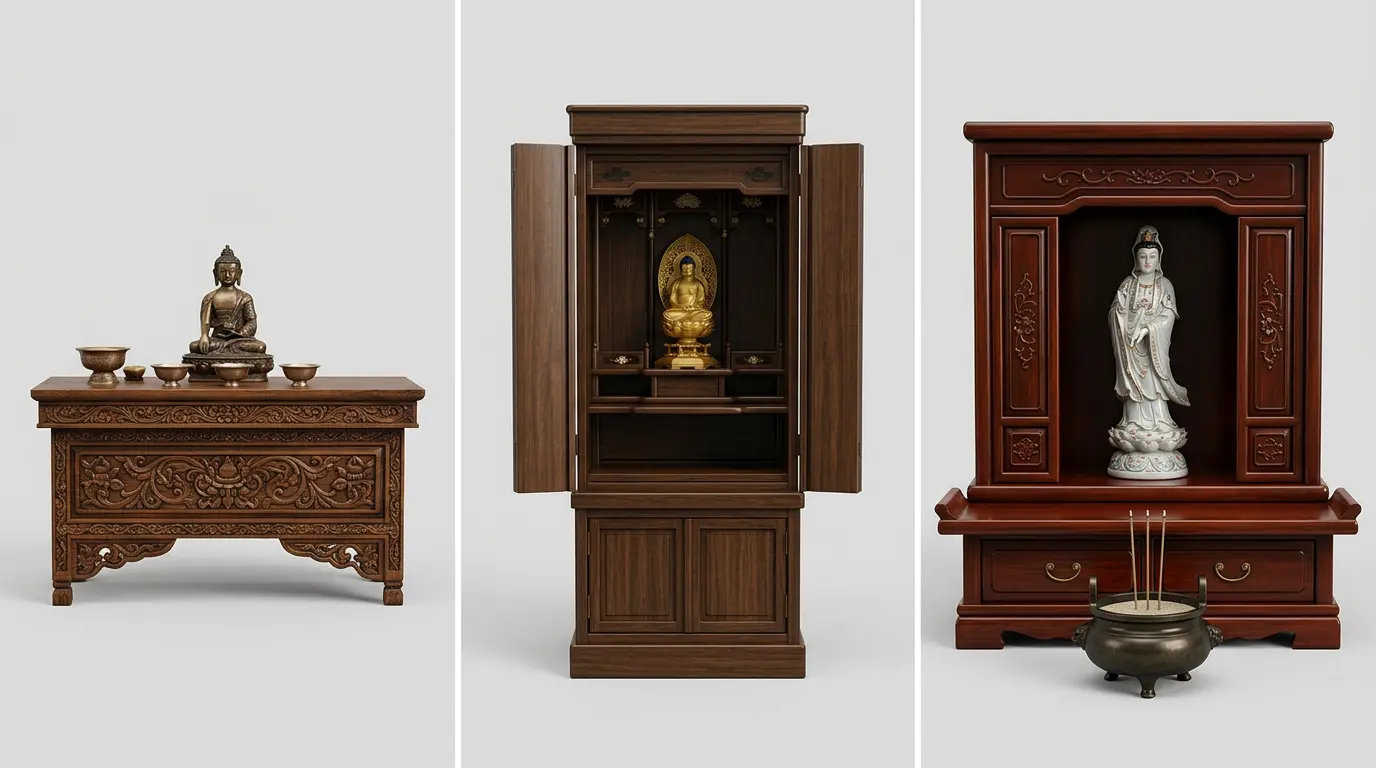
Tradition changes the furniture more than the purpose. Here is how the three main traditions usually set up a home altar:
- tibetština: An open or tiered altar, or a low choktse (a carved Tibetan folding table), with Shakyamuni Buddha in the center. A row of seven water offering bowls often sits in front.
- Japonský: A butsudan, a cabinet with doors that holds the principal image, called the honzon, or a gohonzon scroll. It often holds family memorial tablets too. Some Nichiren Shoshu temples ask members to use a butsudan bought specifically for that purpose, so ask your temple before buying one secondhand.
- Čínština: A shrine cabinet or altar table, often with Guanyin (Kwan Yin) or Amitabha as the main image. An incense burner sits at the front edge.
What Must a Home Shrine Hold at Minimum?
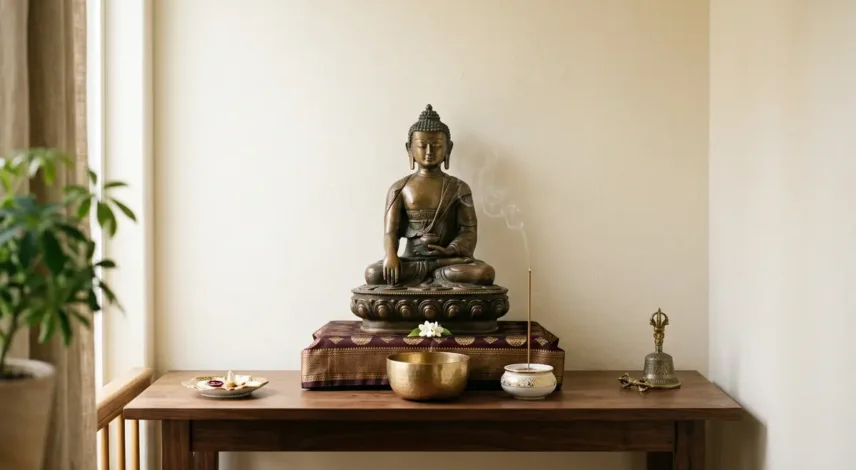
At minimum, a home shrine needs one image of the Buddha, placed higher than anything else on the altar. In the Tibetan arrangement, a scripture sits on the Buddha’s right (your left as you face it) and a stupa on the Buddha’s left, which completes body, speech, and mind. Offerings such as water, light, and incense come after these three and can be added over time.
Owning an altar is not disrespectful in itself. What matters is how you treat it: a statue belongs on a shrine, not on a bathroom shelf. We explain this in our guide to Buddha statue gift etiquette and respectful display.
How High and How Big Should Your Home Shrine Be?
Place your altar so the Buddha image sits higher than your head when you sit facing it. In most homes, that means the statue base is at least 36 inches from the floor. Size the altar surface to fit the statue, not the room.
Height is the one rule nearly every tradition shares. The size of the altar surface then follows from the size of the statue.
How High Should a Buddhist Altar Be?
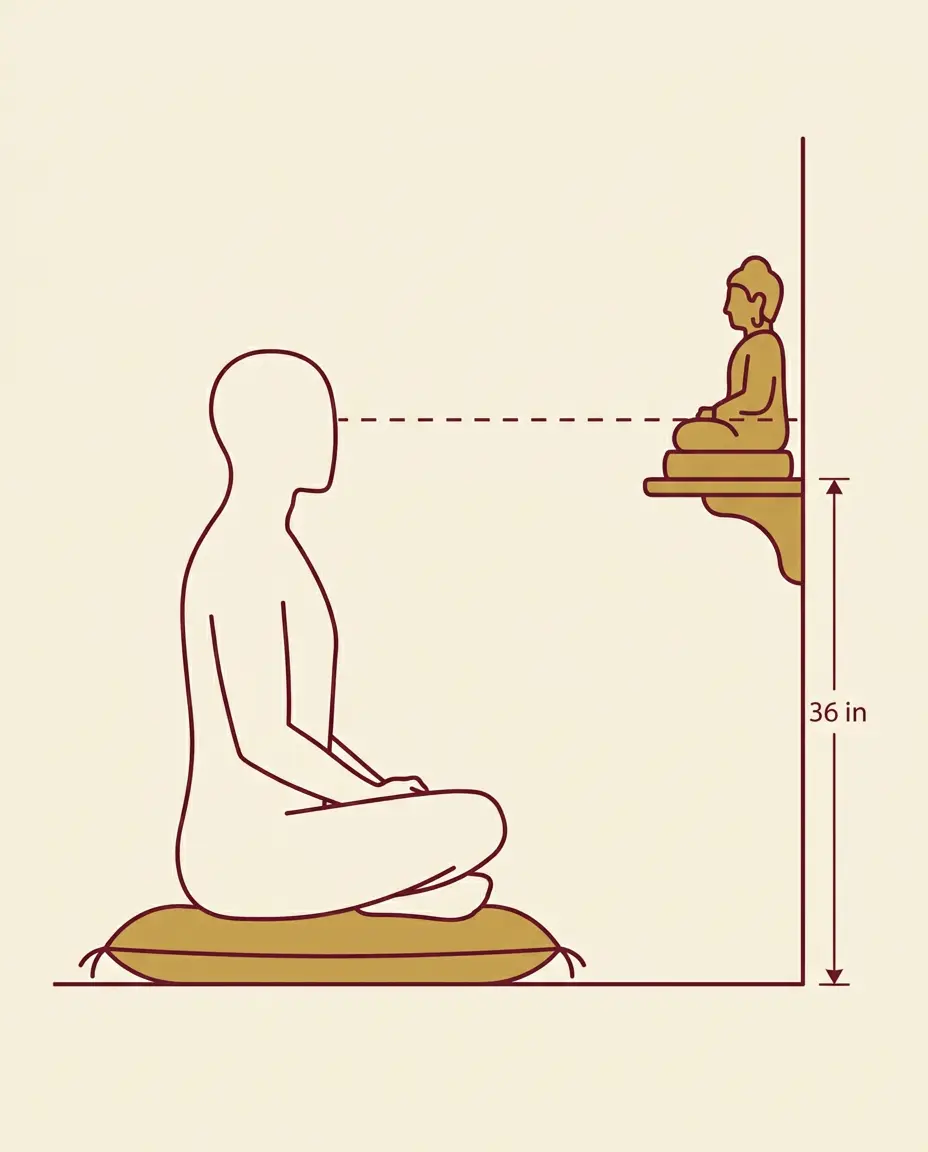
A Buddhist altar should put the image above your seated eye level. Measuring this takes about two minutes. Sit where you will actually practice, on your cushion or chair, and have someone measure from the floor to your eyes. Your Buddha statue’s base should sit at or just above that line.
The 36-inch minimum works for people who sit on a chair or sofa. If you practice on a floor cushion, your eye level is lower, which opens up lower tables. Still, keep the image off the floor and off coffee tables. Our Buddha statue placement height and cultural respect FAQ covers room-by-room placement in more detail.
Can I Put a Buddhist Altar in My Bedroom?
Yes, a bedroom altar is common in apartments, as long as the image sits higher than the bed. Place it along the wall beside the head of the bed, not at the foot, where your feet would point toward it. If you share the room with a partner who does not practice, a cabinet with doors or a closed wall shelf keeps the space respectful without taking over the room. Bedrooms are also where flame safety matters most, which we cover in the safety section below.
What Statue Size Fits Your Shelf? (Quick Chart)
Match the altar format to the statue’s height using this rule-of-thumb chart:
| Statue height | Best altar format | Co zkontrolovat |
|---|---|---|
| Méně než 5 palců | Wall shelf or small choktse | Raise it on a 4 to 6-inch stand so it stays the visual focus |
| 6 až 12 palců | Altar table, console, or wall shelf | Our most common suggestion is an 8 to 12-inch statue on a raised wooden platform |
| Přes 12 palců | Floor cabinet or tiered altar | Interior height at least 2 inches taller than the statue |
Here is a real example of a small statue and its limits. Our handmade Green Sandstone Tibetan Meditation Buddha ($42.95) measures about 3.1 x 1.6 x 4.7 inches. It fits a narrow wall shelf, so you can keep a proper main image even in a studio apartment. It would look lost, though, as the main image in a 24-inch cabinet, so buy it for small altars only. To compare sizes, browse the full Buddha statue collection for home altars.
Cabinet, Folding Table, or Wall Shelf: Which Altar Format Fits Your Space?
Here is how the four main altar formats compare for U.S. homes:
| Formát | Nejlepší pro | Odkaz na velikost | Pevnost | Dávej pozor na |
|---|---|---|---|---|
| Butsudan cabinet | Japanese practice, dusty rooms, homes with kids | A WWII-era butsudan at the Smithsonian measures 22 1/16 x 13 1/4 x 22 1/2 in | Doors protect the image | Interior height limits statue size |
| Tibetan choktse | Renters, people who move often, floor practice | Small folding models run about 16 x 8 x 9 in | Folds flat for moving | Low, so the image needs a stand |
| Nástěnná police | Small apartments, chair practice | Any width that fits your wall | Easily reaches 36 in or higher | Must be anchored into studs |
| Tiered altar or console | Full Tibetan arrangement, several images | Velmi se liší | Room for a full set of offerings | Zabírá podlahovou plochu |
What Is a Butsudan, and Who Needs One?
A butsudan is a Japanese household Buddhist altar: a cabinet with doors that holds a principal image or scroll and, often, memorial tablets for ancestors. It suits families practicing Japanese Buddhism and anyone who wants the image protected from dust and curious hands. Before buying a butsudan, measure your principal image. The interior height decides what fits, not the outer height.
The format also depends on your circumstances. The Smithsonian holds a butsudan that Japanese Americans made by hand while incarcerated at the Jerome camp in Arkansas during World War II. That piece is a reminder that a devoted altar does not require expensive furniture.
Is a Tibetan Choktse Table Right for a Small Apartment?
A choktse is a low, carved Tibetan folding table traditionally used for texts and offerings. It suits renters well because it folds flat, fits in a car, and leaves no holes in the wall. Its limit is height: a table about 9 inches tall puts the image below eye level for most people. Place your statue on a stand, or hang a wall shelf above the choktse and keep offerings on the table below.
When Is a Simple Wall Shelf Enough?
A wall shelf is enough when you honor one image with a few offerings. Choose a shelf deep enough for the statue base plus a row of bowls in front of it. Mount it into wall studs or use anchors rated well above the combined weight. If you rent, check your lease before drilling, since patched anchor holes can cost you part of your deposit.
Wood, Metal, or Stone: Materials, Craftsmanship, and Price Ranges
Solid wood is the traditional choice for altar furniture, but it needs stable humidity. Metal and stone suit statues and offering pieces because they are heavy and age slowly. Wood cracks in dry heat, brass develops a patina over time, and stone chips if it tips over. Choose the material that suits your room’s climate, not only its look.
How Do You Spot Good Craftsmanship Online?
Good craftsmanship shows up in details that a listing either documents or hides. Look for these before you buy:
- Vnitřní rozměry: Serious sellers list inside height, width, and depth, not only outer size.
- Joinery photos: Clean corner joints and doors that hang straight suggest careful work.
- Finish close-ups: Even lacquer or oil with no drips or bare patches.
- Uvedená hmotnost: It tells you whether a shelf or table can carry the piece safely.
At first we assumed heavier always meant better. It doesn’t. A top-heavy bronze statue on a light bamboo shelf is a real tipping risk. Check the statue’s weight against what the shelf can hold.
How Much Does a Buddhist Altar Cost in the U.S.?
Buddhist altar prices in the U.S. range from almost nothing for a shelf you already own to five figures for antiques. Here is what drives the cost at each level:
| Úroveň | Kde to najdete | Co ovlivňuje cenu |
|---|---|---|
| Wall shelf you own | Váš domov | Mostly mounting hardware |
| Mass-produced cabinet or table | Velcí online prodejci | Size, wood type, and shipping weight |
| Handmade or antique | Specialist and antique dealers | Age, carving, and provenance. 1stDibs “Buddhist altar table” listings ran from $278 to $25,000, averaging about $6,500, when we checked in September 2026 |
Spending four figures on an antique is a significant purchase. Ask the dealer for provenance, close-up condition photos, and the interior measurements before you commit. Compare pieces by those interior dimensions, not by the headline price.
Flame, Kids, and Pets: Safety Checks for Lamps and Incense
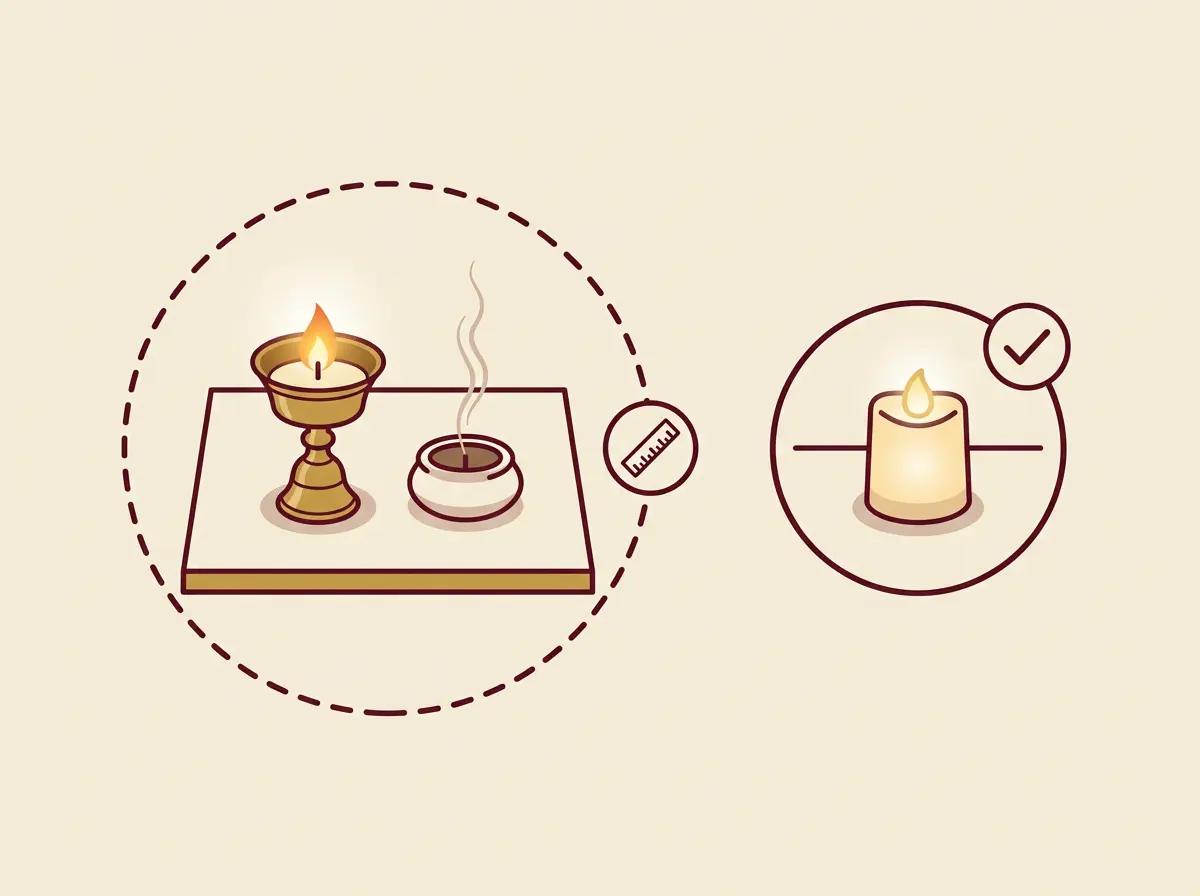
NFPA estimates that candles start 5,894 U.S. home fires a year, so plan your altar’s flame zone before you buy the furniture. Check these five points:
- Odbavení: Keep every flame at least 12 inches from anything that can burn, including thangkas, altar cloths, curtains, and prayer flags.
- Stable holder: Use a heavy, heat-resistant holder that will not tip. A solid brass base beats a light dish.
- Never unattended: Put out lamps and incense before you leave the room or fall asleep.
- Flameless option: An LED butter lamp gives light with no open flame.
- Proud vzduchu: Burn incense where air moves gently, away from drafts that scatter ash.
The same NFPA data counts 63 deaths, 532 injuries, and $286 million in property damage from candle fires each year. It also shows that 36% of candle fires start in bedrooms and that December is the peak month. For a traditional butter lamp, that makes a flameless LED version the safer default in bedrooms and during the holiday season. If you have a toddler or a cat, a flameless lamp is the respectful choice, not a compromise.
Can You Use LED Candles on a Buddhist Altar?
Yes, many practitioners and Buddhist centers use LED or electric lamps as light offerings. Light on an altar traditionally stands for wisdom that clears away confusion, and the meaning comes from your intention rather than the fuel. If your teacher follows a specific lamp practice, ask what they recommend for home use.
Where Should Incense Sit on a Home Shrine?
Incense belongs at the front of the home shrine, centered in front of the image and lower than it. Set it in a burner that catches ash, and keep it at least 12 inches from cloth and paper. Our incense burners and Tibetan incense collection zahrnuje Tibetan backflow incense cones ($20.95 for 60 cones). A backflow burner guides the smoke down into its base, so smoke and ash stay low and away from your statue and altar cloth.
Your Buddhist Altar Buying Checklist
Use this five-step checklist before you buy:
- Choose your tradition and main image. Everything else is measured from the statue or scroll.
- Measure the statue and your seated eye height. This takes about two minutes with a tape measure.
- Pick the format. Choose a cabinet, choktse, or wall shelf, and confirm the interior height is at least 2 inches taller than the statue.
- Nastavte rozpočet. Compare interior dimensions and craftsmanship, not only price.
- Plan the flame zone. Leave 12 inches of clearance, or choose flameless lights.
What Should a Starter Altar Include?
A starter altar needs only one Buddha image, a clean cloth, and one simple offering such as a bowl of fresh water. That is enough to begin daily practice. If you want a small, balanced arrangement, our 4 Noble Truths Mini Buddha Set ($38.95) gives you four matching figures sized for a shelf.
What Can You Add Later?
You can add a scripture, a small stupa, a set of seven offering bowls, a singing bowl, or a meditation cushion once your practice settles in. Add one piece at a time so the altar stays uncluttered. When you are ready, browse our Tibetan prayer altar items for pieces sized to a home shrine.
Ve shrnutí: the right Buddhist altar starts with your tradition and your main image, puts that image above your seated eye level, fits the space you actually have, and keeps every flame 12 inches from anything that can burn. The key takeaway is to measure before you buy.
Start with the image, then build the altar
Potala Store’s Buddha statues and altar pieces are sourced from Tibetan artisan communities. Each listing shows the size you need to plan your home shrine.Shop Buddha statuesSee altar items
Často kladené dotazy
Many Tibetan centers traditionally face their altar east, but the direction is not essential. A clean, quiet spot at the right height matters more than which way the altar faces.
No, as long as you treat it with care. Keep it clean, raised, and off the floor, and never use it as a nightstand or coffee table. Learning what each object means before you arrange it is a good sign of respect.
It depends on your tradition. Some Japanese temples, including some Nichiren Shoshu temples, ask that a butsudan be bought specifically for that purpose, so check with your temple first. If you buy an antique, inspect the doors, the joinery, and any soot inside.
Buy the main image first: a Buddha statue sized to the space you have. Then choose furniture around its measurements using the chart above. You can browse Potala Store’s statue collection to compare sizes and materials.
O autorovi: Yang Tso leads Potala Store and has attended blessing ceremonies at Sera Jhe Monastery since 2014. Editorial process: We fact-check tradition-specific guidance against published teachings and institutional sources, and safety figures against NFPA data. We update prices and product details whenever inventory changes. Spotted an error? Contact us and we will correct it.
Reference
- Tibetan altar purpose and arrangement: Interview with Ven. Tenzin Yignyen on why to keep an altar, where to place it, and what the objects represent. Publikace Shambhala
- Candle fire statistics and safety tips: U.S. home candle fire data and clearance guidance. Národní asociace protipožární ochrany (NFPA)
- Butsudan in Japanese American history: A handmade butsudan from the Jerome incarceration camp, with dimensions and background. Smithsonian Institution, National Museum of American History
- Butsudan overview: Definition, structure, and household use of the Japanese Buddhist altar. Wikipedia