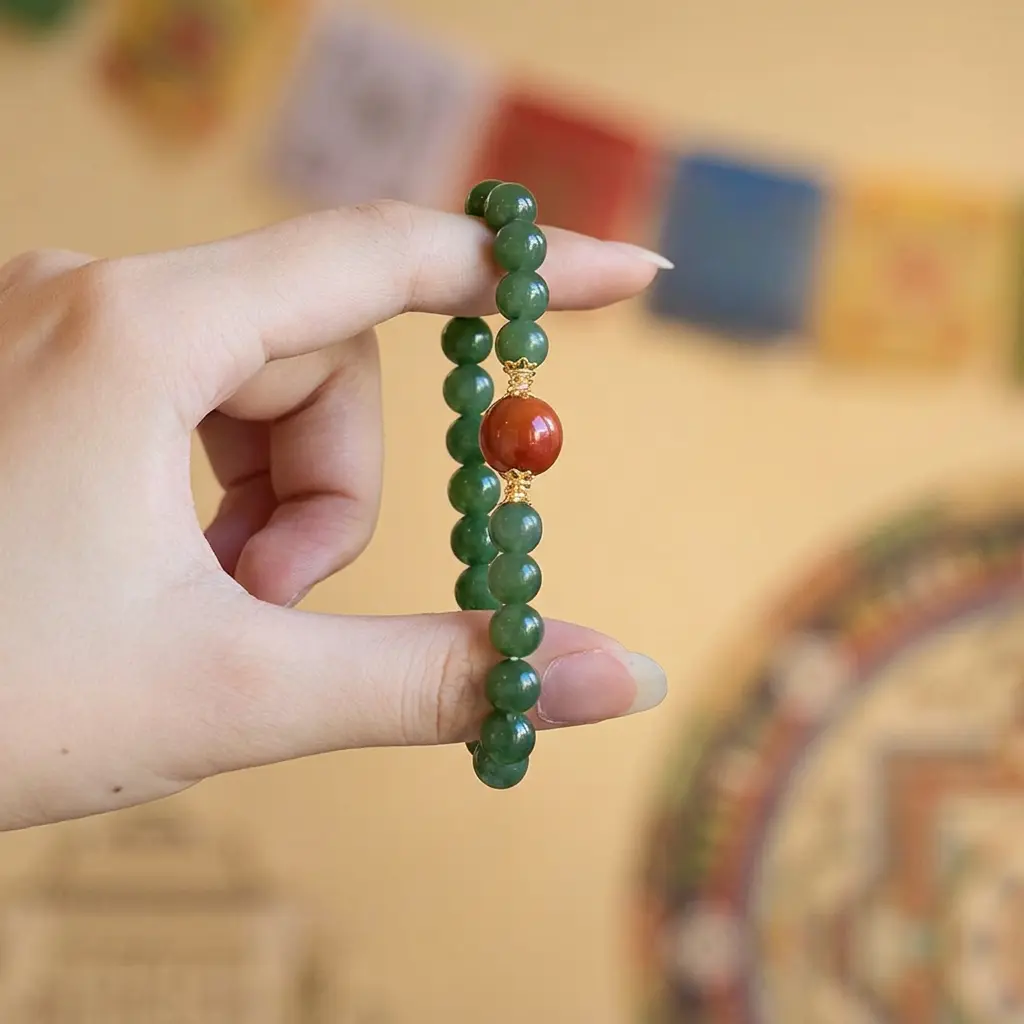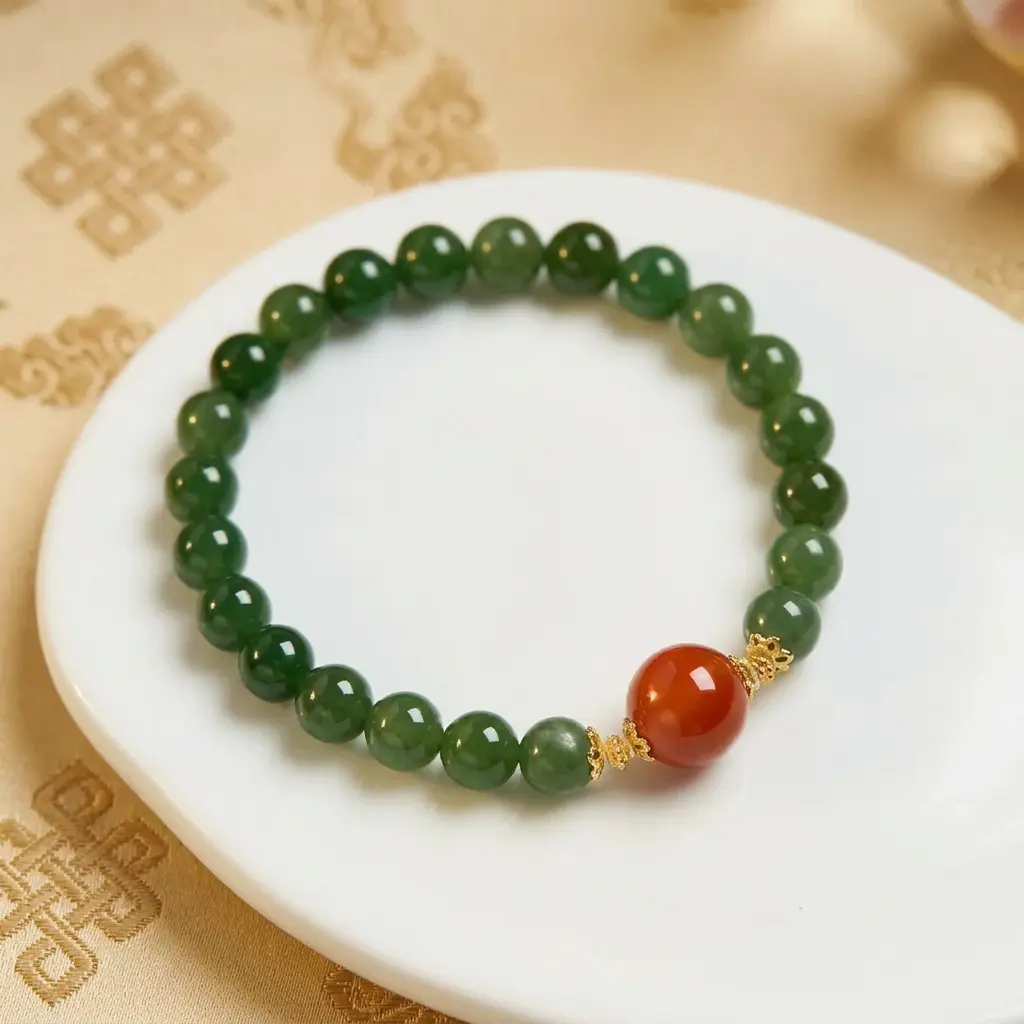


Not sure whether the green bead on your wrist means Wood, or which wrist is the right one? This FAQ gives you the color logic, so you can read any five elements bracelet in about ten seconds.
A five elements bracelet is symbolic jewelry built on Wu Xing (五行), the Chinese system of Wood, Fire, Earth, Metal, and Water. Each phase shows up as a traditional color and a matching stone. Most people wear a Wu Xing bracelet as a daily reminder of balance, not as a guaranteed charm.
At Kedai Potala, we source Tibetan and feng shui jewelry through our founder Yang Tso’s work with artisans connected to Sera Jhe and Kopan monasteries. Our buyers get stuck on the same three questions: meaning, colors, and wrist. This guide answers each one directly.
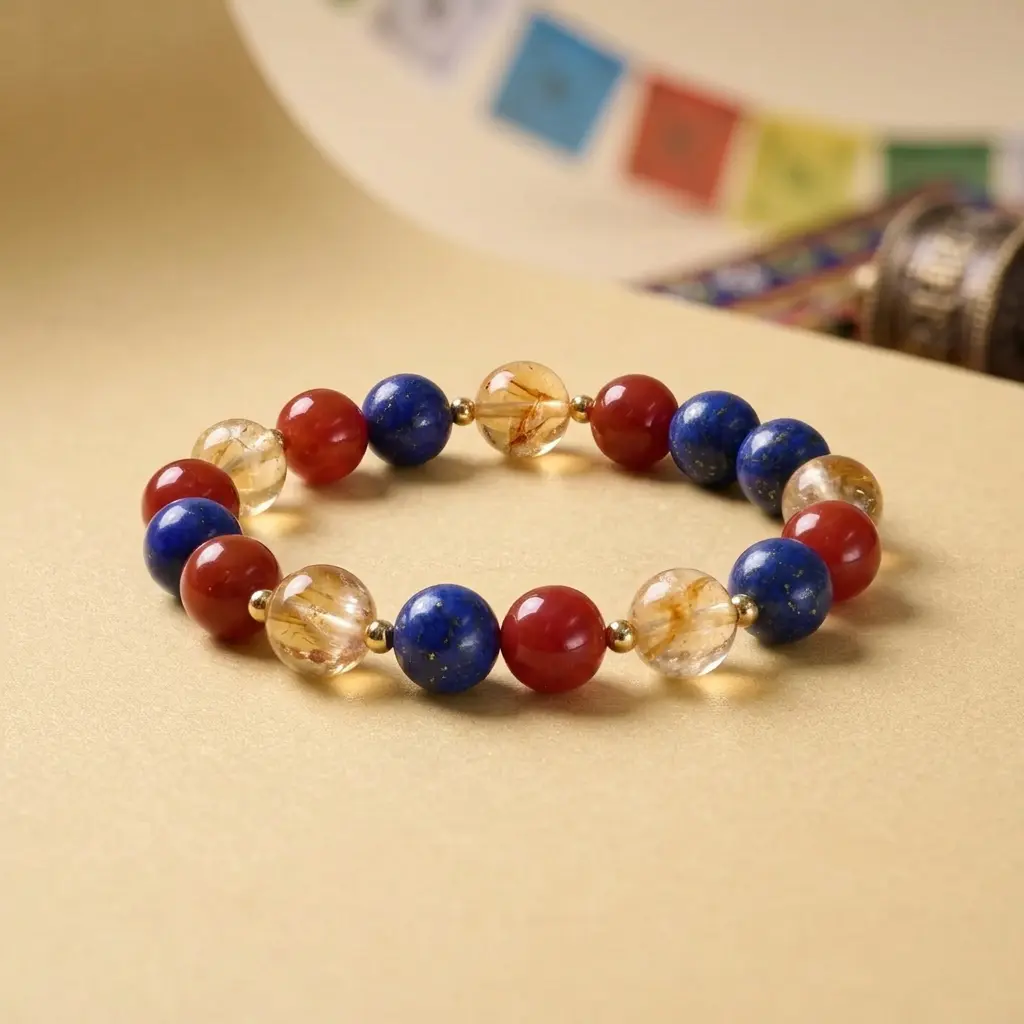
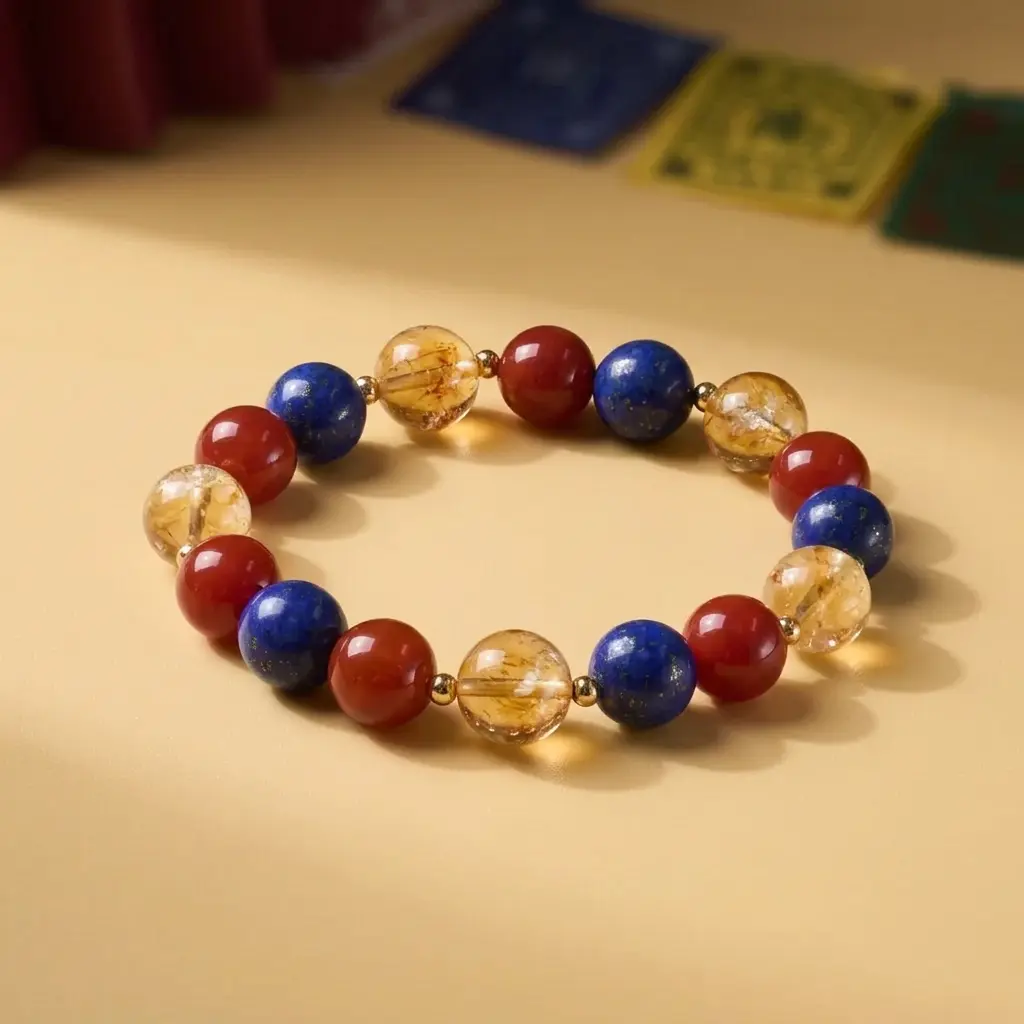
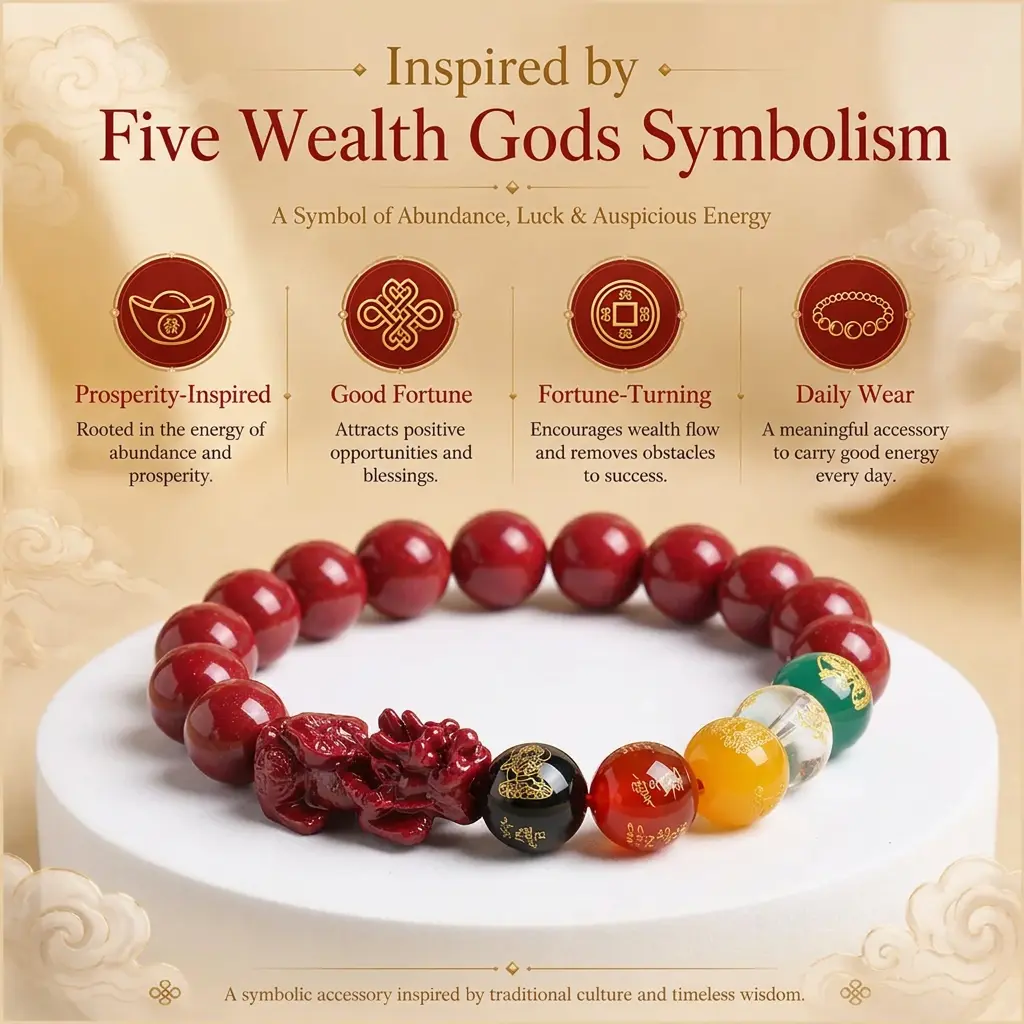
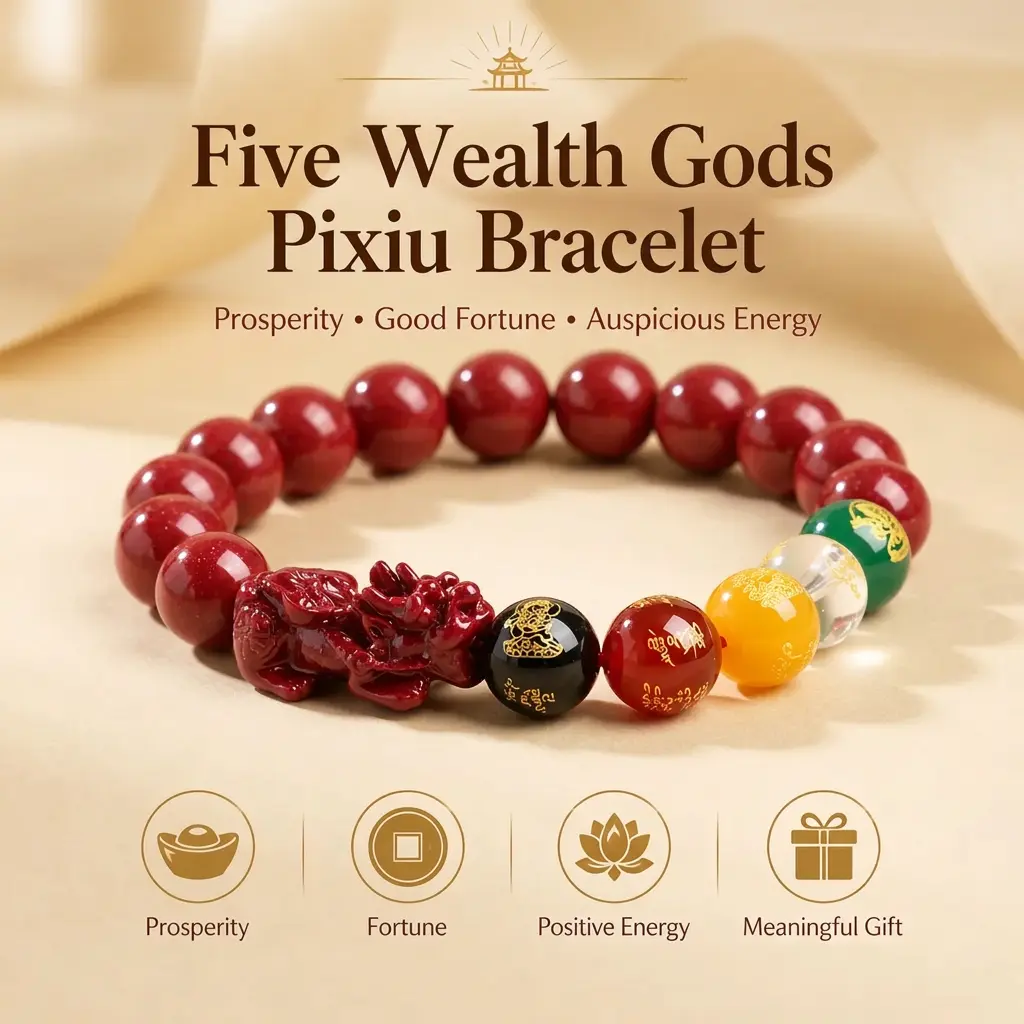
Want to see all five phases on one strand while you read? The Gelang Dewa Kekayaan Citrine ($48.95) assigns one stone to each element on 12mm (0.47-inch) beads.
Jawapan pantas
- Maksudnya: balance among five phases of change.
- Warna: green for Wood, red for Fire, yellow for Earth, white for Metal, black for Water.
- Pergelangan tangan: by custom, left to receive and right to release.
- Penjagaan: wipe with a soft cloth and take it off before showers.
Jadual Kandungan
What Does a Five Elements Bracelet Mean?
A five elements bracelet represents balance among Wood, Fire, Earth, Metal, and Water, the five phases Chinese cosmology uses to describe how things grow, peak, settle, contract, and renew. People traditionally wear one to recall that balance or to emphasize one phase.
The bracelet does nothing mechanical. Its meaning comes from a classification system that dates back more than 2,000 years.
What are the five elements in Wu Xing?
Wu xing is a fivefold scheme that groups things by how they change, not by what they are made of. The Internet Encyclopedia of Philosophy describes the five phases as dynamic, interdependent modes of the universe’s ongoing development.
The Stanford Encyclopedia of Philosophy gives a clear example. The Wood phase places east, spring, the numbers 3 and 8, and the color green in one category. That is why a bead can carry an element. A green stone points to the whole Wood group: growth, spring, and new beginnings.
Why do scholars say “five phases” instead of “five elements”?
Scholars prefer “five phases” because xing means movement or process. Sinologist Nathan Sivin proposed that translation in 1987. His point was that Wood refers to the growth of trees, not to lumber. For you as a wearer, this means the system describes relationships and cycles, not five substances.
While preparing this FAQ, we checked our own guides and found a surprise. Our feng shui articles assign green to Wood, while our Tibetan braiding guide assigns green to Water. Both are right, because they follow two different traditions. We explain the difference in the Tibetan section below.
Does a five element bracelet actually work? The meanings are traditional beliefs, not scientifically tested effects. Many wearers value the bracelet as a daily cue for an intention, and that is a fair way to use it.
What Colors Represent Each of the Wu Xing Elements?
Each Wu Xing phase has one traditional color: green for Wood, red for Fire, yellow for Earth, white for Metal, and black for Water. Color comes first and the stone second. That is why two different green stones can both represent Wood.
Element, color, and stone chart
| Elemen | Warna tradisional | Common bracelet stones | Secara tradisinya dikaitkan dengan |
|---|---|---|---|
| Kayu (木) | Green | Green aventurine, green agate, green jade, green fluorite | Growth, renewal, fresh starts |
| Api (火) | Red, sometimes orange | Red agate, sunstone, strawberry quartz, rhodonite | Passion, courage, action |
| Bumi (土) | Kuning, coklat | Citrine, yellow agate, yellow tiger’s eye, golden rutilated quartz | Kestabilan, pembumian |
| Logam (金) | Putih, perak, emas | Clear quartz, white agate, white jade, white moonstone | Clarity, focus, discipline |
| Air (水) | Hitam, biru tua | Black obsidian, black agate, blue tiger’s eye, aquamarine | Wisdom, calm, flow |
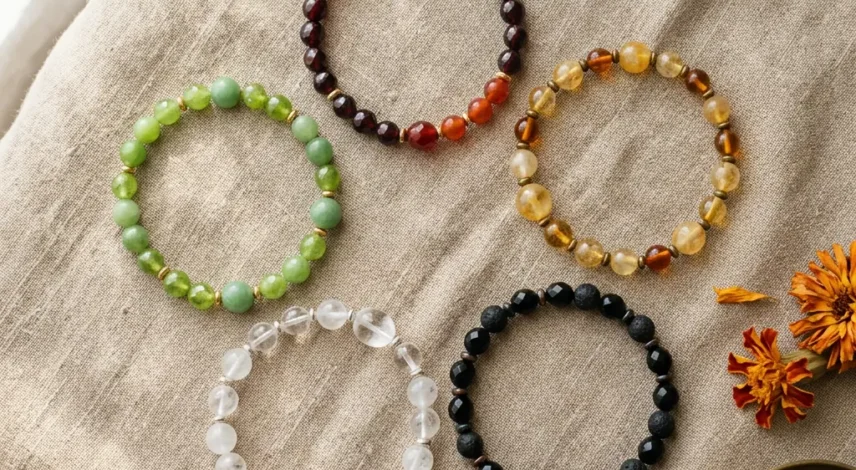
Here is a real example. On the Citrine God of Wealth Bracelet, red agate marks Fire, citrine marks Earth, black obsidian marks Water, green aventurine marks Wood, and clear quartz marks Metal. Because all five phases share one strand, you can start without working out your birth element first.
We also want to be plain about materials. That bracelet’s spec line lists artificial citrine (colored quartz) and acrylic element accents. The colors carry the symbolism, and the materials keep the price at $48.95. Always read the spec line, on our site and everywhere else.
How do the generating and controlling cycles affect color pairing?
The generating cycle, called sheng (生), runs Wood to Fire to Earth to Metal to Water and back to Wood. Each phase feeds the next. In the generating cycle, green Wood feeds red Fire, the way dry wood feeds a flame.
The controlling cycle, called ke (克), runs Wood to Earth to Water to Fire to Metal and back to Wood. Each phase restrains another. Think of the two cycles as an accelerator and a brake.
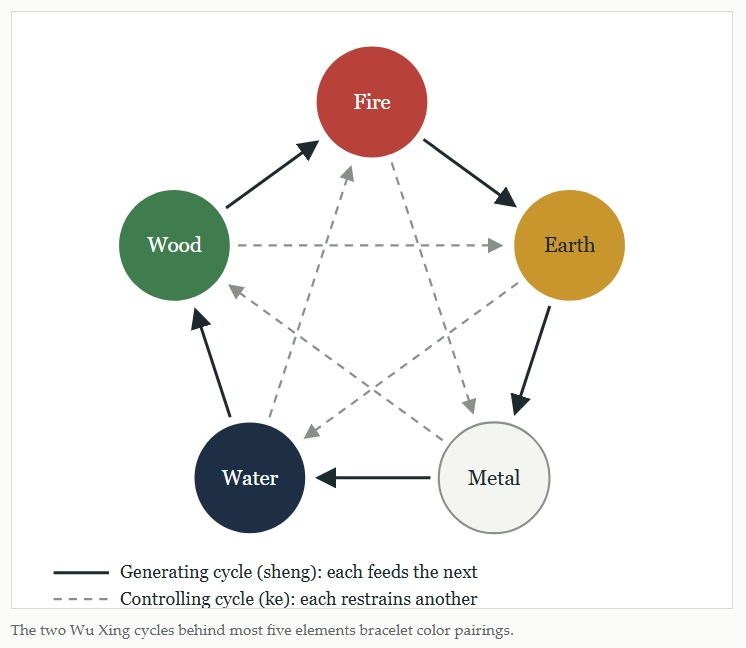
In practice, the cycles give you three simple pairing rules:
- Support a phase: add the color that comes before it in the generating cycle. Green beside red strengthens Fire.
- Soften an excess: add the phase that controls it. Black Water calms a bracelet heavy with red Fire.
- Kekal neutral: wear all five colors on one strand, so no single phase dominates.
Chinese Wu Xing vs. Tibetan Five Colors: Are They the Same?
No. Tibetan five-color cords follow Pancha Varna, a separate Buddhist color system, so the same color can point to a different element. Knowing which system a bracelet follows keeps you from misreading it.
What the Tibetan Pancha Varna colors stand for
Pancha Varna is Sanskrit for “five colors.” In Tibetan Buddhism, blue stands for space, white for air, red for fire, green for water, and yellow for earth. Each color also links to one of the five Buddha families. Green, for example, is tied to Amoghasiddhi and water.
| warna | Chinese Wu Xing | Tibetan Pancha Varna |
|---|---|---|
| Green | Kayu | Air |
| Merah | Fire | Fire |
| Kuning | Bumi | Bumi |
| putih | Logam | Air (wind) |
| BIRU | Dark blue often grouped with Water | Ruang |
| Hitam | Air | Not one of the five colors |
Only red and yellow mean the same thing in both systems. Tibetan tradition has no Metal or Wood, and Wu Xing has no Space or Air. Some thangka sources also swap the white and green assignments, so treat any single chart as one tradition’s view. Our guide to the Tibetan five-element color system in braided knot bracelets shows how each color appears in knot work.
Which system does your bracelet follow?
Three clues settle it in seconds:
- bahan: gemstone beads such as agate, citrine, and obsidian usually signal Chinese Wu Xing. Braided silk or cotton cord usually signals Tibetan Pancha Varna.
- Color set: a blue cord plus a white cord, with no brown or gold, points to the Tibetan set.
- Simbol: a Pixiu charm or Chinese characters point to feng shui. Om Mani Padme Hum or endless knots point to Tibetan Buddhism.
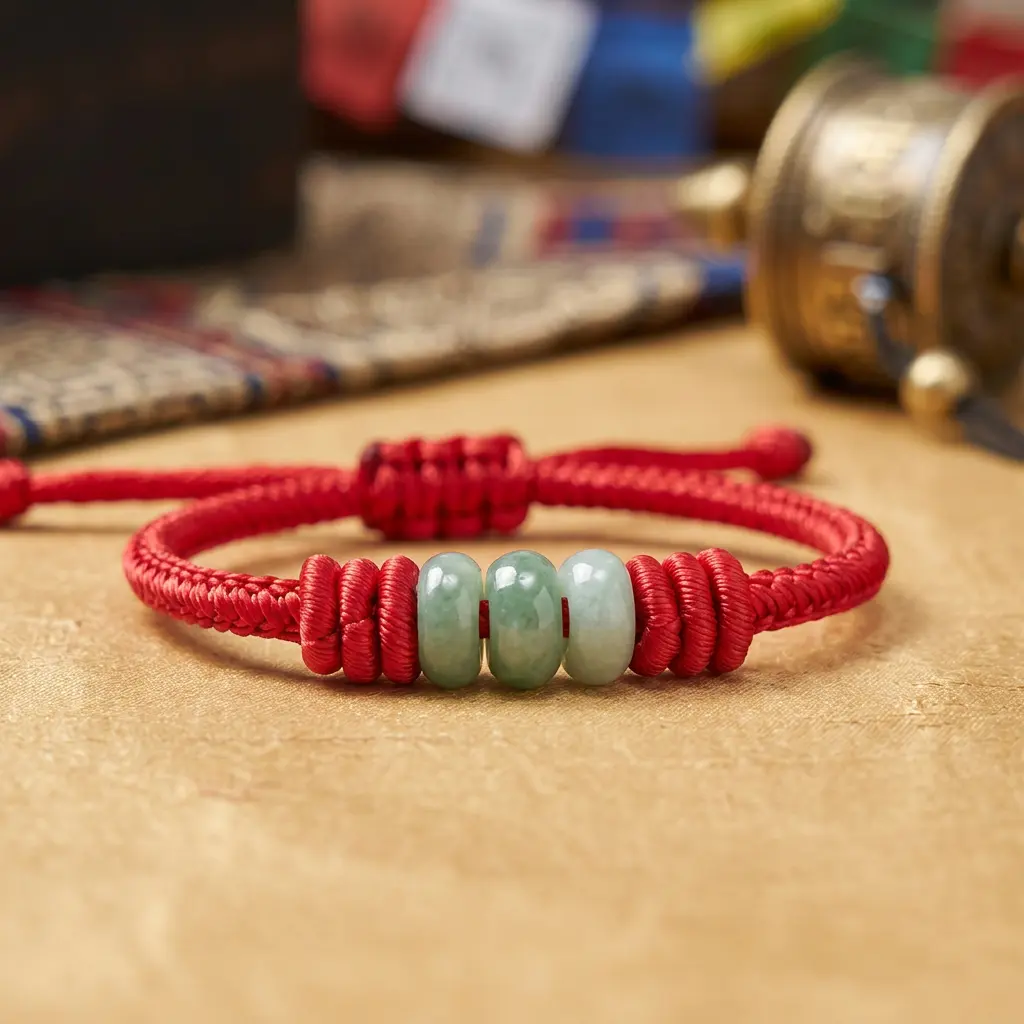
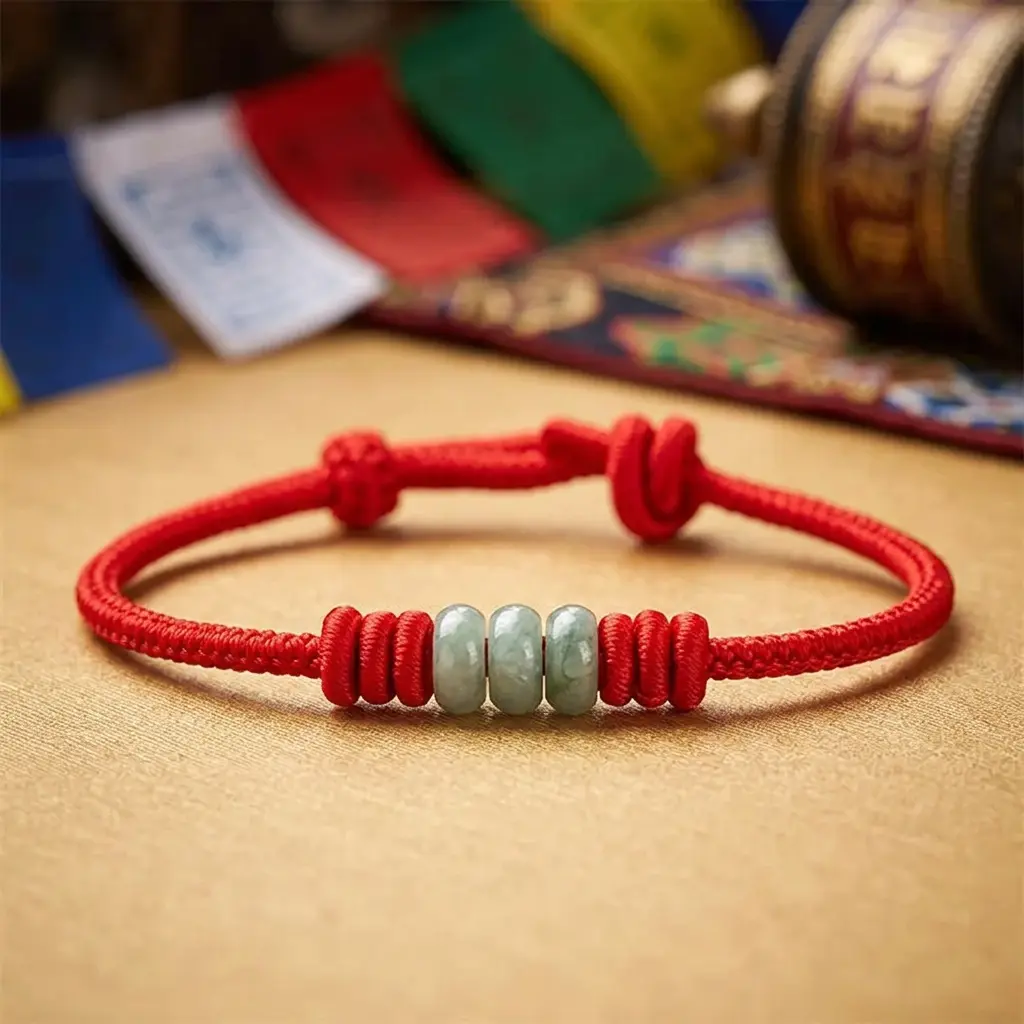
If the Tibetan version speaks to you, the Lucky Buddhist Monk Bracelet ($35.95) carries knots in all five Pancha Varna colors on red silk cord. Artisans recite Om Mani Padme Hum as they tie each knot. Its sliding closure fits wrists from 6.69 to 7.48 inches (17 to 19 cm). That means you do not need to guess a size when you buy it as a gift.
Which Wrist Should You Wear a Five Elements Bracelet On?
There is no universal rule, but the most common feng shui custom is left wrist to receive and right wrist to release. Wear a bracelet on the left to draw a phase in, and on the right when its purpose is protection or letting go.
The “left receives, right releases” custom
The custom treats your left wrist as the receiving side and your right wrist as the giving side. A bracelet on the left wrist is traditionally used to invite a quality in, such as Earth for stability. The common exception is black obsidian, which many wearers put on the right to release negativity.
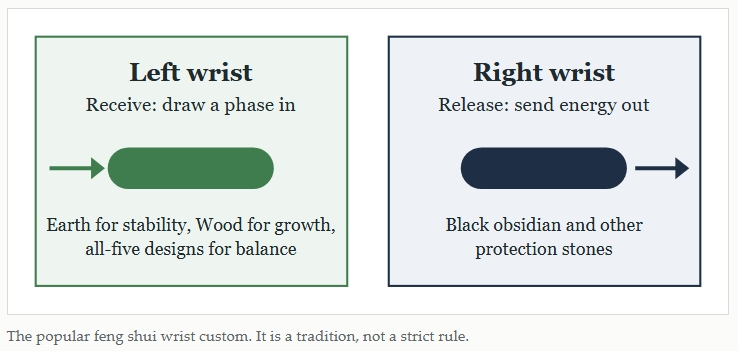
If your bracelet has a Pixiu charm, point its head outward, toward your little finger. Our complete guide to feng shui bracelets and which hand to wear them on covers this and other wrist customs in more depth.
If you’re new to this and the rules feel like a lot, start with your non-dominant wrist. It stays clear of keyboards and desks, so the beads last longer. That choice is perfectly fine.
Can you wear more than one bracelet?
Yes. One or two bracelets per wrist is a practical limit. Pick phases that sit next to each other in the generating cycle, like Wood and Fire. Avoid stacking two phases that clash in the controlling cycle, like heavy Water with heavy Fire. Stricter rules you may see online, such as “no more than three on the left,” are folk customs rather than fixed doctrine.
How to Wear and Care for a Wu Xing Bracelet Day to Day
A five-minute first-wear routine and a monthly wipe-down keep both the meaning and the materials in good shape. You need a soft, lint-free cloth and nothing else.
Step-by-step first-wear routine
- Inspect the strand (1 minute): check the elastic and look for chips. Black obsidian rates 5 to 6 on the Mohs hardness scale, softer than quartz at 7.
- Wipe each bead (2 minutes): use a soft, lint-free cloth. The International Gem Society notes that household dust is harder than obsidian, so scrubbing can scratch it.
- Set an intention (1 minute): hold the bracelet and name one phase you want to focus on, such as steady Earth or calm Water.
- Roll it on (10 seconds): roll the bracelet over your hand instead of stretching it. This protects the elastic cord.
- Repeat the wipe every 30 days: monthly cleaning keeps skin oils from dulling polished stones.
The most common mistake is overstretching the cord over the knuckles. Elastic loses tension each time you pull it past its limit. Some wearers also cleanse the bracelet with incense smoke or a short session in morning sunlight. Keep sun sessions brief, because some dyed or treated beads can fade.
Can you sleep or shower with it?
You can, but taking it off is the safer habit. Soap, hot water, and chlorine weaken elastic cord and can dull polished surfaces. At night, set it on your nightstand. That also keeps the beads from pressing into your wrist while you sleep.
How to Choose One for Yourself or as a Gift
Choose by intention first, element second, and size last. This order keeps the bracelet meaningful to you and comfortable to wear every day.
Match by intention, birth element, or simple preference
- By intention: pick the phase whose traditional qualities match your goal, such as Wood for a fresh start or Metal for focus.
- By birth element: use the last digit of your birth year. 0 or 1 is Metal, 2 or 3 is Water, 4 or 5 is Wood, 6 or 7 is Fire, and 8 or 9 is Earth.
- By preference: if a color simply draws you in, that is a valid reason too.
One caution on birth years: the Chinese calendar follows the lunar cycle. If you were born before early February, your element may belong to the previous year. Our chart for finding your feng shui birth element walks through the edge cases.
Shopping for Thanksgiving or the holidays and unsure of their birth year? You don’t want to guess wrong, so an all-five design is the safe pick. It needs no birth chart, and it reads as a wish for balance rather than one narrow goal.
Sizing, bead diameter, and reading the label honestly
Most five elements bracelets use beads between 8mm and 15mm (0.31 to 0.59 inch). An 8mm bead looks delicate. A 12mm bead reads bold and works well on larger wrists.
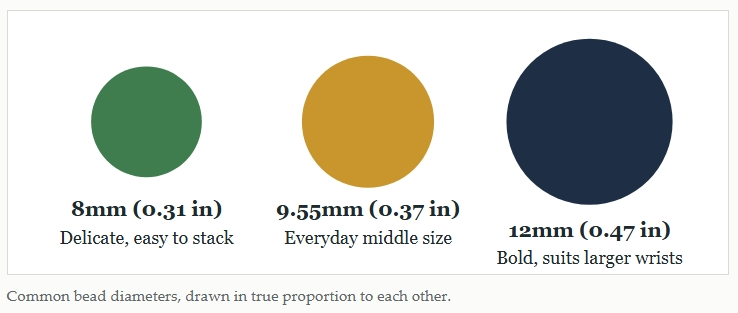
To size a stretch bracelet, wrap a soft tape around your wrist just below the wrist bone. Add about 0.5 inch (1.3 cm) so you can roll it on without strain. Then read the material label, because four common words mean very different things:
- Semulajadi: the stone formed in nature and keeps its original color.
- Dirawat: a natural stone that was heated or dyed to improve its color.
- tiruan: a stone changed to look like another, such as colored quartz sold as citrine.
- Akrilik: plastic beads. They are light and inexpensive, but they are not stone.
None of these labels is wrong. Each one tells you what you are paying for, so you can decide with clear eyes.
Five Elements Bracelet FAQ
Is a five elements bracelet good luck?
It is traditionally associated with balance and good fortune, but that is a cultural belief, not a proven outcome. Most wearers get the most from it as a daily reminder of one intention.
Can anyone wear a Wu Xing bracelet?
Yes. These bracelets are unisex, and you don’t need to follow any religion to wear one respectfully. Curiosity and care are enough.
What if my birth element’s color doesn’t suit my style?
Wear that element as a single accent bead, or choose an all-five design. You can also carry the element’s color in your clothing, or keep one of its stones on your desk instead.
Where can I see all five elements on one bracelet?
Kategori PotalaStore’s collection of five element and crystal bracelets and look for five-stone designs. Where a product page lists its stones, check which stone stands for which phase before you buy.
Pengambilan utama: a five elements bracelet is a color code for the five Wu Xing phases. Read the color first, confirm which tradition it follows, wear it on the wrist that matches your intention, and keep it clean with a soft cloth.
⚠️ Nota Penting: The meanings in this article reflect traditional Chinese and Tibetan beliefs and are shared for cultural and educational purposes. They are not scientific claims. A five elements bracelet does not diagnose, treat, or prevent any condition, and it is not a substitute for professional medical, psychological, or financial advice.
Prefer one element instead of all five?
The Five Elements Pixiu Bracelet ($78.95) comes in a Wood, Fire, Earth, Metal, or Water version. Each version uses stones in that phase’s color on 9.55mm (0.37-inch) beads and a 7.87-inch (20 cm) strand. Pick the phase you want to focus on. Shipping is free, and US delivery takes 5 to 10 business days.Choose your element
📚 Rujukan
- Wuxing (Wu-hsing): Academic overview of the five phases, their cycles, and the “five processes” translation. Ensiklopedia Falsafah Internet
- Religious Daoism: Explains how each phase classifies directions, seasons, numbers, and colors, including Wood and green. Stanford Encyclopedia of Philosophy
- Obsidian Value, Price, and Jewelry Information: Hardness, durability, and cleaning guidance for obsidian jewelry. Persatuan Permata Antarabangsa
- Five Pure Lights: The Tibetan Buddhist five-color system and its links to the five Buddha families and elements. Wikipedia