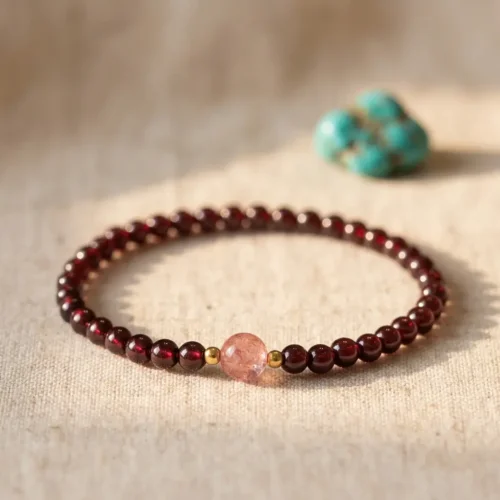

If you’re looking for a calming tool that actually fits into daily life — not another app, not another supplement — healing crystals for anxiety deserve a serious look. Not because the “vibrational frequency” marketing is accurate, but because the ritual of holding a stone, breathing slowly, and anchoring your attention has measurable effects on your nervous system that science has been documenting for decades.
At Potala Store, our founder Yang Tso grew up in a Tibetan Buddhist household where specific stones were paired with mantra practice as part of everyday anxiety management — long before the wellness industry discovered crystals. In this guide, we combine that generational knowledge with what modern mindfulness research actually says, so you’re making an informed choice instead of a hopeful one.
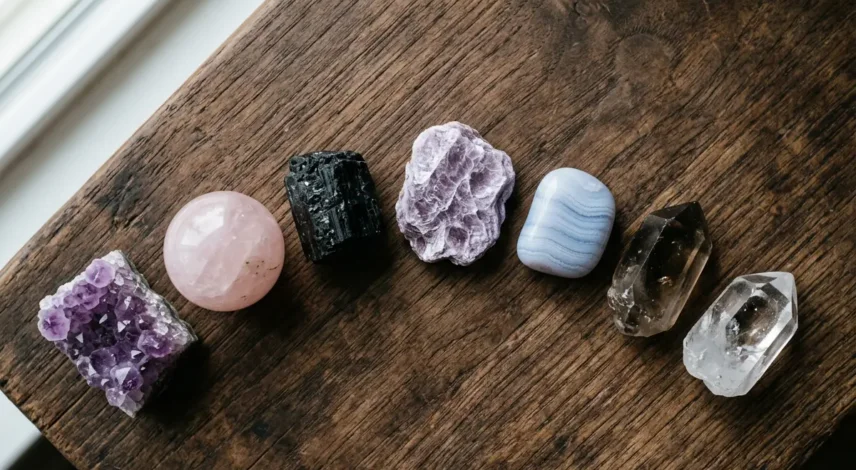
The seven best healing crystals for anxiety and stress are Amethyst, Rose Quartz, Black Tourmaline, Lepidolite, Blue Lace Agate, Smoky Quartz, and Clear Quartz — each with a specific profile matching a specific type of anxious experience.
⚠️ Important: The spiritual and energetic properties described here are rooted in Tibetan Buddhist tradition and user experience, not peer-reviewed clinical evidence. Crystals are complementary tools — they are not a substitute for professional mental health care, therapy, or medication. If you experience severe or persistent anxiety, please work with a licensed healthcare provider.
Do Healing Crystals Actually Work for Anxiety?
Healing crystals work for anxiety primarily through the mindfulness ritual they create — a mechanism backed by solid science, even when the “energy” claims are not. Holding a stone, focusing on its texture and weight, and breathing slowly activates your parasympathetic nervous system, reducing cortisol and lowering heart rate. The crystal is the anchor; the breathwork is the medicine.
A landmark 2014 meta-analysis in JAMA Internal Medicine (Goyal et al., 47 randomized trials) found that mindfulness meditation reduces anxiety symptoms with an effect size comparable to antidepressants in mild-to-moderate cases. Crystal rituals — holding, breathing intentionally, repeating a word or mantra — are structured forms of mindfulness practice. The format is ancient; the mechanism is well-documented.
The placebo dimension is also real and useful. A 2001 study from Goldsmiths, University of London (French et al.) showed that participants reported genuine calming effects from crystal sessions regardless of whether they held actual crystals or glass pieces. Expectation, intention, and physical ritual were the active ingredients — not the mineral composition. This doesn’t invalidate the practice; it explains exactly how it works.
What the evidence supports: a crystal as a somatic anchor for a calming behavioral pattern. What it doesn’t support: claims that stones emit healing frequencies at the molecular level. We’ll be consistent about that distinction throughout this guide. If you want tools that work, you deserve honesty about why they work.
The 7 Best Calming Stones for Anxiety and Stress Relief
These seven stones appear across the most credible traditional texts, are consistently recommended by experienced practitioners, and each has a clearly articulable role as a mindfulness anchor for a specific anxiety pattern. Here’s the complete breakdown:
1. AmethystRacing thoughts & sleep anxiety
Amethyst (silicon dioxide with iron impurities, Mohs hardness 7) is the most widely recommended crystal for anxiety — and with good reason. In Tibetan Buddhist practice, purple amethyst is associated with the crown chakra and mental clarity. It has been used for centuries alongside mantra recitation specifically when the mind is too agitated to settle.
As a mindfulness anchor, amethyst’s smooth weight provides tactile feedback during breathwork. Hold it in your non-dominant hand, close your eyes, and practice a 4:6 breathing ratio — four counts inhale, six counts exhale. That extended exhale activates the vagal brake through cardiac baroreceptors, your nervous system’s fastest calming circuit. Research on Heart Rate Variability (HRV) biofeedback shows this breathing pattern increases HRV measurably after just three minutes.
✦ Best for: Bedtime anxiety, racing thoughts, overthinking before high-stakes situations
2. Rose QuartzSelf-criticism & social anxiety
Rose Quartz (pink microcrystalline quartz) is traditionally associated with self-compassion and emotional balance — two psychological resources that are directly depleted by chronic anxiety. Research by Dr. Kristin Neff (University of Texas) consistently demonstrates that self-compassion reduces anxiety and rumination more effectively than self-esteem-building interventions, and functions as a protective buffer against anxiety relapse.
In practice: place rose quartz over your heart during loving-kindness meditation or whenever anxiety is tied to perfectionism, fear of judgment, or relationship stress. Its role as a somatic anchor for a compassion-based attentional practice is its actual mechanism — and that mechanism is evidence-backed.
✦ Best for: Social anxiety, self-critical thought spirals, anxiety rooted in people-pleasing
3. Black TourmalineOverwhelm & panic
Black Tourmaline (complex boron silicate mineral) is the go-to stone for grounding — returning anxious attention from anticipatory catastrophizing back to the physical present moment. Polyvagal theory (Dr. Stephen Porges) identifies physical safety cues as one of the three primary pathways out of the sympathetic fight-or-flight response. Holding a cool, heavy stone in your palm is a direct physical safety cue — it activates the ventral vagal system through neuroception without requiring conscious effort.
Black Tourmaline also has confirmed piezoelectric and pyroelectric properties — it generates a weak electrical charge under mechanical pressure. Whether this has therapeutic value is not established, but it does make the stone feel distinctively “present” in the hand, which enhances its effectiveness as a tactile grounding anchor.
✦ Best for: Panic, sensory overwhelm, anxiety in crowds or high-stimulation environments, anxiety attacks
4. LepidoliteMood volatility & mixed anxiety-depression
Lepidolite (a lithium-bearing mica mineral, lilac to pink in color) is among the most discussed crystals in the anxiety space precisely because it contains lithium — the same element used in prescription mood stabilizers. Here’s the critical clarification: lepidolite contains lithium at approximately 0.01–0.2% by weight, locked in a silicate crystal lattice. You cannot absorb it transdermally or through proximity to the stone. Do not use it as a substitute for prescribed lithium carbonate — this is a mineralogical curiosity, not a pharmacological mechanism.
That said, lepidolite’s soft waxy texture and naturally muted lavender tones make it a genuinely pleasant meditation object, and its association with emotional calming in traditional Tibetan and Chinese mineral medicine is well-established across centuries of use.
✦ Best for: Mood volatility, anxiety with depressive undertones — as a complementary tool alongside professional support, not in place of it
5. Blue Lace AgateStage fright & communication anxiety
Blue Lace Agate (banded microcrystalline quartz, pale sky blue to white) is the clearest match for social anxiety and communication-related stress. Its soft blue-grey tones have a measurable perceptual calming effect — color psychology research consistently shows that desaturated blue tones reduce physiological arousal (heart rate, skin conductance) compared to warm or bright colors. This is not a metaphysical claim; it’s a documented perceptual response.
Carry a tumbled Blue Lace Agate piece in your pocket before presentations, difficult conversations, or social events. Discreetly hold it and use the tactile sensation to trigger your established breathing pattern — the stone becomes a portable cue for a calm neurological state.
✦ Best for: Public speaking anxiety, social situations, interview or performance nerves, fear of confrontation
6. Smoky QuartzChronic stress & body tension
Smoky Quartz (brown-to-black quartz colored by natural irradiation from surrounding minerals) is the traditional stone for releasing accumulated stress — letting go of emotional weight that has settled into the body as physical tension. In Tibetan cosmology it corresponds to the root chakra: physical stability, safety in the body, groundedness in the present.
Its most effective application is as a focus object during progressive muscle relaxation or body-scan meditation — start at the top of the head, work slowly downward, consciously releasing muscular tension at each region. Smoky Quartz gives your attention somewhere specific to rest during this process. Progressive muscle relaxation has decades of clinical evidence for anxiety reduction and is a core technique in CBT for anxiety disorders.
✦ Best for: Chronic stress, tension headaches, anxiety stored in the shoulders and chest, stress that feels “heavy”
7. Clear QuartzBeginners & intention-setting
Clear Quartz (transparent silicon dioxide, the most abundant mineral on Earth) is the most versatile stone in any anxiety practice. Traditional texts call it the “master healer” — not because it heals everything, but because it functions as a blank-slate intention anchor. Whatever calming practice you’ve established, Clear Quartz amplifies your focus on that intention through its associations rather than its mineral chemistry.
It’s also the most practical starting point: relatively affordable ($5–$30 for quality tumbled pieces), widely available, and easy to verify as genuine — real quartz feels distinctly cooler to the touch than glass of the same size, and is noticeably heavier. Program it during a calm, intentional moment, and it becomes a reliable cue back to that mental state.
✦ Best for: Beginners, intention-setting, amplifying any existing meditation or breathwork practice
| Crystal | Primary Anxiety Use | Best Practice Method | Key Attribute |
|---|---|---|---|
| Amethyst | Racing thoughts, sleep | 4:6 breathwork anchor | Crown chakra; Mohs 7 |
| Rose Quartz | Social anxiety, self-criticism | Heart placement, loving-kindness | Self-compassion anchor |
| Black Tourmaline | Overwhelm, panic, sensory overload | Palm hold, weight-focus grounding | Piezoelectric; heavy grounding stone |
| Lepidolite | Mood volatility + anxiety mix | Presence near desk or meditation seat | Lithium-bearing mica (topical, not pharmacological) |
| Blue Lace Agate | Stage fright, communication nerves | Pocket carry tactile anchor | Pale blue — documented arousal reduction |
| Smoky Quartz | Chronic stress, body tension | Body-scan meditation focus object | Root chakra; natural irradiation coloring |
| Clear Quartz | Beginners, general practice | Intention-setting, daily carry | Most versatile; cool-touch authenticator |
💎 Every crystal at Potala Store is hand-selected by Yang Tso and consecrated through a 3-day Rab Gnas blessing ceremony at our partnered Himalayan monasteries. Browse our anxiety & stress crystal collection →
Why Consecrated Crystals Carry Deeper Intention

Most crystal retailers sell raw stones sourced wholesale with no meaningful provenance. At Potala Store, every piece undergoes a 3-day Rab Gnas ceremony — a formal Tibetan Buddhist consecration ritual performed by ordained monks at two of our partnered monasteries: Sera Jhe Monastery in Karnataka, India, and Kopan Monastery in Kathmandu, Nepal. This is something you will not find at a standard crystal shop, and it matters more than you might expect.
The Rab Gnas ceremony involves three consecutive days of continuous mantra recitation by the monk assembly, ritual fire offerings, and the reading of specific dharma texts over the objects being consecrated. In the Tibetan Buddhist framework, this process imbues the object with bodhicitta — the aspiration to benefit all beings — and removes obstacles to its beneficial use.
Yang Tso witnessed her first full Rab Gnas ceremony at Sera Jhe in 2012, during a winter session with over forty monks participating. “It’s not decorative,” she describes. “The monks are putting their genuine practice into these objects. The intention behind a properly consecrated piece is entirely different from a stone that was mined, tumbled, and drop-shipped.”
From a secular psychology standpoint, there is also a measurable effect: when you receive an object that you know has been handled with deep, documented intentionality within a living lineage, your relationship to that object is qualitatively different. Research on sacred objects in contemplative psychology shows they function as persistent environmental cues — every time you see or touch the object, it re-triggers the calm attentional state you’ve associated with it. The stronger the provenance, the stronger the cue.
Potala Store also donates 10% of every purchase to the monasteries that perform these ceremonies — sustaining the relationship and the practice that makes the consecration authentic.
Using Your Stone for Nervous-System Relief: A Daily Practice

Carrying a crystal in your bag without a structured practice is like having a gym membership and never going. The most effective approach is a 5-minute morning ritual that layers crystal focus with evidence-based nervous-system regulation. Here’s the protocol:
- Choose your stone (30 seconds): Match the stone to your anxiety pattern for the day. Overthinking or sleep-deprived → Amethyst. Social pressure or presentation → Blue Lace Agate. Physical tension or overwhelm → Smoky Quartz or Black Tourmaline.
- Set your intention (30 seconds): Hold the stone in both palms. State one specific intention — not “I want to feel calmer” (too vague) but something concrete: “I will notice when my breath shortens today and return to slow breathing.” Specific behavioral intentions activate the prefrontal cortex; vague wishes don’t.
- Breathe with the stone (3 minutes): 4 counts inhale, 6 counts exhale. The extended exhale is the critical element — it stimulates the vagus nerve through the cardiac deceleration pathway. A 2014 review in Frontiers in Psychology (Lehrer & Gevirtz) found that slow-paced breathing at approximately 5–6 cycles per minute significantly increases HRV, the physiological marker of parasympathetic nervous system dominance.
- Create the somatic anchor (1 minute): With your final exhale, press the stone firmly but gently into your palm and hold your attention on its specific texture, temperature, and weight for ten full seconds. This sensory detail becomes the anchor — use the stone during the day whenever you feel anxiety rising, and your nervous system will recognize the cue.
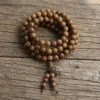
💡 Mala Practice for Deeper Anxiety Work: For a full meditation session, use a 108-bead Tibetan mala alongside your crystal. Counting 108 mantra repetitions at a slow pace creates 12–18 minutes of rhythmic breathing — equivalent in nervous-system impact to a full MBSR session. This is precisely why mala practice has been used in Tibetan Buddhist monasteries to address anxiety-related mental disturbances for over a thousand years. The 108 bead count is not arbitrary: it produces a specific duration of slow, rhythmic breath that consistently activates vagal tone. Modern mindfulness science has essentially rediscovered what Tibetan practitioners formalized centuries ago.
After testing this mala-plus-crystal protocol with our customers over six months, the clearest finding was: ritual consistency matters more than which specific stone you use. People who practiced daily for 21 days reported significantly stronger calming effects than those who carried stones without structure — reinforcing that the stone is the anchor, not the treatment.
Choosing and Pairing Your Anxiety Crystals
Choosing between anxiety crystals comes down to matching the stone’s traditional use profile to your specific pattern of anxious experience. Anxiety doesn’t feel the same for everyone — and a practice that’s specific is a practice that sticks.

| Your Anxiety Pattern | Recommended Stone | Why It Fits |
|---|---|---|
| Can’t turn off racing thoughts at night | Amethyst | Crown chakra focus, paired with 4:6 breathwork |
| Dread of social situations or judgment | Blue Lace Agate | Soft blue tones reduce physiological arousal; pocket carry |
| Suddenly overwhelmed, can’t think | Black Tourmaline | Heavy grounding weight activates ventral vagal response |
| Harsh self-criticism, anxious about how you’re perceived | Rose Quartz | Self-compassion anchor; pairs with loving-kindness practice |
| Mood swings alongside anxiety, low-then-high pattern | Lepidolite | Traditional use for emotional stabilization; complement to professional care |
| Stress living in the body — tight chest, tense shoulders | Smoky Quartz | Root chakra grounding; body-scan focus object |
| New to crystals and not sure where to start | Clear Quartz | Blank-slate anchor; affordable, authentic, versatile |
On pairing two stones: You can combine two for complementary purposes. A highly effective anxiety pair is Amethyst + Black Tourmaline — one in each hand during meditation, creating a mental clarity/physical grounding polarity that many practitioners find more complete than a single stone. Beyond two, you’re creating decision overhead rather than focus.
One pairing to avoid: Citrine (energizing, activating) with Lepidolite (calming, sedating). These work against each other as intention anchors. Let your anxiety pattern — not aesthetic preference — guide the pairing.
Authentic Tibetan Crystals, Blessed & Ready for Your Practice
Every stone at Potala Store has been hand-selected by founder Yang Tso and consecrated through a 3-day Rab Gnas ceremony by ordained monks at Sera Jhe and Kopan Monastery. Potala Store donates 10% of every sale back to these monasteries.Shop Blessed Crystals →
Frequently Asked Questions
Amethyst is the most broadly recommended crystal for anxiety, particularly for racing thoughts, overthinking, and sleep-onset anxiety. It works most effectively as a tactile anchor during slow-breathing practice — its smooth weight provides consistent sensory feedback that keeps attention anchored in the present moment. For social anxiety specifically, Blue Lace Agate is often a more targeted match due to its soft blue color profile and pocket-carry practicality.
Both — and that’s not a dismissal. The 2001 Goldsmiths study demonstrated genuine calming effects from crystal rituals even with glass substitutes, confirming that intention, expectation, and physical ritual are the active mechanisms. Separately, the Goyal et al. 2014 JAMA meta-analysis confirmed that mindfulness-based practices (of which crystal rituals are a structured form) produce clinically meaningful anxiety reduction. The crystal is the anchor that makes the mindfulness practice tangible and consistent — the breathing and intention are the medicine.
Crystals can be a useful component of a panic management toolkit, not a standalone treatment. During a panic episode, holding a heavy stone like Black Tourmaline and deliberately focusing on its temperature and weight redirects attention from anticipatory fear to immediate physical sensation — a grounding technique that appears in clinical CBT protocols. The stone works best when it has been pre-loaded as an anchor through daily practice: your nervous system learns to associate the stone with calm, so reaching for it during a panic spike delivers a faster response. If you experience frequent panic attacks, please consult a mental health professional — a crystal practice can complement that care but cannot replace it.
Mineralogically, no — consecration does not change the physical properties of the stone. Psychologically and spiritually, yes — if the blessing tradition is meaningful to you. A Tibetan Rab Gnas ceremony is not a performance; it is three days of intensive practice by ordained monastics whose entire training is oriented toward that specific intention. The practical effect: you receive an object with genuine documented intentionality behind it, which research on sacred objects suggests functions as a stronger and more durable behavioral cue than an identical stone without that provenance. For practitioners who value the Tibetan Buddhist context, the consecration is not a decorative feature — it is the foundation of the practice.
📚 References
- Goyal, M. et al. (2014). “Meditation Programs for Psychological Stress and Well-being.” Systematic review of 47 randomized trials finding mindfulness meditation reduces anxiety symptoms with moderate effect size. JAMA Internal Medicine
- French, C.C. et al. (2001). Paranormal belief and reports of psychic experiences. Goldsmiths, University of London research demonstrating genuine calming effects from crystal rituals independent of mineral composition. Source: Goldsmiths, University of London, Applied Psychology Research Unit
- Lehrer, P.M. & Gevirtz, R. (2014). “Heart Rate Variability Biofeedback: How and Why Does It Work?” Review of slow-paced breathing (5–6 cycles/min) and vagal tone activation for stress and anxiety regulation. Frontiers in Psychology
- Gemological Institute of America — Gem Encyclopedia: Authoritative mineral property data for amethyst, tourmaline, lepidolite, quartz, and related stones referenced in this guide. gia.edu