
What Is Sound Healing? Science, Practice, and the Role of Tibetan Singing Bowls
 by Yang Tso
0 comments
by Yang Tso
0 comments
Sound healing works — and the science is now specific enough to explain why without mystifying it. If you’ve felt unusually calm after lying in a room with singing bowls or gongs playing, that wasn’t a placebo effect you imagined. Brainwave entrainment and parasympathetic nervous system activation are measurable neurological events, and sound is one of the most reliable ways to trigger both.
At Potala Store, our founder Yang Tso encountered singing bowls not in a wellness studio, but during Buddhist puja ceremonies at Tibetan monasteries. Through our long-standing partnerships with Sera Jhe and Kopan Monastery, we’ve spent over a decade at the intersection of authentic Himalayan tradition and contemporary sound practice. That vantage point shapes everything in this guide — including the parts most Western sound healing articles get wrong.
Sound healing is a therapeutic approach that uses sound frequencies and acoustic vibrations — produced by instruments such as Tibetan singing bowls, gongs, and tuning forks — to promote deep relaxation, reduce stress hormones, and support overall well-being. It works by guiding the brain into slower, calmer wave states and shifting the body’s autonomic nervous system away from stress activation. This guide covers the real science, the cultural tradition, the evidence-based benefits, and how to start a practice at home.
Table of Contents
What Is Sound Healing?
Sound healing — also called sound therapy or vibrational healing — is the intentional use of acoustic frequencies to influence the body’s neurological, physiological, and emotional state. Rather than creating music for entertainment or expression, sound healing practitioners use specific instruments and tones to produce a therapeutic effect: slowing the nervous system, reducing cortisol, and supporting the kind of mental stillness that most people find very difficult to access through mental effort alone.
The practice encompasses several distinct forms, each using sound differently:
| Form | Method | Typical Duration |
|---|---|---|
| Sound Bath | Participants lie down while a practitioner plays singing bowls, gongs, and chimes around the room | 45–60 minutes |
| Singing Bowl Meditation | A single bowl struck or rimmed near the body to guide personal meditation | 10–30 minutes |
| Binaural Beats | Two slightly different frequencies delivered to each ear via headphones, prompting brainwave synchronization | 20–45 minutes |
| Vibroacoustic Therapy | Sound frequencies delivered through a vibrating mat or chair, directly to the body’s tissue | 30–60 minutes |
| Tuning Fork Therapy | Specific-frequency forks applied to acupressure points or held near energy centers | 20–40 minutes |
Sound healing is not the same as music therapy. Music therapy is a board-certified clinical discipline (MT-BC credential in the U.S.) using structured musical interventions within healthcare settings to meet defined treatment goals. Sound healing is broader, more diverse, and primarily wellness-oriented — though its mechanisms overlap significantly with music therapy’s neurological foundations.
How Sound Vibrations Affect Your Brain and Body

Sound healing influences the brain and body through two primary documented mechanisms: brainwave entrainment and parasympathetic nervous system activation — both of which produce measurable physiological changes within a single session.
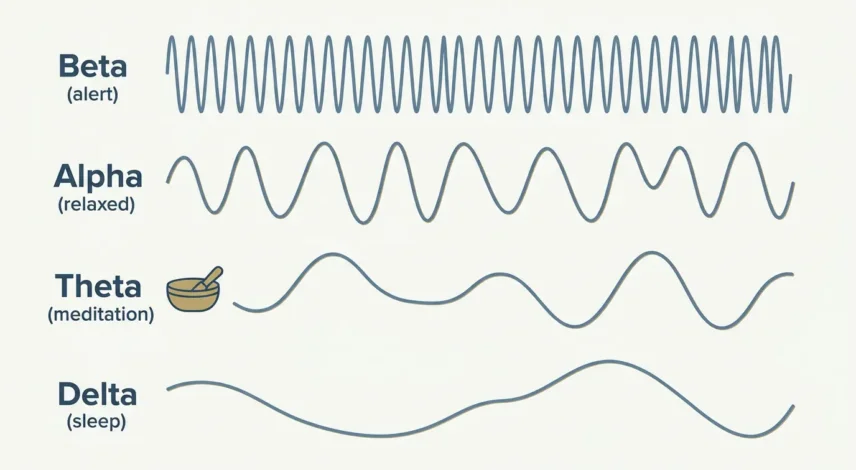
Brainwave entrainment is the brain’s tendency to synchronize its electrical activity to external rhythmic stimuli. When a consistent, rhythmic sound frequency enters the auditory system, the brain begins to match it. This is not a spiritual claim — it’s a property of oscillating systems documented in neuroscience. Tibetan singing bowls produce fundamental frequencies between approximately 110 and 660 Hz, accompanied by rich harmonic overtones. These layered frequencies can guide the brain from busy Beta-wave activity (14–30 Hz, associated with active thinking) down into Alpha states (8–12 Hz, relaxed awareness) or even Theta states (4–8 Hz, associated with deep meditation, light sleep, and heightened creativity). In the Theta state, the body’s production of cortisol — the primary stress hormone — measurably decreases.
Parasympathetic nervous system activation is the second mechanism. Sound reaches the amygdala and limbic system — the brain’s emotional processing centers — faster than most voluntary relaxation techniques, directly reducing the fight-or-flight stress response. Participants in sound healing sessions typically report slower breathing, reduced muscle tension, and a quality of calm that differs from ordinary relaxation within 10–15 minutes of a session beginning.
The most cited peer-reviewed research in this area is the Goldsby et al. (2016/2017) observational study from the University of California San Diego, which followed 62 adult participants — the majority of whom had little to no prior meditation experience — through singing bowl sound meditation. The study found statistically significant reductions in self-reported tension, anxiety, and depressed mood following sessions, with the largest improvements seen in participants who were entirely new to the practice. This finding has been cited by WebMD, UCLA Health, Psychology Today, and the Cleveland Clinic.
To be direct about the science’s current limits: most existing sound healing research uses observational designs and relatively small sample sizes. The results are consistent and promising, but large-scale randomized controlled trials are still limited. The key takeaway is that sound healing is a genuine complementary wellness practice with documented neurological mechanisms — not a clinically established medical treatment, but not pseudoscience either.
Tibetan Singing Bowls: The 2,500-Year Tradition Behind Modern Healing

Tibetan singing bowls are not simply “ancient Himalayan instruments” — they are ritual objects whose original context is Tibetan Buddhist practice, and that context matters enormously for understanding what distinguishes an authentic bowl from a mass-market replica.
In Tibetan and Himalayan Buddhist tradition, singing bowls are used during puja ceremonies, monastery gatherings, and individual meditation practice to mark transitions, call practitioners to presence, and create an acoustic environment that supports contemplative depth. Our founder Yang Tso first encountered them in this role — not at a yoga retreat, but in monastery ritual spaces where the act of sound-making carries spiritual intentionality and centuries of practitioner knowledge. Most Western sound healing content describes bowls as “ancient healing tools” without addressing this distinction, which is exactly the gap that leads people to pay premium prices for machine-stamped bowls that produce acoustically inferior tones.
Traditional Himalayan singing bowls are hand-hammered from a bronze alloy historically associated with a seven-metal tradition — incorporating bronze, tin, zinc, iron, lead, silver, and gold in varying proportions. The hand-hammering process creates a subtly irregular surface that generates the characteristic complex harmonic structure of authentic bowls: multiple simultaneous overtones that layer and evolve as the sound sustains. Machine-stamped bowls lack this tonal complexity because the metal’s crystalline structure is not shaped through the same gradual, deliberate process.
At Potala Store, every singing bowl carries a formal 3-day consecration ceremony (rab gnas) performed by monks at Sera Jhe Monastery or Kopan Monastery. This ritual — involving chanted mantras, prostrations, and offerings — is the same ceremony used to consecrate Buddha statues, thangkas, and other sacred objects before they enter a monastery or practice space. It is not a marketing embellishment. For practitioners who understand Buddhist tradition, a consecrated bowl is not acoustically different from an unconsecrated one — but its place within a lineage of intentional practice is.
Understanding your bowl’s origin is also the most reliable way to judge its acoustic quality. If you want to learn more about Yang Tso’s background and Potala Store’s monastery partnerships, that context is foundational to everything we offer.
🎵 Explore monastery-consecrated Tibetan singing bowls → Each bowl at Potala Store is hand-hammered by Nepalese artisans and passes through a 3-day puja ceremony at Sera Jhe or Kopan Monastery. 10% of every purchase supports monastery education programs.
Key Benefits of Sound Healing: What the Evidence Shows
Based on available peer-reviewed research, sound healing and singing bowl therapy are consistently associated with the following benefits — described here as evidence-informed observations, not clinical guarantees.
- Reduced stress and anxiety: The Goldsby et al. (2016) study documented statistically significant reductions in tension and anxiety following singing bowl meditation sessions (p<0.001). A 2023 follow-up by the same research team replicated these findings in a pandemic-period cohort. Cortisol reduction following sound bath sessions has been reported in multiple observational studies.
- Improved mood and emotional regulation: Participants across multiple studies consistently report improved mood post-session. Importantly, people with no prior meditation experience show the most pronounced improvements — meaning sound healing may be a particularly accessible entry point for emotional self-regulation.
- Better sleep quality: The Theta brainwave state that singing bowl sessions can induce (4–8 Hz) corresponds directly to the hypnagogic state that precedes sleep onset. Many practitioners use a 10–15 minute singing bowl session as a pre-sleep ritual with reported benefits for sleep latency and depth.
- Reduced pain perception: Preliminary research on vibroacoustic therapy in fibromyalgia patients suggests low-frequency sound stimulation may reduce pain intensity and improve mobility. This research area is early-stage; results are promising but not yet conclusive.
- Emotional processing and trauma support: The Theta state associated with deep sound meditation is the same state engaged during certain trauma-focused therapies. Some somatic trauma practitioners incorporate singing bowls into their work. This application is practitioner-specific and not standardized.
- Accessible mindfulness anchor: Sound provides a concrete sensory object for attention — the bowl’s evolving tone is easier for many beginners to follow than the breath. For people who have found traditional breath-focused meditation difficult, sound meditation can be a more reliable entry point.
⚠️ Important: The benefits described above reflect research findings and documented traditional use. Sound healing is a complementary wellness practice — it is not a substitute for professional medical or psychological care. If you are managing a health condition, consult your healthcare provider before beginning any new wellness practice.
Looking for a sound healing tool you can use daily at home? Hand-hammered singing bowls at Potala Store are selected for tonal quality and consecrated through monastery ceremony — the acoustic depth and cultural context that mass-market bowls simply don’t offer.
How to Start a Sound Practice at Home

You don’t need a studio, a practitioner, or prior meditation experience to begin — a single authentic singing bowl and 15 minutes of daily intention is a complete practice. Here’s how to start:
- Choose a quality hand-hammered bowl. Look for bowls made in Nepal with visible hammer marks on the surface — signs of hand-crafted production. Expect to invest $60–$150 USD for a quality small to medium bowl (approximately 4–6 inches in diameter). Machine-stamped bowls are widely available at lower prices, but their flatter tone is acoustically and experientially inferior. Ask specifically about the bowl’s origin and production method before purchasing.
- Set up a simple, consistent space. A quiet room, a meditation cushion or yoga mat, and an agreement with yourself for 15–20 minutes of uninterrupted time. No special equipment required. The bowl rests on a flat cushion or sits in your non-dominant hand.
- Start with striking before rimming. Strike the bowl gently with the wooden mallet and let the tone sustain naturally to fade. This is simpler than rimming (circling the rim to sustain tone) and immediately gives you an acoustic anchor for your attention. Once the tone fades, strike again.
- Synchronize your breath with the bowl’s decay. Exhale as the sound fades. This simple combination deepens parasympathetic activation and makes the experience feel less effortful than trying to quiet the mind directly.
- Practice for 10–15 minutes daily. Consistency matters more than duration. Brief daily sessions produce more noticeable results over time than occasional long ones. Ten minutes of daily singing bowl meditation will produce noticeable effects within two to three weeks.
For a more detailed technique walkthrough — including how to produce the best tone from different bowl sizes and how to advance from striking to rimming — see our guide: How to Use a Tibetan Singing Bowl: A Complete Step-by-Step Guide.
If you prefer to explore sound healing in a group setting before investing in your own bowl, search for sound bath events in your area or explore Potala Store’s full range of meditation tools to find the right starting point for your practice.
Who Should Approach Sound Therapy with Caution
Sound healing is safe for most people — but several conditions warrant discussion with a healthcare provider before you begin, particularly if you plan to attend an immersive sound bath or use vibroacoustic equipment.
- Epilepsy: Rhythmic auditory stimulation can, in some cases, trigger seizures. Consult your neurologist before attending a sound bath or beginning any regular sound healing practice.
- Pregnancy (especially first trimester): Many people practice sound healing comfortably throughout pregnancy, but intense vibration applied near the abdomen is typically avoided in the first trimester. Discuss placement, intensity, and instrument type with your provider.
- Cochlear implants and certain hearing devices: High-volume or high-frequency sound environments can affect hearing device performance. Consult your audiologist about safe exposure levels before attending group sound baths.
- Metal implants or pacemakers (for direct vibroacoustic therapy): If the therapy involves a vibrating mat or direct physical contact with sound equipment, metal implants may be contraindicated. Standard sound baths (no direct contact) are generally unaffected.
- Severe anxiety, PTSD, or active psychosis: For some individuals, the immersive, unstructured sensory experience of a group sound bath can be activating rather than calming. Starting with a brief private or at-home practice is a gentler entry point; discuss with your mental health provider if you’re in active treatment.
- Sound sensitivity (misophonia or hyperacusis): If certain sound frequencies trigger strong aversive reactions, a professional assessment before beginning regular sound healing practice is advisable.
In summary: sound healing’s risk profile is very low for most healthy adults. The precautions above are not reasons to avoid it — they’re variables to address with informed guidance.
Frequently Asked Questions About Sound Healing
Does sound healing actually work? What does the science say?
Research consistently shows that sound healing can produce measurable relaxation effects. The most cited study — Goldsby et al. (2016/2017) from UC San Diego — documented statistically significant reductions in tension, anxiety, and depressed mood in 62 participants following singing bowl meditation sessions. The neurological mechanisms (brainwave entrainment and parasympathetic activation) are well-documented. The honest caveat: most existing research uses observational designs with moderate sample sizes. Sound healing has strong supporting evidence as a complementary wellness practice — it is not yet clinically established as a standalone medical treatment for specific diagnoses, but it is not pseudoscience. The science is real; the marketing claims around it sometimes exceed what the evidence supports.
What is the difference between Tibetan singing bowls and crystal singing bowls?
Tibetan (Himalayan) singing bowls are hand-hammered metal alloy instruments with centuries of documented use in Buddhist practice. They produce a warm, tonally complex sound with multiple simultaneous harmonics that evolve as the note sustains — a characteristic of the hand-hammering process. Crystal singing bowls are made from crushed quartz and produce a cleaner, more sustained single-frequency tone. Crystal bowls are often preferred in Western sound healing settings for their tonal purity; Tibetan bowls are more connected to a specific cultural and spiritual lineage. Both are legitimate — the choice depends on your intended use, aesthetic preference, and whether cultural context matters to you.
What are the 7 healing frequencies (Solfeggio frequencies)?
The Solfeggio frequencies are a set of tones — 396 Hz, 417 Hz, 528 Hz, 639 Hz, 741 Hz, 852 Hz, and 963 Hz — associated in some sound healing traditions with specific therapeutic properties. For example, 528 Hz is often called the “love frequency” and linked to DNA repair claims; 396 Hz is associated with releasing guilt and fear. These frequencies are meaningful within certain healing traditions and have genuine followers. However, the specific healing claims attached to individual Solfeggio frequencies are not supported by peer-reviewed research. They should be understood as part of a spiritual and intuitive framework rather than an established scientific system.
Is sound healing the same as music therapy?
No — though they share neurological foundations, they are distinct. Music therapy is a formal clinical discipline requiring board certification (MT-BC in the U.S.) and uses structured musical interventions to meet defined therapeutic goals within healthcare settings. It has robust clinical evidence for neurologic rehabilitation, dementia care, and pediatric pain management. Sound healing is broader, more diverse, and generally wellness-oriented. It encompasses practices ranging from singing bowl meditation and sound baths to binaural beat recordings, with varying levels of research support. The two can complement each other, but sound healing is not a substitute for clinical music therapy in medical contexts.
Explore Monastery-Blessed Tibetan Singing Bowls
Each bowl at Potala Store is hand-hammered by Nepalese artisans and consecrated through a formal 3-day puja ceremony at Sera Jhe or Kopan Monastery. 10% of every purchase directly supports monastery education programs.Shop Tibetan Singing Bowls →
📚 References
- Goldsby TL, Goldsby ME, McWalters M, Mills PJ. (2016/2017). Effects of Singing Bowl Sound Meditation on Mood, Tension, and Well-being: An Observational Study. Journal of Evidence-Based Complementary & Alternative Medicine. The foundational peer-reviewed study on singing bowl therapy outcomes, conducted at UC San Diego with 62 participants. PubMed Central (PMC5871151)
- UCLA Health. (2025). What is sound therapy — and could it benefit your health? A clinical overview covering binaural beats, sound baths, and vibroacoustic therapy with references to current research. UCLA Health
- Cleveland Clinic. What Is a Sound Bath? A medically reviewed overview of sound bath practice, documented benefits, and safety considerations. Cleveland Clinic Health Essentials
- Seetharaman et al. (2024). Exploring the healing power of singing bowls: A comprehensive systematic review. Explore: The Journal of Science & Healing. A systematic review of peer-reviewed literature on singing bowl therapy outcomes across multiple study designs. (Readers may search Explore journal or PubMed for current access to this article.)