

Placing the wrong crystals together can create an energetic tug-of-war — and in some cases, physically damage the stones themselves. If you’ve ever felt restless, drained, or curiously “off” after setting up a crystal arrangement, the pairing itself may be the cause.
At PotalaStore, we’ve worked with Tibetan Buddhist crystal traditions for years, helping thousands of practitioners build intentional collections. In our crystal bracelet guide, we flag a key principle that most incompatibility lists miss: the conflict between crystals is rarely about the stones themselves — it’s about placing opposing intentions in the same space without clarity.
The core answer: 8 crystal combinations are cited most consistently across the practitioner community as problematic, led by Carnelian + Amethyst, Citrine + Amethyst, Clear Quartz + Smoky Quartz, and Selenite + Malachite. But this guide goes further than any list. We cover the physical reasons some crystals must be separated (Mohs hardness and water chemistry), what Tibetan Buddhist tradition genuinely teaches about combining stones, and a fact from the Gemological Institute of America that directly challenges the most-cited “incompatible pair” in the field.
Table of Contents
Which Crystal Combinations Should You Avoid?
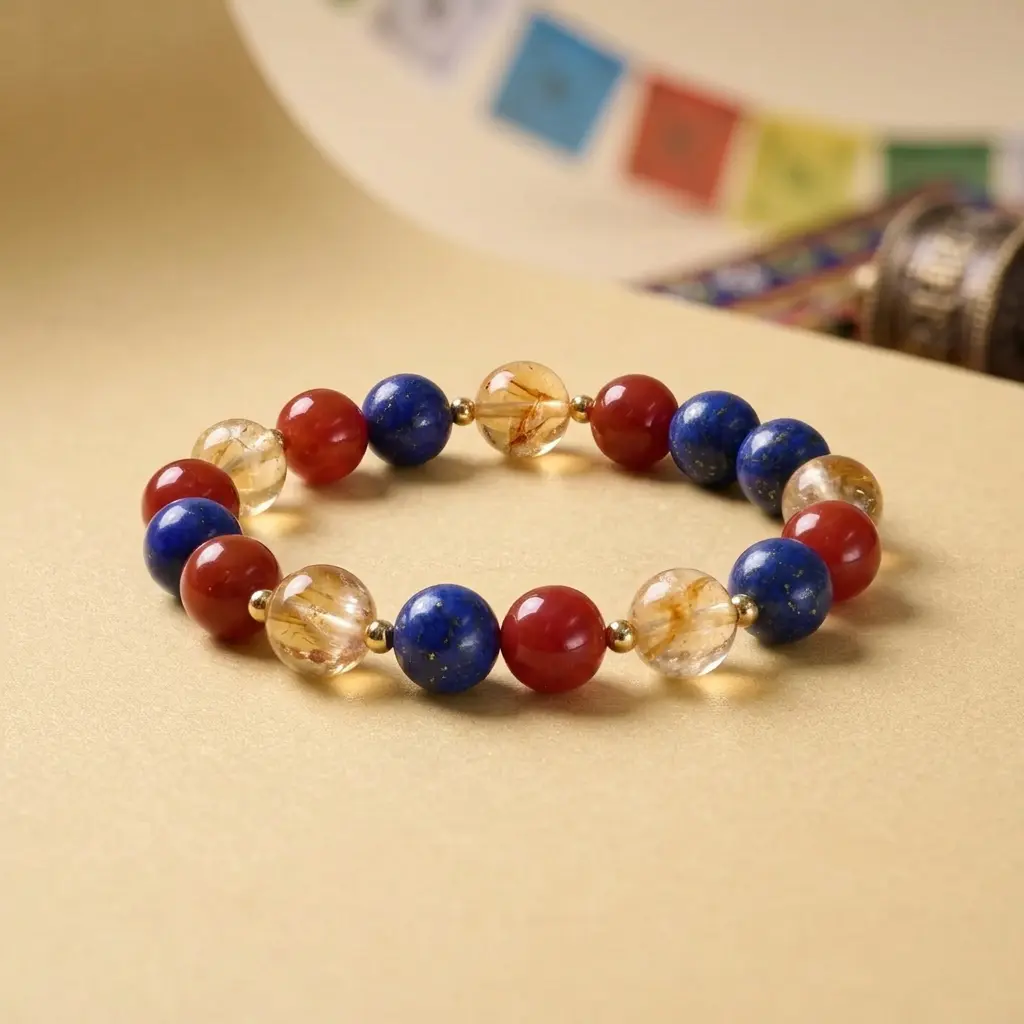
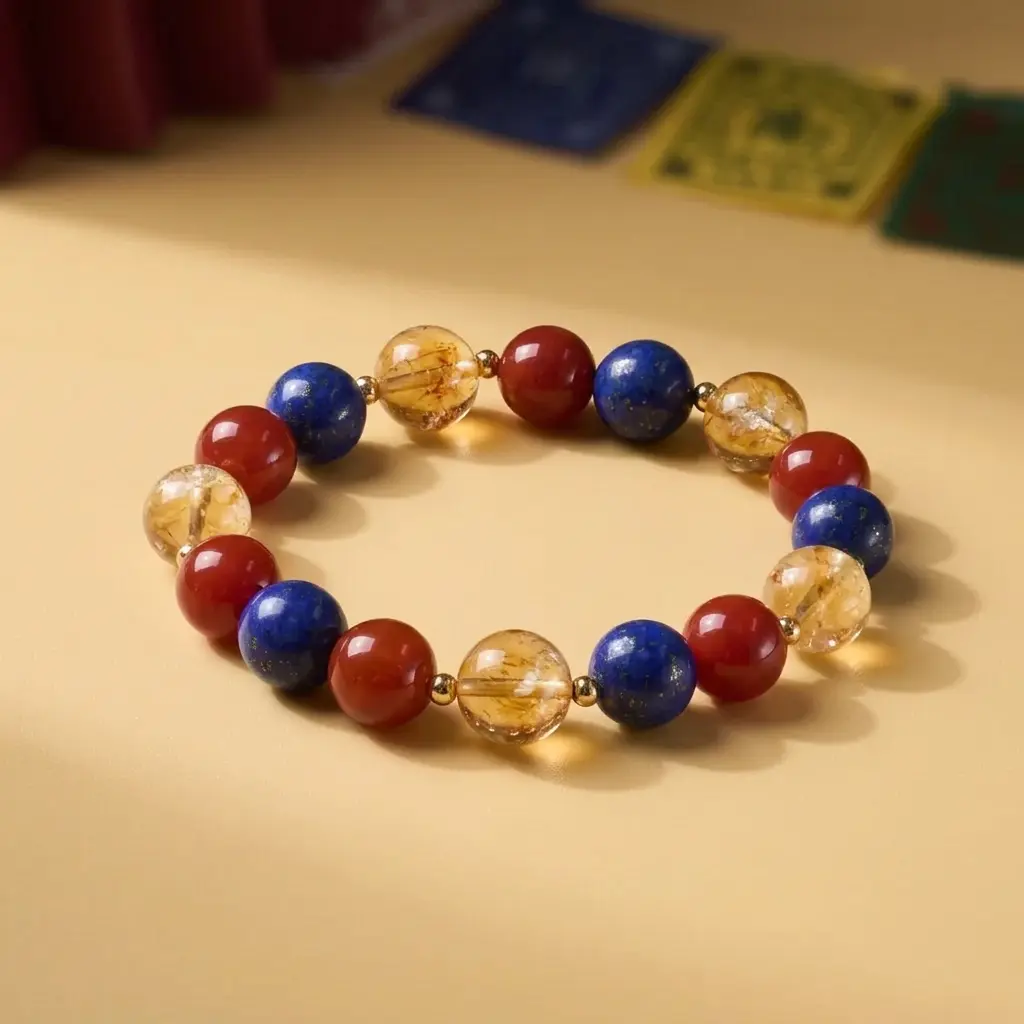
The 8 crystal pairings most practitioners avoid placing together, ranked by cross-source consensus:
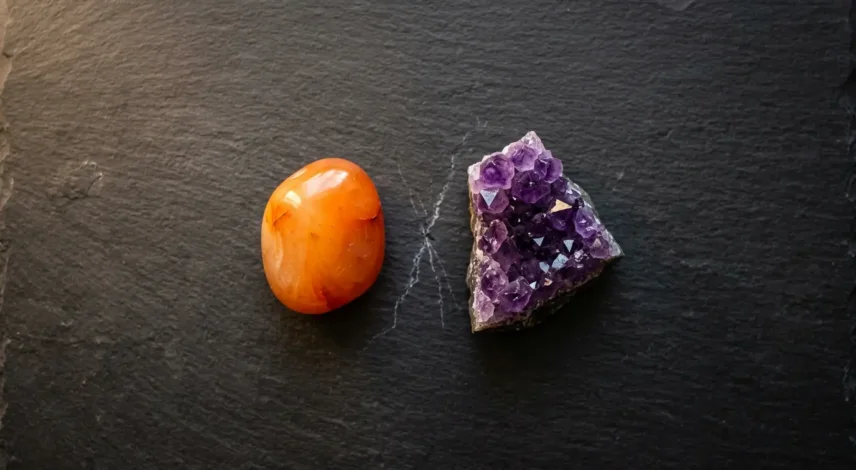
- Carnelian + Amethyst: High-energy fire activation vs. deep calming water energy — opposing intentions create agitation when combined. Cited by 7 out of 10 leading sources.
- Citrine + Amethyst: Outward manifestation energy vs. inward spiritual retreat — reported to cause restlessness when paired (though nature disagrees — see the Ametrine Paradox below).
- Clear Quartz + Smoky Quartz: Clear Quartz amplifies all energy; Smoky Quartz discharges it. The amplifier works against the absorber, creating a feedback loop rather than a resolution.
- Rose Quartz + Black Tourmaline: Open, receptive heart energy vs. dense protective shielding. Many practitioners find one overwhelms the other — though this pairing is genuinely contested.
- Blue Lace Agate + Red Jasper: Calming throat chakra (air element) vs. fiery root chakra activation (earth/fire element) — elemental direct opposites.
- Tiger’s Eye + Hematite: Tiger’s Eye builds momentum and stimulates confidence; Hematite creates deep anchoring grounding. The push-pull disrupts both functions.
- Selenite + Malachite: Energetically and physically problematic. Selenite (Mohs hardness 2) is soft enough to be scratched by Malachite (Mohs 3.5–4). Malachite also releases copper ions when it contacts moisture — a real chemistry concern.
- Clear Quartz + Malachite: Clear Quartz amplifies Malachite’s intensive transformational energy — can feel overwhelming, particularly in sleeping or meditation spaces.
In summary: the most consistent reason to separate two crystals is conflicting intention — one calms while the other energizes — or a genuine physical incompatibility such as hardness mismatch or water sensitivity. Both are real. Neither is mystical hand-waving.
💡 New to crystals? Our 10 best crystals for beginners guide recommends starting with stones that complement each other naturally — so you sidestep most of these pairing conflicts from the start.
Tiger Eye Fortune Lucky Bracelet 10mm
Original price was: $79.96.$46.95Current price is: $46.95.
Buy Now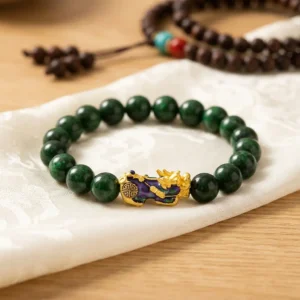
Piyao Jade Bracelet – Feng Shui Wealth Talisman
Original price was: $87.95.$56.95Current price is: $56.95.
Buy Now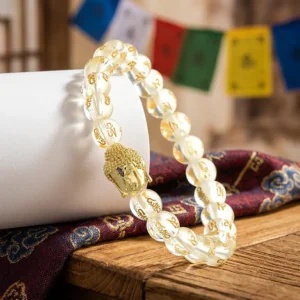
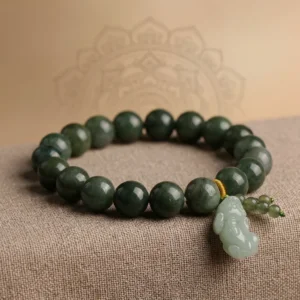
Green Jade Pixiu Bracelet – Feng Shui Fortune
Original price was: $69.97.$48.95Current price is: $48.95.
Buy NowTwo Reasons Crystals Conflict: Energetic Intention and Physical Chemistry
Most crystal incompatibility articles treat all conflicts as one thing: “bad vibes.” In practice, there are two distinct and separate issues — and they require different solutions.
1. Conflicting Energetic Intentions
The practitioner framework treats a crystal as a tool set to a specific energetic purpose — calming, activating, grounding, opening, protecting. When two crystals with opposing purposes are placed together, they ask the same space to do contradictory things simultaneously.
The most reliable compatibility test is simple: Do both crystals serve the same single intention? If the answer is no, use them in separate areas or at separate times.
| Crystal Pair | Conflict Type | Why It Creates Problems | Consensus (of 10 sources) |
|---|---|---|---|
| Carnelian + Amethyst | Fire vs. Water | Carnelian activates and stimulates; Amethyst calms and stills. Opposing directional energies undermine both. | 7/10 |
| Citrine + Amethyst | Outward vs. Inward | Citrine amplifies outward manifestation; Amethyst promotes inward spiritual retreat. | 6/10 |
| Clear Quartz + Smoky Quartz | Amplifier vs. Absorber | Clear Quartz boosts what Smoky Quartz is trying to discharge — creates a loop rather than resolution. | 6/10 |
| Blue Lace Agate + Red Jasper | Air vs. Earth/Fire | Calming throat chakra energy vs. fiery root chakra activation — elemental opposites. | 6/10 |
| Tiger’s Eye + Hematite | Stimulating vs. Grounding | Tiger’s Eye builds forward momentum; Hematite anchors deeply. Push-pull on focus. | 5/10 |
| Selenite + Malachite | Energetic + Physical | Beyond energy conflict — physical chemistry makes this genuinely hazardous (see below). | 5/10 |
| Moonstone + Garnet | Soft vs. Passionate | Gentle intuitive energy clashes with intense passionate activation. | 3/10 |
| Amethyst + Pyrite | Spiritual vs. Material | Pyrite’s materialistic frequency is traditionally said to drain Amethyst’s calming spiritual resonance. | 2/10 |
2. The Mohs Hardness Problem — Physical Damage Most Lists Skip

Storing soft crystals with harder ones causes real, permanent scratches — and this is the issue almost no crystal incompatibility guide addresses. It’s not energetic. It’s basic mineralogy.
The Mohs hardness scale measures a mineral’s resistance to scratching, from 1 (talc) to 10 (diamond). Any crystal can scratch any stone softer than itself. In a shared crystal bowl or drawer, movement during handling causes microscopic — and sometimes very visible — surface damage.
| Crystal | Mohs Hardness | Storage Risk |
|---|---|---|
| Selenite | 2 | Gets scratched by virtually every other crystal. Always store individually wrapped. |
| Calcite | 3 | Fragile — easily chipped and scratched by anything above Mohs 3. |
| Malachite | 3.5–4 | Scratched by quartz-family stones. Also water-soluble — slowly releases copper ions when wet. |
| Fluorite | 4 | Beautiful but fragile. Scratched by anything Mohs 5+. Store separately. |
| Lapis Lazuli | 5–6 | Scratched by quartz-family stones. Avoid water — can fade and degrade the matrix. |
| Amethyst / Citrine / Tiger’s Eye / Carnelian | 7 | Safe to store together (same hardness). Will scratch softer stones. |
| Clear Quartz | 7 | The classic “master healer” amplifier — safe with other Mohs 7 stones. Will scratch softer crystals. |
The practical rule: any crystal with Mohs hardness below 5 needs its own fabric pouch or compartment. Never toss Selenite, Malachite, Calcite, or Fluorite loose into a shared bowl with Quartz-family stones.
For water-specific risks — which stones dissolve, fade, or release toxic compounds when wet — our detailed breakdown in our crystal water safety guide covers Selenite, Malachite, Pyrite, Calcite, and Lepidolite in full.
💡 Quick Storage Rule: A crystal tumbled hard against Selenite in transit can leave a permanent white scratch in seconds. Individually wrap Selenite, Malachite, and Fluorite in fabric before placing them anywhere near other stones — even for short-term storage.
The 4 Most-Cited Conflicting Pairs — What’s Actually Happening
A list of “do not pair” combinations isn’t enough. Here’s what the conflict mechanism actually looks like for the four highest-consensus pairs — so you can make decisions based on understanding, not rules.
Carnelian + Amethyst: Fire Meets Water
Carnelian — a deep orange-red silicate — traditionally represents fire energy: action, physical vitality, creative drive, and outward momentum. Amethyst — the violet quartz — represents water energy: calm, intuition, spiritual depth, and emotional stillness. Together without a unifying intention, practitioners frequently report feeling simultaneously revved up and sedated — a restless, unfocused state that serves neither goal.
Carnelian stimulates the sacral and solar plexus chakras (movement, desire, will). Amethyst calms the crown and third eye chakras (stillness, surrender, perception). When the same space is asked to activate and quiet simultaneously, the conflict is not energetic “cancellation” — it’s competing signals that dilute both.
Clear Quartz + Smoky Quartz: The Amplifier-Absorber Loop
Clear Quartz (Mohs 7, silicon dioxide SiO₂) stores and amplifies whatever energy pattern it encounters. Smoky Quartz — the same base mineral colored by natural radiation — specializes in transmuting and discharging negative or stagnant energy. The conflict: Clear Quartz amplifies what Smoky Quartz is actively trying to release. Instead of discharge and clearing, the pair creates a loop — the discharged energy gets amplified back into the space before the Smoky Quartz can fully process it. Most practitioners separate them: Clear Quartz near active practice spaces; Smoky Quartz near entry points for energetic clearing.
Selenite + Malachite: Two Separate Problems
This pairing has distinct energetic and physical problems. Energetically, Selenite continuously cleanses and resets surrounding energy — some traditions describe it as “stripping” Malachite’s deep, slow transformational process before that work can complete. Physically, Malachite (copper carbonate hydroxide, Cu₂(CO₃)(OH)₂) contains copper that releases slowly as copper ions in humid conditions — particularly problematic if stored in contact with moisture-absorbing materials or in humid climates. Add Selenite’s Mohs 2 softness against Malachite’s Mohs 3.5–4, and the physical scratching risk compounds the energetic concern into a pairing that’s problematic on every level.
Rose Quartz + Black Tourmaline: Genuinely Contested
This is the most honestly debated pair in the community. Rose Quartz promotes energetic openness and receptivity — it works by lowering defenses to invite love and healing. Black Tourmaline does the opposite: it creates a protective energetic barrier against external influences. Some practitioners combine them deliberately, arguing that Tourmaline’s protection allows Rose Quartz to open more safely. Others report that the dense shielding energy overwhelms the softer receptive quality. The honest answer: intention determines the outcome. If protection while opening is your clear goal, this pairing may serve you. If you want pure openness or pure protection, separate them.
What Tibetan Buddhist Tradition Actually Teaches About Combining Crystals

Rigid “never pair these” lists are largely a modern Western New Age invention. Tibetan Buddhist crystal traditions take a meaningfully different approach — and as a brand rooted in this lineage, we think that’s worth sharing directly.
Kunzang Palyul Choling (KPC), one of the few Tibetan Buddhist centers to have publicly documented its crystal practice in detail, combines clear quartz, smoky quartz, rose quartz, amethyst, citrine, tourmaline, apophyllite, and elestials together in a single prayer room — including at least four pairs that appear on Western incompatibility lists. This is not an oversight. It reflects a fundamentally different model.
In Tibetan Buddhist understanding, crystals function as transmitters and supports for spiritual practice — not as autonomous energy generators that conflict with each other. As KPC documentation describes it: “Crystals can act as catalysts — bringing forth and ripening latent karmic potentials within your mind. They are supports to the spiritual path, not objects of refuge themselves.”
In this framework, intention and mantra infusion — known as sung-blessing, a formal dedication of an object through prayer and mantra — determines how any crystal functions, regardless of pairing. A crystal room blessed with a unified intention for the benefit of all beings is not a space of conflicting energies. It’s a unified energetic support for a single purpose.
This doesn’t invalidate Western pairing guidance. It reframes it: pairing lists serve as scaffolding for setting clear intention, not as immutable physical law. If you’re uncertain which crystals support each other rather than conflict, our beginner’s crystal guide offers a starting point aligned with both approaches.
🔬 The Honest Scientific Note: Dr. Christopher French (Head of the Anomalistic Psychology Research Unit, Goldsmiths, University of London) conducted the most-cited crystal study in 2001. He gave 80 participants 5 minutes to meditate holding either a real quartz crystal or an indistinguishable fake paste replica. Both groups reported identical sensations — tingling, warmth, vibration. His conclusion: “There is no evidence that crystal healing works over and above a placebo effect.”
This doesn’t make crystal practice meaningless — intention, ritual, mindfulness, and focused attention all carry genuine psychological value. But it does mean two crystals have no measurable physical energy to “cancel” each other. From a scientific standpoint, crystal incompatibility is a framework for intention-setting — and a useful one — not a description of physical forces.
The Ametrine Paradox: When the Most-Cited “Incompatible Pair” Exists in Nature
Citrine and Amethyst are the most commonly cited incompatible pair in the crystal community. The Gemological Institute of America didn’t agree when it described ametrine.
Ametrine is a naturally occurring gemstone in which Amethyst and Citrine grow fused together in a single quartz crystal — purple and gold zones within one stone. According to the Gemological Institute of America (GIA), there is only one known commercial source in the world: the Anahí mine in eastern Bolivia, near the Brazilian border. The mine also produces natural amethyst and citrine as separate stones from the same geological deposit.
The GIA explains that ametrine’s distinctive dual-color zoning results from differences in iron oxidation state within the same quartz crystal, produced by temperature variation during formation. Amethyst and Citrine are, chemically, identical minerals — silicon dioxide (SiO₂) — distinguished only by how iron atoms are oxidized at the moment of crystallization. They are literally the same crystal expressing two states simultaneously.
What does this mean practically? It reframes “incompatibility” as a description of conflicting intentions, not conflicting substances. If your intention integrates both calming and energizing qualities simultaneously — during creative meditation, visualization work, or transition periods — deliberately combining Citrine and Amethyst (or choosing an ametrine stone) may serve you perfectly. The conflict emerges from the practitioner’s unclear intention, not from the minerals themselves.
Key takeaway: The most-cited “incompatible pair” in the crystal community coexists naturally in one of the world’s rarest gemstones. Crystal incompatibility is a map of intention conflicts, not a mineralogical prohibition. Use the map as a guide to clarity — not as a rulebook.
How to Safely Store and Separate Conflicting Crystals

Once you’ve identified which stones to keep apart, here’s the practical approach — both for energetic and physical reasons.
Distance and Physical Separation
- Energetic separation: Keep intentionally conflicting pairs at least 3 feet apart in your home. For bedroom arrangements specifically — where sleep quality is sensitive — keep grounding stones (Hematite, Black Tourmaline) separate from calming or high-vibration stones (Amethyst, Selenite, Moonstone).
- Mohs-based storage: Any crystal with Mohs hardness below 5 — Selenite, Malachite, Calcite, Fluorite — should be stored in individual fabric pouches or a compartmentalized wooden box. Never loose in a shared bowl with Amethyst, Tiger’s Eye, Clear Quartz, or Citrine.
- Water-sensitive storage: Never immerse Selenite, Malachite, Lapis Lazuli, Pyrite, or Calcite in water. These minerals degrade, dissolve, or release compounds in moisture. Our crystal water safety guide covers each stone in detail.
Cleansing Between Uses
- If two conflicting crystals have been near each other, cleanse both before use — sage smoke (15–30 seconds), a singing bowl (1–2 minutes), or moonlight exposure (3–4 hours under a full moon) all work for most stones.
- Do not use water to cleanse Selenite, Malachite, Pyrite, Calcite, or Lapis Lazuli — water degrades these minerals at the molecular level.
- A 15–20 minute morning sunlight bath works for most quartz-family crystals. Avoid extended direct sun for Amethyst — UV exposure gradually fades its violet color over months.
The One-Intention Test
Before placing any two crystals together, ask one question: What is the single thing I want this arrangement to do? If both crystals serve that same goal, the pairing is intentionally aligned. If one calms and the other energizes, choose one — or find a bridge stone. Fluorite (a balancing stone that works across multiple energetic directions simultaneously) is traditionally recommended when you want to integrate opposing energies without conflict.
💡 One-Week Test: Try any new crystal pairing for seven days and notice your sleep quality, focus, and emotional steadiness. If something feels agitated or “off” by day three, separate the stones and test each one individually. No rule replaces your direct experience.
Frequently Asked Questions
Soft crystals — those with Mohs hardness below 5 — should never be stored loosely with harder stones. Selenite (Mohs 2), Malachite (3.5–4), Calcite (3), and Fluorite (4) need individual fabric pouches to prevent physical scratching. For energetic reasons, keep pairs with opposing intentions — Carnelian and Amethyst, Clear Quartz and Smoky Quartz, Tiger’s Eye and Hematite — in separate areas of your home, ideally at least 3 feet apart.
Yes — particularly when your intention integrates both calming and energizing qualities. In fact, Amethyst and Citrine grow naturally fused together in Bolivia’s Anahí mine as a single gemstone called ametrine, verified by the Gemological Institute of America. That said, practitioners seeking purely calming energy often report feeling unsettled when wearing both simultaneously. Test the combination for one week and observe your own response before deciding.
From a scientific standpoint, no measurable physical energy interaction between crystals has been documented. Dr. Christopher French’s 2001 study at Goldsmiths, University of London, found crystal effects are attributable to the placebo response rather than the crystals themselves. Within practitioner tradition, “cancellation” describes a real experience — confused or agitated energy when two opposing intentions occupy the same space simultaneously. That experience is genuine from the standpoint of intention-setting ritual, even without a physical mechanism behind it.
Most practitioners recommend at least 3 feet between energetically conflicting crystals, or placing them in different rooms. For crystals that are physically incompatible due to hardness mismatches, even sharing the same drawer without pouches causes damage — distance alone isn’t enough. Use separate sealed fabric pouches regardless of how far apart the stones are placed.
Build Your Collection with Intention
Explore PotalaStore’s hand-selected healing crystals and spiritual bracelets — each piece sourced with Tibetan Buddhist tradition in mind, paired with guidance on compatible combinations.Explore Our Crystal Collection →
📚 References
- Ametrine — Natural Coexistence of Amethyst and Citrine: Official gemological description of ametrine’s formation at Bolivia’s Anahí mine, confirming that Amethyst and Citrine naturally fuse as a single quartz crystal. Provides chemical explanation of dual-color zoning. Gemological Institute of America (GIA) — ametrine-description
- Crystal Healing and the Placebo Effect — French (2001): Dr. Christopher French’s study presented at the British Psychological Society Centenary Annual Conference, Glasgow, March 2001. Eighty volunteers meditated with real quartz crystals or identical fake replicas; both groups reported identical physical sensations. Abstract published in Proceedings of the British Psychological Society 9(2), 186. (Referenced via Healthline and academic summaries — original conference proceedings available through the BPS.)
- Do Healing Crystals Work? Lore, History, Research: Overview of the scientific and cultural literature on crystal healing, including discussion of placebo-controlled research and mineralogical properties. Healthline — healing-crystals-what-they-can-do-and-what-they-cant
- Mohs Hardness Scale and Mineral Properties: Reference data on crystal hardness ratings including quartz family (Mohs 7), selenite (Mohs 2), calcite (Mohs 3), malachite (Mohs 3.5–4), and fluorite (Mohs 4). Essential for physical storage compatibility. Mindat.org — Mineralogical Database