

Choosing a Buddha statue starts with one question almost every buying guide skips: what do you actually need it to do? Start with your intention — meditation, protection, healing, or wisdom — and the right pose, material, and size follow naturally. The biggest mistake we see buyers make at Potala Store, after years of sourcing statues directly from Himalayan workshops and monastery partners, is choosing appearance first and meaning second.
This guide covers all four decisions that matter: purpose, pose (mudra), material, and size — plus placement principles grounded in both Buddhist tradition and feng shui. We also cover one factor most guides skip entirely: whether your statue has been consecrated. That distinction, invisible on the outside, changes everything about how Tibetan Buddhists understand and use a statue.
⚠️ Note: Spiritual properties and energy associations described here reflect traditional Buddhist beliefs and practitioner experience, not scientific claims. This guide is for educational purposes. Always approach sacred objects with cultural respect.
How to Choose a Buddha Statue: The 4-Factor Decision Framework
Choose a Buddha statue by working through four decisions in order — intention first, then pose (mudra), then material, then size. Jumping straight to aesthetics produces a beautiful object with no connection to your actual goals. This table maps the most common intentions to their traditional pairings:
| Your Intention | Best Mudra / Pose | Recommended Material | Ideal Placement |
|---|---|---|---|
| Meditation & inner peace | Dhyana Mudra (hands in lap) | Bronze, wood, or stone | Meditation room or altar |
| Protection & overcoming fear | Abhaya Mudra (raised right hand) | Bronze or brass | Home entrance or living room |
| Wisdom & teaching | Dharmachakra Mudra (Wheel of Dharma) | Stone or gilded bronze | Study, office, or library |
| Healing & compassion | Medicine Buddha (lapis-blue body, bowl) | Lapis-painted bronze or brass | Bedroom or wellness space |
| Abundance & generosity | Varada Mudra (open downward palm) | Brass or gold-gilded bronze | Living room or home office |
| Enlightenment & grounding | Bhumisparsha Mudra (earth-touching) | Stone or bronze | Garden or outdoor shrine |
One clarification worth making early: the Laughing Buddha — round, cheerful, holding a sack — is technically Budai, a Chinese folkloric deity associated with contentment and good fortune. He is not Shakyamuni Gautama, the historical Buddha. Both are meaningful; they are simply different. If you want a traditional Tibetan or Buddhist spiritual statue with iconographic meaning, you are looking for a Shakyamuni mudra figure, not Budai.
Understanding Mudras: Matching a Buddha Statue’s Pose to Your Purpose
A mudra is a ritual hand gesture that encodes a specific spiritual quality — not decoration, but meaning made physical. Each of the eight primary mudras reflects a distinct moment or teaching from Buddha’s life. Knowing the difference lets you choose with intention rather than guesswork.

The 8 Core Mudras Explained
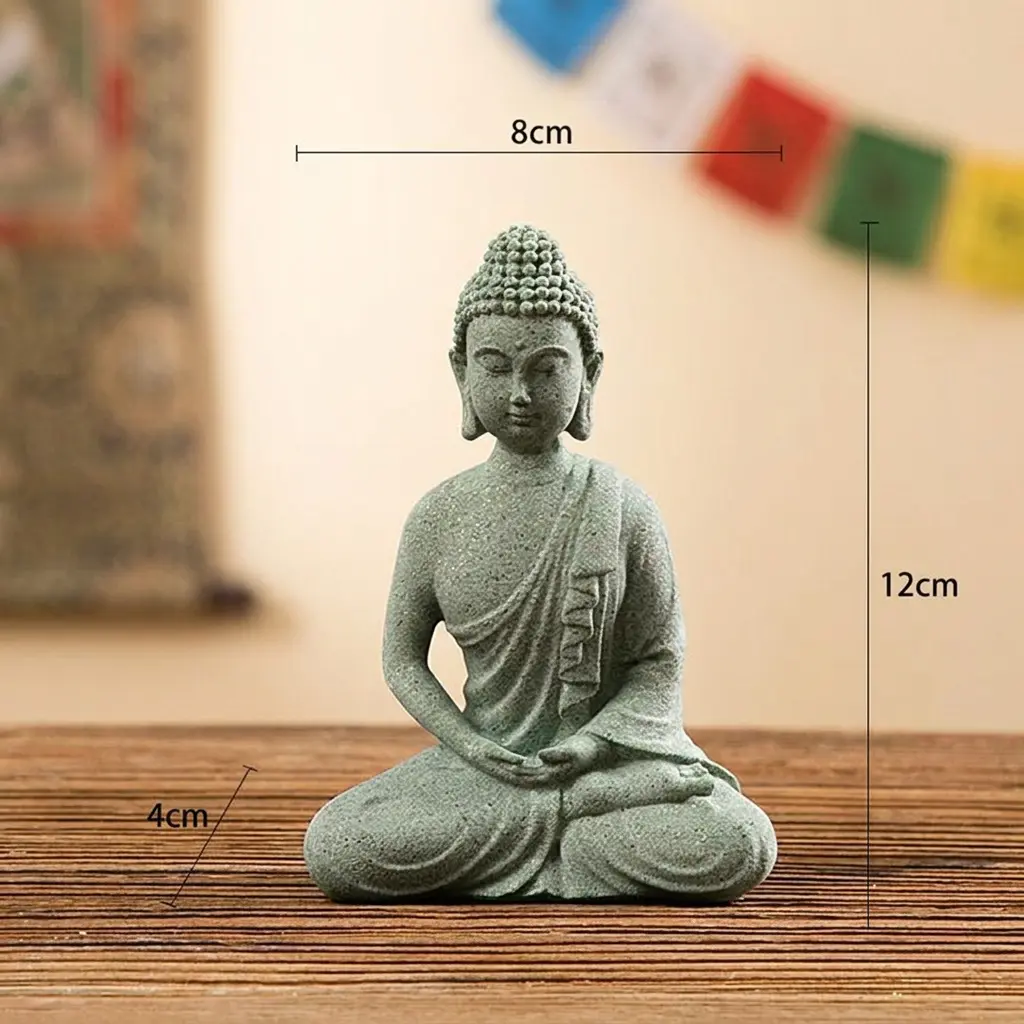
- Dhyana Mudra — Both hands rest in the lap in lotus position, right hand on top, palms facing upward. Represents deep meditation and concentrated inner peace. The most universally recognized seated posture. Best choice for any space dedicated to quiet focus, reflection, or formal meditation practice.
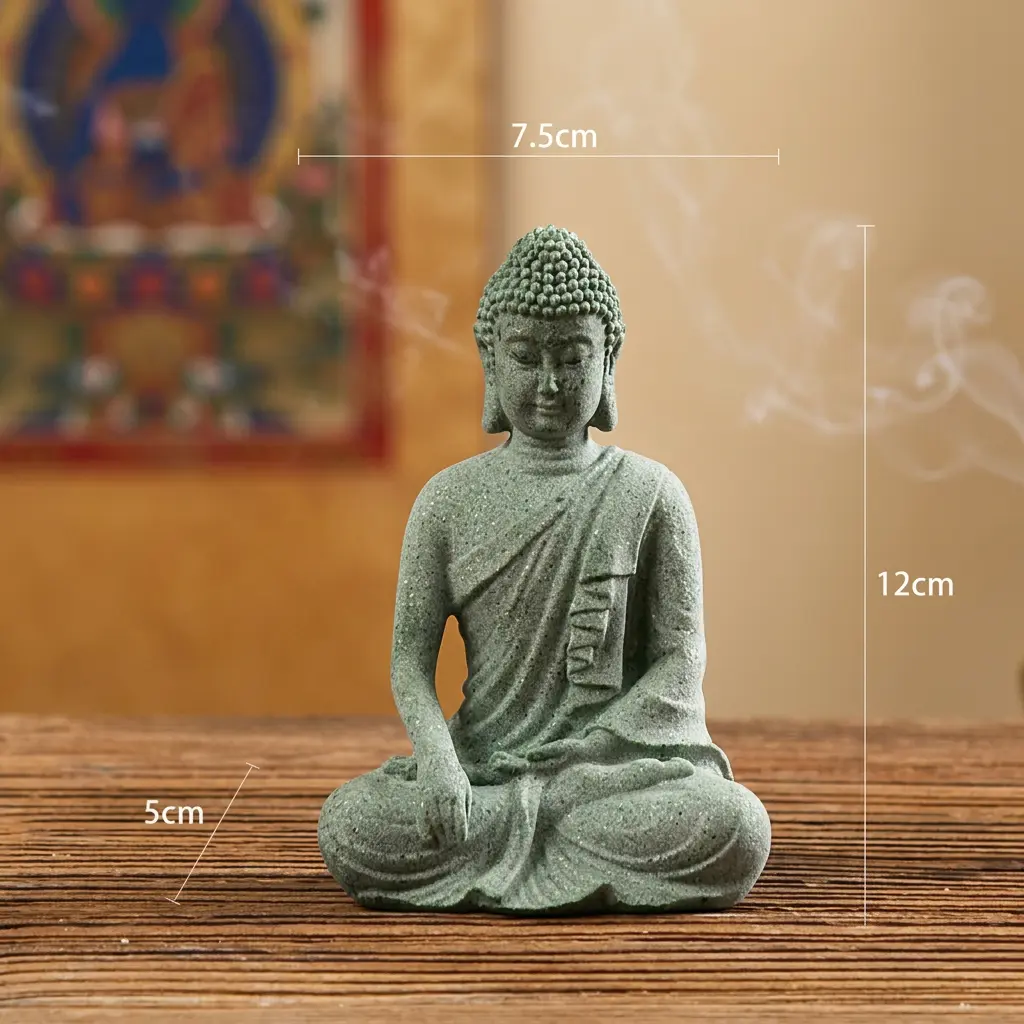
- Bhumisparsha Mudra — Right hand reaches down to touch the earth, left hand rests in the lap. This gesture recalls Buddha’s moment of enlightenment under the Bodhi tree, when he called the earth to witness his awakening after defeating Mara the demon of delusion. Statues with this mudra are traditionally placed facing east.
- Abhaya Mudra — Right hand raised, palm facing outward. Directly translates to fearlessness and protection. Commonly placed at home entrances to offer blessing and a sense of welcome safety to those who enter.
- Dharmachakra Mudra — Both hands held at chest height, thumbs and index fingers touching in a circle. Represents turning the Wheel of Dharma — Buddha’s first teaching at Deer Park after his enlightenment. The right choice for spaces of learning, teaching, or intellectual work.
- Varada Mudra — Left hand open, palm facing downward or outward. A gesture of giving, generosity, and compassion. Traditionally associated with offerings and blessings extended toward all living beings. Often paired with Abhaya Mudra in the same statue.
- Vitarka Mudra — Index finger and thumb touch in a circle while other fingers extend upward. Signals teaching and discussion. Less common than Dharmachakra but appropriate in scholarly and instructional settings.
- Karana Mudra — Index finger and little finger extended, the two middle fingers folded down and held by the thumb. Used to ward off negativity and dispel obstacles. One of the more powerful protective gestures in the Tibetan tradition, often misidentified online.
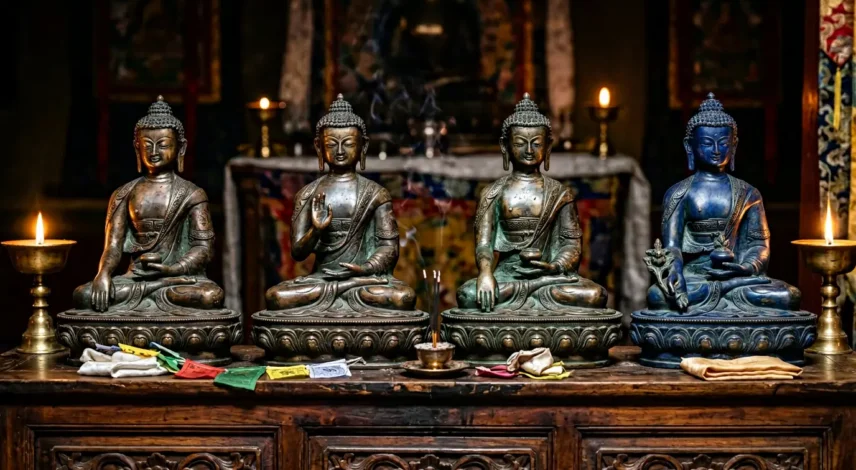
- Medicine Buddha Pose — Seated in lotus position with a deep lapis-blue body, the right hand resting on the knee in a giving gesture holding the myrobalan plant (a traditional healing herb), the left hand in the lap holding a bowl of medicine. Sangye Menla, the Medicine Buddha, is a fully distinct figure from Shakyamuni — central to Tibetan healing practice and barely mentioned in most Western buying guides. If your intention involves wellness, recovery, or supporting someone through illness, this is the statue to choose.
💡 根据我们的经验: 药佛是我们寺院供应商最需要的雕像之一,但几乎没有主流指南对此进行解释。在传统的藏传佛教祭坛中,药佛像被认为与释迦牟尼—一样重要,而不是补充。 浏览我们的药佛系列 如果这与你的意图产生共鸣。
Buddha Statue Materials: What Each One Means and How Long It Lasts
Material choice affects both the spiritual tradition a statue draws from and its practical durability — a bronze statue in the Tibetan tradition lasts over 100 years with basic care, while a resin composite rarely exceeds 15 years and holds no ceremonial significance.
| Material | Durability | Price Range (USD) | Tradition | Best For |
|---|---|---|---|---|
| Bronze / Brass | 100+ years | $60–$800+ | Central to Tibetan Buddhist altar practice | Home altars, serious practitioners |
| Copper (gilded) | 100+ years | $150–$1,200+ | Tibetan and Nepali — highest ceremonial grade | Monastery-quality home altars |
| Stone (sandstone, granite, marble) | Centuries outdoors | $80–$600 | Indian, Southeast Asian traditions | Gardens, outdoor shrines, statement pieces |
| Wood (teak, sandalwood, rosewood) | Decades with care | $40–$300 | East Asian and Chinese Zen traditions | Warm interior environments, gifting |
| Resin / Composite | 5–15 years | $15–$80 | Modern, non-traditional | Decorative use, budget purchases |
A warning worth knowing: A significant amount of “stone” statues sold online are actually resin cast with sand mixed in. They look and feel like sandstone but are composite material. A genuine stone statue will be noticeably heavier, often cold to the touch, and will show natural variation and slight imperfection in texture. If the weight feels off for the size, ask the seller directly about composition before buying.
For Tibetan Buddhist practice specifically, bronze — often with a gilded face and blue-black patina body — is the traditional choice. The metal is considered a pure, durable vessel that holds blessing energy reliably, and most consecration rituals in the Tibetan tradition are designed specifically for metal statues rather than wood or resin.
🪔 Looking for authentic bronze or copper statues handcrafted in Nepal? Browse Potala Store’s hand-selected bronze collection — each piece sourced directly from Kathmandu Valley artisans.
Buddha Statue Size Guide: Matching Dimensions to Your Space
Choose your Buddha statue size based on the distance from which it will be viewed, not on how it looks in a product photo. A 6-inch statue looks refined on a home altar but nearly disappears in a large living room. Here is a practical size chart based on placement context:
| Placement Location | Recommended Height | Notes |
|---|---|---|
| Desktop / bedside table | 3–5 inches (7–13 cm) | Viewed close-up; fine details in the face and mudra matter most |
| Bookshelf / windowsill | 5–8 inches (13–20 cm) | Allow at least 2–3 inches of clearance above the statue’s head |
| Home altar / dedicated shelf | 8–14 inches (20–36 cm) | In Tibetan tradition, the statue’s eyes should align at or just above seated eye level when practicing in front of it |
| Living room console or mantel | 12–20 inches (30–51 cm) | Scale to surrounding objects; allow negative space on either side |
| Floor placement / room focal point | 20–30 inches (51–76 cm) | The statue’s eyes should meet a standing adult’s eye level or above — never place below waist height without an elevated stand |
| Garden / outdoor shrine | 24–36 inches (61–91 cm) | Scale to surrounding plants; bronze and granite weather best; stone weathers better than cast resin outdoors |
| Entryway or corridor | 10–18 inches (25–46 cm) | Should be visible immediately upon entering; Abhaya Mudra (blessing/protection) is the traditional choice for this position |
One thing we learned working directly with Tibetan artisans and monastic traditions: a Buddha statue is never placed on the floor or below waist height. This is considered disrespectful in virtually all Buddhist lineages. If you have a small statue and your only option is a low shelf, a simple carved wooden base or altar box to raise it 4–6 inches resolves the concern while adding visual intention.

For home altar setups, the most effective combination is typically an 8–12 inch bronze statue on a raised wooden platform, with a small offering bowl and candle on either side. This is the standard configuration in Tibetan homes and creates a proportional focal point even in modest spaces.
Placement Principles Grounded in Buddhist Tradition and Feng Shui
Place your Buddha statue at or above eye level, facing the room’s main entrance, on a clean raised surface — these three rules cover the core of both traditional Buddhist respect and feng shui placement guidance.
- Height. Always at or above eye level when seated in practice, or at least waist height for a decorative placement. Never on the ground. Positive energy (chi) in feng shui theory rises and concentrates at upper levels, which aligns with the Buddhist principle that sacred images are treated with reverence rather than ignored underfoot.
- Direction. Traditionally, statues face the main entrance to welcome and protect those who enter the space. East-facing placement is preferred for Bhumisparsha Mudra statues — representing the direction Shakyamuni faced at Bodh Gaya during his moment of enlightenment. Feng shui guidelines generally favor east or north-facing orientation for calm, protective energy.
- Surface. Use a dedicated, clean surface. A simple altar cloth, wooden tray, or carved platform separates the statue from everyday objects and signals intentional placement. Avoid positioning near shoes, in bathrooms, or directly beside kitchen appliances.
- Surroundings. In Tibetan and Southeast Asian homes, a candle, a small water bowl, or fresh flowers placed beside the statue are traditional offerings — not decoration, but gestures of respect that create a sacred space around the object. This is optional for a purely decorative placement, but meaningful if your intent is spiritual.
- Bedroom. A meditating Buddha (Dhyana Mudra) is appropriate in a bedroom when placed at a comfortable height on a dresser or dedicated shelf. Avoid positioning any statue directly facing the bed. A side surface or corner placement is typically preferred.
Does Consecration Matter? What Most Buying Guides Don’t Tell You

A consecrated Buddha statue — filled with mantras, sacred herbs, and blessed through a formal puja ceremony by a qualified lama — carries a fundamentally different intention than a decorative sculpture, even when both look identical from the outside. This distinction is nearly absent from mainstream buying guides but is central to how Tibetan Buddhists choose, care for, and relate to their statues.
In the Tibetan tradition, a statue only becomes a true spiritual support (a rupa, or “representation body”) after it has been consecrated. The interior is packed with specific sacred substances: rolled mantra scrolls, dharanis (protective texts), medicinal herbs, and sometimes relic substances. The ceremony — called rab-ne in Tibetan — is performed by an authorized monk or lama and activates the statue as a living support for practice. Without this process, even a masterfully crafted bronze sculpture is viewed as a beautiful object, meaningful but not a functioning spiritual support.
The common question: does it matter if you are not Buddhist? For purely decorative purposes, no — consecration is optional. But if you are establishing a meditation altar, supporting a serious contemplative practice, or seeking a statue with genuine spiritual lineage, choosing a consecrated piece changes your relationship with it from the beginning.
At Potala Store, our monastery-sourced statues undergo a 3-day puja blessing ceremony conducted by resident monks at our partner monasteries — including Sera Jhe Monastery and Kopan Monastery in Nepal. Our founder, Yang Tso, witnessed the first of these consecration ceremonies in Lhasa and built our sourcing model around this standard. Every statue sold through our monastery program contributes 10% to ongoing monastery support and educational programs.
“The first time I saw a rab-ne ceremony at Sera Jhe, I understood why the Tibetan teachers insist on it. The ritual is not symbolic — it is the moment the object is understood to become something more than craft.” — Yang Tso, Potala Store founder
If you want to understand how to identify whether a statue has been filled and consecrated before purchase — and what questions to ask any seller — our guide to authentic Buddhist statues covers the specifics in detail.
Find Your Authentic Buddha Statue
Browse Potala Store’s collection of monastery-blessed bronze and copper statues — handcrafted in Nepal and Tibet, consecrated by resident monks, and shipped worldwide.Shop Blessed Buddha Statues →
Frequently Asked Questions
The best Buddha statue for a home depends on your intention. A Dhyana Mudra (meditation) statue in bronze or wood suits most spaces — it promotes inner peace and focus without being culturally specific to any single tradition. For the front entrance, an Abhaya Mudra (protection) statue is the traditional choice. For a study or workspace, a Dharmachakra Mudra teaching statue is appropriate. Start with your goal, then choose the pose.
Avoid placing a Buddha statue on the floor, in bathrooms, near shoes, or directly at ground level in high foot-traffic areas. In Tibetan and most Southeast Asian Buddhist traditions, a statue placed below waist height or in spaces associated with uncleanliness is considered disrespectful. Kitchens are also typically avoided unless there is a dedicated elevated shelf away from cooking areas.
Yes — many non-Buddhists display Buddha statues as symbols of peace, mindfulness, and spiritual aspiration. Respectful intent is what matters: treat the statue as a meaningful object rather than simple decoration, place it appropriately, and understand the tradition behind the object you’re choosing. Buying from suppliers who source authentically and support Buddhist communities — rather than mass-producing replicas with no cultural connection — is one practical way to honor that respect.
In most Buddhist traditions, Buddha statues face the main entrance of a room to welcome those who enter and offer protection or blessing. East-facing placement is specifically traditional for Bhumisparsha Mudra statues, representing the direction Shakyamuni Buddha faced during his enlightenment at Bodh Gaya. Feng shui guidelines generally suggest east or north-facing orientations for positive energy flow. The most important principle: the statue should face outward into the room, not toward a wall.
📚 References
- Buddhist Iconography and Mudra Traditions: Scholarly overview of hand gestures, postures, and iconographic conventions across Theravada, Mahayana, and Vajrayana traditions. Source: Smithsonian National Museum of Asian Art, Asia Collections — asia.si.edu (Search “Buddhist sculpture mudra” at asia.si.edu)
- Tibetan Buddhist Ritual Objects and Consecration: Research documentation on rab-ne consecration ceremonies, sacred filling materials, and the role of ritual objects in Vajrayana practice. Source: Rubin Museum of Art, New York — rubinmuseum.org
- Medicine Buddha (Sangye Menla) Practice and Iconography: Overview of the Medicine Buddha tradition, healing practice context, and standard iconographic attributes in the Gelug tradition. Source: Foundation for the Preservation of the Mahayana Tradition (FPMT) — fpmt.org
- Feng Shui and Sacred Object Placement: Cross-cultural comparison of Chinese feng shui and Tibetan Buddhist principles applied to statue placement in residential settings. Source: Learn Religions — learnreligions.com