
PotalaStore Meditation Starter Kit: Everything You Need to Begin Your Journey
 by Yang Tso
0 comments
by Yang Tso
0 comments
You’ve decided to start meditating — now you’re staring at a screen full of cushions, bells, and beads, wondering what you actually need. That decision paralysis is the single biggest reason beginners never sit down for their first session. The good news: a beginner meditation kit is far simpler than the internet makes it look.
At PotalaStore, we’ve spent years sourcing authentic Tibetan and Himalayan tools directly from the artisan workshops and monasteries where these objects are made. We’ve helped thousands of new practitioners build a daily mindfulness practice — and we’ve learned, clearly, which tools earn their place in a starter kit and which ones are just nice to look at.
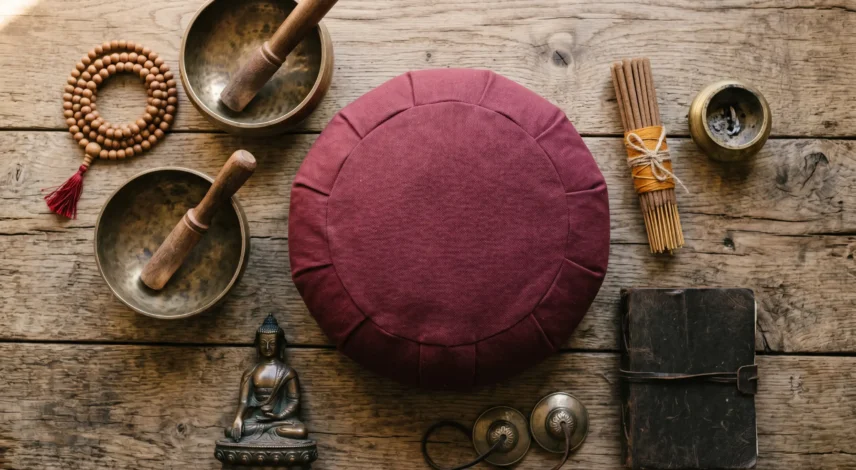
A complete meditation starter kit includes seven core tools: a zafu cushion for supported posture, mala beads for focused counting, a Tibetan singing bowl as your session anchor, Tibetan incense as a transition cue, tingsha bells for clear session boundaries, a simple altar focal point, and a reflection journal. Together, they address every practical need of a daily sitting practice — where to put your body, how to focus your attention, and how to mark the beginning and end of each session.
Below you’ll find exactly what each item does, how to use it step by step, and how to build your first seven days of practice around them.
What’s Inside a Complete Meditation Starter Kit?
A meditation starter kit is a curated bundle of essential tools that gives a new practitioner everything needed to sit comfortably, stay focused, and build a consistent daily practice. A complete kit includes seven items:
- Zafu meditation cushion — a round, buckwheat hull–filled seat that raises your hips above your knees, allowing the spine to stack upright without muscular strain
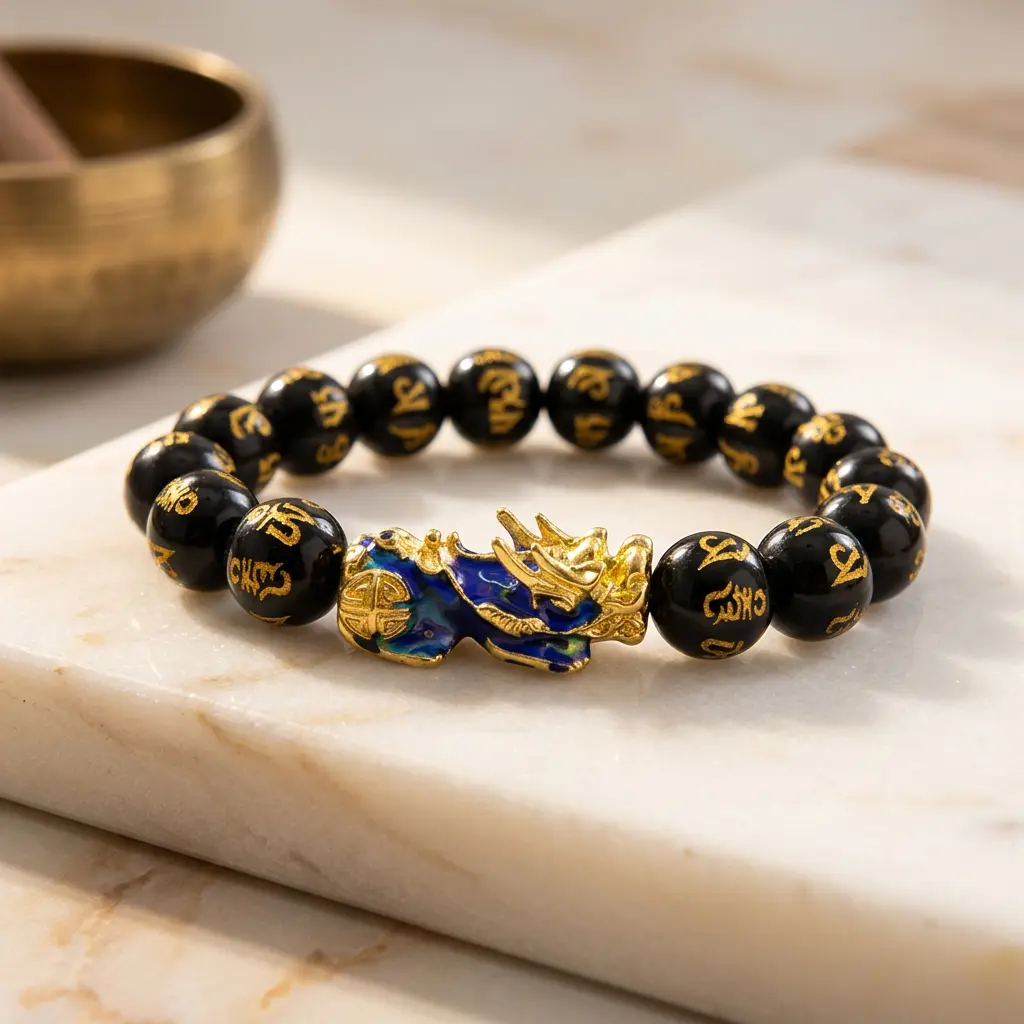
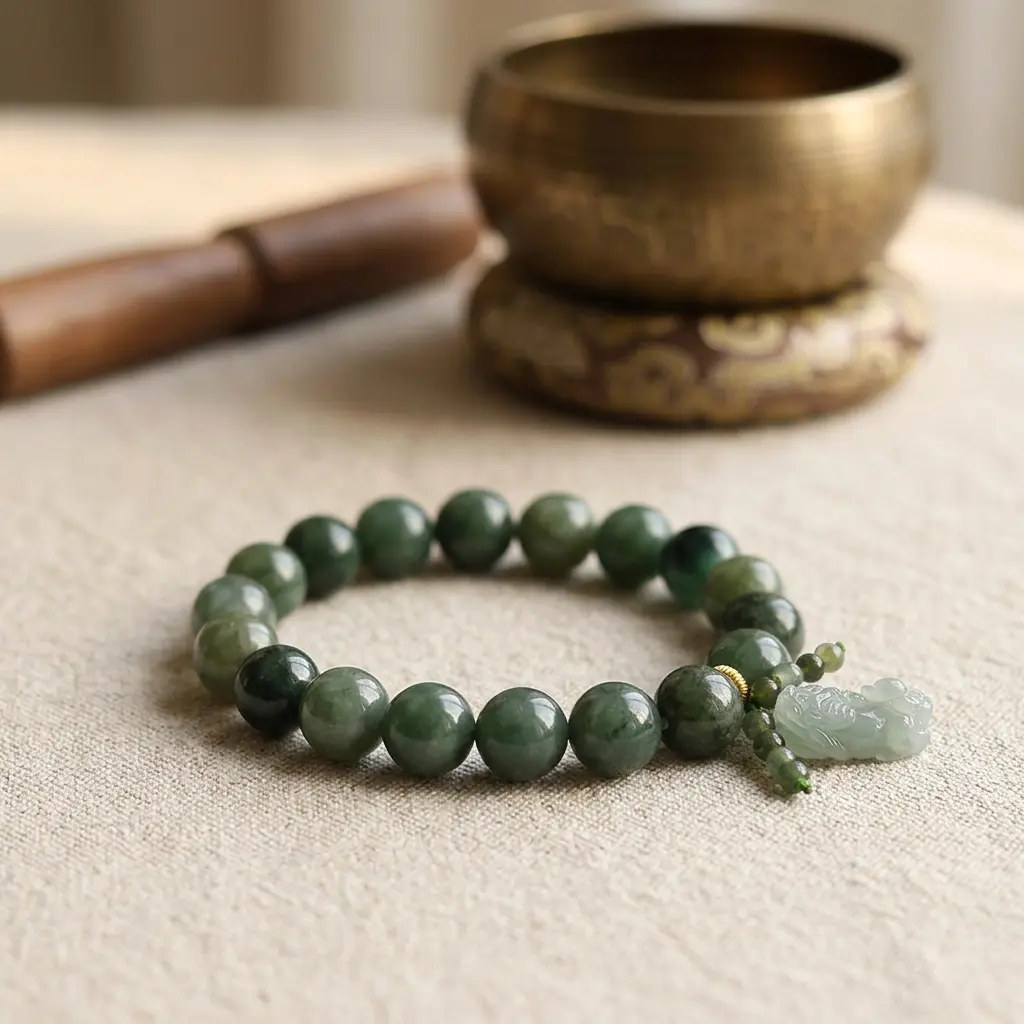
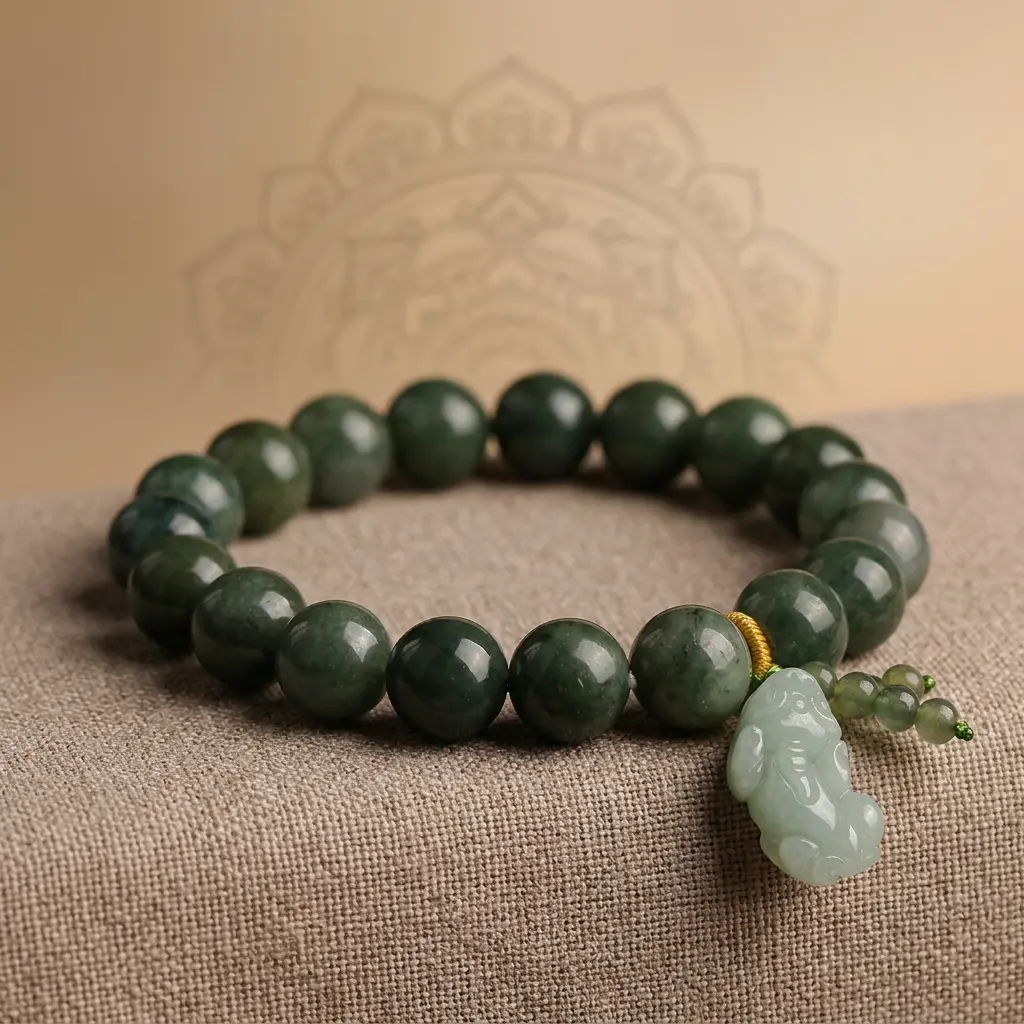
- Mala beads (108 beads) — a traditional Tibetan Buddhist string of prayer beads used to count breath cycles or mantra repetitions during seated meditation
- Tibetan singing bowl — a hand-hammered bronze bowl that produces two distinct resonant tones used to mark the opening and closing of each session
- Tibetan incense + holder — handcrafted sticks made from juniper, cedar, and sandalwood that serve as an olfactory cue, signaling to the mind that “practice time” has begun
- Tingsha bells — a pair of small brass cymbals struck together to produce a clear, penetrating tone; ideal as a clean start and stop signal
- Simple altar focal point — a candle, small statue, or printed image that gives your eyes a resting place and anchors your attention to the practice space
- Meditation journal or card deck — used for 2–3 minutes after each session to consolidate your experience and track patterns over time
You don’t need all seven items on day one. If you’re testing the waters, the three practical essentials are the zafu, a mala, and incense. Those three cover posture, focus, and session ritual — everything else adds depth over time.
Why Physical Anchors Build a Lasting Mindfulness Practice
You technically need nothing to meditate — just a quiet space and a willingness to sit still. But most beginners who try to start with nothing quit within two weeks. The reason is rarely lack of motivation; it’s the absence of sensory anchors that make sitting feel like a distinct, recognizable activity rather than just another thing you’re half-doing between tasks.
A 2019 study published in Behavioural Brain Research (Basso et al.) found that brief daily meditation — as few as 13 minutes per session — significantly improved attention, working memory, mood, and emotional regulation in beginners, but only after 8 continuous weeks of practice. The challenge isn’t the 13 minutes; it’s bridging the gap between week one and week eight without dropping off. Physical tools do exactly that.
Think about how brewing coffee signals “morning has started” before a conscious decision has been made. Lighting Tibetan incense works the same way — after a few weeks, that specific fragrance begins to shift your mental state toward focus and quiet before you’ve even settled onto the cushion. Your zafu sitting in the corner becomes a visual prompt. The singing bowl’s strike becomes a reliable on-switch for your nervous system. These aren’t spiritual gimmicks; they’re behavioral conditioning in service of a habit you want to keep.
The two practical pillars of a sustainable meditation practice are posture (handled by the cushion) and an attention anchor (handled by the mala, bowl, or incense). Get both in place, and sitting for 10 minutes a day begins to feel as automatic as brushing your teeth.
💡 Ready to commit? Explore PotalaStore’s authentic Tibetan meditation starter kits — handcrafted in Nepal and Tibet, assembled to give beginners exactly what they need and nothing they don’t.
How to Use Each Item — A Step-by-Step Primer
Most beginner guides list what goes in a meditation kit. This section shows you exactly how to use each one.
The Zafu Cushion — Getting Your Posture Right

A zafu is a round meditation cushion, typically 3–5 inches tall, filled with buckwheat hulls or kapok fiber. Its only structural job is to tilt your pelvis slightly forward, raising your hips above your knees. That small elevation allows your lumbar spine to sit in its natural curve without muscular effort — which is why you can sit on a zafu for 20 minutes without back pain, while sitting on a flat floor for the same time leaves you hunched and aching.
To sit correctly: place the zafu on a flat surface, sit in a cross-legged position (full lotus, half lotus, or simple cross-legged all work), and feel both sitting bones make even contact with the cushion. Let your hands rest on your thighs, palms up or down. Tuck your chin slightly to lengthen the back of your neck. Your gaze rests on the floor about two feet in front of you, or on your altar focal point.
If your knees are hovering above the floor, place a folded blanket beneath each knee for support. This is very common in new practitioners — tight hip flexors are the primary cause, and they loosen noticeably within 2–4 weeks of daily sitting.
Mala Beads — The 108-Count Technique
A mala is a string of 108 beads used in Tibetan Buddhist practice to count mantra repetitions or breath cycles. The number 108 has a canonical origin: the Mokugenji Sutra — one of the foundational texts in the Buddhist canon — records the Buddha instructing practitioners to thread 108 beads and recite the Buddha’s name one bead at a time, specifically to “eradicate 108 defilements” — the full range of mental afflictions that obscure clarity. This is the origin of every Buddhist mala from Tibet to Japan.
⚠️ Note on Spiritual Content: The traditional significance described here — including energy properties attributed to mala beads — reflects centuries of Buddhist practice and cultural belief, not scientific claims. Meditation as a habit-building and attention-training tool is research-supported; its spiritual dimensions are matters of personal faith and tradition.
To use a mala during meditation: drape it over your right hand, holding the beads between your thumb and middle finger. Move one bead per breath (a full inhale and exhale = one bead) or per mantra repetition. In Tibetan Buddhist tradition, the index finger is not used to hold or move the beads — it is associated with ego and points away from the practice. This is one of those technique details that most beginner guides skip entirely, but Tibetan practitioners consider it meaningful.
When you reach the guru bead — the larger central bead connecting both ends of the mala — stop, flip the mala around, and begin moving back in the opposite direction. Do not cross over the guru bead; the “flip and reverse” keeps the practice circling without a fixed end point. If you lose count, simply start again from the guru bead without judgment.
We’ve found that first-time mala users often rush through the beads, trying to complete all 108 as quickly as possible. There’s no hurry. The count is a tool for sustaining attention, not a race to be finished. If 108 feels like too many for a 5-minute session, use a wrist mala of 27 beads to count a shorter cycle.
For beginners, a sandalwood or bodhi seed mala is the most practical starting point — both materials are lightweight, comfortable to hold for extended periods, and widely used across Tibetan Buddhist practice.
Tibetan Singing Bowl — Strike vs. Rim Method

A Tibetan singing bowl produces two distinct sounds, and knowing which to use changes its function in your practice entirely.
The strike method: tap the outside wall of the bowl with the padded end of the wooden mallet. You’ll get a clean, bell-like tone that resonates and fades over 15–20 seconds. Use this to mark the definitive start and end of each sitting session — one strike to begin, one to close. The clarity of the sound creates a clear psychological boundary: practice is either happening or it isn’t.
The rim method: press the mallet against the outer rim of the bowl and move it in slow, even clockwise circles. After 5–10 seconds of steady circling, the bowl begins to sustain a deep, complex harmonic tone — this is the “singing.” Use this mid-session to bring a wandering mind back to the present. The sustained vibration gives the attention something to settle on.
Common beginner mistake: pressing too hard or moving the mallet too fast. Both kill the resonance and produce a buzzing or scratchy sound instead of the sustained tone. Lighten your pressure and slow the circle until the bowl opens up — it usually takes about 30 seconds to find the right touch on a new bowl, and it’s immediately satisfying when you get it right.
Browse PotalaStore’s hand-hammered Tibetan singing bowls — each one sourced from metalworking workshops in the Kathmandu Valley, where this craft tradition has been continuous for over four centuries.
Tibetan Incense — The Transition Ritual
Traditional Tibetan incense is made from juniper, sandalwood, cedar, and medicinal herbs, following formulas developed in Himalayan monasteries where incense is used daily in ritual practice. Unlike Indian or Japanese incense varieties, authentic Tibetan incense burns slowly: one stick lasts 30–45 minutes, long enough to scent the entire duration of a standard beginner session.
The practical role of incense is behavioral: scent is processed by the olfactory bulb, which sits directly adjacent to the limbic system — the region governing emotion and memory. After a few weeks of lighting incense before every session, the fragrance alone begins to cue a calm, attentive mental state. You’re conditioning your nervous system to recognize what “practice time” feels like, using a sense that bypasses conscious thought entirely. It’s one of the simplest and most underrated tools in a beginner’s kit.
Light the incense 1–2 minutes before sitting, place it in a holder to your left or in front of your altar, then let it work in the background. No further attention is needed — the scent will do its quiet work while your eyes close and your breath settles.
Setting Up a Meditation Space at Home

You don’t need a dedicated room. A 3×3-foot corner is enough — space for your cushion, a small table or shelf for your bowl and incense, and a focal point for your eyes. What matters far more than the size of the space is whether you use it consistently.
Choose a specific corner and return to it every day. Consistency of location is almost as important as consistency of time. Your brain will begin to associate that exact spot with a quiet, focused state — and over several weeks, simply walking into that corner begins to shift your mental mode before you’ve even sat down. The space trains you as much as you train in it.
In Tibetan Buddhist tradition, an altar is oriented facing east, toward the direction of dawn, with the practitioner seated so they also face east. If your apartment layout doesn’t allow it, don’t worry — the directional tradition is a cultural preference rooted in symbolism, not a structural requirement for an effective practice. The real purpose of any altar arrangement is to orient your attention, not to comply with a rule.
A practical beginner altar needs only three things: something elevated (a low table, a wooden crate, a shelf at eye level when sitting), something that holds your gaze (a candle, a small Buddha or Tara statue, a thangka print, or a natural object), and your mala, draped nearby when not in use. Keep your singing bowl and incense holder within arm’s reach. You can add to this altar slowly over months — but even this minimal version creates a place your mind will learn to respect.
Your First 7 Days: A Beginner Practice Plan
The most common beginner mistake is starting with a 20-minute session and burning out by day three. Start short, add tools progressively, and let each item earn its role in your practice through repeated use.
| Day | Duration | What to Do | Tools in Use |
|---|---|---|---|
| Days 1–2 | 5 minutes | Sit comfortably and follow the breath. When attention drifts, gently return — no self-criticism. | Zafu cushion + incense |
| Days 3–4 | 7 minutes | Add mala counting: one bead per complete breath cycle (inhale + exhale). Count through one full round of 108 or fewer if time runs short. | Zafu + incense + mala beads |
| Days 5–6 | 10 minutes | Strike the singing bowl once to begin. Sit with breath and mala counting. Strike the bowl once to close. The bookend tones create a clear session container. | Zafu + incense + mala + singing bowl |
| Day 7 | 15 minutes | Full session using all tools. After closing, spend 2–3 minutes writing in your journal: What was easy? What was difficult? What changed by the end? | Full kit (all seven items) |
By day seven, you’ll have used every item in the kit at least twice and will have a clear, personal sense of which tools are most valuable to your practice. Most new practitioners find that the mala beads are most useful for sustaining focus, and the singing bowl strike is most useful for anchoring the beginning and end. But every practice is different — follow what actually works for you.
Choosing Your Tibetan Meditation Kit by Budget
You don’t need to buy everything at once. Below is a simple framework for building your kit based on where you’re starting from — and what level of commitment you’re ready to make.
| Tier | What’s Included | Best For | Approx. Price |
|---|---|---|---|
| Minimalist | Mala beads + incense bundle (20–30 sticks) + holder | Testing meditation for the first time; students and travelers | $30–$50 |
| Standard | Zafu cushion + mala beads + small singing bowl + 30-stick incense set | Committed beginners building a daily home practice | $80–$150 |
| Complete Altar | Zafu + zabuton mat + master-grade singing bowl + full mala + tingsha bells + curated altar incense set | Practitioners setting up a permanent home practice space | $200+ |
If you’re unsure which tier to choose, the Standard kit is the most practical investment for someone genuinely committed to a daily practice. The zafu alone makes a significant difference in how long you can sit without discomfort — and a zafu you don’t own is the single most common reason beginners cut sessions short from knee or lower-back pain.
Every piece in a PotalaStore kit is made by artisan workshops in Nepal and Tibet — not mass-produced reproductions. Authenticity here is not a marketing claim; it’s visible in the hand-hammered irregularities on a singing bowl, the hand-rolled texture of a Tibetan incense stick, and the individual knot at each bead of a hand-strung mala. A portion of every order supports our artisan giving fund, which has contributed to Himalayan craft communities since the store’s founding.
Ready to Begin Your Practice?
Browse authentic Tibetan meditation starter kits — from minimalist starter sets to complete altar collections — handcrafted by Himalayan artisans and shipped directly to your door.Shop Meditation Starter Kits →
Frequently Asked Questions
Start with 5 minutes per day for the first two weeks, then build gradually toward 10–15 minutes. Research by Basso et al. (2019) found that 13 minutes of daily meditation produced measurable improvements in attention, memory, and mood — but only after 8 consecutive weeks of practice. Consistency matters more than duration. Five minutes every single day is more effective than 30 minutes three times a week.
You don’t need one if you sit in a chair — but if you’re sitting on the floor, a proper zafu cushion makes a significant practical difference. Without one, most beginners develop knee or lower-back discomfort within 5–10 minutes, which forces the session to end early. A zafu’s buckwheat hull filling raises your hips above your knees, allowing the spine to sit upright naturally. Most practitioners who skip the cushion regret it; most who get one use it for years.
A mala is a string of prayer beads used in Buddhist (and Hindu) practice to count mantra repetitions or breath cycles during meditation. The number 108 comes from the Mokugenji Sutra, a canonical Buddhist text in which the Buddha instructs practitioners to thread 108 beads and recite the Buddha’s name once per bead, specifically to “eradicate 108 defilements” — a concept encompassing the full range of mental afflictions that obscure clarity. This teaching is the origin of every Buddhist mala tradition, from Tibetan practice to Japanese and Southeast Asian Buddhism.
A Tibetan singing bowl has two playing methods: the strike method (tap the outer wall with the padded mallet for a clear bell tone lasting 15–20 seconds — use this to begin and end each session) and the rim method (press the mallet against the outer rim and circle clockwise with steady, even pressure until the bowl sustains a deep resonant hum — use this mid-session to refocus a wandering mind). Beginners: if the bowl buzzes instead of sings, lighten the pressure and slow the circling. The right touch is lighter than most people expect.
📚 References
- Brief Daily Meditation and Cognitive Benefits: Basso, J.C., McHale, A., Ende, V., Oberlin, D.J., & Suzuki, W.A. (2019). Brief, daily meditation enhances attention, memory, mood, and emotional regulation in non-experienced meditators. Behavioural Brain Research, 356, 208–220. PubMed ID 30153464 (via Unbound Medicine)
- Mindfulness-Based Stress Reduction (MBSR): Overview of Jon Kabat-Zinn’s evidence-based 8-week MBSR program developed at the University of Massachusetts Medical School. A foundational framework for research on daily meditation practice duration and outcomes. Wikipedia — Mindfulness-based stress reduction
- Buddhist Prayer Beads — Mala Origins and Tradition: Historical and doctrinal overview of the japa mala (Buddhist prayer beads), including the canonical origin in the Mokugenji Sutra and the significance of the 108-bead count across Buddhist traditions. Wikipedia — Japamala
- Tibetan Buddhist Mala Symbolism and Use: Detailed explanation of the origins, symbolism, and correct use of a Buddhist mala with 108 beads, including the role of the guru bead. Kagyu Samye Dzong — Buddhist Mala Guide