
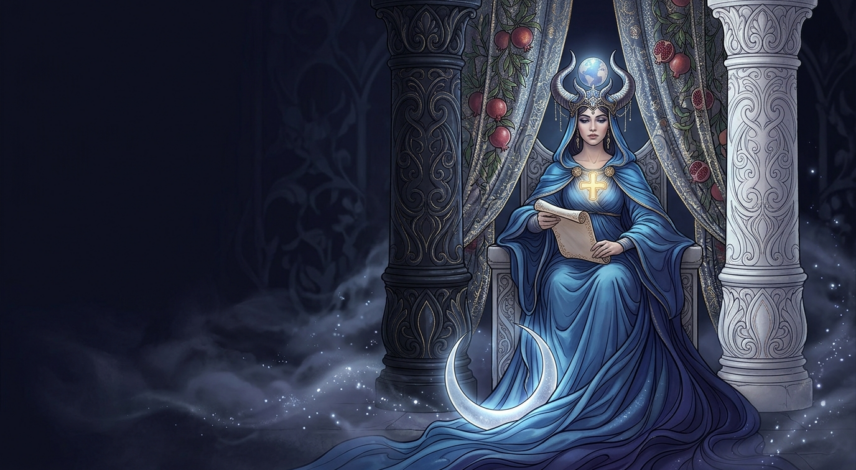

If you just pulled the High Priestess, here is the short answer. She is card II of the Major Arcana, and she asks you to trust your intuition before you act. In the Rider-Waite-Smith tarot deck, she sits between two pillars and guards knowledge that has not yet surfaced.
This guide covers her symbols, her history, her upright and reversed meanings in love and career, and why tarot sources disagree on yes or no. At PotalaStore, we traced the card back to the Visconti-Sforza Popess in the Morgan Library & Museum catalog. We also compared six yes-or-no pages in November 2026.
Table of Contents
What Does the High Priestess Tarot Card Mean?
The High Priestess is card II of the Major Arcana, and she is traditionally associated with intuition, sacred knowledge, the subconscious mind, and the divine feminine. Upright, she asks you to pause and trust your inner voice. Reversed, she is often read as secrets, self-doubt, or a disconnection from intuition.
In the Fool’s Journey, the Magician (card I) shows you how to act on will. The High Priestess follows with the opposite skill: receiving. She values mystery and stillness over quick answers.
In a reading, she often appears when the answer exists but cannot be proven yet: a hunch about a job offer, a pause in a conversation, or a detail that does not add up.
New to the deck? Our guide to all 78 tarot card meanings, from the Major to the Minor Arcana, shows where she fits.
Is the High Priestess a Good Card to Get?
In most readings, the High Priestess is a positive but quiet card: she rewards patience and inner listening rather than fast action. Think of her as a pause button, not a warning. She does not promise an outcome. She asks you to notice what you already sense.
Why She Is Card II (and Why Some Guides Call Her the Third Card)
The High Priestess is numbered II. Because the Fool is card 0, she is the third card you meet in the Major Arcana sequence. The number 2 signals duality, which her black and white pillars repeat. The sequence begins with the Fool, card 0 of the Major Arcana, then moves to the Magician at card I.
From La Papesse to Pamela Colman Smith: Where Card II’s Symbols Come From
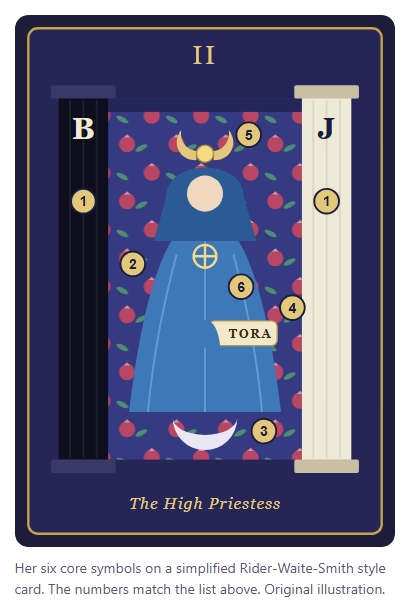
Before she was the High Priestess, she was the Popess. Her key Rider-Waite-Smith symbols are:
- Black and white pillars: Boaz (B) and Jachin (J) frame the card as duality.
- Pomegranate veil: a decorated curtain hides what lies beyond her.
- Crescent moon: a lunar crescent at her feet links her to intuition and cycles.
- TORA scroll: a half-hidden scroll marks knowledge shared only with the ready.
- Horned crown and globe: a diadem Waite described, often compared to Isis.
- Blue robe and solar cross: flowing water-blue robes fall below a cross on her chest.
The Popess in Renaissance Milan
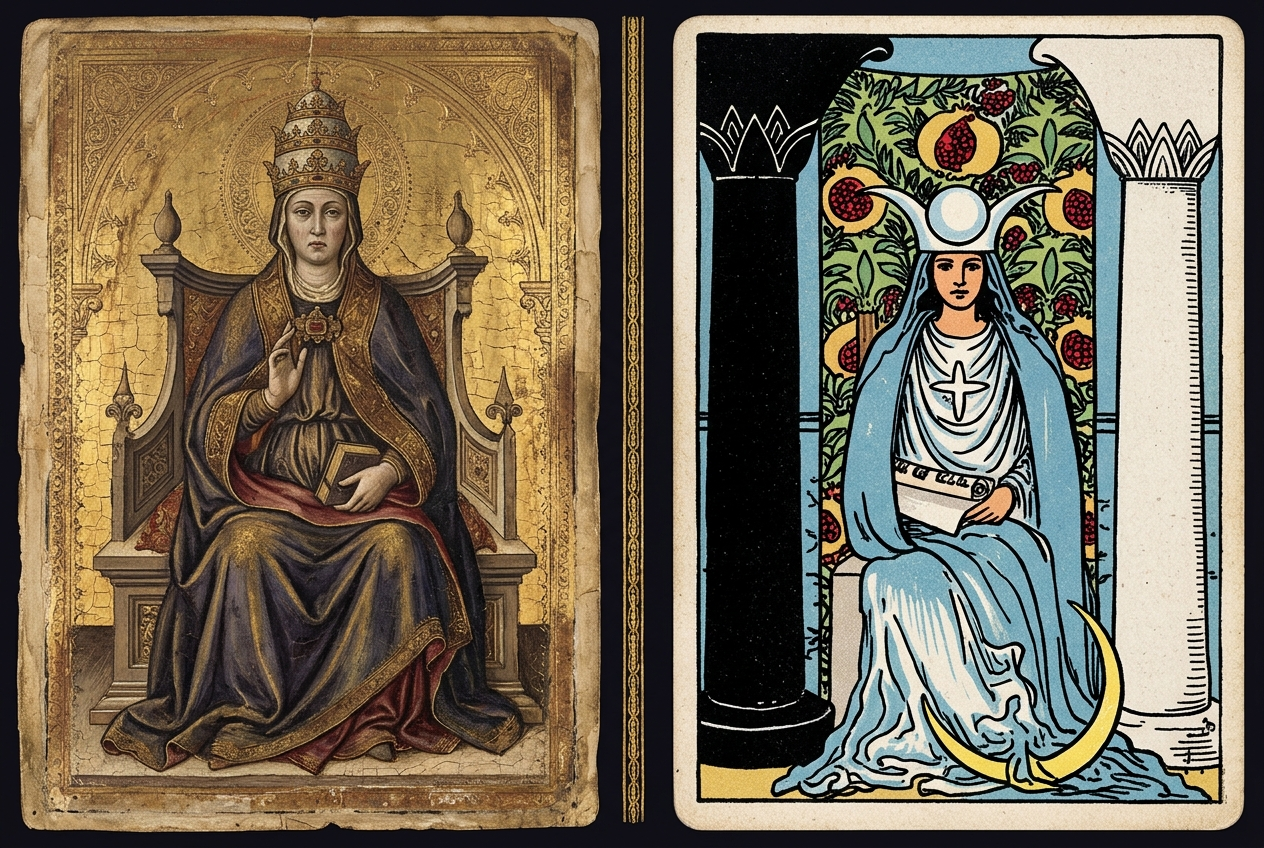
La Papesse, the Popess, appears on a hand-painted Visconti-Sforza card made in Milan in the mid-15th century. The Morgan Library & Museum in New York catalogs it as MS M.630, no. 3. The museum attributes it to the painter Bonifacio Bembo and dates the set to about 1450 to 1480. The card measures about 6.8 x 3.4 inches (173 x 87 mm).
Tarot began as a card game in fifteenth-century Italy, and fortune-telling use came later. Scholars including Gertrude Moakley and Michael Dummett have suggested the Popess may portray Sister Manfreda, a Milanese nun executed for heresy around 1300.
In the Tarot de Marseille, she keeps the name La Papesse and wears a papal-style crown. The Rider-Waite-Smith deck (1909) renamed her the High Priestess. Pamela Colman Smith drew the card under A. E. Waite’s direction and gave her the pillars, veil, and crescent moon most readers know today. Other decks, such as the Thoth deck, redraw her with very different imagery.
Boaz and Jachin: The Black and White Pillars
The black pillar marked B is Boaz (“in his strength”), and the white pillar marked J is Jachin (“he will establish”). Together they frame the card as duality. Both names come from the two bronze pillars at the entrance of Solomon’s Temple. Many readers see her seat between them as the middle path between opposites, such as light and dark or conscious and unconscious.
The Pomegranate Veil, Crescent Moon and Half-Hidden Scroll
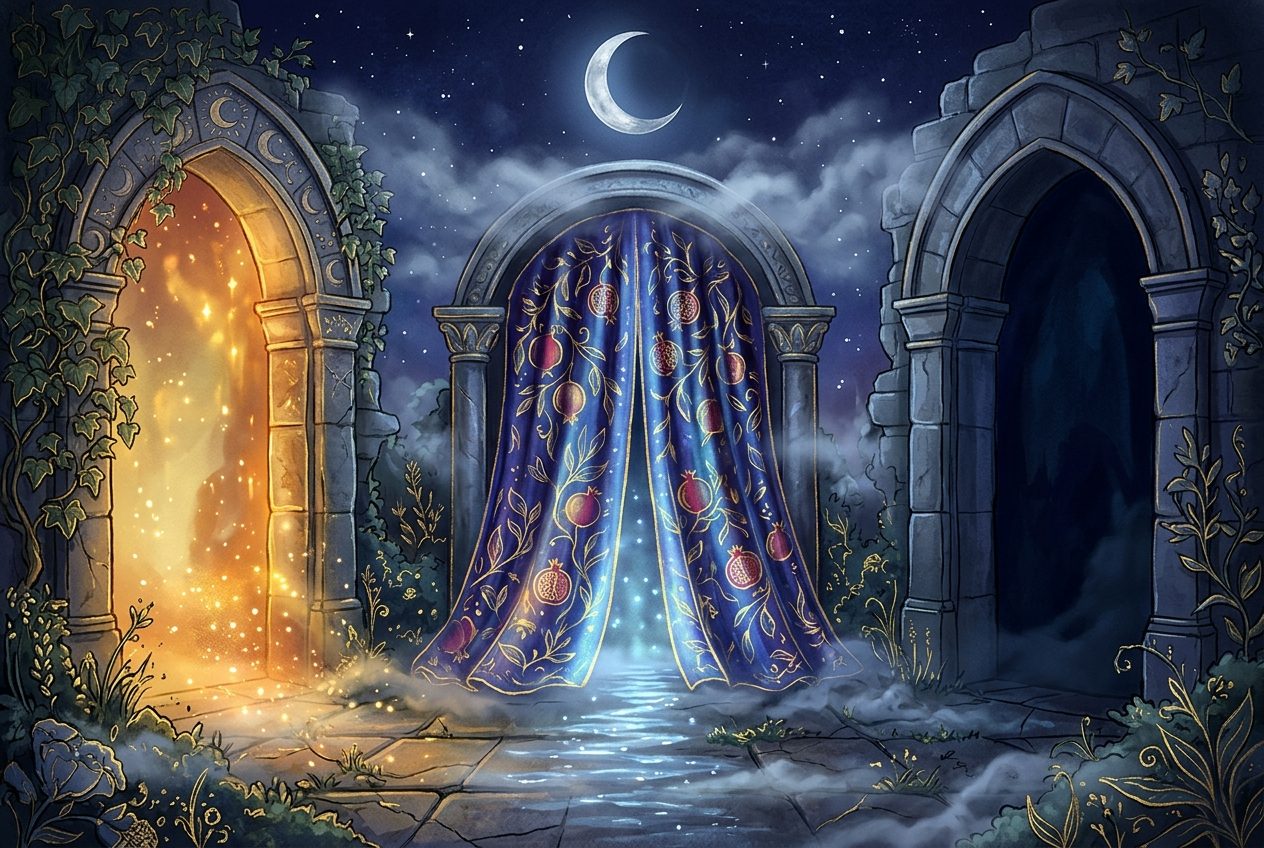
Behind her, a veil decorated with pomegranates hides what lies beyond. Pomegranates link to Persephone, who ate pomegranate seeds in the underworld, so the veil suggests knowledge that is not meant for casual viewing.
A crescent moon rests at her feet, tying her to lunar cycles and intuition. In her hands, a scroll marked TORA is partly hidden under her robe. Many readers take that as a sign that deeper teaching reaches only those who are ready.
A. E. Waite described a horned diadem with a globe at its center and a large solar cross on her chest. Writers often compare the crown to the headdress of the Egyptian goddess Isis.
Upright vs. Reversed Meaning in Love, Feelings and Career
Upright, the High Priestess points to trusted intuition and quiet knowing. Reversed, she is often read as secrets, self-doubt, or ignoring what your gut already senses.
| Theme | Upright | Reversed |
|---|---|---|
| Core meaning | Intuition, sacred knowledge, quiet knowing | Secrets, disconnected from intuition, withdrawal |
| Love | Emotional depth, patience, unspoken understanding | Hidden information, emotional distance, repressed feelings |
| Feelings | A deep, private pull kept quiet | Confusion, suppressed feelings |
| Career | Observe before acting, study, seek mentors | Office secrets, ignored instincts |
| Money | Keep finances private, wait for full information | Decisions made on missing information |
Keywords synthesize the lists from Biddy Tarot, Labyrinthos, and Dark Forest Tarot Cards.
What Does the High Priestess Reversed Mean?
The High Priestess reversed usually means your inner voice is being drowned out. That does not make it a bad card. Other people’s opinions, overthinking, or secrets and hidden agendas on either side can all muffle what you sense.
Biddy Tarot lists secrets, withdrawal, and silence among her reversed themes. Labyrinthos adds repressed intuition, hidden motives, and superficiality. A. E. Waite’s own 1910 keywords for the reversed card are passion, moral or physical ardor, conceit, and surface knowledge, which is why older and modern guides sometimes read her differently.
If she lands in a tense reading, take a breath. She points to a pause, not a verdict. Ask yourself: where am I asking everyone except myself?
What Does the High Priestess Mean in Love?
In love readings, the High Priestess points to emotional depth, patience, and things felt but not yet said. If you are single, she often describes a connection built slowly with someone who values your inner world. If you are partnered, she asks you to notice what stays unspoken. Read as someone’s feelings, she shows a deep, private pull that the person has not voiced.
The High Priestess in Career and Money Readings
In career readings, she advises you to observe, study, and gather information before you act. A mentor or a quiet period of research often fits her energy. In money readings, she suggests keeping finances private and waiting for complete information before a big decision. Tarot can prompt reflection, but it is not financial advice.
Is the High Priestess a Yes or No Card? Why Readers Disagree
Tarot sources split on the High Priestess in a yes-or-no spread: some read her as “maybe” or “not yet,” some as a yes, and some as a conditional yes. The split exists because she represents information that has not surfaced yet, not a clear outcome.
We compared six yes-or-no pages in November 2026 and recorded each answer for the upright card. Where a page also stated a reversed answer, we recorded that too.
| Source | Upright answer | Reversed answer |
|---|---|---|
| Dark Forest Tarot Cards | Maybe | Not recorded |
| Deckaura | Maybe, or “not yet” | Not recorded |
| Astrostyle | Yes | Not recorded |
| Tarostarot | Yes | No |
| Sibyl Tarot | Conditional yes | Hesitant no |
| Tarot Atlas | Yes, with conditions | No, depending on attitude |
“Not recorded” means we did not capture a reversed answer from that page.
Two pages say maybe, two say yes, and two say yes with conditions. None of the six gives an unconditional no for the upright card. All three pages that record a reversed answer lean toward no. What surprised us: none of the six pages explained why it disagrees with the others.
Why Sources Split on This Card
Readers who emphasize waiting answer “maybe.” Readers who emphasize trusting intuition answer “yes.” Readers who treat the reversed card as blocked intuition answer “no.” Each answer follows from a different reading of the same theme.
How to Read “Maybe” in Practice
When the High Priestess answers “maybe,” treat it as a request for more information, not a stalemate. Try these three steps:
- Pull one clarifying card. Let it show what is still missing.
- Reword the question. Ask, “What do I need to know before deciding?”
- Check the neighboring cards. They show whether the missing piece is information, patience, or trust.
Magician, Empress or Hierophant? Telling the Neighboring Cards Apart
The Magician acts, the High Priestess listens, and the Empress creates. Card I turns will into action, card II turns inward to hidden knowing, and card III turns that knowing into visible abundance.
| Card | Number | Mode | Keyword | Correspondence |
|---|---|---|---|---|
| The Magician | I | Active, conscious | Manifestation | Mercury |
| The High Priestess | II | Receptive, inner | Intuition | Moon |
| The Empress | III | Creative, outward | Abundance | Venus |
| The Hierophant | V | Structured, public | Tradition | Taurus |
What Is the Difference Between the High Priestess and the Empress?
The High Priestess knows, while the Empress brings forth: one holds hidden knowledge inside, and the other turns it into visible growth. Many writers treat the two as sisters, one guiding seekers toward hidden mysteries and the other nurturing life in the visible world. Myth gives a second clue: she echoes Persephone, who knows the underworld, while the Empress echoes Demeter, goddess of the harvest.
When She Appears Next to The Moon or The Hierophant
The Moon (card XVIII) shares her lunar imagery but leans toward illusion and confusion. The Hierophant (card V) teaches openly what she keeps veiled. Beside the Moon, ask what is real. Beside the Hierophant, ask whose teaching you trust.
Working With Card II: Correspondences, Moonstone and a Quiet Practice
The High Priestess corresponds to the Moon, the element of Water, and the Hebrew letter Gimel, so many readers pair her with lunar stones such as moonstone.
Element, Planet, Zodiac and Hebrew Letter at a Glance
| Aspect | Detail |
|---|---|
| Number | II (2) |
| Planet | Moon |
| Element | Water |
| Hebrew letter | Gimel (camel) |
| Zodiac | Cancer (most common) |
Cancer is the most common zodiac match because the Moon rules that sign, though some decks assign Pisces, Virgo, or Taurus. PotalaStore’s zodiac crystal guide pairs Cancer with moonstone for intuition and emotional balance.
Moonstone and Labradorite: Stones Traditionally Paired With Her
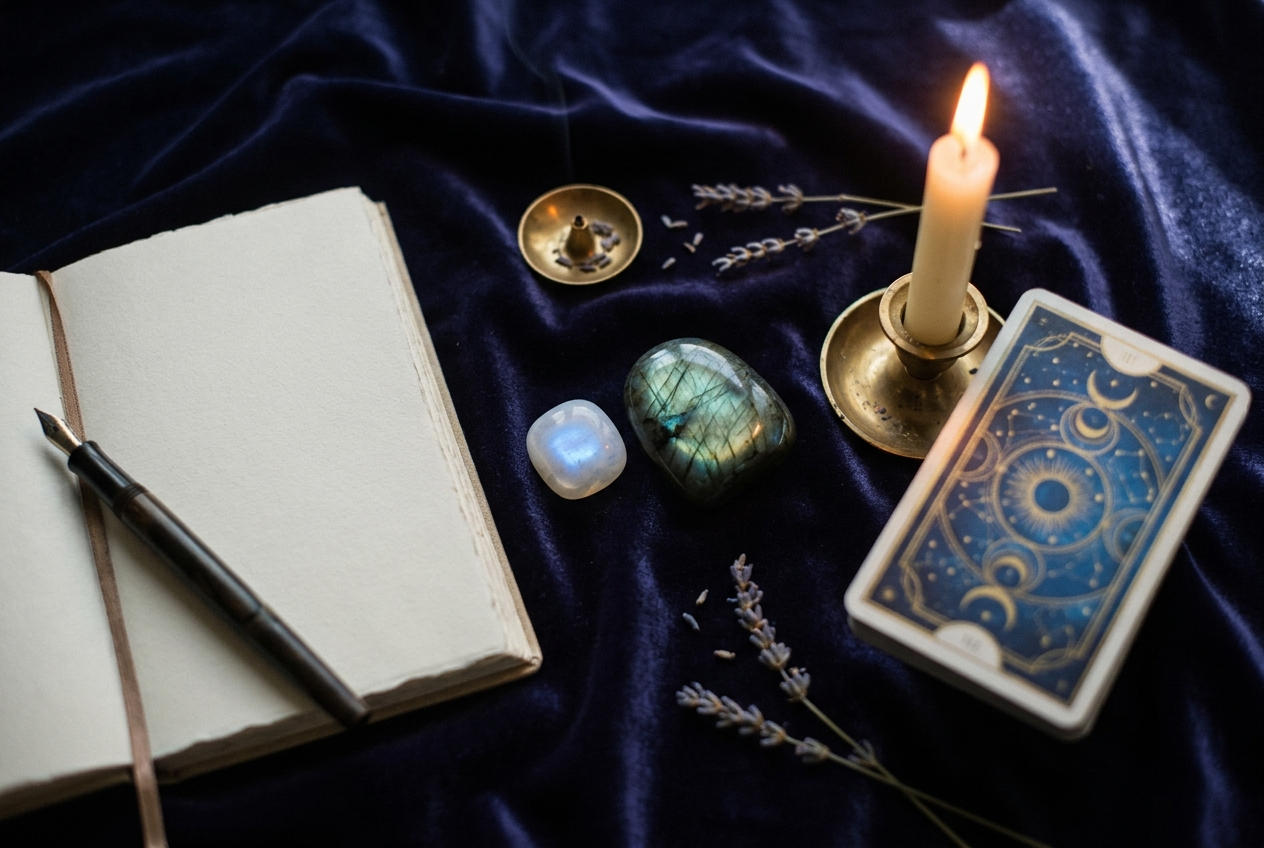
Many readers pair the High Priestess with moonstone, which echoes her lunar link, and labradorite, which is traditionally chosen for intuition work. Both are feldspar minerals rated about 6 to 6.5 on the Mohs scale, so they scratch more easily than quartz. Wipe them with a soft damp cloth and skip hot water.
For your tarot altar: The Dragon’s Heart labradorite necklace uses genuine natural labradorite selected for visible labradorescence. That blue-green flash shifts as the light moves. It gives you a small visual cue to pause and listen when you draw a card or write in your journal.
The listing gives a weight of 40 to 50 grams (about 1.4 to 1.8 oz) and an adjustable sliding-knot cord, so you set the length. It also makes an easy gift for a friend who is learning tarot this holiday season.
A Five-Minute “Veil” Journaling Practice
This five-minute practice works like a short meditation with a pen:
- Dim the lights (30 seconds). Place the card where you can see it.
- Hold a stone (30 seconds). Hold the card and a moonstone or labradorite, and take three slow breaths.
- Ask the question (30 seconds). Say or write, “What is still hidden from me?”
- Write without editing (3 minutes). Keep the pen moving, even if the words feel unfinished.
- Pull one clarifier (30 seconds). Draw one more card and note the first word that comes to mind.
These prompts borrow from the idea behind Labyrinthos’s High Priestess spread. For a larger layout, try one of our 10 beginner tarot spreads.
Frequently Asked Questions
In many tarot traditions, the High Priestess is one of the cards most associated with intuition and psychic sensitivity. Readers usually treat her as encouragement to trust subtle impressions, not as proof of any special power.
In a future position, she is often read as a period of learning, waiting, or a truth coming to light in its own time. Treat it as a cue to gather information before acting, not as a fixed prediction.
Moonstone is traditionally paired with her because of her link to the Moon, and labradorite is often chosen for intuition work. To get started, browse our natural crystal collection and pick the stone you will actually keep beside your deck.
As a birth card, the High Priestess is commonly interpreted as a life path shaped by intuition, inner study, and quiet wisdom. Many readers see it as an invitation to value your inner life as much as your outer achievements.
The key takeaway: the High Priestess tarot card does not hand you answers. She asks you to listen for the ones you already hold, to wait for complete information, and to treat your intuition as evidence worth examining.
Ready to build your tarot altar?
Choose a stone to keep beside your deck, then keep learning the Major Arcana card by card.
Shop PotalaStore crystals Read more tarot card guides
Important note: Tarot is a tool for reflection and is traditionally interpreted, not predictive. The meanings in this guide reflect tarot tradition and reader experience, not scientific evidence, and the stones mentioned are offered as focus aids, not treatments. This content is for educational purposes and does not replace medical, legal, financial, or mental health advice.
How we wrote this: This guide follows the Rider-Waite-Smith tradition. We checked historical details against the Morgan Library & Museum catalog and Wikipedia, compared keyword lists from Biddy Tarot and Labyrinthos, and reviewed six yes-or-no pages in November 2026. Last updated 11/09/2026.
References
- The Popess (Visconti-Sforza Tarot, MS M.630, no. 3): Catalog record for the mid-15th-century Milan card. The Morgan Library & Museum
- The High Priestess Tarot Card Meanings: Keywords, symbols, and reversed readings. Biddy Tarot
- The High Priestess Meaning: Upright and reversed meanings by theme. Labyrinthos
- The High Priestess: History, naming, and quotations from A. E. Waite’s The Pictorial Key to the Tarot. Wikipedia