
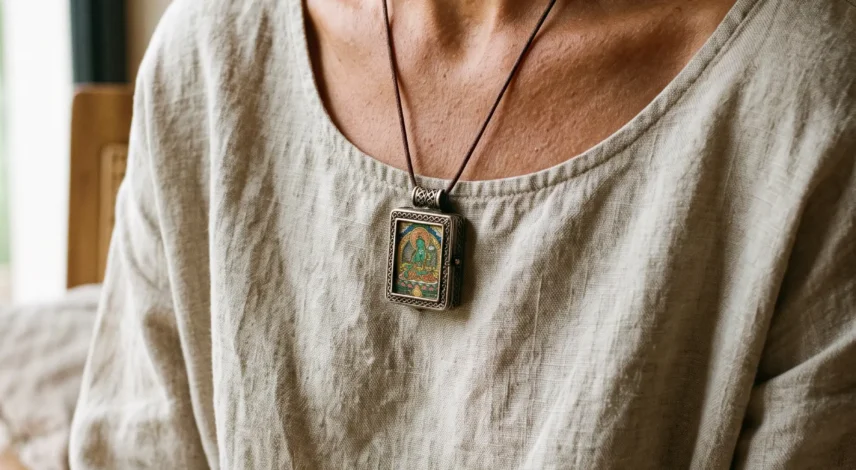

Still deciding between Green Tara and White Tara? Look at her feet first. If one leg extends outward as if she is ready to stand, she is Green Tara, the Tibetan Buddhist female Buddha traditionally called on for swift protection. If both legs are folded and her palms show eyes, she is White Tara, traditionally associated with long life, healing, and calm.
Both appear on thangka paintings, in meditation mantras, and on pendants. So the choice usually comes down to the moment you are wearing her for. This guide gives you a 10-second way to tell them apart, what each color and mantra means, and which one fits you.
At PotalaStore, we checked every symbol below against museum and encyclopedia sources, and we point out where those sources disagree. We also tell you plainly which Tara pendants we sell and which we do not.
⚠️ Important Note: This guide describes traditional Tibetan Buddhist beliefs for cultural and educational purposes. It is not medical advice, and no pendant, mantra, or image promises a spiritual or health outcome. If you or someone you love is ill, medical care comes first.
Table of Contents
What Is the Difference Between Green Tara and White Tara?
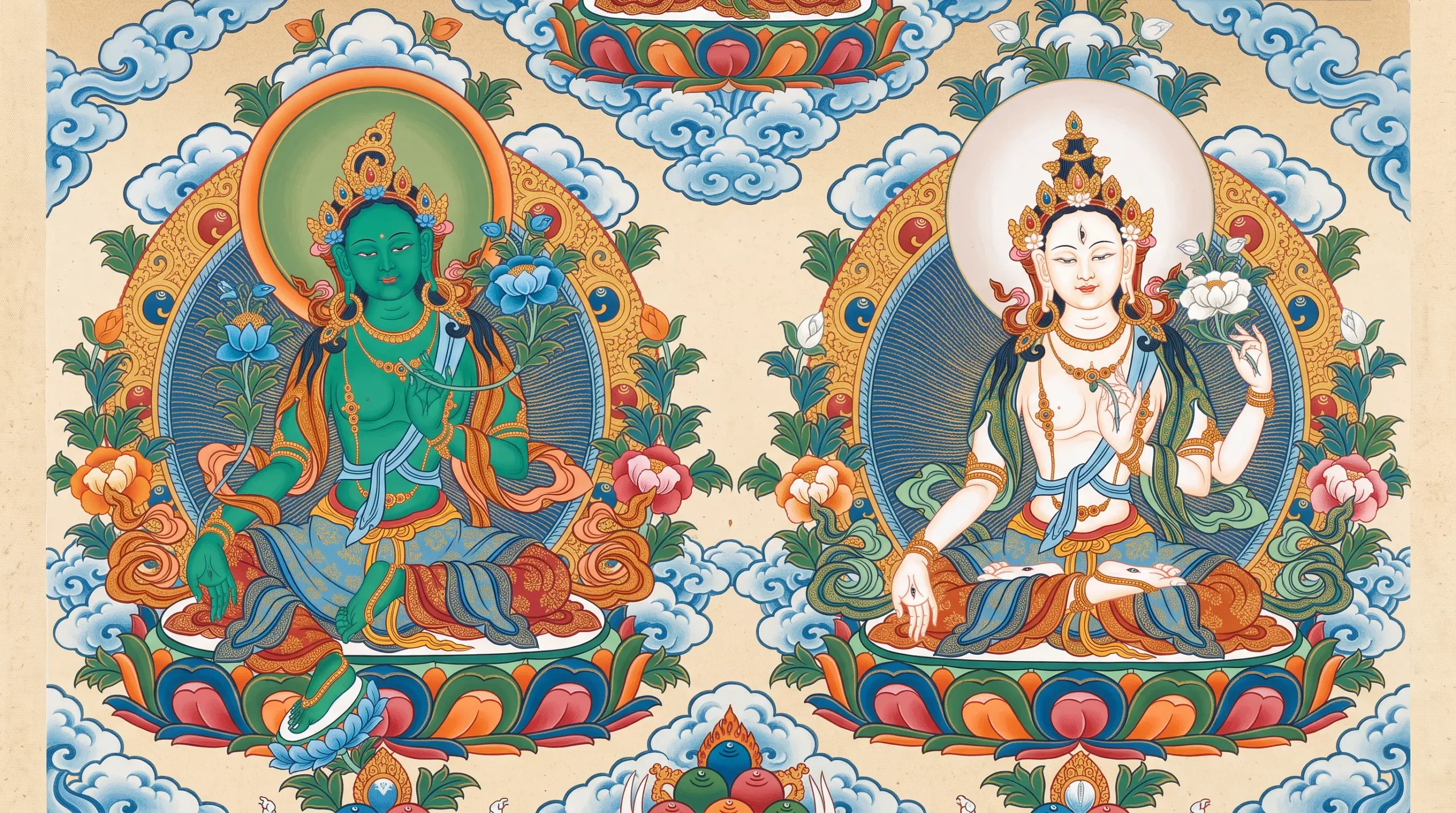
Green Tara and White Tara are two forms of the same Tibetan Buddhist female Buddha. Green Tara, shown with one leg extended, is traditionally associated with swift protection from fear and obstacles; White Tara, seated in full lotus with seven eyes, is associated with long life, healing, and calm.
Himalayan Art Resources describes the pair as two activities of one Tara. White is linked with longevity, and green is linked with activity of every kind. Think of them as the same friend in two moods: one already standing up to help, one sitting with you through the long night.
Britannica records a widely told legend that Tara was born from a tear of Avalokiteshvara, the bodhisattva of compassion. That origin is why compassion sits at the center of both forms.
Green Tara vs White Tara at a Glance (Comparison Table)
Here is the side-by-side view most people need before choosing a pendant.
| Feature | Green Tara | White Tara |
|---|---|---|
| Body color | Green | White |
| Posture | Right leg extended, left leg drawn in | Full lotus, both legs folded |
| Eyes | Usually two | Usually seven |
| Traditional association | Swift protection and action | Long life, healing, calm |
| Mantra | Om Tare Tuttare Ture Soha | Same root, plus a long-life line |
Are Green Tara and White Tara the Same Deity?
Yes and no: tradition treats them as two forms of one awakened Tara, but each has her own image, mantra, and practice. Himalayan Art Resources notes that, in one tradition, White Tara is a long-life emanation of Green Tara.
Many lineages practice both, so you will see them side by side in the same temple. Other teachers treat them as separate practices with separate lineages. That is why you will find slightly different answers depending on the source.
Where the Sources Disagree
Three details vary between museums, encyclopedias, and teachers. Knowing them keeps you from being thrown off when a piece does not match a blog post.
- White Tara’s eyes: Himalayan Art Resources counts seven (three on the face, one on each palm, one on each sole). Britannica says she is sometimes shown with eyes on her palms and soles, and the Rubin Museum’s description of a 15th-century brass White Tara mentions only the face and palms.
- Green Tara’s third eye: Some artists add a visible third eye on the forehead and others do not, so eyes are not a reliable test for Green Tara.
- The two queens: In the legend of Tibet’s early king and his two foreign wives, Britannica pairs White Tara with the Chinese princess and Green Tara with the Nepalese princess. Some texts reverse the pairing.
What Do the Colors Mean? Green Activity vs. White Purity
In Tibetan art, color works like a job description: green signals fast action, and white signals purity and the steady work of long life. The colors are not decoration. They tell you what kind of help each Tara is traditionally asked for.
Why Is Green Tara Green? Swift Activity and the Wind Element
Green is traditionally linked with Amoghasiddhi’s activity family and the wind element, which is why Green Tara is called the swift one. Wind moves fast, so green stands for help that arrives before the problem grows.
Traditional texts also list eight fears she is invoked against. If you only remember one thing, remember this: green means action, not waiting.
Why Is White Tara White? Purity, Moonlight, and Long Life
White Tara’s color stands for purity, and she belongs to a small group of long-life deities in Tibetan Buddhism. The Rubin Museum places her with Amitayus and Ushnishavijaya as the three deities associated with long life. It also calls her one of the most popular female deities across Tibetan traditions.
That long-life role explains why White Tara is often paired with Amitayus, the Buddha of Longevity, when families commission images for an elder. Himalayan Art Resources lists the three together as the Three Long-life Deities. We come back to that pairing in the “Which Tara Should You Wear?” section.
How Can You Tell Them Apart in Art and Jewelry?
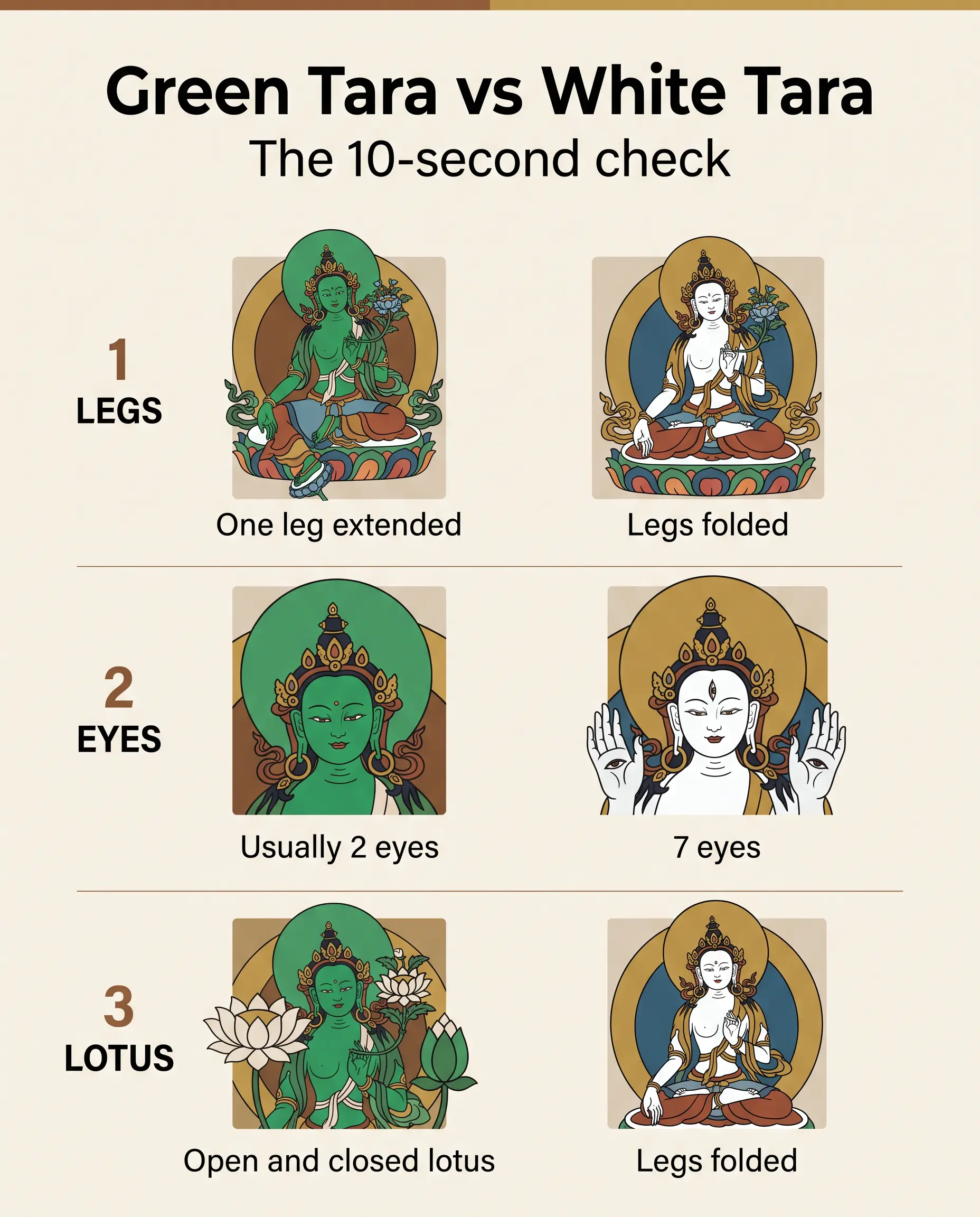
You can identify either Tara in about 10 seconds by checking three things in order: her legs, her eyes, and her lotus.
- Check her legs. One extended leg means Green Tara. Both legs folded means White Tara.
- Count the eyes. Seven eyes (face, palms, soles) means White Tara. Two or three eyes with an extended leg still means Green Tara.
- Look at the lotus. Contrasting lotus symbols, one open and one closed, often mark the pair.
Clue 1: One Leg Extended Means Green Tara
Green Tara sits with her right leg extended and her left drawn in, a posture Himalayan Art Resources lists for her principal forms, showing she is ready to rise and help. Our Green Tara pendant symbols and 5 buying checks guide shows this posture on real jewelry.
On pieces this small, palm eyes shrink to dots, so we check the legs first. The legs are the one detail that stays readable at pendant size.
Clue 2: Seven Eyes Mean White Tara
White Tara is usually shown with seven eyes, three on her face and one on each palm and sole, symbolizing compassion that sees suffering everywhere. Remember the caveat from earlier: some images show eyes only on the face and palms.
If you can see eyes on her palms, you are almost certainly looking at White Tara. If you cannot, fall back on the legs.
Clue 3: Check the Lotus
Britannica describes the pairing of an open lotus and a closed lotus as a sign of compassion that works both day and night. It is a helpful supporting clue when a piece shows lotus stems, though it is not as quick as the legs.
See it up close: Our hand-painted Ga Wu box pendant with a Green Tara thangka lets you check the extended-leg detail for yourself.
Which Mantra Belongs to Each Tara?
Both Taras share the same root mantra, Om Tare Tuttare Ture Soha; White Tara’s version adds a request for increased life, merit, and wisdom. A mantra is a short sacred phrase repeated during meditation, often counted on a mala.
The Green Tara Mantra: Om Tare Tuttare Ture Soha
The Green Tara mantra has ten syllables and is widely known across the Himalayan region, according to the Rubin Museum. A simple way to say it is “OM TAH-ray too-TAH-ray TOO-ray SO-ha.”
Teachers commonly explain it as a progression: Tare frees you from suffering, Tuttare from the eight fears, and Ture gives true benefit. It is short enough to repeat quietly on a commute or before a hard conversation.
The White Tara Long-Life Mantra, Line by Line
White Tara’s mantra keeps the Green Tara root and adds a wish: “mama ayur punye jnana pushtim kuru,” traditionally read as “may my life, merit, and wisdom increase.”
The added line is what makes it a long-life practice. Say it respectfully, the way you would treat a prayer from someone else’s tradition. Formal visualization practices are traditionally taught after an empowerment, so ask a teacher before going further than the mantra itself.
Which Tara Should You Wear? Matching Your Intention, Moment, and Format
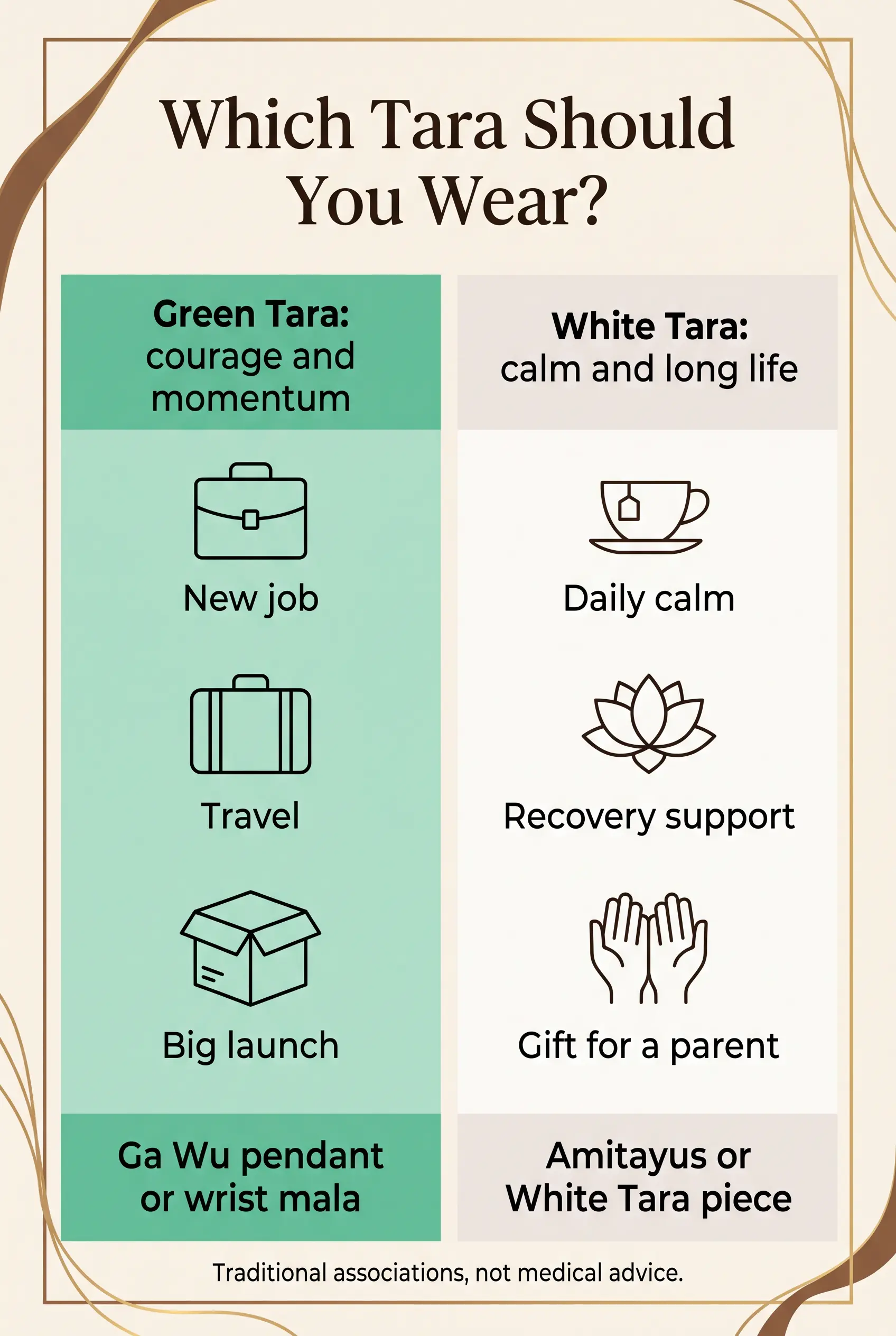
Choose Green Tara for seasons that ask for courage and momentum, and White Tara for seasons of recovery, aging parents, or a need for calm; many people simply wear the one that matches the moment. The table below turns that into a quick match.
| Your moment | Tara traditionally linked | Suggested format |
|---|---|---|
| New job, move, or big launch | Green Tara | Ga Wu box pendant |
| Travel or a stretch of anxiety | Green Tara | Wrist mala for mantra counting |
| Recovery after illness (as support, not treatment) | White Tara | Pendant or card gift |
| Gift for an aging parent | White Tara or the long-life family | Amitayus thangka pendant |
| Daily calm and meditation | Either | The one you will actually wear |
Choose Green Tara When You Need Courage and Momentum
Green Tara suits moments when you need to act: a first day, a hard conversation, a long drive. She is a reminder, not a guarantee.
Made of white copper, our Ga Wu box pendant measures 1.85 x 2.22 in (47 x 56.3 mm), so the Green Tara thangka sits in a pendant you can open and wear every day. That gives you a small, visible cue to walk in with courage. It is $68.95 (regularly $93.95) as of 10/29/2026, and the style range includes a Green Tara option among 14 designs. Our 60-day returns policy lets you judge the real piece before you commit.
Choose White Tara When You Want Calm, Healing Support, or Long Life
White Tara is traditionally invoked for long life and healing, so many people wear or gift her during recovery or for an aging parent, alongside, never instead of, medical care.
We don’t currently carry a White Tara design, and we’d rather tell you than sell you the wrong deity. If long life is your intention, our 3D hand-painted thangka pendant in Green Tara or Amitayus style is the closest match. Amitayus, the Buddha of Longevity, belongs to the same long-life group as White Tara in Himalayan Art Resources, and the Rubin Museum notes that Amitayus images are often commissioned for a practitioner’s long life.
The 3D pendant comes in 16 styles, including Green Tara and Amitayus, on an adjustable cotton cord. It is $68.95 (regularly $93.95) as of 10/29/2026 and has a 4.33 out of 5 rating from 3 reviews, which is a small sample.
Pendant, Thangka, or Wrist Mala: Which Format Fits Your Day?
Pick the format by how you will use it: a Ga Wu box works as a wearable shrine, a 3D thangka pendant shows the most detail, and a wrist mala lets you count her mantra discreetly. A wrist mala, commonly 21 beads, suits a desk job or a commute where a pendant feels too visible.
If you are unsure how many beads you need, our guide to wrist mala vs full mala explains when each one makes sense.
Ready to choose? Compare both thangka pendants on PotalaStore, or browse PotalaStore’s Tibetan pendant necklaces. The Ga Wu box is the pick for Green Tara, and the 3D pendant covers Green Tara and Amitayus.
Can You Wear Green Tara and White Tara Together?
Yes; tradition treats them as complementary forms of the same Tara, and many practitioners keep both on an altar or in daily practice. A simple pairing is one pendant plus one wrist mala. We suggest avoiding several deity images stacked on a single chain, which tends to look cluttered and feels less respectful.
If you are building a small set of protective pieces, the deities behind other Tibetan protection amulets and the deities behind them are explained in our amulets guide.
How Do You Wear a Tara Pendant Respectfully?
Wear a Tara pendant above the waist, take it off for showers and sleep, and treat it as a sacred image rather than a costume piece; that is most of the etiquette. You do not need to be Buddhist to wear her. You just need to wear her with care.
Placement, Chain Length, and When to Take It Off
For most adults, a 16 to 20 in chain puts a pendant at or just below the collarbone; larger 2 in Ga Wu boxes sit better on a 20 to 22 in cord. Taking it off for showers and sleep protects the painted panel and the cord, and it keeps the piece clean.
| Pendant height | Suggested chain or cord length |
|---|---|
| 1 to 1.5 in | 16 to 18 in |
| 1.5 to 2 in | 18 to 20 in |
| Over 2 in | 20 to 22 in |
“Blessed” Claims and Gifting Etiquette
In Tibetan Buddhism, images are traditionally consecrated through a ritual called rab gnas, performed by qualified monks or lamas, so ask any seller who blessed a piece and how. A Reiki blessing is a Japanese practice and a different thing, so make sure you know which one a seller means. Our Tibetan jewelry authenticity checklist walks through the questions worth asking.
If you are giving a Tara piece as a gift, add a short card so the recipient knows what they are wearing. For example: “This is Green Tara, a Tibetan Buddhist symbol of swift compassion. I thought of you.” It takes ten seconds and avoids any awkward guessing.
In summary, Green Tara vs White Tara is not a contest. Pick Green Tara when you need courage and action, pick White Tara or an Amitayus piece when you want calm and long life, and let the legs, eyes, and lotus confirm which is which.
Frequently Asked Questions About Green Tara and White Tara
Yes. Tradition treats them as two complementary forms of one Tara, and many practitioners honor both. A simple pairing is one pendant plus a wrist mala, rather than two deity images stacked on one chain.
No. Many teachers say non-Buddhists can wear Tara imagery and recite her short mantra respectfully. Formal visualization practices are traditionally taught after an empowerment from a qualified teacher, so ask a local center if you want to go deeper.
Britannica notes that Tibetan temple banners often show 21 Taras in white, red, and yellow, grouped around a central Green Tara. Himalayan Art Resources indicates that the Green Tara and long-life White Tara forms come from separate lineages, so the answer depends on the system you follow.
White Tara is traditionally associated with long life and healing, so she is a common choice as a gesture of care, never a substitute for medical treatment. Add a short card explaining who she is, and if you want a wearable option, compare the deity styles on our thangka pendant page.
Find the Tara That Fits Your Moment
Browse PotalaStore’s hand-painted Tibetan thangka pendants, with 60-day returns so you can see the real piece before you decide.Shop Tibetan Pendant Necklaces →
📚 References
- Tara (Buddhist goddess): Overview of Tara’s origins, forms, the 21 Taras, and the open and closed lotus symbolism. Encyclopaedia Britannica
- White Tara (C2005.16.34): Museum catalog entry for a 15th-century brass White Tara, including her place among the long-life deities. Rubin Museum of Art
- Tara iconography, Green and White: Visual references for posture, eyes, and attributes. Himalayan Art Resources (Green Tara) and Himalayan Art Resources (White Tara)
- Tara in Tibetan Buddhist practice: A practitioner-oriented introduction for readers who want to go deeper. Lion’s Roar