
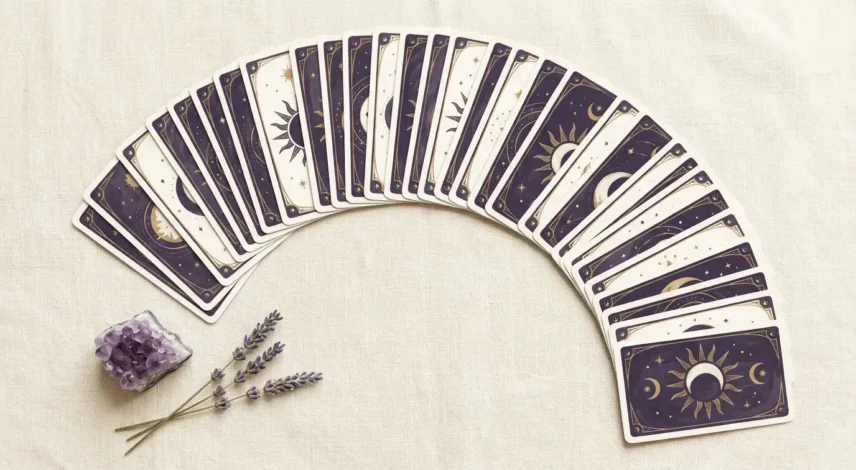

A tarot deck holds 78 cards, split into 22 Major Arcana that mark life’s big turning points and 56 Minor Arcana that cover everyday experience. If 78 sounds like a lot to learn, here is the reassuring part: you do not have to memorize a list. Learn a few patterns, and you can read almost any card on sight.
This guide explains all 78 tarot card meanings in the Rider-Waite-Smith tradition, the 1909 system that most modern decks follow. You get upright and reversed keywords for every card, the four suits and their elements, and a simple method for decoding the numbers and court cards.
At PotalaStore, we work with Himalayan artisans and spend our days around the intuition tools that readers reach for, from amethyst to malas. That lens shapes this guide. Alongside the standard meanings, we point out which calming, focus-building tools pair naturally with a reading, so the cards fit into a real practice rather than sitting in a box.
⚠️ A note before you begin: Tarot is best used for reflection and self-discovery, not fixed prediction. The meanings below draw on traditional symbolism and how many readers interpret the cards, not scientific evidence. Treat the cards as a mirror for your own thinking, and this guide becomes far more useful.
Table of Contents
How Many Tarot Cards Are There?
A tarot deck has 78 cards: 22 Major Arcana and 56 Minor Arcana. The Major Arcana carry the biggest symbolic weight and point to major life themes. The Minor Arcana describe the texture of daily life, from love and money to conflict and work.
Once you see the deck this way, it stops feeling random. Every card belongs to a group, and every group has a clear job. That structure is the fastest way in.
Major Arcana vs Minor Arcana
The Major Arcana holds 22 cards numbered 0 through 21, each standing for a life lesson or turning point. The Minor Arcana holds 56 cards across four suits, and each suit runs Ace through Ten plus four court cards. When several Major Arcana cards appear in one reading, the situation usually touches something deeper than a routine day.
The Rider-Waite-Smith System
Most decks follow the Rider-Waite-Smith deck, published in 1909 by mystic Arthur Edward Waite and illustrated by artist Pamela Colman Smith. It was the first widely produced deck to put a full illustrated scene on every card, including the numbered suit cards, which made the meanings far easier to read from the image. This guide, like most modern references, follows that tradition.
What Do the Major Arcana Mean?

The 22 Major Arcana trace the Fool’s Journey, a symbolic path from The Fool (0) to The World (21). The Major Arcana and the Fool’s Journey work as one story: the Fool sets out knowing nothing, meets teachers and trials along the way, and arrives whole. Each card marks a major theme rather than a passing mood.
The Fool’s Journey Explained
Read in order, the Major Arcana moves from raw potential to completion. Early cards like The Magician and The High Priestess introduce willpower and intuition. Middle cards like Death and The Tower bring transformation and sudden change. A quick word on those two: newcomers often panic at Death, but it signals endings and renewal, not literal death. That single reframe removes most of the fear beginners feel.
Cards like The Star, The Moon, and The Sun deal with hope, uncertainty, and joy. This is where a reading often turns inward. If The Moon or The High Priestess speaks to you, many readers keep amethyst and moonstone for intuition and navigating the unknown nearby, since both stones carry that same “trust what you sense” association.
Major Arcana Quick-Reference Table
| Card | Upright | Reversed |
|---|---|---|
| 0 The Fool | New beginnings, innocence, free spirit | Recklessness, hesitation, fear of risk |
| I The Magician | Manifestation, willpower, skill | Manipulation, untapped talent, poor planning |
| II The High Priestess | Intuition, mystery, inner wisdom | Blocked intuition, secrets, surface thinking |
| III The Empress | Abundance, nurturing, fertility | Creative block, dependence, neglect |
| IV The Emperor | Authority, structure, stability | Rigidity, control issues, domination |
| V The Hierophant | Tradition, guidance, shared belief | Rebellion, questioning norms, personal path |
| VI The Lovers | Love, union, aligned choices | Disharmony, imbalance, poor choices |
| VII The Chariot | Willpower, drive, victory | Loss of control, scattered focus |
| VIII Strength | Courage, patience, inner power | Self-doubt, low confidence, raw emotion |
| IX The Hermit | Reflection, solitude, inner guidance | Isolation, withdrawal, lost direction |
| X Wheel of Fortune | Cycles, fate, turning point | Resistance, bad timing, setbacks |
| XI Justice | Fairness, truth, accountability | Unfairness, avoidance, dishonesty |
| XII The Hanged Man | Pause, surrender, a new angle | Stalling, resistance, needless delay |
| XIII Death | Endings, transformation, renewal | Clinging, stagnation, fear of change |
| XIV Temperance | Balance, moderation, patience | Excess, imbalance, impatience |
| XV The Devil | Attachment, temptation, limiting patterns | Release, breaking free, reclaiming power |
| XVI The Tower | Sudden change, upheaval, revelation | Fear of change, delayed collapse, avoided crisis |
| XVII The Star | Hope, renewal, inspiration | Doubt, discouragement, lost faith |
| XVIII The Moon | Intuition, uncertainty, the subconscious | Releasing fear, clarity returning |
| XIX The Sun | Joy, success, vitality | Delayed happiness, low energy |
| XX Judgement | Reflection, awakening, a calling | Self-doubt, ignoring the call |
| XXI The World | Completion, wholeness, achievement | Unfinished business, loose ends |
What Do the Four Tarot Suits Mean?

The 56 Minor Arcana split into four suits, and each suit is tied to an element: Cups (Water), Wands (Fire), Swords (Air), and Pentacles (Earth). Learn the suit, and you already know the area of life a card touches before you look anything up.
| Suit | Element | Life Area | Reading Signal |
|---|---|---|---|
| Cups | Water | Emotions, love, relationships | Feelings are driving the situation |
| Wands | Fire | Passion, ambition, creativity | Energy and momentum are building |
| Swords | Air | Thoughts, conflict, decisions | The situation needs clear thinking |
| Pentacles | Earth | Money, work, home, health | Practical, material matters need attention |
Cups: Water, Emotions, and Relationships
The Suit of Cups governs your emotional world. A reading heavy with Cups means feelings deserve attention before action makes sense.
| Card | Upright | Reversed |
|---|---|---|
| Ace | New love, emotional opening | Blocked feelings, emptiness |
| Two | Partnership, mutual attraction | Imbalance, broken connection |
| Three | Celebration, friendship | Overindulgence, group tension |
| Four | Apathy, reflection | Renewed interest, awareness |
| Five | Grief, loss, regret | Acceptance, moving on |
| Six | Nostalgia, innocence | Stuck in the past |
| Seven | Choices, illusion | Clarity, a decision made |
| Eight | Walking away, seeking meaning | Fear of change, drifting |
| Nine | Contentment, wishes met | Dissatisfaction, overindulgence |
| Ten | Lasting happiness, family harmony | Broken harmony, misaligned values |
| Page | Creative message, intuition | Emotional immaturity, blocks |
| Knight | Romance, charm, idealism | Moodiness, unrealistic hopes |
| Queen | Compassion, emotional depth | Codependency, insecurity |
| King | Emotional balance, diplomacy | Moodiness, suppressed feelings |
Wands: Fire, Passion, and Ambition
The Suit of Wands covers drive, creativity, and the will to act. Lots of Wands means things are moving fast and focus matters.
| Card | Upright | Reversed |
|---|---|---|
| Ace | Inspiration, creative spark | Delays, blocked energy |
| Two | Planning, future vision | Fear of change, playing small |
| Three | Expansion, foresight | Delays, limited vision |
| Four | Celebration, homecoming | Instability, conflict at home |
| Five | Competition, conflict | Avoiding conflict, resolution |
| Six | Victory, recognition | Lack of recognition, ego |
| Seven | Perseverance, standing firm | Giving up, feeling overwhelmed |
| Eight | Speed, movement | Delays, frustration |
| Nine | Resilience, persistence | Exhaustion, stubbornness |
| Ten | Burden, responsibility | Releasing the load, delegation |
| Page | Enthusiasm, exploration | Lack of direction, impulsiveness |
| Knight | Passion, adventure | Haste, scattered energy |
| Queen | Confidence, charisma | Insecurity, jealousy |
| King | Vision, bold leadership | Impulsiveness, overbearing |
Swords: Air, Intellect, and Conflict
The Suit of Swords deals with the mind: thoughts, words, and hard truths. When Swords dominate, the situation calls for clear thinking over emotional reaction.
| Card | Upright | Reversed |
|---|---|---|
| Ace | Clarity, breakthrough, truth | Confusion, mixed signals |
| Two | Indecision, stalemate | Clarity, a choice made |
| Three | Heartbreak, sorrow | Healing, releasing pain |
| Four | Rest, recovery | Burnout, restlessness |
| Five | Conflict, hollow victory | Reconciliation, moving past |
| Six | Transition, moving on | Unfinished transition, baggage |
| Seven | Deception, strategy | Coming clean, exposure |
| Eight | Feeling trapped, restriction | Freedom, facing fears |
| Nine | Anxiety, worry | Recovery, releasing fear |
| Ten | Painful ending, rock bottom | Recovery, survival |
| Page | Curiosity, mental energy | Gossip, scattered thinking |
| Knight | Fast action, ambition | Recklessness, haste |
| Queen | Clear boundaries, honesty | Coldness, harsh judgment |
| King | Mental clarity, ethical authority | Misuse of power, coldness |
Pentacles: Earth, Money, and Stability
The Suit of Pentacles covers the physical world: money, career, health, and home. When Pentacles dominate, resources and practical planning need your focus.
| Card | Upright | Reversed |
|---|---|---|
| Ace | New opportunity, prosperity | Missed chance, poor planning |
| Two | Balance, adaptability | Overwhelm, disorganization |
| Three | Teamwork, craftsmanship | Poor teamwork, low quality |
| Four | Security, holding on | Greed, or learning to let go |
| Five | Hardship, isolation | Recovery, help arriving |
| Six | Generosity, giving and receiving | Strings attached, imbalance |
| Seven | Patience, long-term view | Impatience, poor payoff |
| Eight | Skill-building, diligence | Perfectionism, lost focus |
| Nine | Abundance, self-sufficiency | Dependence, overwork |
| Ten | Legacy, family wealth | Instability, financial loss |
| Page | Ambition, new skills | Procrastination, short-term thinking |
| Knight | Routine, reliability | Stagnation, boredom |
| Queen | Practical nurturing, security | Work-life imbalance, smothering |
| King | Prosperity, discipline | Greed, overindulgence |
How to Decode Any Card: Numbers and Court Cards
You do not have to memorize 56 Minor Arcana. Learn ten number patterns and four court ranks, then combine them with the suit. This is the shortcut most beginners never get told, and it turns a wall of cards into a simple grid.
What the Numbers Mean (Ace to Ten)
Each number carries the same theme in every suit. Pair the number with the suit and the card explains itself.
- Ace: a beginning, raw potential, a seed planted
- Two: balance, partnership, a choice
- Three: growth, early results, collaboration
- Four: stability, structure, a pause
- Five: conflict, disruption, a test
- Six: harmony, recovery, generosity
- Seven: reflection, strategy, assessment
- Eight: movement, mastery, momentum
- Nine: near-completion, culmination, solitude
- Ten: completion, transition, the end of a cycle
Try it: Three of Cups is growth (Three) in the emotional world (Cups), which reads as celebration and friendship. Five of Pentacles is disruption (Five) in the material world (Pentacles), which reads as financial hardship.
What the Court Cards Mean (Page, Knight, Queen, King)
Each suit has four court cards, and each rank marks a stage of mastery. Court cards can stand for real people, parts of your own personality, or a role you are playing.
- Page: a message, a student, fresh curiosity
- Knight: action and pursuit, energy in motion
- Queen: inner mastery, emotional depth, care
- King: outward mastery, authority, leadership
What Do Reversed Tarot Cards Mean?

A reversed card, one that appears upside down, usually points to the same energy blocked, delayed, or turned inward. The idea that reversed simply means “the opposite” is a common myth. More often, a reversal shows blocked energy rather than a flat negative.
Upright vs Reversed at a Glance
An upright card expresses its energy openly and actively. A reversed card signals that the same energy is internalized, resisted, or slow to arrive. The upright Ace of Cups is a new emotional beginning. Reversed, it points to blocked feelings or emotional withdrawal. Same card, different direction.
Should Beginners Use Reversals?
Not necessarily, and that is fine. Many experienced readers interpret every card upright and rely on the surrounding cards for nuance. If you are just starting, reading upright only is a practical choice until the deck feels familiar. You can add reversals later without relearning anything.
How to Read the Cards with This Guide
Start with the 22 Major Arcana, learn two or three a day, then use the suit-and-number patterns to read the rest. Within about a month, the whole deck starts to feel familiar. It is normal to feel overwhelmed at first, so lean on the patterns instead of the full list.
A Simple Learning Path for Beginners
Learn the Major Arcana first, since those cards carry the most weight in a reading. Next, memorize the four suits and their elements. Then learn the ten number themes. That is the entire framework. Many readers also keep a study ritual, and a blessed Tibetan mala for a calm pre-reading ritual gives your hands and mind something steady to settle into before you draw.
Center Yourself Before a Reading
A short pause before you draw improves your focus and keeps you honest about what the cards say. Breathe, quiet the noise, then ask a clear question. If you like a physical anchor for that pause, our Tibetan meditation and centering tools are built for exactly this kind of quiet, intentional moment.
Ready to build a calmer reading practice? A reading feels clearer when your mind is settled first. Explore PotalaStore’s chakra-stone and amethyst pendants to keep an intuition-focused stone close while you learn the cards.
Frequently Asked Questions
The 78 cards are 22 Major Arcana, which cover life’s big themes, and 56 Minor Arcana across four suits: Cups, Wands, Swords, and Pentacles. Each suit runs Ace through Ten plus a Page, Knight, Queen, and King.
No. Learn the patterns instead: the four suits, the ten number themes, and the four court ranks. Combine a suit with a number and you can read most cards without looking them up.
There is no single strongest card, since each carries its own kind of power. That said, The World, the Wheel of Fortune, Death, and The Tower tend to signal the biggest life shifts when they appear.
No specific deck is required, but a Rider-Waite-Smith based deck is easiest to learn because most guides, including this one, reference its imagery. Many readers like to settle first, and a Tibetan mala makes a calming pre-reading ritual.
📚 References
- Rider-Waite-Smith History & Origins: Exhibition tracing tarot from Renaissance Italy through the 1909 Rider-Waite-Smith deck by Arthur Edward Waite and Pamela Colman Smith. The Morgan Library & Museum
- Pamela Colman Smith & the Deck’s Artwork: Overview of original tarot works held in the Cary Collection of Playing Cards. Beinecke Rare Book & Manuscript Library, Yale University
- Renaissance Roots of Tarot: Reporting on tarot’s Italian origins and its later use for divination. Smithsonian Magazine
- Arthur Edward Waite (Co-Creator): Biographical background on the mystic behind the Rider-Waite Tarot. Wikipedia