
How to Choose Buddhist Ritual Items: A Practical Guide by Purpose, Lineage, and Craft
 by Yang Tso
0 comments
by Yang Tso
0 comments
If you’re unsure which Buddhist ritual items to buy first, or worried about picking the wrong vajra or a mass-made singing bowl, you’re not alone. This guide gives you a five-step way to choose sacred tools for meditation, offerings, and mantra practice, so every piece on your altar has a clear job.
Here’s the short answer. Choose in this order: define your practice purpose, match the item to your tradition, check material and craftsmanship, verify authenticity, then set a budget. Most home practitioners need only four things to start: a Buddha image, seven offering bowls, incense, and a light.
At Potala Store, we source Tibetan practice tools from Himalayan artisans and work with monastic communities such as Sera Jhe and Kopan. The most common mistake we see is buying a full ritual kit on day one, then learning that half of it belongs to practices that require a teacher. A mismatched set is not a disaster, but it costs money and leaves tools you can’t use yet.
If you’d like the meaning behind each object first, read our complete guide to Tibetan ritual objects and their meanings. This page stays focused on choosing and buying.
Starting your first shrine? Browse our Buddhist prayer altar items for your home shrine and build from one essential piece at a time.
Table of Contents
What Items Are Needed for a Buddhist Altar?
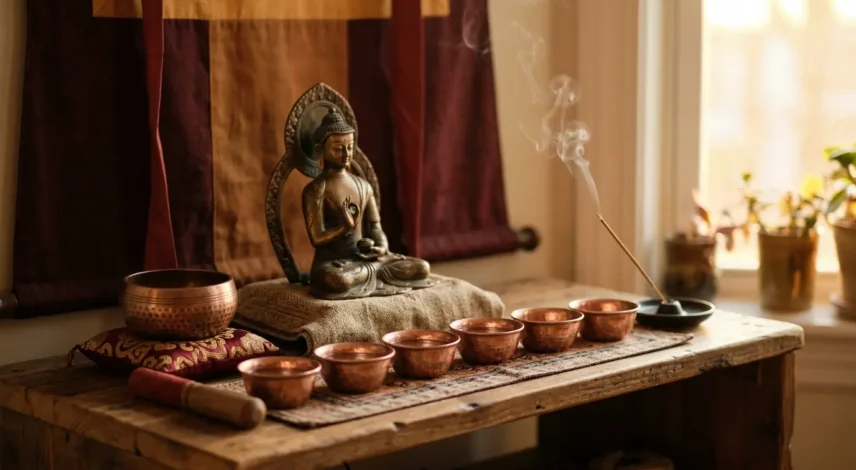
A Buddhist altar needs four core items: an image of the Buddha, seven offering bowls, incense, and a light such as a butter lamp or candle. Add a mala if you recite mantras. Tantric implements like the vajra and bell can wait until a teacher advises you.
Set up your altar in this order (about 30 minutes once you have the pieces):
- Place a Buddha image: a statue, thangka, or framed print on the highest point of the altar.
- Line up seven offering bowls: small bowls, 3 to 4 inches across, in a straight row in front of the image.
- Add incense: one stick or cone offered at the start of each practice session.
- Add a light: a butter lamp, candle, or LED lamp, traditionally a symbol of wisdom.
- Keep a mala within reach: 108 beads for counting mantras during meditation.
Start With Your Practice Purpose
Your purpose decides your first purchase. A meditator needs a way to mark time. A mantra practitioner needs a counting tool. Someone making daily offerings needs bowls and a light. Use this table to find your starting point:
| Your purpose | Start with | Add later |
|---|---|---|
| Daily meditation | Buddha image, small singing bowl to open and close sessions | Cushion, incense |
| Mantra recitation | 108-bead mala | Hand prayer wheel |
| Offerings and devotion | Seven offering bowls, light, incense | Mandala offering set |
| Vajrayana practice with a teacher | Matched vajra and bell set | Damaru or other tools your teacher names |
| A meaningful gift | Mala or small singing bowl | A short card explaining its meaning |
In our experience, a small altar you actually use beats a crowded one you only dust. Pick the row that matches how you practice this month, not the practice you hope to have next year.
The Four-Item Starter Altar
A traditional Tibetan shrine represents the Buddha’s body, speech, and mind. A statue or thangka stands for body, a Dharma text for speech, and a small stupa for mind. The Rubin Museum’s Tibetan Buddhist Shrine Room, now on view at the Brooklyn Museum, is organized around this same idea. A home altar can start with the image alone and grow from there.
The seven offering bowls on a home altar traditionally hold clean water, offered fresh each morning and emptied before evening. Many teachers suggest placing the bowls about a grain of rice apart, close but not touching. Don’t worry about getting every detail perfect on day one. Clean, simple, and respectful is what counts.
When to Add a Mala or Singing Bowl
Add a mala once you begin reciting mantras daily. A traditional mala has 108 beads plus one larger guru bead, and many malas split the strand into four sections of 27 with marker beads. If you’re curious how that structure is built by hand, see how Tibetan 108-bead malas are handmade in the workshop.
For a first mala, our 108-bead natural wood mala bracelet ($25.95) uses 8 mm (0.31 in) beads in rosewood, ebony, wenge, or tiger skin wood on an elastic cord. Because it wraps around your wrist, your counting tool travels with you, so mantra practice can happen on a commute or a lunch break, not only at the altar. Add a singing bowl when you want a clear sound to start and end each session; the next sections show how to pick one.
Vajra and Bell: Which Prong Count Matches Your Tradition?
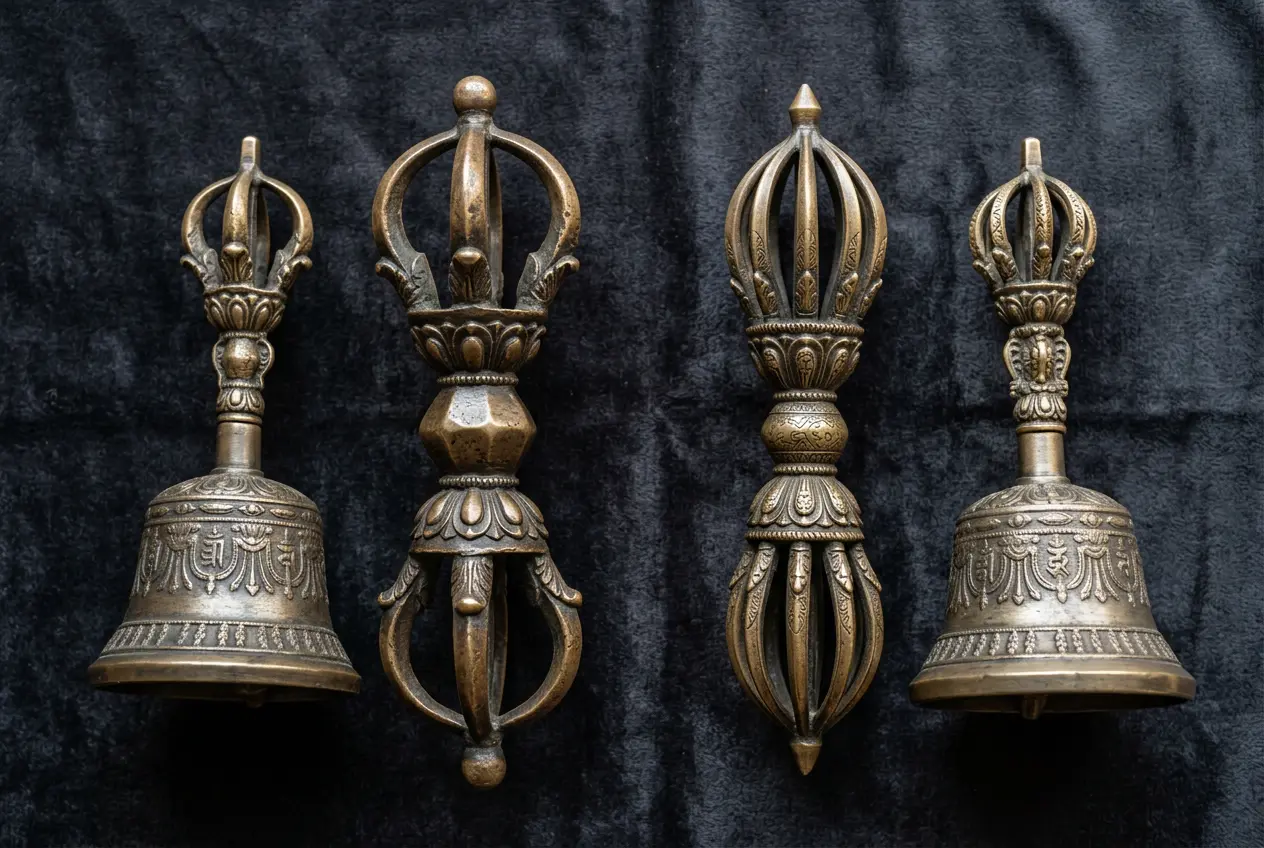
Choose a five-prong vajra and bell unless your teacher belongs to the Nyingma lineage, which most commonly uses nine prongs. The two are used as a pair: the vajra in the right hand, the bell in the left.
| Feature | Five-prong vajra | Nine-prong vajra |
|---|---|---|
| Main lineages | Sarma (new) schools: Sakya, Kagyu, Gelug, Jonang | Nyingma |
| How common | The standard form in Tibetan practice | Less common overall |
| Best for | Most students, and gifts for Sarma practitioners | Nyingma practitioners, on a teacher’s advice |
| Matching bell | Bell with a five-prong half-vajra handle | Bell with a nine-prong half-vajra handle |
5-Prong vs. 9-Prong Vajra
The prong count of a vajra signals lineage, not power. Himalayan Art Resources notes that the Nyingma tradition most commonly uses nine prongs, while the new schools use five. The vajra (Tibetan: dorje) is a small metal scepter whose prongs curve inward to form a rounded enclosure at each end. The ghanta (Tibetan: drilbu) is the hand bell topped with a half-vajra handle.
In Vajrayana practice, the vajra and bell together express method and wisdom: the vajra stands for compassionate method, the bell for the wisdom of emptiness. For the deeper symbolism, read what the dorje (vajra) symbolizes in Tibetan Buddhism.
The mistake we hear about most often: buying a nine-prong vajra because it looks more ornate. If your teacher is Gelug or Kagyu, that set won’t match your practice. One more detail most guides skip: a five-prong vajra with open tips that don’t touch the center prong is a wrathful form, made that way on purpose. It is not a casting flaw.
Do You Need an Empowerment?
You don’t need an empowerment to own or display a vajra and bell, but using them in tantric ritual traditionally requires one. An empowerment (Tibetan: wang) is a ceremony in which a qualified teacher authorizes a student for a specific practice, along with commitments called samaya.
We understand the worry about “doing it wrong.” If you have no teacher yet, keep the set on the altar as a reminder, with the vajra on the right and the bell on the left, and off the floor. That is a respectful first step, and it leaves room to learn the ritual properly later.
Buying a Matched Set
Buy the vajra and bell together from one workshop. A matched pair shares the same prong count, alloy, and scale, so the bell’s handle mirrors the vajra you hold. Ring the bell before you buy: a clear, even tone that fades slowly points to a well-cast alloy, while a short clank suggests thin or mixed metal.
If you want the vajra’s meaning close at hand without a ritual set, our copper vajra dorje pendant with a rotating Om Mani Padme Hum bead ($42.95) hangs on a 17.7 to 19.7 inch (45 to 50 cm) chain. It is a symbol you wear, not a ritual implement, so the empowerment question doesn’t arise, and the reminder stays with you through the day.
Singing Bowls and Offering Vessels: Material and Craft Checks
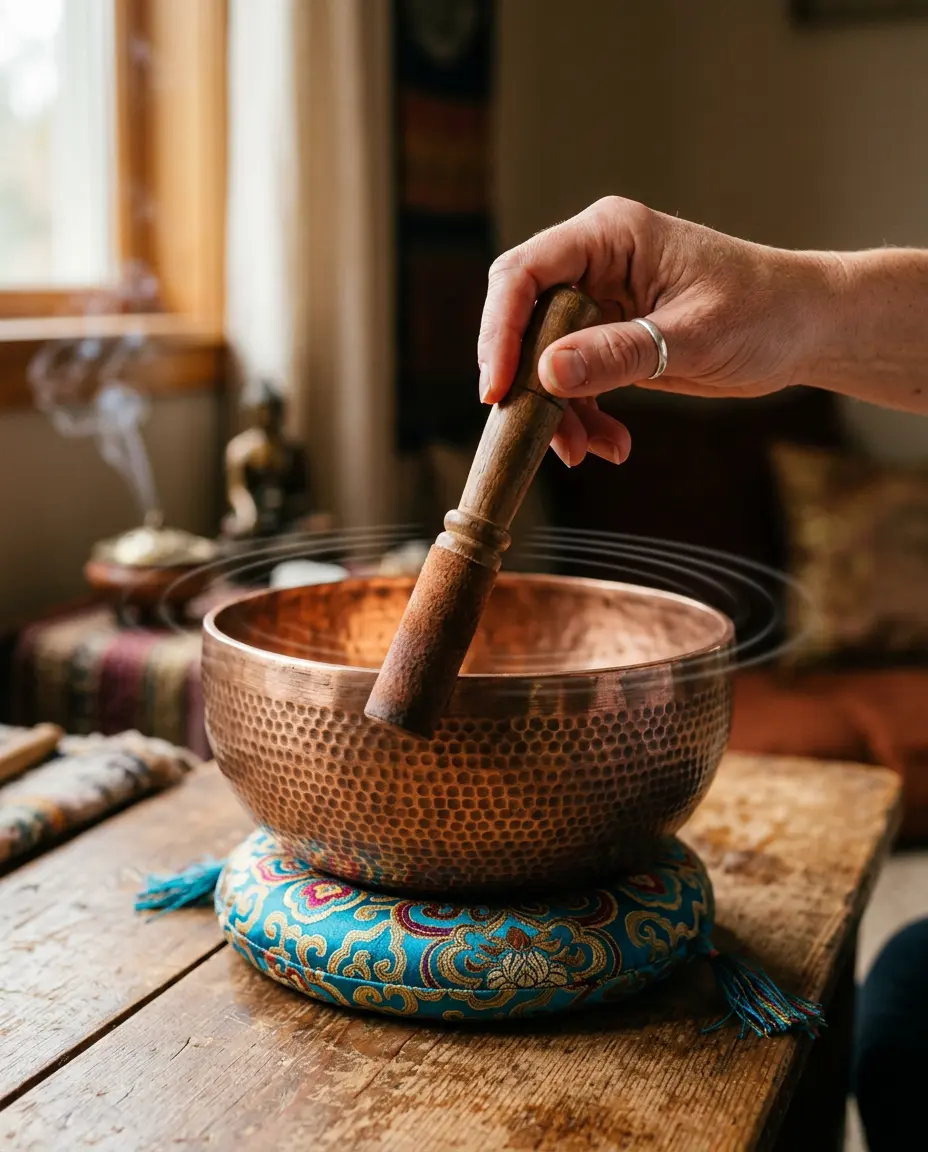
Pick a singing bowl by alloy, hand-finishing, and size. Traditional Himalayan bowls are hand-hammered bell bronze, a copper and tin alloy, which produces long, layered overtones. Brass bowls and perfectly uniform bowls are usually cast or machine-spun.
- Alloy: bell bronze (copper plus tin) gives depth; brass (copper plus zinc) looks brighter yellow; pure copper sounds softer and darkens with patina.
- Hammer marks: small, irregular dimples on the outer wall show hand-hammering. Fine circular lathe lines point to machine spinning.
- Wall thickness: slight variation around the rim is normal for handwork.
- Sustain: a good bowl keeps humming well after a single strike.
Bronze, Brass, or Copper?
Bell bronze suits long sound meditation, while brass and copper suit altar use and short sessions. Bronze costs more because the alloy is harder to work and each bowl takes hours of hammering. Brass is fine for decor and offerings, but rarely rings as long.
We’ll be straight with you: our hand-etched Om Mani Padme Hum copper singing bowl ($40.95 to $46.95) is pure copper, not bell bronze, and we say so on the listing. It measures 3.14 to 3.74 inches across and weighs 6.2 to 10.6 oz, and it arrives with a dual-ended mallet and a ring cushion. That compact size fits a small altar, so you get a clear chime to open and close each session without a $150 bronze purchase.
Offering bowls follow the same logic. Choose brass or copper bowls 3 to 4 inches across, heavy enough not to tip, with smooth interiors that dry easily. Buy all seven as one set so they sit level in a row.
Choosing Size by Pitch
Bowl diameter sets the pitch: the smaller the bowl, the higher the note. Use this guide:
- Under 4 inches: bright chime for marking the start and end of practice.
- 4 to 6 inches: clear, higher tone; easy to hold in one palm.
- 6 to 8 inches: balanced tone and a good all-round meditation size.
- 8 inches and up: deep, long sustain for sound sessions; heavier and pricier.
Our 5-Minute Strike Test
You need the bowl, a wooden mallet, a phone stopwatch, and a quiet room. The whole test takes about 5 minutes:
- Set up (1 minute): place the bowl on its cushion on a flat surface.
- Strike once (10 seconds): tap the rim with the felt end and start the stopwatch.
- Time the fade (1 to 2 minutes): stop the clock when you can no longer hear the tone, and write the seconds down.
- Rim the bowl (30 seconds): circle the rim with the bare wood end. Listen for a steady “sing” with no rattle.
- Inspect (1 minute): tilt the bowl toward a light and look for hammer dimples or lathe lines.
When we started comparing bowls, we assumed a shinier bowl meant better quality. It often meant the opposite, since heavy polish can hide machine lines. Now we trust sustain and hammer marks over shine. Comparing two bowls side by side with this test tells you more than any product photo.
⚠️ Important Note: Many practitioners report that singing bowl sound helps them settle into meditation. Claims about spiritual or energetic effects come from traditional belief and personal experience, not scientific proof. This content is for educational purposes and does not replace professional medical or mental health advice.
How Do I Know If Tibetan Sacred Objects Are Authentic?
Authentic ritual objects show hand-finishing, traditional materials, correct iconographic proportions, and a seller who can name the workshop or region of origin. If a listing can’t tell you where and how a piece was made, treat the word “authentic” with caution.
Five Authenticity Checks
- Material named plainly: the listing states bronze, brass, or copper for metal, and bodhi seed, wood, or bone-free resin for beads. Vague terms like “metal alloy” deserve a question.
- Hand marks: tool marks, slight asymmetry, and hand-painted details that vary a little from piece to piece.
- Proportions: faces, hands, and prongs follow iconographic rules. On a closed-prong vajra, the outer prongs should meet the center prong cleanly.
- Provenance: the seller names a region or workshop, such as Kathmandu, Patan, or Lhasa, and answers follow-up questions.
- Price sanity: a hand-hammered bronze bowl or hand-cast vajra set at a bargain price is almost always cast in bulk.
Red Flags in Product Listings
The biggest red flag is a promise the tradition itself never makes. Listings that claim an object “guarantees” luck, cures illness, or works as a magic charm are selling a story, not a ritual tool. Be wary too of “antique” labels at new-item prices, missing dimensions, and stock photos reused across several stores.
Ask the seller two questions before you buy: where was it made, and how? A seller who works with real workshops answers in a sentence. One who doesn’t changes the subject.
What Do Buddhist Ritual Items Cost in 2026?
Expect to spend $10 to $30 on incense or prayer flags, about $25 and up for a wooden mala, and $40 to $150 for a singing bowl or small statue. Hand-cast vajra and bell sets, hand-painted thangkas, and antiques often run into the hundreds.
| Tier | Budget (USD) | What fits | Good first pick |
|---|---|---|---|
| Starter | Under $50 | Incense, prayer flags, wooden mala, compact singing bowl | 108-bead wood mala ($25.95) or copper altar bowl ($40.95) |
| Practitioner | $50 to $150 | Seven offering bowl set, statue, 5 to 8 inch hand-hammered bowl | Offering bowls plus a Buddha image |
| Serious practice or collecting | $150 and up | Bronze vajra and bell set, hand-painted thangka, antique pieces | A matched set chosen with your teacher |
Starter Budget Under $50
Under $50 buys one useful tool, not a full altar. Pick by purpose: a mala if you recite mantras, a compact bowl if you meditate on a timer. Add offering bowls and a statue in a second round. Spreading purchases over a few months also lets you learn what your practice actually needs.
Gifts That Respect the Tradition
You don’t want a spiritual gift to land as decor. For Thanksgiving hosts, birthdays, or the holiday season, choose a mala or small singing bowl and add a short note explaining what it’s for. Skip tantric implements unless the recipient practices with a teacher. For more ideas by price, see our 2026 guide to housewarming gifts with spiritual meaning.
Frequently Asked Questions About Sacred Altar Tools
Yes, when they’re treated with respect. Keep them clean, off the floor, and out of bathrooms or purely decorative spots. Tantric implements such as the vajra and bell are traditionally used in ritual only after an empowerment.
Not to own or use them in basic practice. Some practitioners ask a lama to consecrate a statue or implement, a ceremony called rabné in Tibetan, before placing it on the altar. If a seller claims a blessing, ask who performed it and where.
A full Tibetan mala has 108 beads plus a guru bead. Shorter wrist malas with 27 beads are common for prostrations and travel, since four rounds equal one full count.
Start with a Buddha image and seven offering bowls, then add incense and a light. When you’re ready for the next piece, compare the altar essentials linked at the top of this guide and pick the one that fits your daily practice.
The bottom line: Choosing Buddhist ritual items comes down to purpose first, lineage second, and craft third. Start small, match any vajra and bell to your teacher’s tradition, trust hammer marks and sustain over shine, and buy from a seller who can tell you where each piece was made.
Build Your Altar One Meaningful Piece at a Time
Explore Potala Store’s authentic Tibetan spiritual items from Himalayan artisans, from malas to singing bowls, with a 60-day return window.Shop Tibetan spiritual items
⚠️ Disclaimer: Descriptions of spiritual meaning in this guide reflect Tibetan Buddhist tradition and practitioner experience. For guidance on tantric practice, consult a qualified teacher in your lineage.
📚 References
- Vajra Scepter: Explains five-prong and nine-prong vajras, the Nyingma and Sarma lineage split, and wrathful open-prong forms. Himalayan Art Resources
- Vajra: Encyclopedia entry on the vajra as a ritual symbol, its standard five-prong form, and use with the bell. Encyclopaedia Britannica
- Tibetan Buddhist Shrine Room: Museum installation showing how butter lamps, offering bowls, vajras, and bells are arranged in a traditional shrine. Rubin Museum of Himalayan Art
- Yönchap: Water Offering: Tibetan and Himalayan Library text on the seven water bowl offering practice. University of Virginia, Mandala Collections