

Tayata Om Bekandze Bekandze Maha Bekandze Radza Samudgate Soha. That is the Medicine Buddha mantra, a Tibetan Buddhist healing mantra, as practitioners chant it in Tibetan centers: a request to the “Great Healer” to remove suffering at its root. If you have seen three different spellings and are not sure how to say it, you are not alone.
This guide gives you the word-by-word meaning, a pronunciation key, and a first chanting session of about 10 minutes. We wrote it at PotalaStore for first-time chanters who want the text right before they buy anything. We checked the mantra against FPMT and Drepung Gomang Monastery sources, and we say where teachers differ.
By the end, you will know what each word means, how to say it, and how to finish a session with a mala.
New to mantra practice? A 108-bead mala keeps count so your attention can stay on the sound.
Table of Contents
What Is the Medicine Buddha Mantra?
The Medicine Buddha mantra is the healing mantra of Bhaisajyaguru (Tibetan: Sangye Menla), chanted as “Tayata Om Bekandze Bekandze Maha Bekandze Radza Samudgate Soha.” It is drawn from the Medicine Buddha Sutra and is usually recited 7, 21, or 108 times. We use the spelling common in FPMT materials. Bekanze and Bhekandze are variant spellings of the same word. For jewelry that carries mantras, see our guide to Buddhist mantra jewelry and the Medicine Buddha mantra.
What are the short mantra and the long dharani?
The short mantra is the final line of the longer Medicine Buddha dharani. A dharani is a longer, mantra-like verse. This one opens with “Namo bhagavate bhaisajyaguru,” and the sutra describes Bhaisajyaguru speaking it. This page teaches the short mantra only. Learn the long dharani from a recording or a teacher.
Who is Bhaisajyaguru (Sangye Menla)?
Bhaisajyaguru, called Sangye Menla in Tibetan, is the Buddha of healing in Mahayana Buddhism, formally named “Medicine Master and King of Lapis Lazuli Light.” Tibetan Vajrayana practitioners recite his mantra. Thangka painters and statue makers show him in lapis lazuli blue. He holds a bowl of healing nectar with a sprig of myrobalan, a plant Tibetan medicine treats as a universal remedy.
The Medicine Buddha Sutra records his twelve vows to relieve suffering. Tibetan physicians in the Sowa Rigpa (Tibetan medicine) tradition regard him as the source of medical knowledge. He is a different Buddha from Shakyamuni, who is the teacher of the sutra.
What Does Tayata Om Bekandze Mean, Word by Word?
Word by word, the mantra says: “Thus: Om, healer, healer, great healer, king, arisen. So be it.” “Bekandze” is the Tibetan way of saying the Sanskrit bhaiṣajye, meaning “medicine” or “healing.” Teachers in the FPMT tradition, including Lama Zopa Rinpoche, explain it as “eliminating pain.” They read pain broadly, as every kind of suffering and not only disease.
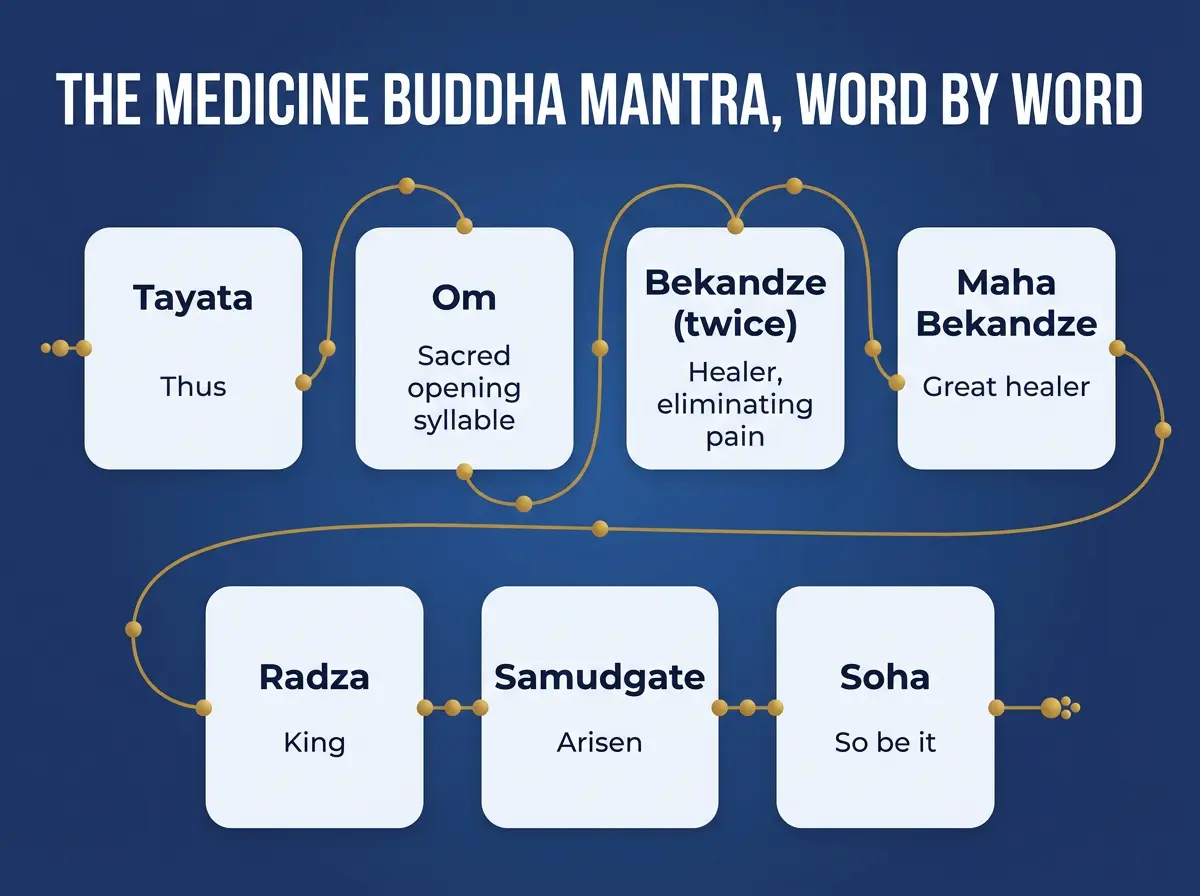
Word-by-word translation table
| Word | Sanskrit | Meaning |
|---|---|---|
| Tayata | tadyathā | “Thus” or “it is like this.” Some teachers treat it as an introduction, not part of the mantra. |
| Om | oṃ | A sacred opening syllable used at the start of many mantras. |
| Bekandze (said twice) | bhaiṣajye | “Healer,” “medicine,” or “eliminating pain.” |
| Maha Bekandze | mahābhaiṣajye | “Great healer” or “great eliminating of pain.” |
| Radza | rāja | “King.” |
| Samudgate | samudgate | “Arisen” or “come forth.” |
| Soha | svāhā | A closing word, often translated “so be it.” |
Translators differ most on Samudgate. While comparing published translations for this guide, we found it rendered three ways. Sources say “arisen” or “come forth.” The 17th Karmapa’s teaching, as relayed by Dakini Translations, reads it as a call to “appear.” We use “arisen.” None of these readings changes the purpose of the mantra.
Why does “Bekandze” repeat three times?
In Drepung Gomang Monastery’s commentary, each repetition goes one level deeper. The first Bekandze eliminates the pain of true suffering. The second eliminates its cause, which is karma driven by disturbing thoughts. Maha Bekandze eliminates even the subtle imprints those thoughts leave on the mind.
The same commentary says the three together hold the remedy of the whole graduated path to enlightenment, known as lamrim. Teachers often add that this medicine works on the three poisons of attachment, anger, and ignorance, not only on physical illness. For a similar syllable-by-syllable approach, see the six syllables of Om Mani Padme Hum, explained.
Some centers recite a fourth Bekandze before Radza, and both versions are in circulation. Use the count your teacher or center uses.
How Is It Pronounced in Tibetan and Sanskrit?
In Tibetan style, the mantra is said Tad-ya-ta Om Be-kan-dze Be-kan-dze Ma-ha Be-kan-dze Ra-dza Sa-mung-ga-te So-ha. In Sanskrit style, it is Tad-ya-ta Om Bhai-sha-jye Bhai-sha-jye Ma-ha Bhai-sha-jye Ra-ja Sa-mud-ga-te Sva-ha. Both are accepted, so pick the one your teacher or recording uses and stay with it. Say “dz” like the “ds” in “adds.” These syllable breaks follow the Tibetan and Sanskrit pronunciation guides published by Drepung Gomang Monastery.
Tibetan-style vs. Sanskrit pronunciation
| Written word | Tibetan style | Sanskrit style | Tip |
|---|---|---|---|
| Tayata | Tad-ya-ta | Tad-ya-ta | The same in both styles. |
| Bekandze | Be-kan-dze | Bhai-sha-jye | Say the Tibetan “dz” like the “ds” in “adds.” |
| Maha | Ma-ha | Ma-ha | Give both syllables equal time. |
| Radza | Ra-dza | Ra-ja | Keep the “r” light. |
| Samudgate | Sa-mung-ga-te | Sa-mud-ga-te | A soft “ng” instead of a clear “d” is standard in Tibetan style. |
| Soha | So-ha | Sva-ha | Do not trail off on the last syllable. |
Common pronunciation mistakes
- Mixing styles in one round. Pairing Tibetan “Be-kan-dze” with Sanskrit “Sva-ha” is the most common slip. Choose one style per session.
- Turning “dz” into a plain “j.” “Bay-kan-jay” drops the Tibetan sound. Aim for “ds.”
- Treating the missing “d” as an error. In Tibetan style, “Sa-mung-ga-te” is correct. Only add the “d” if you chant in Sanskrit style.
- Rushing “Ma-ha.” Fast chanting squeezes it into one beat. Slow down until both syllables are clear.
- Swallowing the ending. The closing “So-ha” carries the dedication. Let it finish before you start the next repetition.
How to Chant It: A 10-Minute Beginner Practice
A first session takes about 10 minutes: settle, set an intention, chant 108 times with a mala, then dedicate.
Time: about 10 minutes. You need: a 108-bead mala (or a hand tally) and a quiet seat.
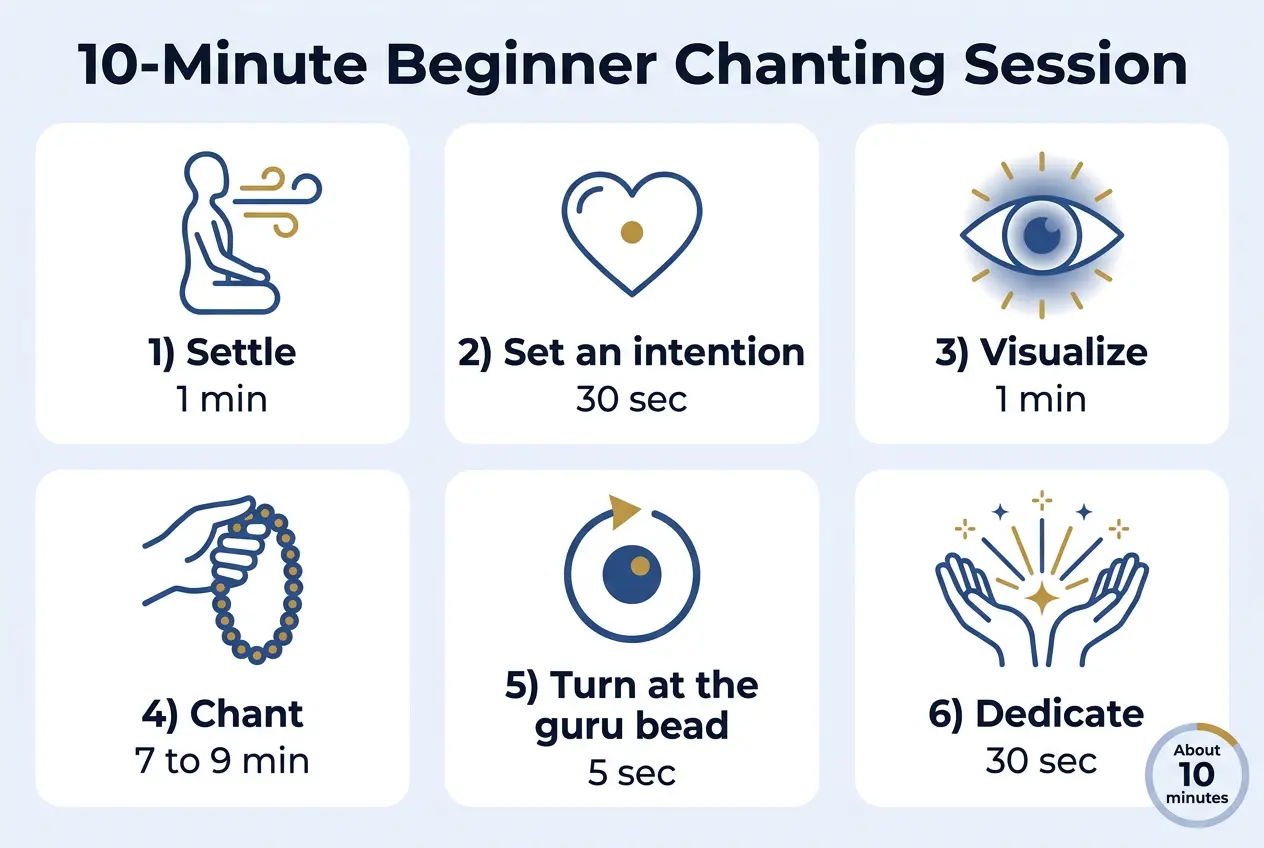
Step-by-step: your first session
- Settle (1 minute): Sit comfortably and breathe slowly.
- Set an intention (30 seconds): Name one wish for yourself or for someone you care about.
- Visualize (1 minute, optional): Picture the Medicine Buddha in front of you, lapis lazuli blue, holding a bowl of nectar. Imagine soft blue light flowing from him toward you and the person you named. A thangka or statue gives your eyes something to rest on.
- Chant (7 to 9 minutes): Say the mantra once per bead, starting beside the guru bead. One full round of 108 repetitions takes about 7 to 9 minutes at a steady pace.
- Stop at the guru bead (5 seconds): Turn the mala around instead of crossing the guru bead.
- Dedicate (30 seconds): Offer the merit to the well-being of all beings. Dedication of merit is the closing wish that the benefit of your practice reaches others.
It’s fine to start with 7 slow repetitions. Clarity matters more than speed.
Counting with a 108-bead mala
A mala is a string of 108 counting beads plus one larger guru bead that you never count. Each bead marks one repetition of the mantra. A wrist mala wrapped four times holds about 27 beads per wrap, so 27 × 4 = 108.
PotalaStore’s 8 mm wood 108 mala beads bracelet for mantra counting has 108 beads of 8 mm (0.31 in) wood on elastic cord, plus a guru bead. It wraps four times around the wrist and costs $25.95 at the time of writing (11/20/2026). The beads count for you, so your attention stays on the mantra instead of the math. At 21 repetitions you stay inside a single wrap, which makes a lunch-break round easy to track.
If your attention drifts, count one wrap at a time and take one slow breath at each wrap. You restart fresh four times in one round.
What beginners often get wrong
- Crossing the guru bead. Turn the mala around instead. The guru bead marks the end of a round.
- Chasing speed. A faster round does not count for more. Keep a pace you can sustain.
- Counting in your head while you chant. Let the beads do the counting.
- Restarting after every slip. If you stumble, continue from the next bead.
- Wearing the mala but never using it. A mala only counts when you move through the beads.
How Many Times Should You Chant the Medicine Buddha Mantra?
Most practitioners chant the Medicine Buddha mantra 7, 21, or 108 times per session. Beginners often start with 7 or 21, then build to one full round of 108 on a mala once the practice feels steady.
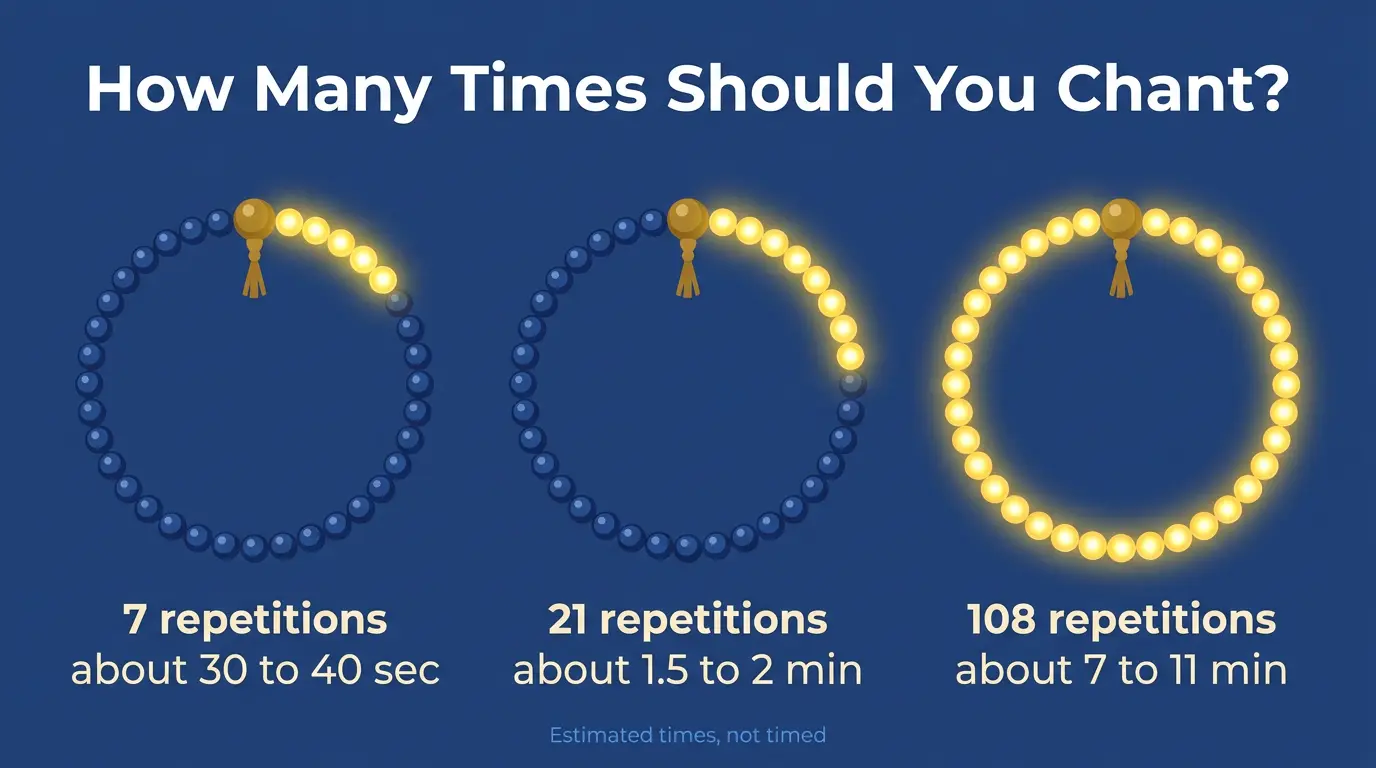
7, 21, or 108 repetitions: which should you choose?
| Count | Estimated time | Best for |
|---|---|---|
| 7 repetitions | About 30 to 40 seconds | A first try, or a busy morning. |
| 21 repetitions | About 1.5 to 2 minutes | A daily habit. It fits inside one wrap of a wrist mala. |
| 108 repetitions | About 7 to 11 minutes | One full mala round. |
These times are our calculation, not a stopwatch result. The short mantra has 23 syllables, and a steady pace of 4 to 6 seconds per repetition gives the ranges above. Your own pace will differ.
For the number itself, read why a Buddhist mala has 108 beads.
When is the traditional time to chant?
Many practitioners chant in the morning or before sleep. Many Tibetan Buddhists also set aside the eighth day of each Tibetan lunar month as Medicine Buddha Day for a longer session. A small daily count works like a New Year’s resolution you can keep: 7 repetitions each morning is enough to begin.
Can you chant it for someone who is ill?
Yes. Traditionally, you hold the person in mind, chant, and dedicate the merit to their well-being. Chanting can sit alongside medical care; it is not a replacement for it.
⚠️ Important Note: The benefits described in this guide come from traditional Buddhist belief, not from scientific evidence. Chanting is not a substitute for diagnosis or treatment. If you or someone you love is unwell, please talk to a licensed clinician.
Frequently Asked Questions About Sangye Menla’s Mantra
Generally, no. Many teachers and practitioners say the short mantra is open to everyone, and it is commonly recited without an empowerment. A full Medicine Buddha practice is different. It is usually learned through an empowerment (wang) or an oral transmission (lung, a teacher reading the text aloud) from a qualified teacher. If you join a center, follow its guidance.
Yes. Hold the person in mind, chant, and dedicate the merit to their well-being. Treat it as support alongside their medical care, never as a replacement.
Both are correct. “Bekandze” is the Tibetan pronunciation of the Sanskrit bhaiṣajye (“medicine” or “healing”). Use whichever matches your teacher or recording.
Start with 7 or 21 repetitions each morning for one week. Then try one full round of 108 on a mala. A 108-bead mala makes the counting automatic.
In summary, the Medicine Buddha mantra is a short Tibetan Buddhist healing mantra. Say it clearly, start with 7 or 21 repetitions, build to 108 on a mala, and dedicate the merit when you finish. Keep it alongside medical care, never in place of it.
Ready to make this a daily practice? A Medicine Buddha thangka pendant gives you an image to focus on, and a 108-bead mala keeps your count. PotalaStore lists its Ga Wu box pendant as hand-painted, with a Medicine Buddha variant and a sealed glass-faced frame that keeps the painting visible. It measures 1.85 × 2.22 in (47 × 56.3 mm) and costs $68.95 as of 11/20/2026. Worn against the chest, it keeps the blue figure within sight during visualization.
See the Medicine Buddha thangka pendant Browse Tibetan malas
Buying for someone who is currently ill? Our Buddha statue gift etiquette guide lists an active illness as a time to avoid gifting a Buddha image. It can read as a comment on the illness. A mala, or a note that you are chanting for them, may be gentler.
📚 References
- Mantra of the Medicine Buddha: Tibetan and Sanskrit pronunciation, word meanings, and the three layers of Bekandze. Drepung Gomang Monastery
- Medicine Buddha Mantras: Short mantra audio with Tibetan and phonetic text from FPMT, and teaching transcripts on Bekandze from the Lama Yeshe Wisdom Archive.
- Medicine Buddha: Tibetan and Sanskrit mantra text, the sutra, the twelve aspirations, and iconography. Samye Institute Wiki
- Master of Healing, Bhaisajya: Sutra of Medicine Buddha: The 17th Karmapa’s teaching on the dharani, Sanskrit pronunciation, and the translation of the mantra. Dakini Translations
- Medicine Master Buddha: Formal name, the sutra, the dharani, and the short form mantra. Tibetan Buddhist Encyclopedia