

Tibetan prayer flags hang left to right in one fixed order: blue, white, red, green, and yellow. Hang them high, keep them clean, and keep the cloth off the ground. That covers most of what Tibetan Buddhist tradition asks.
Holding a new string of these Buddhist prayer flags and wondering how to hang them right? This guide gives you the color order, the best spots at a U.S. home, from porch to meditation corner, and a simple plan for faded flags.
Potala Store works with Tibetan artisans and cultural sources, and one worry reaches us most: will I get this wrong? Every rule below is checked against the Tibetan Nuns Project and the University of Virginia’s Mandala Collections. Where traditions differ, we say so.
Important note: The meanings below reflect traditional Tibetan Buddhist belief and practice, not scientific claims. This guide is educational. For questions about your own practice, ask a teacher or a local Buddhist center.
Quick answer
- Order: blue, white, red, green, yellow, from left to right.
- Place: high, in open air, and clear of the ground.
- Timing: Losar (02/07/2027) or any sunny, windy morning.
- Old flags: burn them with intention, or let them fade beside new ones.
Table of Contents
What Is the Correct Order of Prayer Flag Colors?
Tibetan prayer flags are traditionally hung left to right in a fixed order: blue, white, red, green, and yellow. Each color stands for one element: sky or space, air or wind, fire, water, and earth. The set stays together so the elements remain in balance.
Blue, White, Red, Green, Yellow: The Five-Color Order Chart
Read the string left to right as you face it: blue comes first and yellow comes last.
| Position | Color | Element |
|---|---|---|
| 1 | Blue | Sky and space |
| 2 | White | Air and wind |
| 3 | Red | Fire |
| 4 | Green | Water |
| 5 | Yellow | Earth |
Traditionally, prayer flags come in sets of five, one flag per color. Longer strings repeat that cycle, so a 20-flag string holds four complete sets. The five colors are sometimes called the Five Pure Lights.
How Do the Five Colors Connect to Lung Ta, the Wind Horse?
Lung ta is the Tibetan name for the horizontal string of prayer flags. The wind horse at its center is believed to carry prayers on the wind. The five colors around it stand for the five elements.
The horse bears three flaming jewels, which stand for the Three Jewels of Tibetan Buddhism: the Buddha, the Dharma, and the Sangha. The four animals in the corners are known as the Four Dignities. The flag tradition itself traces back to Bön, Tibet’s pre-Buddhist religion.
The University of Virginia’s Mandala Collections text on Lungta pairs five animals with the five elements. The wind horse matches space, the tiger wind, the lion earth, the dragon water, and the garuda fire.
Want the full symbol story? Read what the wind horse and Om Mani Padme Hum on prayer flags mean, which also covers the mantra’s link to Avalokiteshvara.
Can the Order Ever Be Reversed? Where Traditions Differ
Yes, some sources list the same five colors in reverse: yellow, green, red, white, and blue. The site prayerflags.com from Radiant Heart Studios writes the order that way. It adds that a horizontal string can run from right to left or from left to right. Read from the other end, it is the same sequence.
Teachers also differ on two colors. According to prayerflags.com, the New Translation schools give the air and water elements different colors than the Nyingma school does. The order stays the same.
For a home porch, follow the Tibetan Nuns Project order, with blue on your left as you face the string. We share published guidance, and your own teacher’s word comes first.
Where Should You Hang Them at Home in the U.S.?
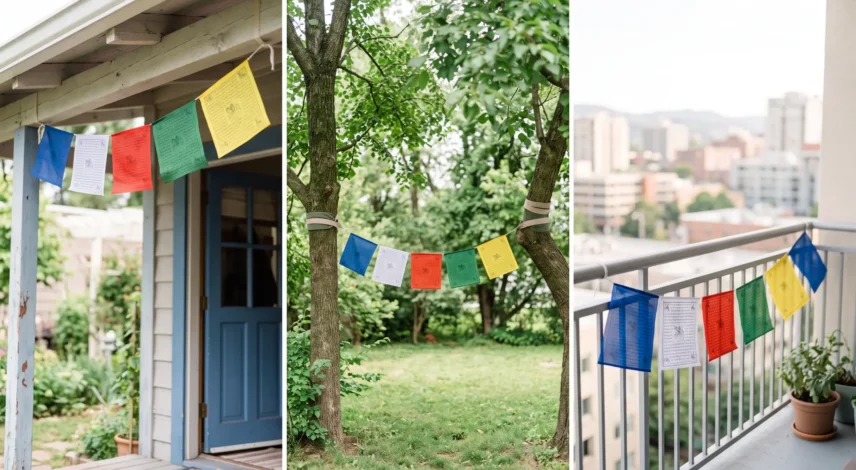
Traditionally, prayer flags hang high in open air, on mountain passes, rooftops, and between trees, so the wind can move them. At a U.S. home, that means a porch beam, a fence line, a balcony rail, or a span between two trees.
| Spot | Verdict | What to watch |
|---|---|---|
| Porch beam or eave | Good | Tie both ends above head height and keep the string clear of the walkway. |
| Between two backyard trees | Good | Use a soft strap around each branch to protect the bark. |
| Fence line or pergola | Good | Keep every flag well above the ground and away from wet grass. |
| Apartment balcony rail | Good with care | Check your lease, tie both ends firmly, and expect stronger wind on upper floors. |
| Indoors near a window | Good with care | Choose a spot with moving air, above head height. |
| Dorm room wall | Good with care | Use removable hooks and check your housing rules first. |
| Floors, bathrooms, or trash areas | Avoid | Low or dirty places fall short of the respect the cloth traditionally receives. |
If you live under an HOA, check the exterior decoration rules before you drill or tie anything. Renters can ask the landlord about balcony rails.
A sheltered porch moves the cloth less than a windy mountain pass does. Pick the spot with the most breeze, and expect a gentler flutter indoors.
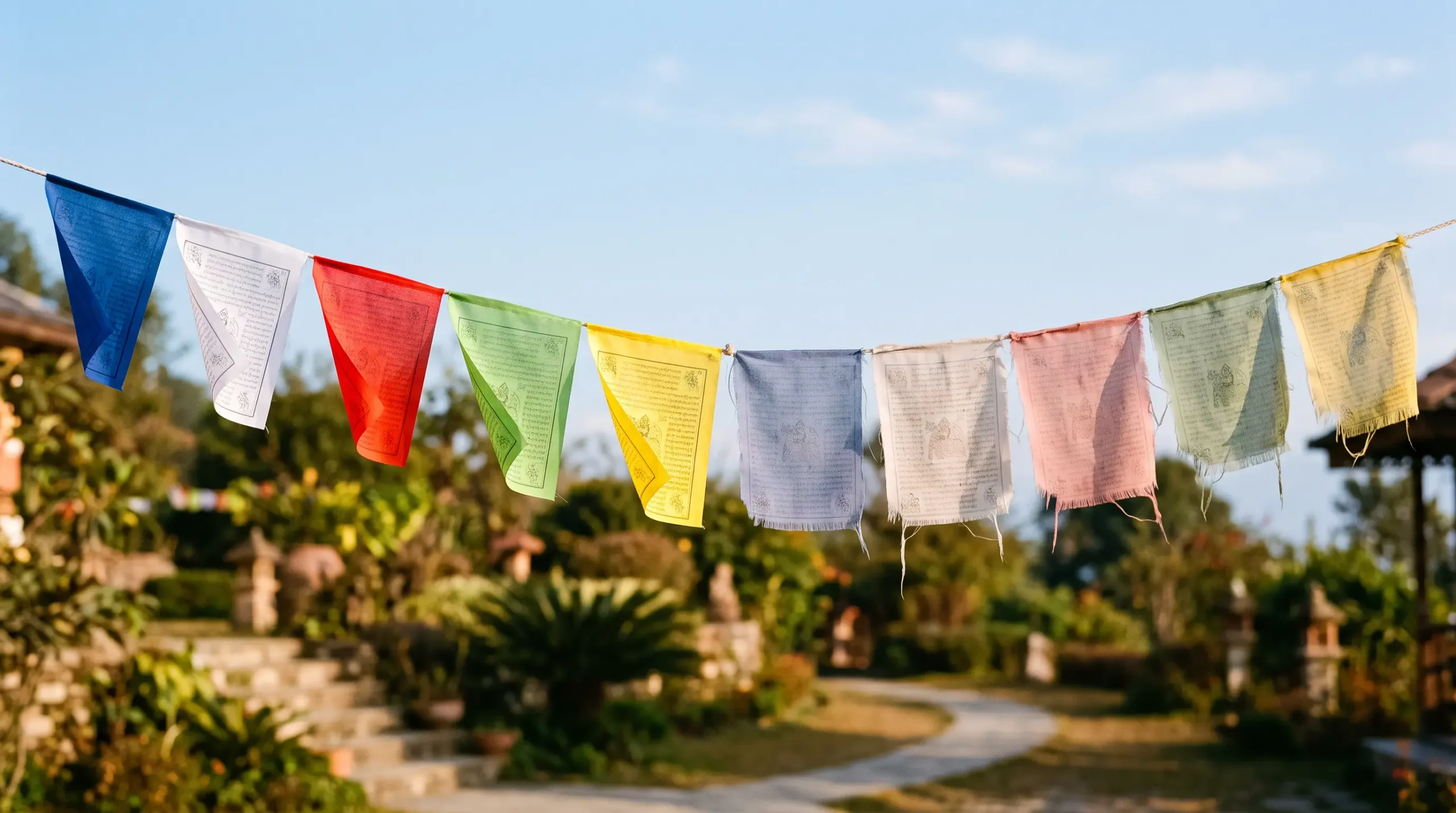
Best Outdoor Spots: Porch, Backyard Trees, and Balcony Rails
Choose an outdoor spot where air moves freely and nobody walks under the cloth. Three spots work well at most U.S. homes.
- Porch beam or eave: Tie each end above head height, with the string clear of the walkway.
- Two backyard trees: Wrap a soft strap around each branch so the bark stays protected.
- Balcony rail: Tie both ends firmly, and recheck the knots after strong wind.
A full 20-flag string runs about 23 ft (7 m). Measure your span first so the cloth hangs free.
Can You Hang Prayer Flags Inside Your House?
Yes, you can hang prayer flags inside your house. The Tibetan Nuns Project says they are normally hung outdoors so the wind can carry the prayers, but people hang them indoors too.
Pick a spot near an open window or a doorway where air moves, above head height and away from floors, shoes, and laundry. Many people see indoor flags as a daily reminder of compassion.
Can Non-Buddhists Hang Prayer Flags Without Being Disrespectful?
Yes, non-Buddhists can hang Tibetan prayer flags. The Tibetan Nuns Project says it is fine, as long as you treat the flags with respect, because they carry sacred texts and symbols.
If you have worried about cultural appropriation, that care already points you in the right direction. A good motivation helps too: wish that everyone the wind touches will benefit.
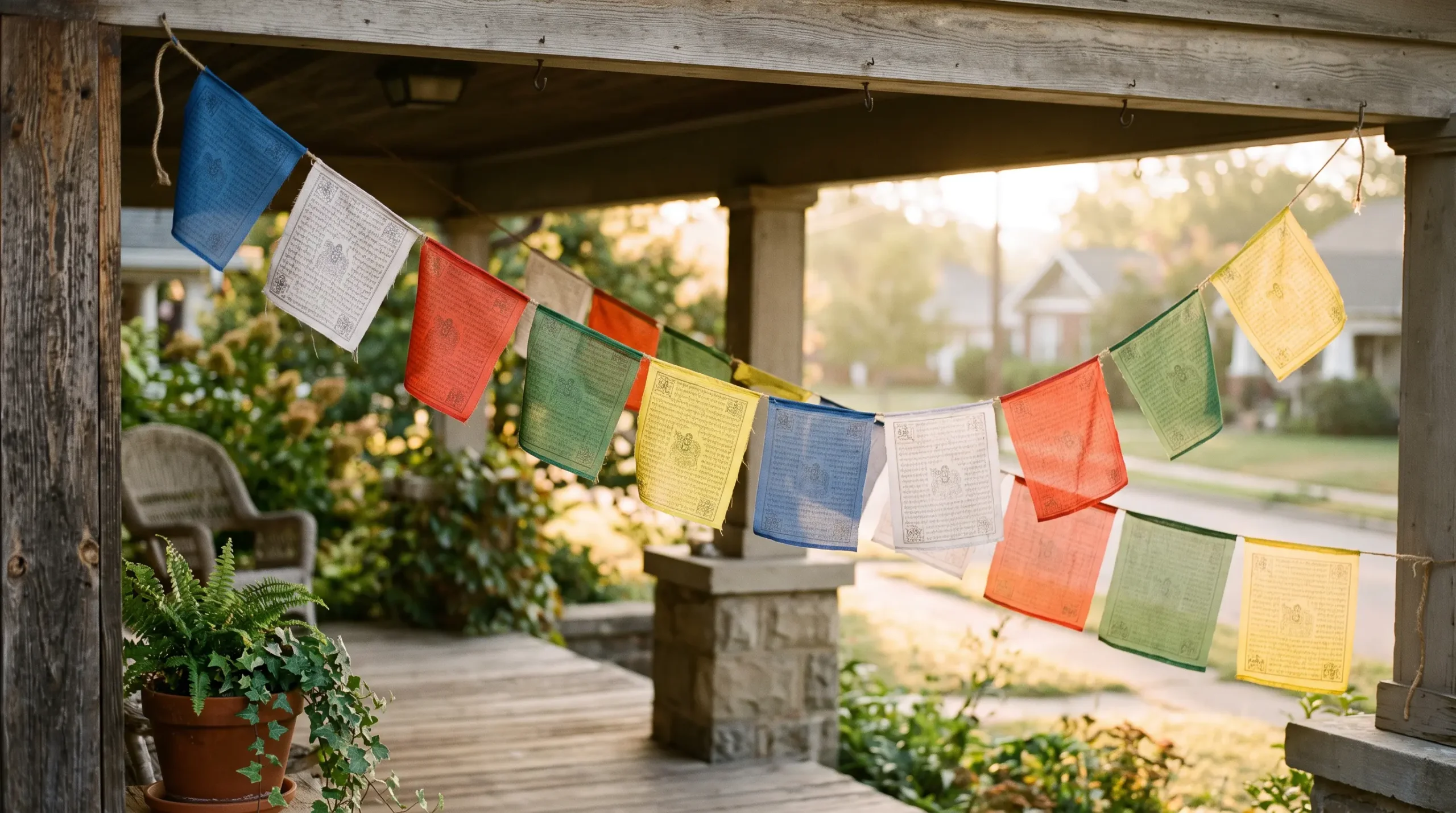
How to Hang Them Step by Step
Hanging a set takes about 15 minutes with two anchor points, a stepladder, and a soft strap for trees.
- Set your intention (1 minute): Pause and wish that all beings benefit. The Tibetan Nuns Project calls proper motivation important when you raise prayer flags.
- Check the order (1 minute): Face the string and confirm blue, white, red, green, and yellow run left to right. Keep the five colors together.
- Pick two high anchors (3 minutes): Choose a porch beam, fence post, or tree branch above head height. Measure the span first.
- Tie the blue end first (3 minutes): Fix the blue end to the anchor on your left with a secure knot.
- Run a gentle line with slack (4 minutes): Slope the string from one anchor down to the other and leave a little slack so the cloth can move.
- Check the clearance (2 minutes): Walk the line and confirm no flag touches the ground, a shrub, or a railing. Tie the last knot with a quiet wish for others.
Before You Tie the First Knot: Setting Your Intention
Pause for a moment and wish that all beings benefit. Traditionally, prayer flags are used to promote peace, compassion, strength, and wisdom.
Tibetan tradition holds that the wind spreads goodwill and compassion to everyone it touches. A simple wish works well: may everyone this breeze reaches be safe, well, and happy.
Diagonal, Level, or Facing East? What Matters Most
Color order and ground clearance matter more than slope or compass direction. Sources disagree on both, and the Tibetan Nuns Project notes that the wind changes direction anyway.
Our product notes suggest a gentle diagonal from a higher point to a lower one, which keeps the string moving. A level line also works. Choose what your space allows.
Common Mistakes People Make (and Easy Fixes)
Four common mistakes are easy to fix.
- Pulling the string tight like party bunting. Leave a little slack so the cloth can move.
- Splitting the set or mixing the colors. Keep all five colors together, in order.
- Hanging low, or letting a flag rest on the ground. Retie it above head height.
- Tossing faded flags in the trash. See the retirement options below.
When Is the Best Time to Hang New Flags?
Traditionally, new prayer flags go up at Losar, the Tibetan New Year, which falls on 02/07/2027. Many people also choose a sunny, windy morning. The Tibetan Nuns Project notes that nuns at Dolma Ling Nunnery take down and burn old flags at Losar and hang new ones.
Losar 2027 and Other Traditional Times to Refresh Your Flags
Losar 2027 begins on Sunday, 02/07/2027, and opens the Year of the Fire Sheep. Many families hang fresh prayer flags during the festival, as the Smithsonian’s National Museum of Asian Art notes.
Planning other dates? Our 2027 Tibetan Buddhist calendar with Losar and Saga Dawa dates lists the key days, including Saga Dawa Düchen on 06/18/2027 in the Phugpa calendar. Some center calendars list a different Saga Dawa date, so check with your own teacher.
A housewarming, a new job, or any fresh start also counts as an auspicious occasion. Intention counts more than the date, and Wikipedia notes that the best time to put up new flags is a sunny, windy morning.
How Long Should Prayer Flags Stay Up?
Prayer flags traditionally stay up for one year and are replaced each Losar. That yearly cycle matches the way Tibetans renew their hopes for the world with new flags.
You may also hang new flags beside old ones, according to the Tibetan Nuns Project. If wind loosens a knot, retie the string soon so no flag rests on the ground.
Cotton vs. Polyester: Choosing Flags That Fade the Right Way
Cotton prayer flags fade faster than synthetic ones, according to the Tibetan Nuns Project. Tibetans traditionally welcome the fading as prayers released into the world. Choose the fabric by how you want your flags to age.
| Feature | Cotton | Polyester |
|---|---|---|
| Fade speed | Faster | Slower, holds vivid color longer outdoors |
| Closest to tradition | Traditional fabric, often block-printed | Modern fabric with the same colors and symbols printed on it |
| Best spot | Gardens and altars where you welcome visible fading | Porches, balconies, and exposed spots with sun and wind |
Why Natural Cotton Fades Faster, and Why Tibetans Welcome It
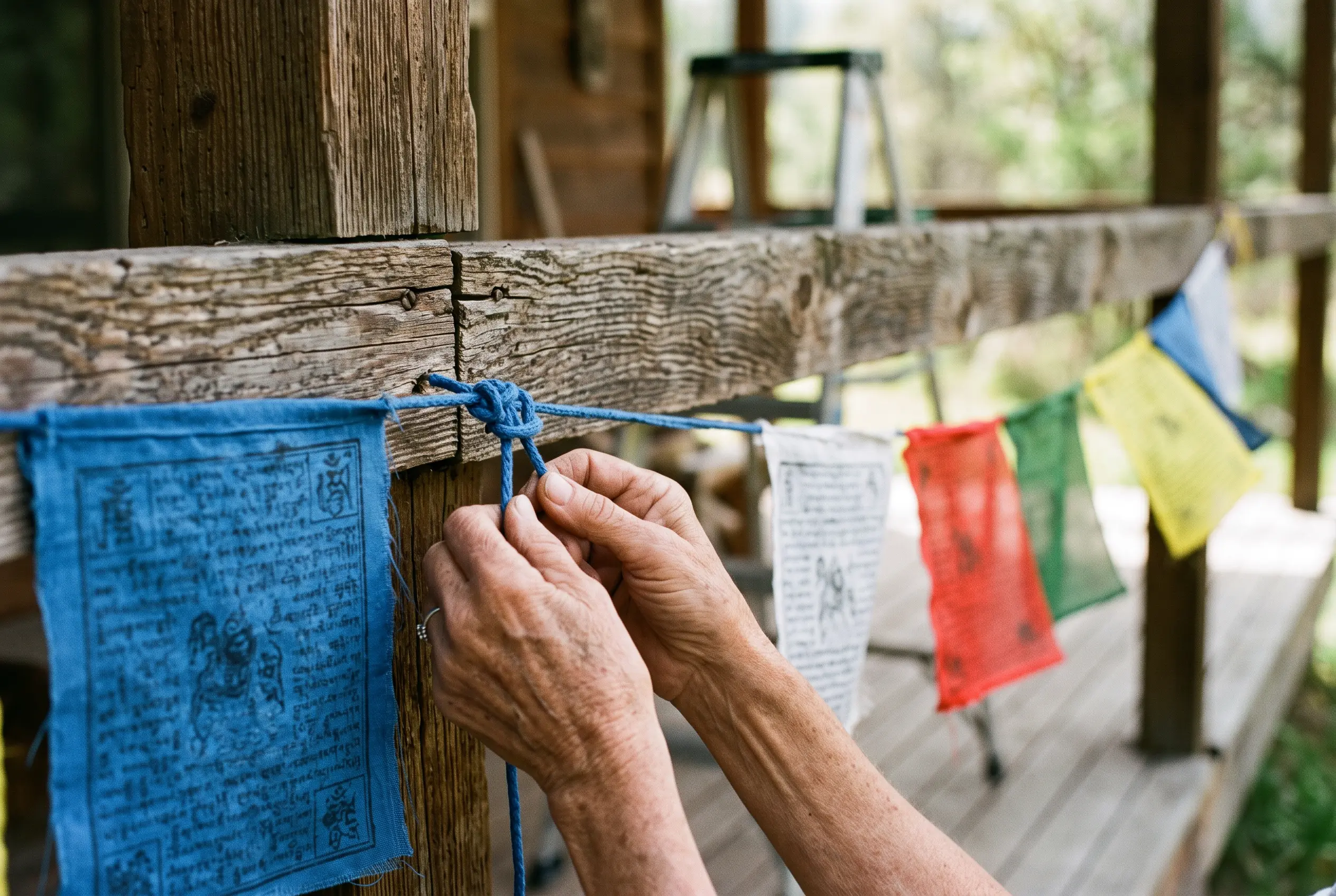
Cotton flags fade sooner than synthetic ones, and Tibetan tradition welcomes that. As the prints weather, the prayers are believed to become a permanent part of the universe, as Wikipedia summarizes the tradition.
Fading also reflects impermanence, a central idea in Buddhism. New flags replace the old, and the cycle continues.
How to Spot Block-Printed Flags Before You Buy
Check the listing for the fabric, the printing method, and where the flags were made. Traditional flags use woodblock printing, and prayerflags.com notes that woodblocks for flags came from China in the 15th century.
A listing that names cotton, block printing, and a maker gives you more to verify than one that says only “Tibetan style.” Our 20-flag windhorse set uses weather-resistant polyester in a Tibetan design, so it suits exposed outdoor spots where color needs to last. If you want the traditional fade, compare fabrics before you choose.
How Do You Retire Old Prayer Flags Respectfully?
Traditionally, old prayer flags are burned so the smoke carries their blessings, never thrown in the trash. You may also let them fade and fall apart naturally while new flags hang beside them.
The Traditional Way: Burning With Intention
The Tibetan Nuns Project says to burn old flags so the smoke may carry their blessings. Keep the flags from touching the ground as they burn. Where local rules allow, use a fire pit or metal container and keep water nearby. Rules on open burning vary by city and season, so check yours first.
For a full walkthrough, read our step-by-step guide to disposing of old prayer flags respectfully.
Can’t Burn Them? Three Respectful Alternatives
Many U.S. homes sit where backyard fires are restricted. Respect for the tradition and respect for local law can go together. If you live under burn restrictions, you can honor both.
- Let them fade naturally: The Tibetan Nuns Project says you may let old flags fade and disintegrate while you hang new ones beside them.
- Ask a local Buddhist center: A center or teacher can tell you how their community retires flags.
- Store them with care: Keep old flags folded in a clean, high spot, above waist level, until you can burn them.
Frequently Asked Questions
No single rule applies. The Tibetan Nuns Project says the wind changes direction anyway, so many people simply face the string toward the breeze or the morning sun. Keeping the color order and keeping the flags off the ground matter more.
Tradition says no. The printed mantras are sacred, so the flags should stay off the floor while you hang, store, or take them down. If one falls, pick it up gently and retie it above head height.
Polyester holds color longer in sun and wind, while cotton fades faster and follows the traditional path. Compare both in the material table above, then pick the set that suits your spot.
Some traditions advise against hanging flags on inauspicious days, and teachers differ on which days those are. If you follow a teacher or a local center, ask them. Otherwise choose a sunny morning and hang the flags with good intention.
The Bottom Line
In summary, Tibetan prayer flags hang left to right as blue, white, red, green, and yellow. Hang them high, in open air, and clear of the ground. Refresh them at Losar on 02/07/2027, or on any sunny, windy morning. When the cloth fades, burn it with intention or let it weather beside a new set. Hang your flags with care, and you share in a practice meant to spread goodwill to all beings.