
The Legend of Reincarnated Lamas: A Tibetan Story of Compassion and Continuity
 by Yang Tso
0 comments
by Yang Tso
0 comments
Reincarnated lamas, known in Tibetan as tulkus, are Buddhist teachers believed to return by choice, out of compassion, to continue their work. Tibetan Buddhism has recognized them for more than 700 years, and the tradition now sits at the center of a global succession debate around the Dalai Lama.
This guide explains what a tulku is, who the first one was, how search parties find a child, why the Golden Urn is disputed, and what comes next. Reading time is about 10 minutes.
At PotalaStore, we study Tibetan Buddhist practice closely before we write about it. Every claim below points to a named source, including Encyclopaedia Britannica, the Office of His Holiness the Dalai Lama, the Treasury of Lives, and the U.S. Commission on International Religious Freedom (USCIRF). On contested political questions, we report what each side has said and leave the judgment to you.
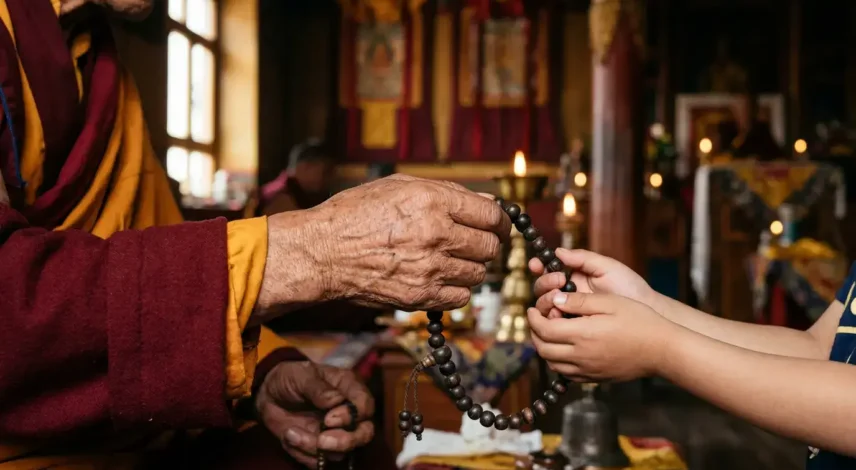
The story begins with a rosary. In 1939, the journal Nature reported that a small boy in Amdo took the late 13th Dalai Lama’s rosary, counted its beads, and repeated the mantra Om Mane Padme Hum.
New to Tibetan Buddhism? Read Is Buddhism a religion or a philosophy? Our beginner’s guide first.
Important note: This article explains Tibetan Buddhist beliefs and documented history for educational purposes. Descriptions of rebirth reflect traditional teachings, not claims of fact. On contested political questions, we summarize the position of each party and cite our sources. This content is not professional advice.
Table of Contents
What Is a Tulku, and Why Would a Master Choose to Return?
A tulku is a Tibetan Buddhist teacher recognized as the reincarnation of a previous master. The Tibetan word means “emanation body,” translating the Sanskrit term nirmanakaya. Tradition holds that a realized lama chooses rebirth out of compassion, returning to keep teaching and carry a lineage forward.
What Does “Tulku” Mean?
The term tulku (sprul sku) names the visible form that an awakened mind is believed to take for the benefit of others. A yangsi is the rebirth of one specific earlier master.
Popular sources sometimes call tulkus “living Buddhas.” That is a loose translation. Teachers such as Geshe Tenzin Legtsok of the FPMT note that not every tulku is an emanation of a buddha.
Is Every Rinpoche a Tulku?
No. Rinpoche means “precious one,” an honorific given to respected lamas, and many holders of the title were never identified as reincarnations. A tulku is usually addressed as Rinpoche, but the reverse does not always hold.
Compassion as the Reason to Return
According to Tibetan Buddhist teaching, ordinary beings are reborn through karma and mental afflictions. A tulku is believed to take rebirth by choice, moved by compassion and bound by the bodhisattva vow to keep serving others until all beings are free.
The Dalai Lamas are traditionally regarded as emanations of Avalokiteshvara, the bodhisattva of compassion. For the wider picture of ordinary rebirth, see our companion guide to the six realms of existence in Buddhist rebirth.
Who Was the First Reincarnated Lama?
The first formally recognized reincarnated lama is generally considered to be Karma Pakshi (1204-1283), the 2nd Karmapa, identified through a prediction letter left by the 1st Karmapa, Düsum Khyenpa (1110-1193). Later lineages, including the Dalai Lamas, adopted the same idea of recognized rebirth.
Sources agree on the broad story but not on every detail. When we compared them, dates and interpretations did not always match, so we note where they differ. Palpung Europe, for example, gives 1206 as an alternate birth year for Karma Pakshi.

The Karmapa’s Prediction Letter (1110-1283)
Düsum Khyenpa is credited with the innovation of leaving details of his next birth, so that his students could recognize his successor. According to the Kagyu Office, this prediction letter guided the search that led to Karma Pakshi.
Tsurphu Monastery in central Tibet, founded by Düsum Khyenpa, became the seat of the Karmapa lineage.
What Historians Debate About the “First” Tulku
Tradition names Karma Pakshi, but the Treasury of Lives notes that the line may have been formalized only when the 3rd Karmapa, Rangjung Dorje (1284-1339), identified himself as Karma Pakshi’s rebirth. A Harvard Asia Center program on the Dalai Lama institution also places the start of recognized reincarnation in the 13th century.
From Gendun Drup to the Title “Dalai Lama” (1391-1578)
The Dalai Lama line begins with Gendun Drup (1391-1474), but the title itself arrived in 1578, when the Mongol ruler Altan Khan honored Sonam Gyatso, who became the 3rd Dalai Lama. The first two holders were recognized retroactively, so the numbering counts them as earlier lives.
Sonam Peldren: The Earliest Recorded Female Tulku
Buddhist teacher Pema Khandro describes Sonam Peldren, a 13th-14th century figure, as Tibet’s first female tulku. According to Khandro, her recognition came late in life and did not create a broader system for women.
How Is a New Dalai Lama Identified?
Search parties traditionally follow five stages:
- Read the signs: Senior lamas study dreams, the direction of cremation smoke, and other omens after a Dalai Lama dies.
- Consult the oracle: The Nechung Oracle, long linked to the Tibetan government, is asked for guidance.
- Seek visions at Lhamo Latso: Regents meditate at the oracle lake, about 16,400 ft (5,000 m) above sea level, watching for images of the child’s birthplace.
- Test the candidates: A search party shows young children the late lama’s belongings mixed with copies and notes which items each child picks.
- Confirm and enthrone: Once confirmed, the child begins monastic training. The 14th Dalai Lama, identified at age 2, was enthroned in Lhasa on 02/22/1940.
In summary, the process pairs ritual guidance with tests of recognition and memory.

Reading the Signs: Dreams, Smoke, and the Oracle Lake

Lhamo Latso is a small lake southeast of Lhasa linked to the protector goddess Palden Lhamo. The Treasury of Lives says visions seen in its waters are traditionally read as signs of where the next Dalai Lama will be found.
Accounts of the 14th Dalai Lama’s search add two details. The late 13th Dalai Lama’s embalmed body is said to have turned toward the northeast, and Regent Reting Rinpoche is said to have seen a vision at the lake in 1935 that pointed to Amdo.
The Object Test: “It’s Mine, It’s Mine”
Search parties traditionally test a candidate by mixing the late lama’s belongings with look-alike replicas and watching which items the child picks. The Dalai Lama’s official website says the boy chose correctly each time, saying “It’s mine, it’s mine.”
Evaluators also consider memory, temperament, and behavior, so the object test is one clue among several.
Case Study: The Rosary That Found Lhamo Dhondup

The Nature report from 1939 describes a boy in Amdo who took the late 13th Dalai Lama’s rosary, counted its beads, and repeated Om Mane Padme Hum, the six-syllable mantra of Avalokiteshvara. You can read more in our guide to the meaning of Om Mani Padme Hum, Avalokiteshvara’s six-syllable mantra.
The same report says he also chose the late Dalai Lama’s small drum and walking stick over replicas, an object test that another candidate had failed. The boy, born Lhamo Dhondup on 07/06/1935, was about two years old when the search party reached him.
We found the rosary detail surprising. It appears in a science journal, while many retellings mention only the object test in general terms.
Curious about the tool in that story? Read why a Tibetan Buddhist mala has 108 beads.
What Is the Golden Urn Method?
The Golden Urn method selects a reincarnation by drawing lots: candidates’ names are written on slips, sealed in a golden urn, and one is drawn, a procedure introduced by the Qing court in the 1790s. It contrasts with the traditional approach of signs, oracles, and personal tests.
A Qing-Era Lottery Born in the 1790s

The Qianlong Emperor introduced the urn after growing concern about corruption in the search process, according to historian Max Oidtmann. A review of Oidtmann’s Forging the Golden Urn in the Asian Review of Books says he treats the lottery as a reinterpretation of local ritual, not a simple imperial imposition.
The urn was used at some times and waived at others, and historians still debate how often it decided a case.
Traditional Recognition vs. the Golden Urn
| Feature | Traditional recognition | Golden Urn |
|---|---|---|
| Who decides | Senior lamas, and for major lineages the Dalai Lama or Panchen Lama | A lot drawn from the urn, then state approval |
| Key methods | Signs, oracles, visions, and object tests | Names of finalists drawn by lot |
| Tie-breaker | Divination such as the dough-ball method (zen tak) | The draw itself |
| Origin | 13th century (Karmapa line) | Qing court, 1790s |
| Modern position | The Gaden Phodrang Trust says it alone recognizes the next Dalai Lama | Chinese rules (2007) and Foreign Ministry statements (2025) call for lot-drawing and state approval |
The table compares procedures and each side’s stated position. It does not rule on legitimacy.
What Happened in the Selection of the 11th Panchen Lama?
On 05/14/1995, the Dalai Lama announced six-year-old Gedhun Choekyi Nyima as the 11th Panchen Lama. USCIRF says authorities abducted the boy and his family on 05/17/1995, and it lists his current status as unknown.
In 2020, Chinese officials said he had finished his education and held a job. Beijing has said its own process followed religious ritual and historical custom. On 11/29/1995, a lot-drawing at the Jokhang temple in Lhasa named Gyaincain Norbu, whom the state recognizes as the Panchen Lama.
The Panchen Lama traditionally helps search for the next Dalai Lama, so this dispute shapes the succession question. Whatever one’s view of the politics, the human cost to a six-year-old and his family is part of this story.

Myths vs. Facts: What People Get Wrong About Tulkus
Most misunderstandings about tulkus come from Western ideas of a soul, while Tibetan tradition speaks of an emanation or a continuing stream of mind.
Myth: A Tulku Is the Same Soul in a New Body
Fact: Buddhism rejects a fixed, permanent soul. A tulku is understood as an emanation that continues a teacher’s mindstream and work, and recognized children still receive years of study and training.
Myth: A Lama Can Only Return After Death
Fact: The Dalai Lama’s office describes a ma-dhey tulku, an emanation that may appear before the predecessor dies. It also describes a dough-ball divination called zen tak, used when search teams cannot separate two strong candidates. In this method, names are sealed inside balls of dough, and the ball that emerges after ritual is taken as the answer.
Most English-language guides we reviewed skip both terms.
Myth: Tulkus Are Always Tibetan Boys
Fact: Sonam Peldren was a woman, and Tenzin Ösel, born in Spain in 1985, was recognized as the rebirth of Lama Thubten Yeshe. Lama Yeshe co-founded Kopan Monastery in Nepal.
Myth: Recognition Is Purely Mystical
Fact: Recognition has always involved institutions, estates, and patrons as well as faith, and scholars debate how much of its origin was spiritual versus political. It has also produced rival claimants, as in the case of the 17th Karmapa.
Reincarnated Lamas Today: What Happens After the 14th Dalai Lama?
On 07/02/2025, the 14th Dalai Lama affirmed that the institution of the Dalai Lama will continue, and said the Gaden Phodrang Trust has sole authority to recognize his reincarnation. He added that no one else has any authority to interfere.
The 07/02/2025 Declaration
Ahead of his 90th birthday, the Dalai Lama said Tibetans and Buddhists had asked him to continue the line, and he agreed. Officials of the Trust said the successor may be of any gender and any nationality, and the Dalai Lama has said his successor will be born outside China.
The Dalai Lama turned 91 on 07/06/2026. As of 09/30/2026, no successor has been identified.
Beijing’s Position and the Prospect of Two Dalai Lamas
China’s Foreign Ministry maintains that the reincarnation must be chosen by lot from the golden urn and approved by the central government. Beijing has required state approval of lama reincarnations since its 2007 regulations.
Tibetan exile officials and many analysts warn that two rival Dalai Lamas could emerge, one named through the Trust’s traditional process and one approved by the state. Both statements appear in the sources listed at the end of this article.
Carrying the Story Home: Compassion as Continuity
You do not need to take a side to take something from this story: the idea that compassion is worth coming back for. Families do something similar every year, passing recipes and values down around a Thanksgiving table, and the tulku tradition applies that instinct to teaching itself.
In summary, reincarnated lamas are Tibetan Buddhism’s answer to a question every tradition faces: how wisdom and compassion outlast the person who carries them. Compassion is the constant, and continuity is how the tradition keeps it alive.
Frequently Asked Questions
Tibetan tradition describes the intermediate state, or bardo, between death and rebirth as lasting up to 49 days. Prayers and readings from the Bardo Thodol are traditionally offered during this period. Timelines for recognizing a tulku vary widely, from about two years in the case of the 14th Dalai Lama to longer searches for other lineages.
Yes, according to officials of the Dalai Lama’s Trust, who said in 2025 that the successor can be of any gender and any nationality. Tibetan tradition also includes female tulkus, beginning with Sonam Peldren in the 13th-14th century.
Yes. Tenzin Ösel, born in Spain in 1985, was recognized as the rebirth of Lama Thubten Yeshe, co-founder of Kopan Monastery. Recognition of non-Tibetans remains rare.
Many people begin with a simple compassion practice, such as reciting Om Mani Padme Hum while counting a 108-bead mala, the kind of rosary in the 1939 story. Learn the basics first, and treat the mala as a practice tool rather than a charm. To find one, explore PotalaStore’s Tibetan mala and necklace collection.
Carry the Story Into Daily Practice
A 108-bead mala counts your recitations for you, so your attention stays on the mantra. Explore handcrafted Tibetan malas from PotalaStore, made in the traditional 108-bead format.
References
- How Is the Dalai Lama Chosen? Overview of search, signs, and the Golden Urn. Encyclopaedia Britannica
- Rebirth and the Recognition Tradition (09/24/2011): The Dalai Lama’s own statement on reincarnation, including ma-dhey tulku and zen tak. Office of His Holiness the Dalai Lama
- The Karmapa Incarnation Line: Scholarly biographical entry on the earliest recognized tulku lineage. The Treasury of Lives
- Gedhun Choekyi Nyima: Case record on the 11th Panchen Lama, including dates and current status. U.S. Commission on International Religious Freedom