
Halloween vs Hungry Ghost Festival vs Ullambana: How Buddhists Honor the Dead
 by Yang Tso
0 comments
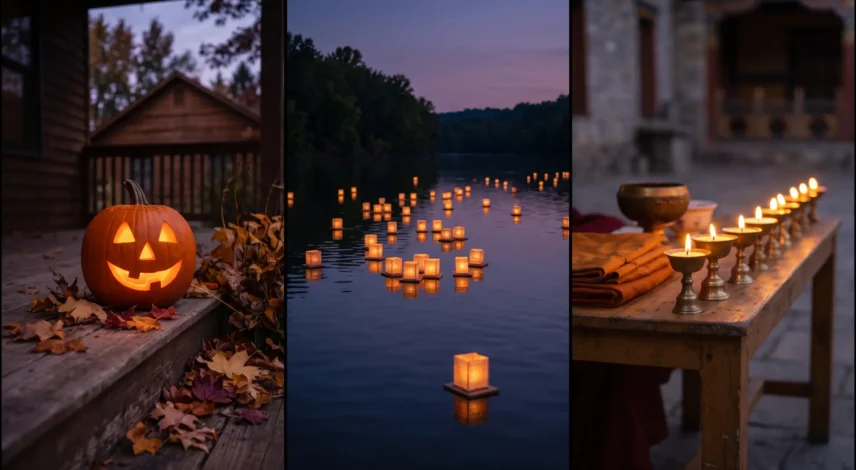
Halloween plays with the dead, the Hungry Ghost Festival feeds them, and Ullambana makes merit for them. Ullambana (Yulanpen) is the Buddhist festival of the dead, built on offerings to monks and the dedication of merit to deceased parents. This guide compares all three on one table, then shows how Buddhists honor the dead with a simple practice you can do at home. At Potala Store, we work with Tibetan artisans, so we see how often these traditions get blended together.
Americans are projected to spend $13.5 billion on Halloween in 2026, or $115.14 per person, according to the National Retail Federation. Yet the Buddhist festival that most resembles Halloween centers on gratitude, not fear. Halloween falls on Saturday, 10/31/2026. This year’s Ullambana was on 08/27/2026, and the next one arrives on 08/16/2027.
Descriptions of merit and rebirth below reflect Buddhist teaching and tradition, not verifiable claims.
Table of Contents
Is the Hungry Ghost Festival the Same as Halloween?
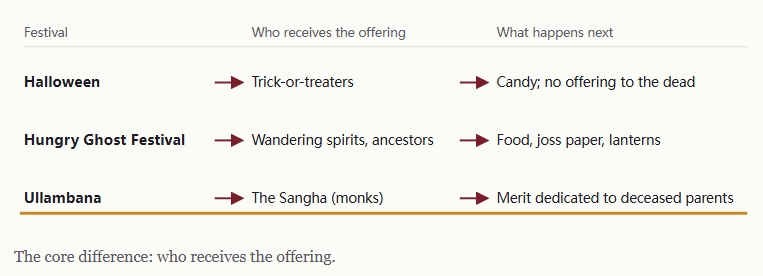
No. Halloween turns fear of the dead into a playful secular holiday, the Hungry Ghost Festival appeases wandering spirits with food and ritual, and Ullambana is a Buddhist day of offering to monks and dedicating the merit to deceased parents.
Halloween vs Hungry Ghost Festival vs Ullambana at a Glance
| Festival | Date | Origin | Who Receives the Offering | Core Practice | Mood |
|---|---|---|---|---|---|
| Halloween | 10/31/2026 (Saturday) | Samhain and All Saints’ Day | Trick-or-treaters; no offering to the dead | Costumes, jack-o’-lanterns, trick-or-treating | Playful, festive |
| Hungry Ghost Festival | 08/27/2026; next 08/16/2027 | Taoist Zhongyuan, Buddhist Yulanpen, and folk belief | Wandering spirits and ancestors | Food, joss paper, river lanterns, stage performances | Solemn, cautious |
| Ullambana | 08/27/2026; next 08/16/2027 | Yulanpen Sutra and the story of Mulian | The Sangha (monastic community); merit goes to deceased parents | Offerings to monks, chanting, dedication of merit | Reverent, grateful |
Why “Chinese Halloween” Is a Misleading Label
The shorthand fails because the two festivals pursue opposite goals. Halloween grew from Samhain, a Celtic harvest festival marked around 11/01, and from All Saints’ Day, which Pope Gregory III moved to 11/01 in the 8th century, according to the Library of Congress. All Hallows’ Eve, the night before, became Halloween. All Souls’ Day followed on 11/02.
The Hungry Ghost Festival works differently. It blends Taoist Zhongyuan, Buddhist Yulanpen, and folk belief. Families answer the dead with food, joss paper, and floating river lanterns, not costumes.
We used to use “Chinese Halloween” as shorthand too. That stopped working once we read the Yulanpen Sutra and saw that no one in the story is trying to scare anyone.
Mexico’s Day of the Dead (11/01 and 11/02) is the closer Western parallel, because it also welcomes ancestors home with offerings.
What Is Ullambana, and How Is It Different From the Hungry Ghost Festival?
Ullambana is the Buddhist festival, based on the Yulanpen Sutra, in which families make offerings to the monastic community on the 15th day of the seventh lunar month and dedicate the merit to deceased parents of seven generations.
Maudgalyayana (Mulian) and the Yulanpen Sutra
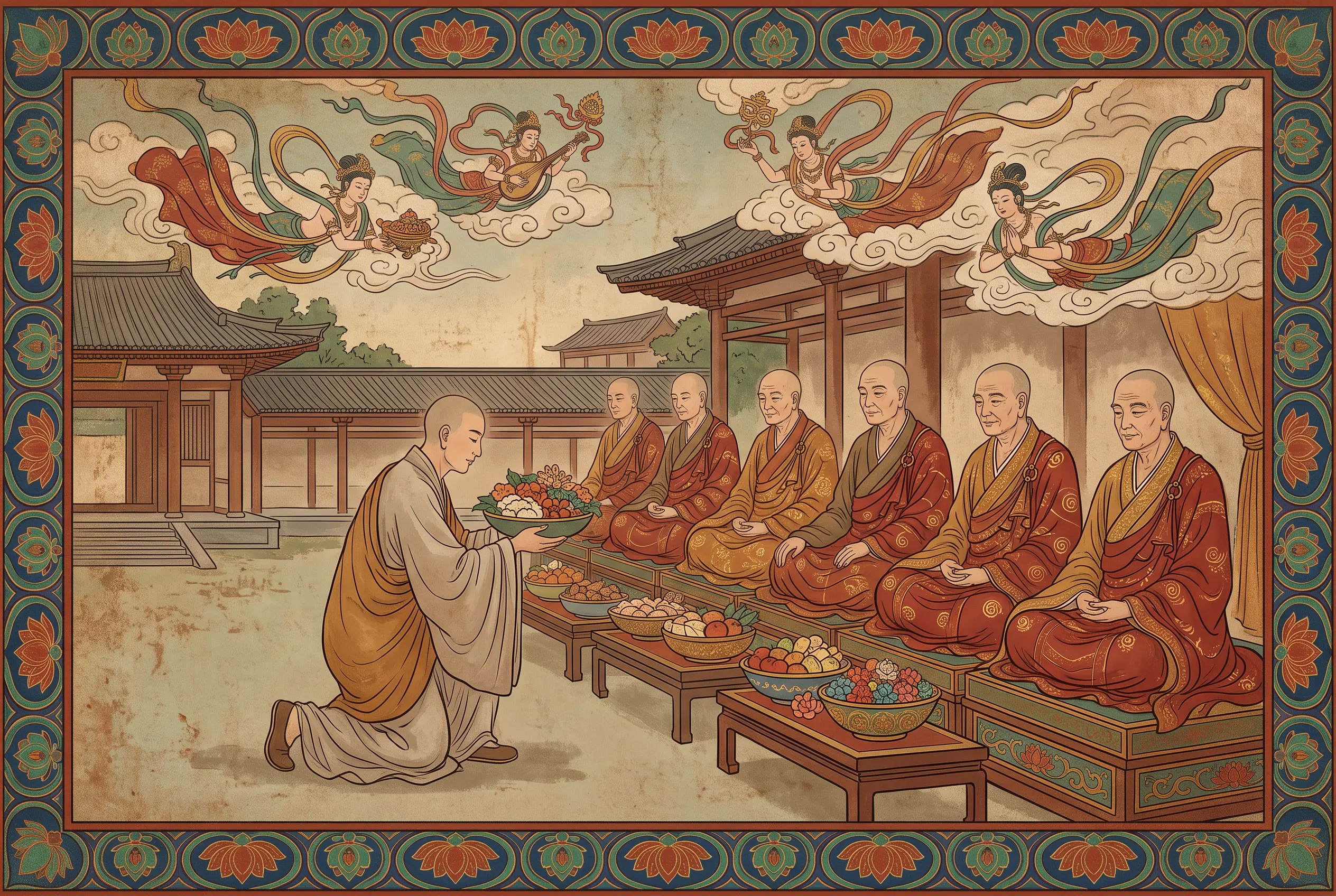
The Yulanpen Sutra, catalogued as Taisho 685, is traditionally credited to the translator Dharmarakṣa in the late 3rd century. Scholars still debate that attribution, so it is safest to say “traditionally credited.”
The sutra tells of Maudgalyayana (Mulian), a disciple of the Buddha known for his supernatural powers. He searches for his deceased mother and finds her reborn as a preta, or hungry ghost. Food he offers bursts into flames before she can eat it.
The Buddha explains that no single person can free her. Instead, Mulian should offer food and gifts to the Sangha on the day the monks end their summer retreat. That act, the sutra teaches, benefits parents of seven generations. For this reason, Mulian became the model of filial piety. To see where his mother was reborn, read about the hungry ghost realm in the six realms of existence in Buddhism.
What surprised us most is the date. It was not chosen because “the gates of hell open.” It marks Pravāraṇā, the ceremony that closes the monks’ three-month summer retreat.
Who Receives the Offering? Buddhist Ullambana vs Taoist Zhongyuan
In Ullambana, the offering goes to the Sangha, and the merit then travels onward to the dead. In the Taoist Zhongyuan Festival, linked to Diguan, the Official of Earth, offerings go directly to wandering spirits, and rites seek forgiveness for the departed.
Over the centuries, the two traditions merged into the Ghost Festival most people know today. Many Chinese Buddhist temples also hold rites for hungry ghosts, so the practices overlap in daily life. Neither is the same as Qingming, the April tomb-sweeping day devoted to one’s own ancestors.
When Are Ghost Month and Ullambana in 2026 and 2027?
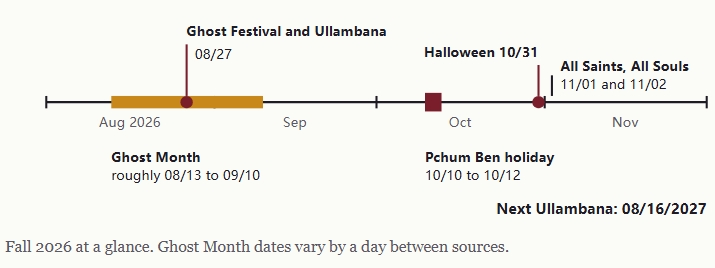
In 2026, Ghost Month ran roughly from 08/13 to 09/10, with the Ghost Festival and Ullambana on 08/27; the next one falls on 08/16/2027, while Halloween is always 10/31.
Ghost Month 2026: 08/13 to 09/10
The festival date shifts each year because it follows the lunar calendar. Ullambana falls on the 15th day of the seventh lunar month, and parts of southern China observe it a day earlier. That is why a few sources list 08/26/2026.
Lunar months last 29 or 30 days, which is why some sources list Ghost Month’s closing date one day apart (09/10 or 09/11).
Halloween, All Souls’ Day, and Pchum Ben on the Fall Calendar
- Halloween: 10/31/2026, a Saturday.
- All Saints’ Day and All Souls’ Day: 11/01 and 11/02.
- Pchum Ben (Cambodia): a 15-day observance for ancestors, with a three-day national holiday on 10/10 to 10/12/2026.
- Ullambana (next): 08/16/2027.
For every other date that year, see our 2027 Tibetan Buddhist calendar of key holy days.
How Do Buddhists Honor the Dead?
Buddhists honor the dead mainly by making merit, through offering, chanting, and generosity, and then dedicating that merit to the deceased, a practice traditionally believed to support the loved one’s journey after death.
Dedicating Merit to a Deceased Loved One
Dedication of merit means ending an act of generosity or prayer with a wish that its benefit reach another being. In Tibetan practice, practitioners close nearly every session this way.
Three low-barrier forms are common: a light offering such as a butter lamp, incense, and mantra recitation counted on a mala. Many practitioners choose Om Mani Padme Hum, the mantra associated with compassion. Behind all three sits karma. For a plain-language primer, read how karma and merit work in Buddhism.
The most common mistake is treating the offering itself as the goal. In Buddhist teaching, intention and dedication matter more than the size of the gift.
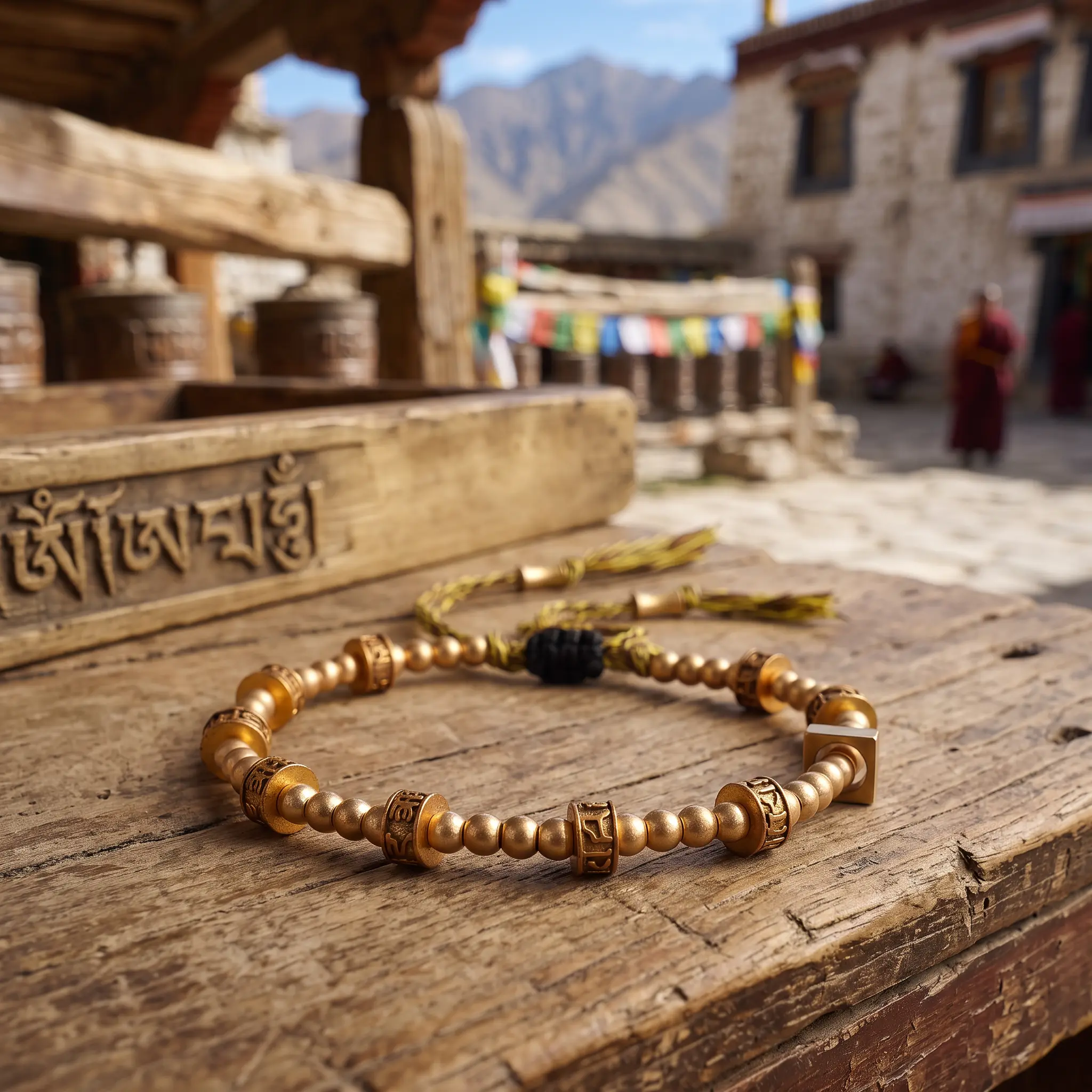
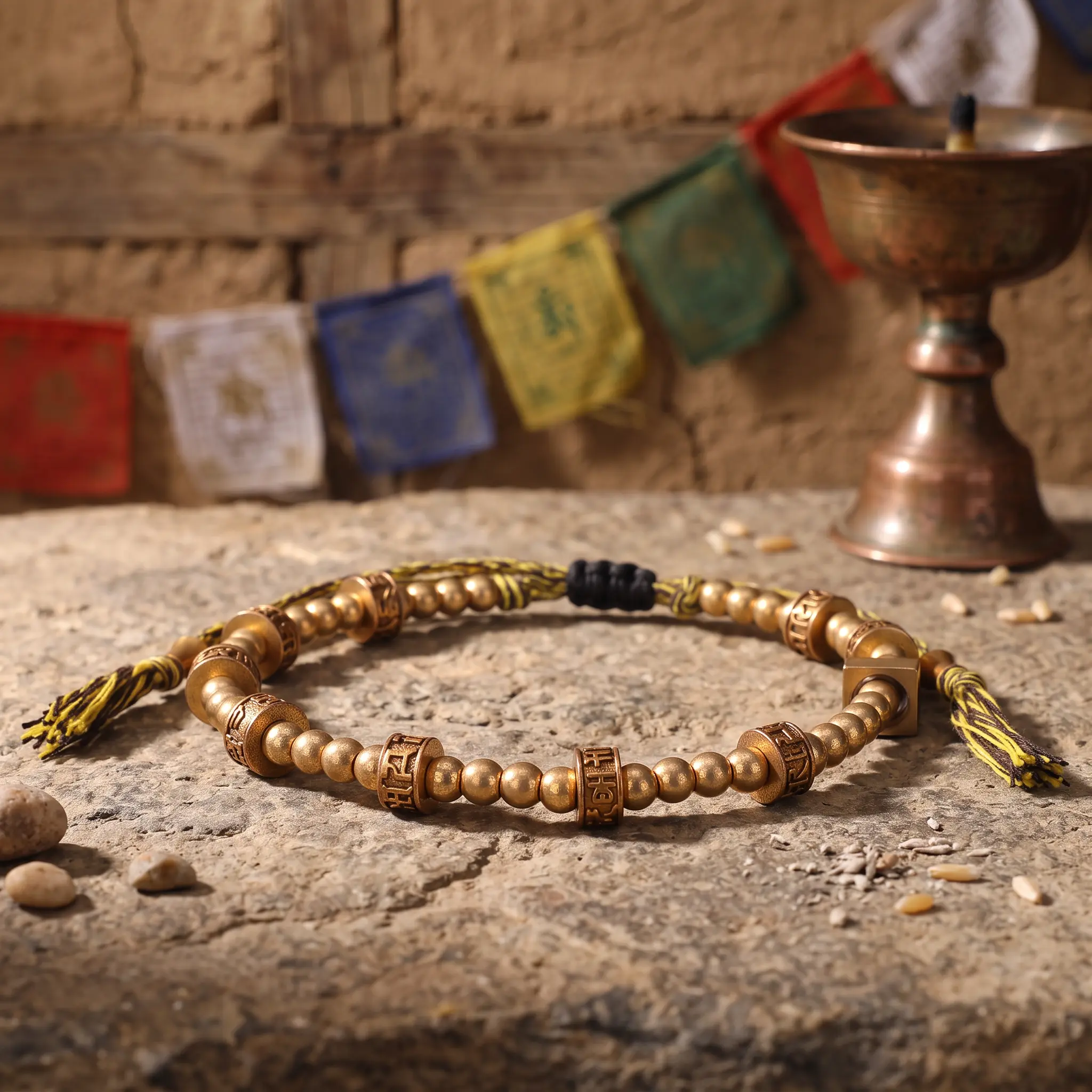
If you are grieving, no small gesture is the wrong one. A 108-bead sandalwood mala bracelet gives you a full round of mantra to count, so your attention stays on the person you are remembering. Practitioners who prefer not to recite aloud sometimes turn a Tibetan prayer wheel for silent mantra practice. Potala Store donates 10% to Tibetan artisans, so the purchase itself becomes a small act of generosity.
The Tibetan View: 49 Days in the Bardo
In Tibetan Buddhism, the bardo is the intermediate state between death and rebirth, traditionally described as lasting up to 49 days. Families commonly arrange prayers and merit dedications during this period, often on each seventh day.
Monastery pujas often run for several days and close by dedicating merit to all beings, not only to one’s own family. For the wider Tibetan picture of rebirth, see our story on Tibetan beliefs about rebirth and reincarnated lamas.
Important note: Descriptions of merit, rebirth, and the bardo reflect Buddhist teaching and tradition, not scientific evidence. This article is for cultural and educational purposes and does not replace guidance from a qualified teacher or grief professional.
Which Asian Festivals Share the Same Roots? Obon, Vu Lan, and Pchum Ben
Japan’s Obon, Vietnam’s Vu Lan, and Cambodia’s Pchum Ben all grew from the same Buddhist idea: making offerings so that merit can reach the dead.
Obon in Japan (and Bon Odori in America)
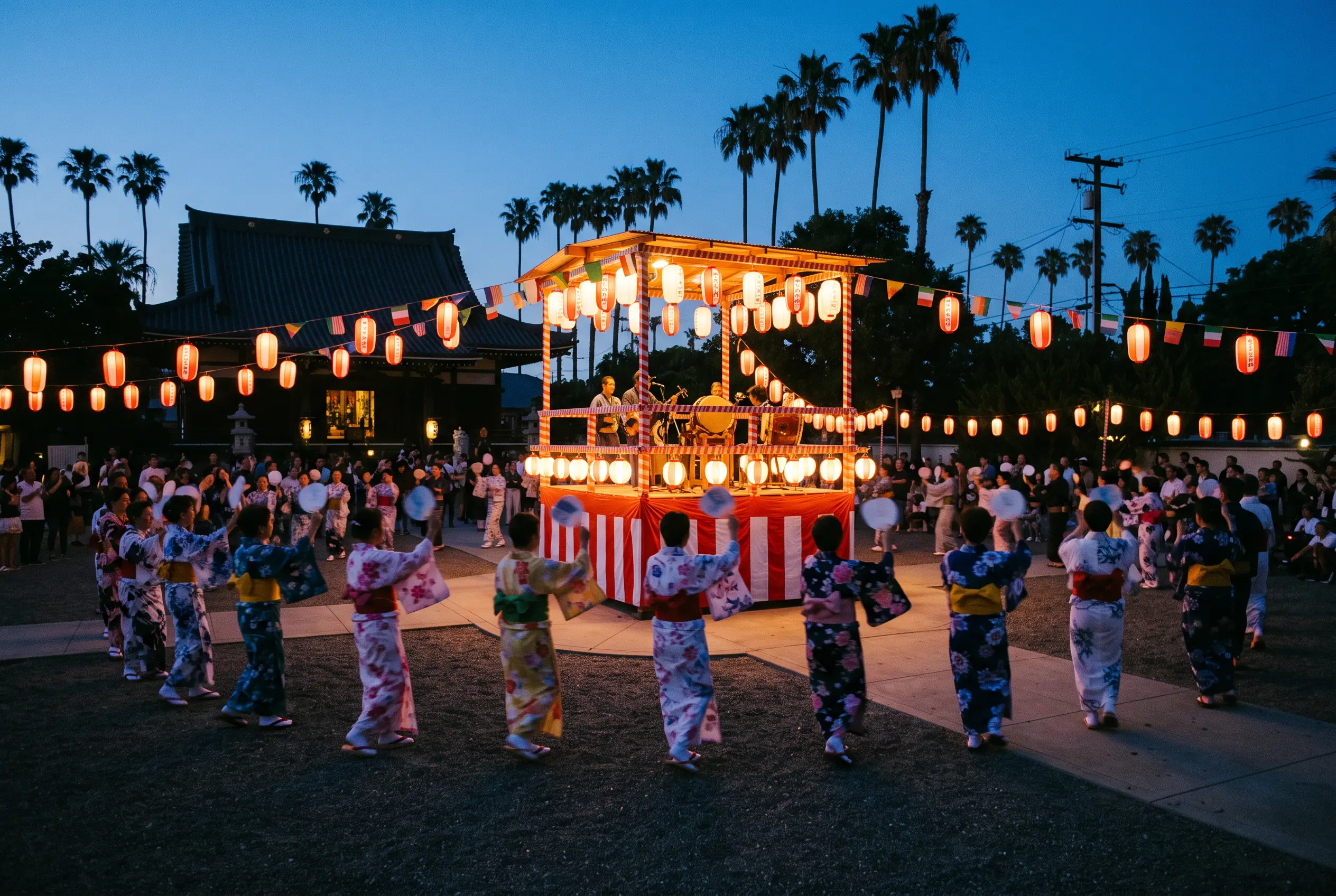
Obon is a shortened form of Ullambana. It lasts about three days and is most commonly observed around 08/15, though some regions celebrate in July. The Bon Odori dance is traditionally tied to the joy of Mulian’s mother’s release.
If you have been to a summer Bon Odori at a Japanese American Buddhist temple in California or Hawaii, you have already seen an Ullambana tradition.
Vu Lan in Vietnam and Pchum Ben in Cambodia
Vu Lan is Vietnam’s name for Ullambana. It falls on the same lunar date and centers on gratitude to parents.
Pchum Ben is a 15-day Cambodian observance rooted in the Theravada text Petavatthu. Families bring food offerings to pagodas for ancestors of up to seven generations. In 2026, the three-day national holiday ran from 10/10 to 10/12.
How Can You Observe Ullambana at Home in the U.S.?
To observe Ullambana at home, set out one light, one stick of incense, and clean water, recite a short prayer or mantra for your loved one, and dedicate the merit; the whole practice takes about 15 minutes.
A 15-Minute Home Remembrance Practice
Total time: 15 minutes. You need: one lamp, one incense stick, one bowl of clean water, and a mala (optional).
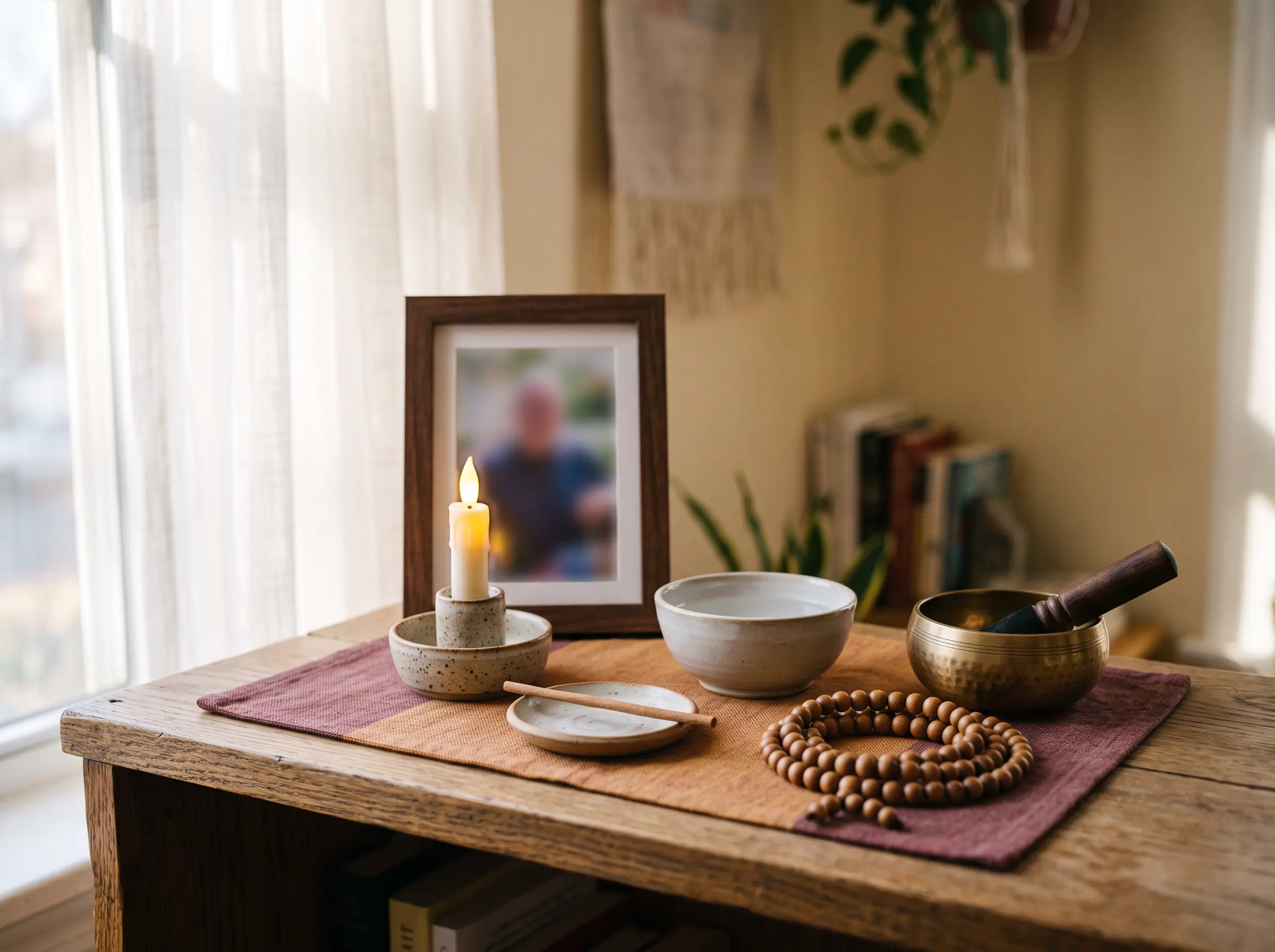
- Set out one light (1 minute): Place an LED lamp or butter lamp near a photo or name card of your loved one.
- Offer incense and water (2 minutes): Light one stick of incense and fill a small bowl, about 3 to 4 inches across, with clean water.
- Speak your loved one’s name (1 minute): Say it aloud and state your intention in one sentence.
- Recite or sit in silence (8 minutes): Repeat Om Mani Padme Hum, counting on a 108-bead mala, or simply sit quietly.
- Dedicate the merit (3 minutes): Close with the wish that the benefit of your practice reach your loved one and all beings.
Tibetan altars traditionally hold seven water bowls, but a single bowl is a fine start.
Can Non-Buddhists Take Part Respectfully?
Yes. Lighting a candle, offering incense or water, and remembering someone with gratitude is open to anyone, as long as it is done respectfully. Leave tantric rituals and formal dedications to a teacher or temple.
Burning joss paper and hell bank notes is mainly a Chinese folk and Taoist custom, and it is not required for Buddhist remembrance. If you are grieving, a light and a quiet minute are enough.
What You Need (and Don’t Need) for a Simple Offering
You need very little: a light, incense, a bowl of water, and a photo or name. A full altar is not required. If you want to build one over time, our guide to choosing Buddhist ritual items by purpose, lineage, and craft explains where to start.
Open flames and smoke detectors rarely mix in apartments. Use an LED lamp, keep incense on a heat-safe dish near an open window, and check your lease first. Low-smoke Tibetan incense and meditation supplies help here, because less smoke means fewer false alarms.
A compact Tibetan singing bowl for a small prayer altar, around 3 to 4 inches across, fits a shelf. One clear strike marks the start and end of the practice, so you do not need a large bronze bowl.
In summary, Halloween plays with the dead, the Hungry Ghost Festival feeds them, and Ullambana makes merit for them. If you want to honor someone this fall, Ullambana’s oldest lesson is also its simplest: make an offering, say the name, and dedicate the merit.
Start With One Light and One Stick of Incense
You do not need a full altar to honor someone. Browse Potala Store’s Tibetan ritual items, made by Himalayan artisans, and build a simple remembrance corner at your own pace.
Explore Tibetan ritual items for a simple remembrance corner
Frequently Asked Questions About Honoring the Dead
No. Both involve spirits, but Halloween grew from Samhain and All Saints’ Day into a playful secular holiday, while the Hungry Ghost Festival is a solemn ritual period for feeding wandering spirits and honoring ancestors. Folk cautions, such as not whistling at night, belong to Ghost Month custom, not to Buddhist teaching.
They fall on the same day, the 15th day of the seventh lunar month, but the focus differs. Ullambana centers on offerings to monks and dedicating merit to deceased parents, while the Hungry Ghost Festival blends Taoist and folk rites for wandering spirits.
No. Lighting a candle, offering incense or water, and remembering a loved one with gratitude are open to anyone, as long as they are done respectfully. Tantric rituals and formal dedications are best left to a teacher or temple.
The next one falls on 08/16/2027; the 2026 festival was on 08/27/2026. To plan ahead, check the full list of Tibetan Buddhist holy days in 2027.
📚 References
- Hungry Ghost Festival: Overview of the Ghost Festival, the Mulian story, and related Obon customs. Encyclopaedia Britannica
- Where Did Halloween Come From?: Background on Samhain and All Saints’ Day. Encyclopaedia Britannica
- Ullambana Festival (Sangha Day): A Buddhist temple’s own explanation of offering to the Sangha. Nan Tien Temple
- The Origins of Halloween Traditions: How All Saints’ Day and All Souls’ Day shaped Halloween. Library of Congress