

The Four Noble Truths are Buddhism’s core teaching on why life feels unsatisfying and how that dissatisfaction ends. In plain terms, they say this: life contains suffering, suffering has a cause, that cause can stop, and there is a clear path to stop it. The Buddha taught these four truths in his very first sermon around 528 BCE at Sarnath, and every school of Buddhism still treats them as the foundation of the entire tradition.
If you have read other explanations and walked away more confused than when you started, you are not alone. At Potala Store, we work directly with monasteries in Lhasa and Kathmandu, and after years of hearing the same question from curious beginners, we have learned that most articles bury a genuinely simple idea under Sanskrit terms. This guide keeps the terms but explains each one in everyday English, so you leave understanding what these Buddhist teachings actually mean for daily life.
⚠️ A note on this content: The Four Noble Truths are a living religious teaching held sacred by millions of practitioners. This article explains them respectfully for educational purposes. It is not a substitute for guidance from a qualified teacher, nor is it medical or mental-health advice.
Table of Contents
What Are the Four Noble Truths?

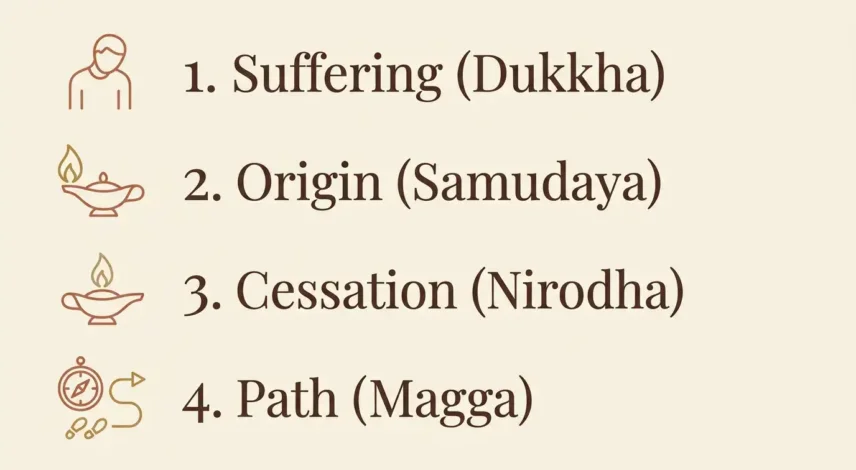
The Four Noble Truths are a four-step diagnosis of human dissatisfaction: the truth of suffering, its origin, its cessation, and the path leading to its end. The Buddha framed them the way a physician frames an illness. He named the symptom, identified the cause, confirmed a cure exists, and then prescribed the treatment.
Here is the whole framework at a glance, with the traditional Pali name beside each plain-English meaning.
| Noble Truth | Pali Name | Plain-English Meaning |
|---|---|---|
| 1. Suffering | Dukkha | Life includes stress, dissatisfaction, and impermanence |
| 2. Origin | Samudaya | Suffering is caused by craving and clinging |
| 3. Cessation | Nirodha | Suffering can end when craving is released |
| 4. Path | Magga | The Noble Eightfold Path is the practical route out |
One point clears up a lot of early confusion: the word “noble” does not describe the truths as grand or lofty. In the original teaching it describes the practitioner. These are the truths understood by a “noble one” — someone who sees clearly. Read that way, “noble truth” simply means “a truth grasped by those who wake up to how things really are.”
Why the Buddha Taught Them as a Set
The four only work together. Naming suffering without its cause leads to despair; promising an end without a path leads to wishful thinking. Taught as a sequence — problem, cause, cure, treatment — they turn a vague sense of unease into something you can actually work with.
Understanding Dukkha, Craving, and the End of Suffering

Dukkha, craving, and cessation are the first three truths, and together they explain both the problem and the reason it can be solved. Understanding these three plainly is what makes the fourth truth — the path — make sense.
The First Truth: Dukkha (Suffering)
Dukkha is often translated as “suffering,” but that word is too narrow. Dukkha covers three levels: obvious pain like illness and grief, the stress of change when good things end, and a subtle background dissatisfaction that even a good life carries. The old image is a potter’s wheel slightly off its axle — it still turns, but it wobbles. The first truth simply asks you to admit the wobble is there.
The Second Truth: Samudaya (The Cause)
Craving — tanha in Pali, literally “thirst” — is the origin of suffering. We suffer not because we want things, but because we cling to them and demand that impermanent things stay permanent. Buddhism identifies three forms of this thirst: craving for pleasure, craving for existence, and craving to avoid what we dislike. Notice the modern version of this thirst next time you refresh a screen you already checked a minute ago.
The Third Truth: Nirodha (The End)
Cessation is the good news of the whole system: when craving is released, suffering releases with it. This is Nirvana — not a place you go, but the state of freedom that remains when clinging stops. The third truth is the Buddha’s confirmation that the cure is real and reachable, not just a comforting idea.
The pattern in one line:
Craving (thirst) → grasping at impermanent things → dukkha (the wobble)
Let go of the craving → the grasping stops → nirodha (freedom)
How the Noble Eightfold Path Ends Suffering

The fourth truth is the Noble Eightfold Path — eight practical guidelines grouped into wisdom, ethical conduct, and mental discipline. This is the Buddha’s prescription, and it is why Buddhism is a practice rather than only a philosophy. The path is often called the Middle Way because it avoids both harsh self-denial and unchecked indulgence.
The eight factors fall into three groups:
- Wisdom (Prajna): Right View and Right Intention — seeing life clearly and setting a wholesome direction.
- Ethical Conduct (Sila): Right Speech, Right Action, and Right Livelihood — living honestly and without harm.
- Mental Discipline (Samadhi): Right Effort, Right Mindfulness, and Right Concentration — training the mind through steady attention and meditation.
“Right” here does not mean “correct versus wrong.” It carries the sense of skillful, whole, and balanced — like a wheel that runs true. The eight factors are not eight steps to complete in order; they are eight qualities cultivated together, each supporting the others.
This is also where the Four Noble Truths connect to everyday tools. Many practitioners use a set of 108 mala beads to steady attention during Right Mindfulness and Right Concentration, moving one bead per breath to keep a wandering mind anchored. If you want to see how the truths sit within Buddhism as a whole, our guide on whether Buddhism is a religion or a philosophy traces how each tradition puts these teachings into practice.
New to the practice side of these teachings? Our meditation starter guide walks through the simple tools that support the mindfulness and concentration factors of the path — no prior experience needed.
Frequently Asked Questions
In simple terms: life has suffering, suffering is caused by craving, that suffering can end, and the Noble Eightfold Path is the way to end it. The Buddha taught them as a problem-and-solution set — a diagnosis followed by a cure.
“Noble” refers to the person who understands them, not to the truths themselves. In the original teaching, these are the truths seen clearly by a “noble one,” meaning someone awakened to how reality actually works. A more literal reading is “the four truths of the noble ones.”
The Eightfold Path is not separate from the Four Noble Truths — it is the fourth truth. The first three truths explain the problem and confirm it can be solved, while the Eightfold Path is the practical method that solves it.
📚 References
- The Four Noble Truths: Scholarly overview of the truths, their Pali terminology, and their place in Buddhist doctrine. Encyclopædia Britannica
- Buddhism and Its Core Teachings: Educational overview of the Buddha’s life, the Four Noble Truths, and the Eightfold Path. BBC — Religion & Ethics