


Om Mani Padme Hum is the six-syllable Sanskrit mantra of Avalokiteshvara, the Buddhist bodhisattva of compassion, and it is most often translated as “the jewel in the lotus.” In Tibetan Buddhist tradition, its deeper meaning is that compassion (the jewel) and wisdom (the lotus) together can transform an ordinary mind into an enlightened one.
If you have seen this mantra carved into a roadside stone, rolled inside a spinning prayer wheel, or printed across a string of mala beads, you have probably wondered what it actually says. You are in the right place. At PotalaStore, we work directly with Tibetan artisans connected to the Sera Jhe and Kopan monasteries, and we have spent years learning how these six syllables are understood by the people who recite them every single day.
Below, you will get a clear, respectful answer in under a minute, then a deeper look at what each syllable means, where the mantra comes from, why English translations disagree, and how it is traditionally chanted. No prior knowledge of Buddhism required.
Table of Contents
What Does Om Mani Padme Hum Mean?
Om Mani Padme Hum literally means “the jewel in the lotus,” and it is the compassion mantra of Avalokiteshvara — known in Tibet as Chenrezig — the bodhisattva who vowed to relieve the suffering of all beings. The phrase is built from Sanskrit roots: mani means “jewel,” and padme means “lotus.”
Yet most Tibetan teachers will tell you the literal words matter less than what they point to. The jewel symbolizes method — the compassionate wish to help others — while the lotus symbolizes wisdom, the clear seeing of how things truly are. Reciting the mantra is a way of joining those two qualities inside yourself.
This single phrase is considered the heart of Tibetan Buddhism. Using a mala to recite it is one of the most widespread of all Tibetan Buddhist practices, repeated by everyone from young children to elderly monks. That is why the words appear everywhere across the Himalayas — on flags, stones, jewelry, and the prayer wheels that line monastery walls.
The Six Syllables of Om Mani Padme Hum, Explained
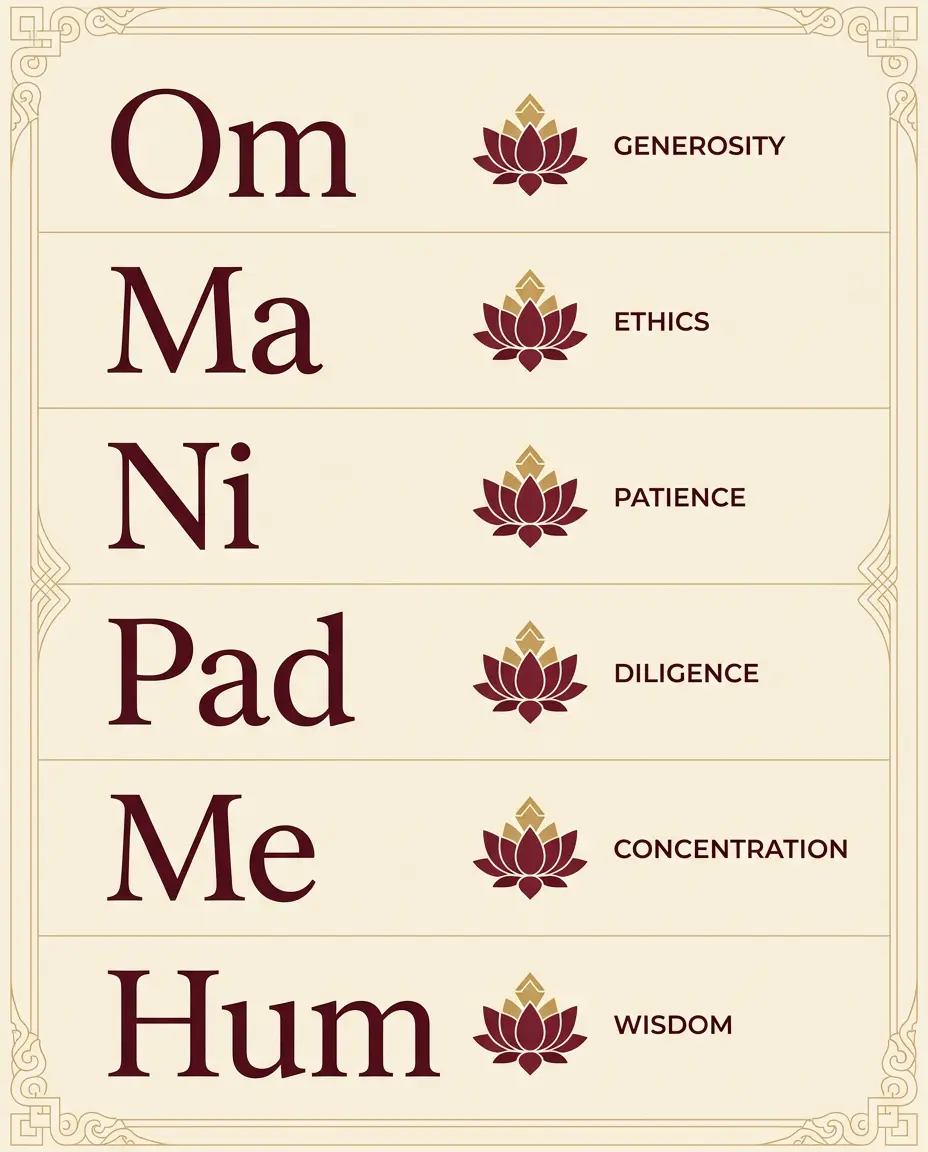
Each of the six syllables is traditionally believed to purify one negative emotion and cultivate one of the six perfections, the qualities that move a practitioner toward enlightenment. Here is the full breakdown in one place:
| Syllable | Pronounced | Symbolizes | Poison Purified | Perfection Cultivated |
|---|---|---|---|---|
| Om | ohm | Body, speech & mind of the Buddha | Pride / ego | Generosity |
| Ma | mah | The path of practice | Jealousy | Ethics |
| Ni | nee | “Jewel” (method, compassion) | Desire / attachment | Patience |
| Pad | pad | “Lotus” (wisdom) | Ignorance | Diligence |
| Me | may | Purity through wisdom | Greed / miserliness | Concentration |
| Hum | hung | Indivisible union of method & wisdom | Hatred / aggression | Wisdom |
The 14th Dalai Lama explains the grouping simply. Om stands for the impure body, speech, and mind that practice gradually transforms into their pure, enlightened form. Mani, the jewel, is the method of compassion. Padme, the lotus, is wisdom — a flower that grows from the mud yet stays clean, the perfect image of a mind that engages the world without being stained by it. Hum is the indivisibility of the two: you cannot truly have compassion without wisdom, or wisdom without compassion.
You will see slight variations between teachers on which syllable maps to which realm or poison, and that is normal — these are layers of meaning, not a fixed code. The constant across every tradition is the pairing of method and wisdom.
Some practitioners like to keep the meaning physically close while they learn it. A rotating Om Mani Padme Hum vajra pendant carries a hand-painted mantra bead that spins like a miniature prayer wheel — a quiet daily reminder of the jewel in the lotus.
Where Did the Mantra Come From?
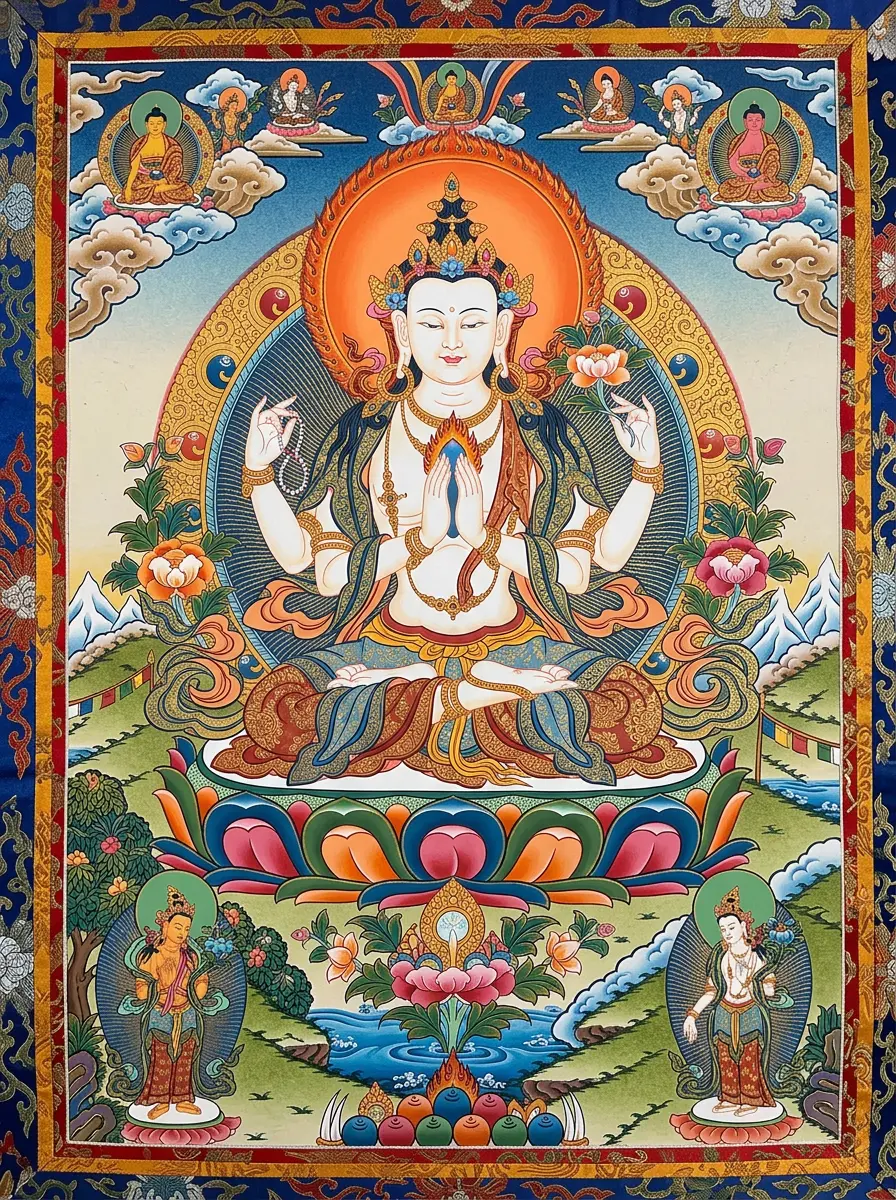
Om Mani Padme Hum first appears in the Kāraṇḍavyūha Sūtra, a Mahayana Buddhist text describing the mantra as the condensed essence of all the Buddha’s teachings. Scholar Alexander Studholme, in The Origins of Oṃ Maṇipadme Hūṃ (SUNY Press, 2002), identifies this sūtra as the earliest textual source for the mantra and dates the work to roughly the late 4th or early 5th century CE.
The mantra belongs to Avalokiteshvara, and his story explains its compassionate heart. According to tradition, the bodhisattva vowed never to rest until he had freed every being from suffering. Overwhelmed by the scale of that vow, his body is said to have shattered — and the Buddha Amitābha restored him with a thousand arms, each hand bearing an eye, so that he could see and reach all who suffer at once. The mantra is the sound of that limitless compassion.
This is also where the common “Hindu or Buddhist?” question gets settled. Om Mani Padme Hum is a Buddhist mantra, central to the Vajrayana Buddhism of Tibet, Nepal, and Bhutan. The opening syllable “Om” is shared across several Indian spiritual traditions, but the mantra itself is the mantra of a Buddhist bodhisattva. It traveled from India into Tibet, where it became the most beloved recitation in the entire culture.
“Jewel in the Lotus”? Why the Translations Differ
There is no single “correct” English translation of Om Mani Padme Hum — and in Tibetan Buddhist tradition, the meaning matters far more than the literal words. If you have searched this phrase before, you have likely seen it rendered three or four different ways, and that inconsistency confuses a lot of people.
Here is why. The popular version, “the jewel in the lotus,” treats mani and padme as two separate images. Studholme argues on grammatical grounds that maṇipadme is better read as a single word in the locative case — closer to “in the jewel-lotus” — a reference to taking birth from a lotus in a pure realm. Both readings are defensible, which is exactly why sources disagree.
The 14th Dalai Lama cuts through the debate directly: the six syllables cannot be captured by any one phrase, and a practitioner should focus on the vast meaning behind them rather than a tidy translation. So if two trusted websites give you two different wordings, neither is wrong. They are simply describing the same compassion mantra from different angles.
How to Chant and Pronounce Om Mani Padme Hum

In Sanskrit the mantra is pronounced “om mani padme hum,” while Tibetans typically say “om mane peme hung.” Both are correct — the Tibetan pronunciation simply reflects how the language evolved. You can recite it out loud, whisper it under your breath, or repeat it silently in your mind; tradition holds that all three are valid.
If you would like to bring the mantra into a simple daily practice, here is the traditional approach:
- Set your intention. Begin by recalling that you are reciting for the benefit of all beings, not only yourself.
- Use a mala to count. A traditional mala holds 108 beads, and one full circuit equals 108 recitations. Hold it in your hand and move one bead per repetition.
- Pick a number. Many Tibetan teachers suggest a minimum of 21 recitations daily, ideally one full mala of 108.
- Stay steady, not perfect. When your attention drifts, simply return to the next syllable. Consistency matters more than speed.
There is also a uniquely Tibetan way to “recite” without speaking at all: the prayer wheel. Each cylinder holds a tightly rolled scroll printed with the mantra, and spinning it clockwise is traditionally understood to release those recitations into the world. It is the same principle whether the wheel is the size of a monastery pillar or small enough to wear around your neck. (If you want the deeper distinctions, our guide to choosing a dorje, vajra, or prayer wheel pendant walks through each one.)
One detail we have learned firsthand from our partner artisans is worth sharing. The 108-bead malas we craft pass through workshops tied to the Sera Jhe and Kopan monasteries, where the makers recite Om Mani Padme Hum as they string each strand — the mantra is woven into the object before it ever reaches a wearer. That lineage of intention is something no mass-produced bead can replicate, and it is the main reason we source the way we do.
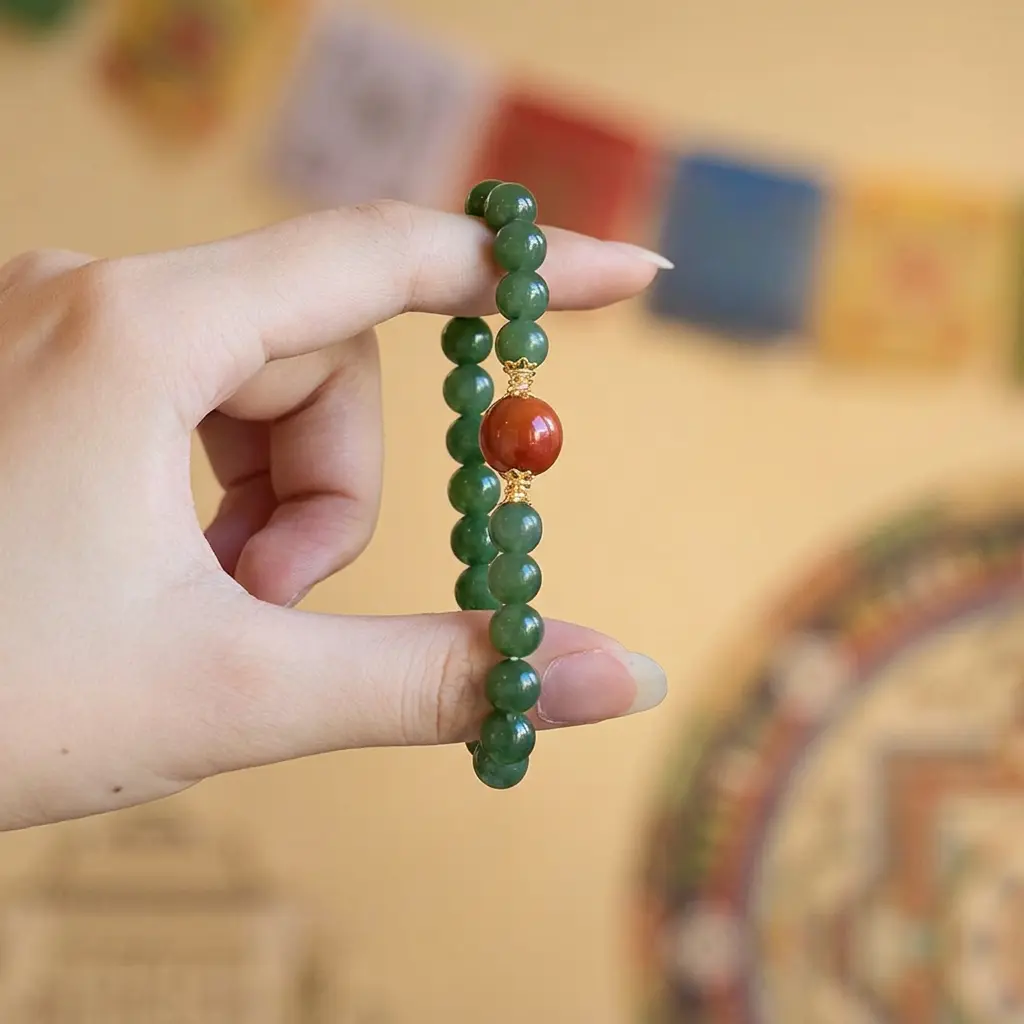
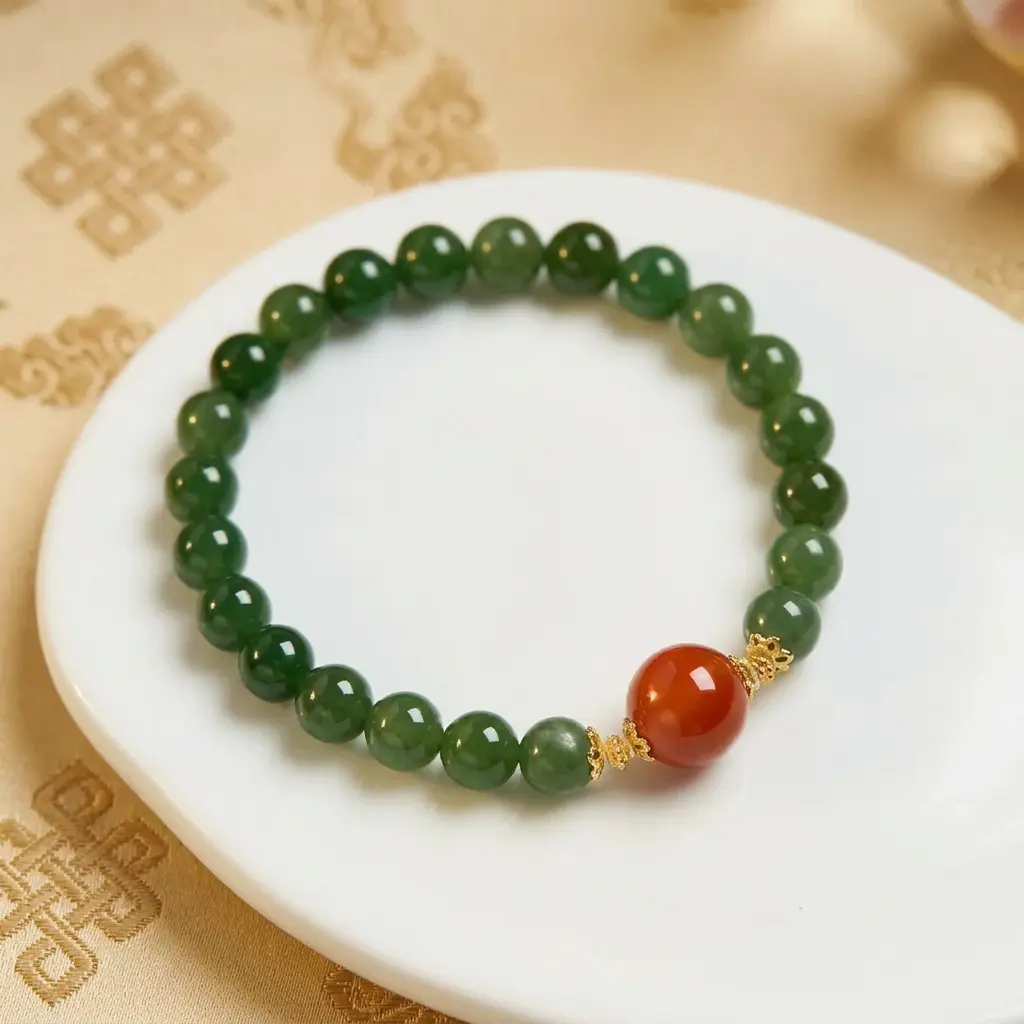
New to counting recitations? A handcrafted 108 mala beads bracelet gives you a tactile way to keep your place — and doubles as a piece of meaningful jewelry you will actually wear.
Why Om Mani Padme Hum Still Matters Today
Om Mani Padme Hum endures because it cultivates compassion — a quality that anyone, of any background, can practice with sincerity and respect. You do not need to be a Buddhist to find value in a phrase whose entire purpose is to point the mind toward kindness.
For modern practitioners, the mantra works on two levels at once. As a spiritual practice, it is believed to purify negative emotions and accumulate merit. As a mindfulness anchor, the simple act of repeating six syllables can steady a scattered mind, much like a breath count. Many people who first encounter it through meditation or yoga return to it for exactly this reason.
A note on respect: this is a living sacred tradition, not a decorative slogan. If you choose to wear or display the mantra, doing so with genuine appreciation honors the culture it comes from. That principle guides everything we make at PotalaStore — and if you want the full picture of how the mantra is used in practice, our companion article on the meaning and benefits of Om Mani Padme Hum goes deeper into its daily applications.
⚠️ Important Note: The information about the spiritual and energetic qualities of Om Mani Padme Hum reflects traditional Tibetan Buddhist beliefs and the experiences of practitioners, not scientific evidence. This content is for educational purposes and is not a substitute for professional medical, psychological, or spiritual guidance.
Carry the Mantra of Compassion
Explore handcrafted Tibetan malas, prayer wheels, and Om Mani Padme Hum jewelry, sourced directly from Himalayan artisans.Explore the Collection →
Frequently Asked Questions
It is a Buddhist mantra, central to the Tibetan (Vajrayana) tradition, and first recorded in the Mahayana Kāraṇḍavyūha Sūtra. The opening syllable “Om” appears across several Indian traditions, but the mantra itself belongs to the Buddhist bodhisattva Avalokiteshvara.
Tibetan teachers commonly suggest at least 21 recitations a day, and ideally 108 — one full circuit of a mala. There is no strict rule, however. You can recite it aloud, whisper it, or repeat it silently as often as feels meaningful.
Yes. Unlike some advanced tantric practices that require formal initiation, this mantra is open to everyone regardless of religious background, and Tibetan masters welcome sincere practitioners of all traditions. As the 14th Dalai Lama taught, the meaning of the six syllables is “great and vast” — worth reflecting on as you recite.
In Sanskrit it is “om mani padme hum”; in Tibetan it is usually pronounced “om mane peme hung.” If you want to bring it into daily practice, a set of 108 mala beads makes it easy to count and carry your recitations.
📚 References
- His Holiness the 14th Dalai Lama on the Six Syllables: Primary teaching on the meaning of the mantra and its syllable-by-syllable significance. Tibetan Nuns Project
- The Origins of Oṃ Maṇipadme Hūṃ: Alexander Studholme’s academic study of the Kāraṇḍavyūha Sūtra and the mantra’s earliest textual roots (SUNY Press, 2002). State University of New York Press
- Om mani padme hum — Etymology & Meaning: Encyclopedic overview of the mantra’s syllables, variations, and history. Wikipedia
- Avalokiteśvara, Bodhisattva of Compassion: Background on the deity whose vow and iconography give the mantra its meaning. Wikipedia