
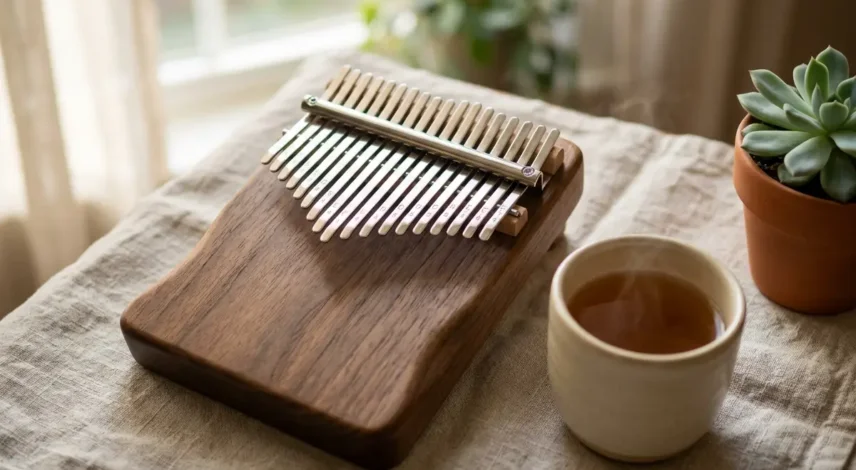

After a loud, screen-filled day, your nervous system craves an off-switch you can hold in your hands. A kalimba is exactly that — a small African thumb piano with soft, bell-like notes that many people find calming within the first few minutes, no musical training required. At Potala Store, we’ve spent years helping people build gentle, hands-on relaxation rituals, and the kalimba is one of the easiest doorways in. By the end of this guide you’ll know precisely what a kalimba is, where it comes from, and you’ll have a simple routine to unwind tonight.
Table of Contents
01What Is a Kalimba? (The Thumb Piano Explained)
A kalimba is a small African musical instrument — also called a thumb piano, mbira, or finger piano — made of a wooden board or resonator box with metal tines you pluck with your thumbs. It belongs to the lamellophone family and produces soft, bell-like tones many people find deeply relaxing.
You’ll see the same instrument sold under several names: thumb piano, mbira, finger piano, and the older word sanza. Musicians classify it as a lamellophone, part of the plucked idiophone family — meaning the sound comes from a stiff strip of material vibrating on its own, not from a string or a drumhead.
A standard modern kalimba carries 17 keys (metal tines) tuned to the C major scale, though 8-, 10-, 15-, and 21-key models exist too. It’s quiet — roughly 75–90 dB up close, just above the level of ordinary conversation — which is a big part of why it feels soothing rather than jarring.
That gentle, music-box-like tone is the reason beginners fall for it. Because every tine is pre-tuned to one scale, the notes sit in harmony no matter which ones you pluck. In practice, that makes it nearly impossible to play something that sounds “wrong.”
02Where the Mbira Came From: African Roots & Cultural Meaning
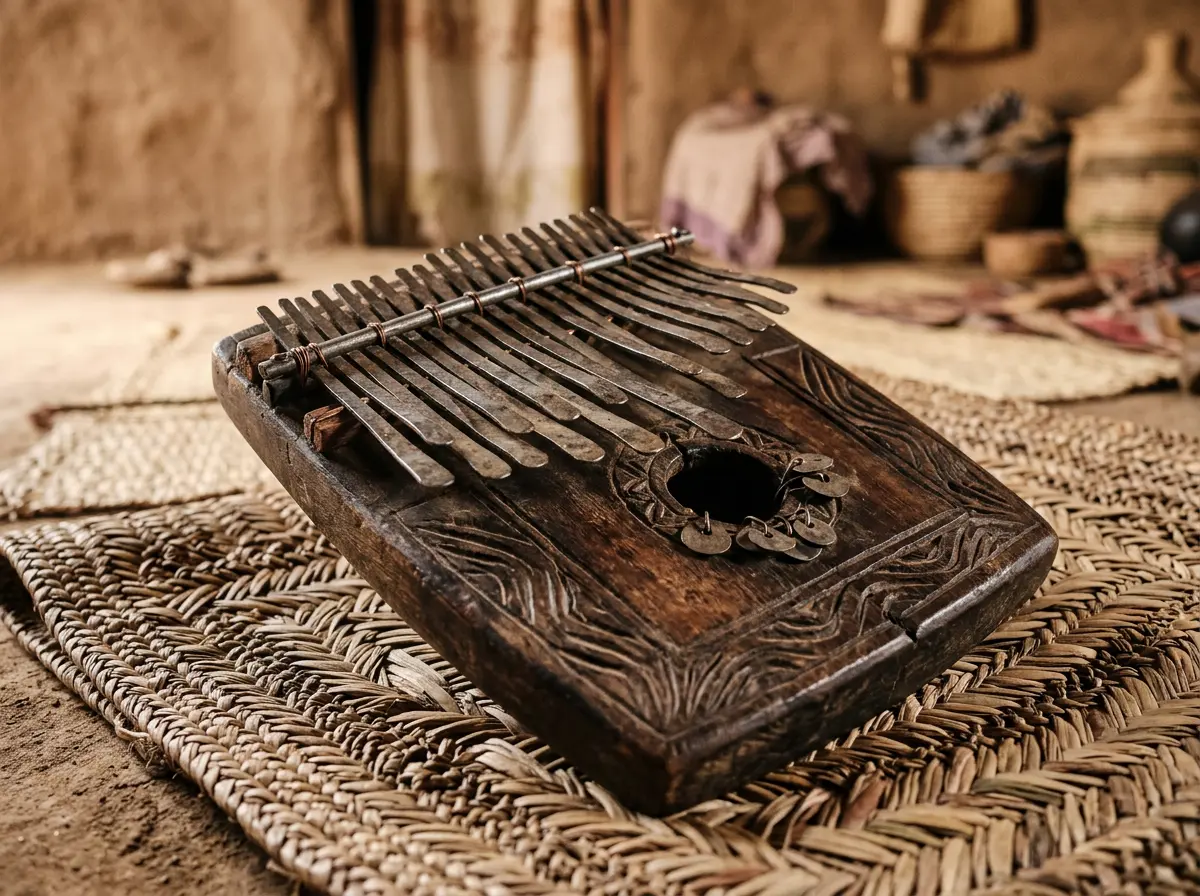
The kalimba descends from the mbira, a traditional instrument of the Shona people of Zimbabwe. What most shop blogs skip is how deep — and how recent, in recognition terms — that heritage runs.
The mbira is the African ancestor of the modern kalimba, and its cultural weight is formally acknowledged. The “Art of crafting and playing Mbira/Sansi, the finger-plucking traditional musical instrument in Malawi and Zimbabwe,” was inscribed on UNESCO’s Representative List of the Intangible Cultural Heritage of Humanity at the 15th session of the Intergovernmental Committee, held 14–19 December 2020.
The Western version you can buy today traces to one person. In 1954, ethnomusicologist Hugh Tracey introduced easy-to-play, Western-tuned kalimbas to a global audience — the same year he founded the International Library of African Music (ILAM) and the company African Musical Instruments (AMI). Those kalimbas are still handmade from kiaat wood in Grahamstown (Makhanda), South Africa.
The instrument reached pop culture soon after. Maurice White of Earth, Wind & Fire first played a Treble Kalimba in 1973, and again in 1974 on the songs “Evil” and “Kalimba Story,” carrying its bright, plucked tone to millions of listeners.
In Shona tradition, the mbira is often described as a “telephone to the ancestors” — a sacred instrument played to call on spirits during ceremonies. When you pick up a kalimba, you’re holding the friendly, portable descendant of a deeply spiritual African instrument.
Is a kalimba the same as an mbira?
Not exactly. The mbira is the older, traditional Shona instrument, often with a buzzing, resonant tone and irregular tuning tied to ceremonial music. The modern kalimba is a Western-tuned adaptation — cleaner, standardized to a major scale, and built for easy melodies. Think of the kalimba as the mbira’s approachable cousin.
03How a Finger Piano Makes Its Soothing Sound
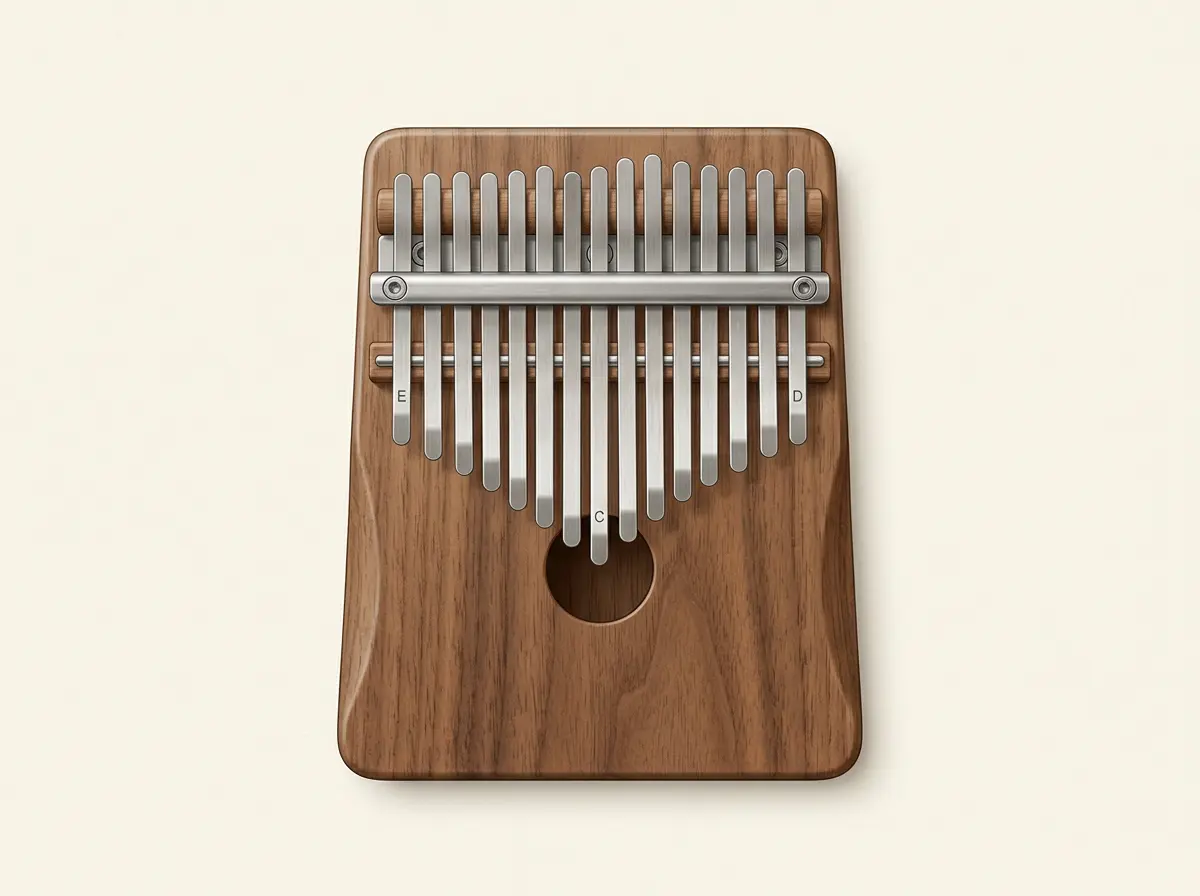
A finger piano makes sound when you pluck a metal tine, which vibrates and is amplified by the hollow wooden body beneath it. The physics are simple, and understanding them helps you get a warmer tone.
Each tine is a small steel strip fixed at one end and free at the other. Pluck the free end with a thumbnail, and it vibrates; the resonator — the wooden board or hollow sound box — amplifies that vibration into the bell-like note you hear. Tine length controls pitch: the longer, center tines produce lower notes, while the shorter, outer tines ring higher. The C-major layout alternates left and right, so neighboring notes climb the scale as you move outward.
Material shapes the character of the sound. Most quality kalimbas use mahogany, koa, or acacia bodies with steel tines; a common 17-key model measures about 7 × 5 × 1.4 inches (18 × 13 × 3.5 cm) and weighs roughly 0.7–1.25 lb (0.3–0.6 kg). Solid-wood bodies give a warmer, rounder tone, while acrylic bodies sound brighter and more percussive.
What is a kalimba made of?
A kalimba is made of two core parts: a wooden body (solid hardwood like mahogany, koa, or acacia, or a hollow resonator box) and a row of steel tines held down by a bridge and pressure bar. Some budget models use acrylic bodies, which are more durable but less warm in tone.
04Why the Kalimba Helps You Relax and De-Stress
The kalimba supports relaxation because its soft, repetitive, low-volume tones — felt as gentle vibration in your hands — give your attention a calm, single thing to rest on. That combination of sound and touch makes it a natural tool for winding down.
Three things work together here. First, the tone itself is quiet and rounded, without harsh attack. Second, you feel the vibration physically through your thumbs and palms, which grounds your attention in your body. Third, the slow, repetitive plucking becomes a kind of active meditation — your mind follows the notes instead of the day’s mental chatter. Many players associate this settled state with the alpha and theta brainwave ranges linked to calm, relaxed focus.
The broader science points the same direction, with honest limits. A systematic review and meta-analysis — de Witte et al. (2020), “Music therapy for stress reduction: a systematic review and meta-analysis,” published in Health Psychology Review (Taylor & Francis) — found that music listening is strongly associated with stress reduction through lower physiological arousal, including reduced cortisol, lowered heart rate, and decreases in mean arterial pressure. A companion review of 104 randomized controlled trials reported a positive physiological effect (d = .380, 95% CI [0.30–0.47]).
⚠️ A note on wellness claims: This research covers music and sound broadly, not the kalimba specifically. Many people find playing a kalimba calming, and it may help you unwind — but it’s best treated as a complementary self-care tool, not a replacement for professional medical treatment. If you’re managing anxiety or another health condition, please talk with a qualified provider.
Curious how sound itself becomes a relaxation practice? Our guide to the science and practice of sound healing explains why gentle, resonant instruments feel so grounding.
05How to Use Your Thumb Piano for Relaxation: A Simple 5-Minute Routine
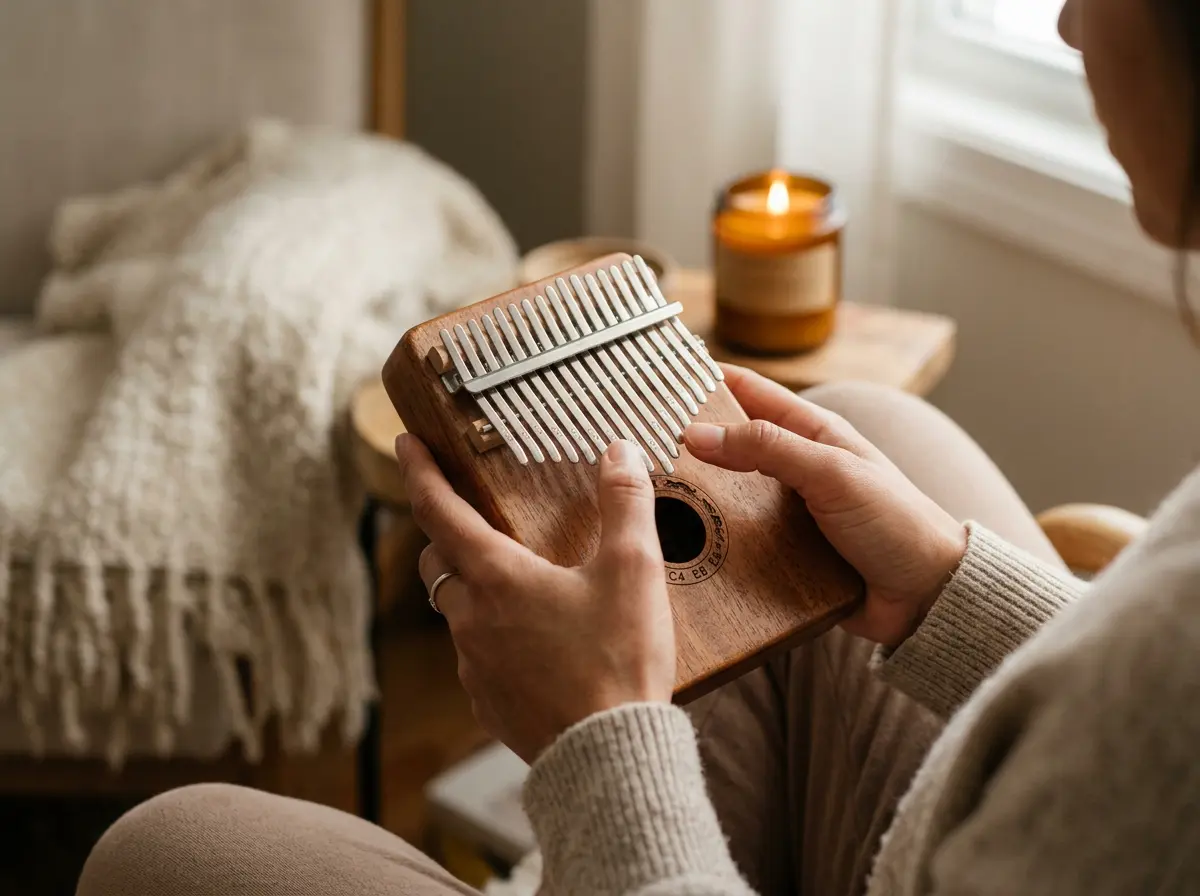
To use a thumb piano for relaxation, play slow, single notes for about 5 minutes while syncing each pluck to your breath. Here’s a beginner routine you can do tonight:
- Set your space & intention. Find a quiet spot, sit comfortably, and put your phone out of reach. Take one slow breath before you play.
- Hold it and pluck slowly. Cradle the kalimba in both hands, thumbs resting on the tines. Pluck one center tine and just listen as it fades — don’t rush the next note.
- Play a gentle left-right pattern. Alternate one tine on the left, one on the right, working slowly outward. Let each note ring fully before the next; you’re aiming for sustained, gentle sound, not a melody.
- Breathe with the notes. Inhale as one note fades, pluck the next as you exhale. After a few rounds, your breathing and the tones settle into the same slow rhythm.
Aim for a 3–5 minute session to unwind, or 10–15 minutes a day if you want it to become a steady habit. Don’t cover the back sound holes with your fingers — that muffles the resonance you’re after.
One honest heads-up from our own experience: your thumbs may feel a little sore the first few days, right where the nail meets the tine. That’s completely normal and fades within a week as the skin toughens up. And remember — because the whole instrument is tuned to one scale, you truly can’t play a wrong note. Perfection isn’t the goal; the calm is.
For this kind of practice, a resonant solid-wood kalimba makes a real difference — the warmer sustain is easier to breathe with. You’ll find handcrafted options in our Kalimba Thumb Piano collection.
06Choosing Your First Kalimba (and Kalimba vs. Singing Bowl)
For most beginners, a 17-key kalimba in C major made of solid wood is the sweet spot — approachable to play, warm in tone, and priced around $20–$50 USD for entry-level models. Seventeen keys give you enough range to grow into without overwhelming a first-timer, and solid hardwood delivers the resonant sustain that makes relaxation practice feel good.
If you’re weighing the kalimba against another popular calming instrument, here’s how it compares to a Tibetan singing bowl:
| Kalimba (thumb piano) | Tibetan singing bowl | |
|---|---|---|
| How you use it | Pluck tines with thumbs; play gentle melodies | Strike or rim-rub for a sustained drone |
| Skill needed | Minimal — melodies within minutes | Minimal — but sustained rim tone takes practice |
| Best for | Active, hands-on relaxation & mindfulness | Passive sound bath / deep meditation |
| Portability | Very high — fits in one hand | Moderate — bowl plus mallet |
| Origin | Mbira of the Shona, Zimbabwe | Himalayan / Tibetan-Buddhist tradition |
Both are wonderful; the difference is active versus passive. If you like doing something with your hands to quiet your mind, the kalimba wins. If you’d rather sit back and let sound wash over you, explore our handcrafted Tibetan singing bowls instead — or keep both for different moods.
How much does a kalimba cost?
Entry-level 17-key kalimbas typically run $20–$50 USD. Premium, larger-range, or artisan-carved models cost more but offer richer tone and craftsmanship — worth it if the instrument is also meant as a keepsake or gift.
Recommended from Potala Store
34-Key Kalimba — Black Walnut, Tree of Life
$235$334 (currently ~30% off)
A premium, wide-range 34-key model in warm black walnut with a carved Tree of Life motif. It’s a step above the beginner standard — a lovely choice if you want extra range or a meaningful, calming gift that lasts.
View the 34-Key Black Walnut Kalimba →
Ready to hold your own off-switch?
Explore Potala Store’s handcrafted kalimbas — resonant, meditation-ready instruments built for the kind of calm you can feel in your hands.Explore the Kalimba Collection →
FAQKalimba Questions, Answered
Yes. Most beginners play a simple melody within the first 15 minutes, because a standard kalimba is tuned to one scale (C major) — so it’s nearly impossible to hit a wrong note. Mastering vibrato and chords takes a few months of light practice.
A 17-key kalimba in C major is the most recommended starting point. It balances an approachable layout with enough range to grow into. (Potala Store’s in-house model is a premium 34-key for players who want extra range.)
Many people find its soft, repetitive, bell-like tones calming and use it for mindfulness and winding down. It’s best treated as a complementary self-care tool, not a replacement for professional medical care.
Browse Potala Store’s handcrafted Kalimba Thumb Piano collection for a resonant, meditation-ready instrument made from warm solid wood.
📚References
- Mbira / Sansi Intangible Cultural Heritage: Official inscription of the art of crafting and playing the mbira/sansi of Malawi and Zimbabwe (2020). UNESCO Intangible Cultural Heritage
- Music Therapy for Stress Reduction: Systematic review and meta-analysis on music, cortisol, and physiological arousal — de Witte et al. (2020), Health Psychology Review. Taylor & Francis Online
- Hugh Tracey & African Musical Instruments: Background on the International Library of African Music (ILAM) and the origins of the Western-tuned kalimba. Source: International Library of African Music, Rhodes University (Readers may search the institution’s website for current resources.)
- Mbira / Kalimba Overview: General reference on the lamellophone family, Shona tradition, and instrument classification. Wikipedia: Mbira