
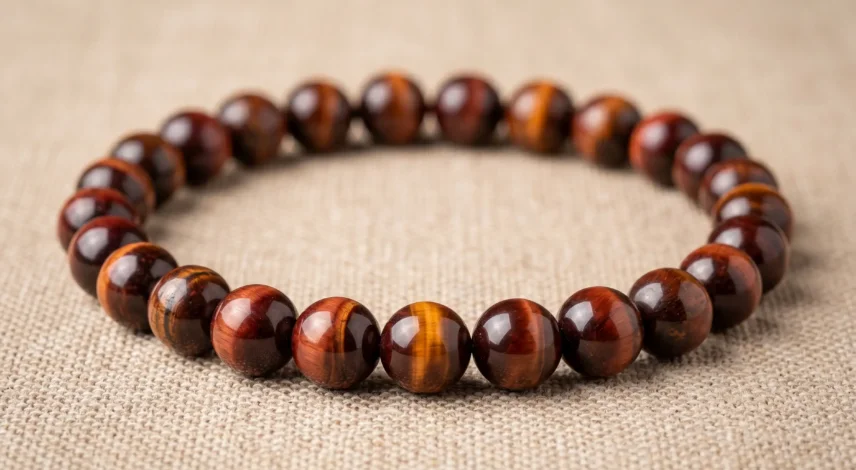

Red tiger eye is a reddish-brown variety of quartz, traditionally called the “stone of action” and believed in crystal healing to fuel motivation, vitality, and grounded confidence by activating the root chakra. Where golden tiger’s eye is the planner, red tiger eye is the doer—the stone people reach for when they know what to do but can’t get moving. After years of hand-selecting tiger eye gemstones at our workshop, we’ve also learned the one buying fact most guides skip: nearly all red tiger eye on the market is heat-treated, and some is simply dyed. Below you’ll find what it means, what it’s used for, who it suits, and how to tell the real thing apart.
Table of Contents
What Is Red Tiger Eye and What Does It Mean?

Red tiger eye—also called Dragon’s Eye, Ox Eye, or Bull’s Eye—is a chatoyant gemstone in the quartz family, made of silicon dioxide (SiO₂) with a Mohs hardness of 7 and a specific gravity of roughly 2.64 to 2.71. Its signature “cat’s eye” shimmer, called chatoyancy, comes from light reflecting off parallel fibers locked inside the stone.
The deep red itself is a chemistry story. Incomplete oxidation of iron produces blue tiger’s eye, complete oxidation creates the familiar gold, and further oxidation of that iron into hematite (Fe₂O₃) turns the stone red. So the color you’re admiring is iron, transformed.
Symbolically, red tiger eye is a stone of strength, courage, and survival instinct. In crystal healing traditions it is tied to the root chakra for grounding and stability, with its warmer red energy also linked to the sacral chakra. Its traditional rulers are Mars and the Sun—the classic pairing of drive and vitality. The lore runs deep: Roman soldiers carried engraved tiger’s-eye amulets into battle for courage, and the ancient Egyptians prized the stone for protection.
What Are the Benefits and Energy of Red Tiger Eye?
In crystal healing traditions, red tiger eye is most often reached for when motivation and physical energy are running low. These are believed properties rather than medical claims, but they appear consistently across crystal guides:
- Motivation and vitality. It’s described as a “get-up-and-go” stone that pairs grounding earth energy with the fiery vibration of the Sun—useful for beating afternoon sluggishness or starting a long project.
- Grounding through the root chakra. Many people find it steadying during stressful periods, helping the mind disconnect from anxiety and reconnect to the physical present.
- Confidence and willpower. It’s believed to quiet self-doubt, which is why wearers favor it before interviews, presentations, and big decisions.
- Passion and creativity. Its red energy is traditionally tied to courage, sensuality, and creative drive.
A simple way to remember it: gold tiger eye is linked to mental clarity (the solar plexus), while red tiger eye is linked to physical action (the root). Many crystal healers suggest pairing the two—thought plus action. If you’re curious how the blue, red, and gold varieties stack up on chakra and energy, our guide to tiger eye bracelet benefits breaks it down side by side.
Natural, Heat-Treated, or Dyed? How to Tell Real Red Tiger Eye Apart

Here’s what most “red tiger eye meaning” articles won’t tell you, and it matters before you spend money. Naturally red tiger eye does exist—formed when iron inside golden tiger eye oxidizes all the way to hematite—but it is genuinely rare. In practice, most market specimens are heat-treated at roughly 300–400°C (570–750°F) to deepen the iron to red. That treatment is stable and permanent, and most of the red tiger eye you’ll see for sale started life as ordinary golden tiger eye.
Is heat-treated red tiger eye “fake”? No. Heating is an accepted, disclosable enhancement in the gem trade. The stone is still genuine quartz, still hardness 7, and still chatoyant—the color has simply been brought forward. What you actually want to avoid is dyed material. When we first started sourcing, the easiest mistake we made was assuming bright color meant quality; in reality, the brightest, most uniform “cherry-red” stones were usually the dyed ones. Use this checklist:
- Look for color variation. Genuine red tiger eye shows depth—burgundy shifting to rust, with streaks of golden-brown and black banding. Dye looks flat and unnaturally even.
- Make the eye move. Tilt the stone. A real chatoyant band glides smoothly across the surface. No moving “eye,” no genuine tiger eye.
- Watch the cracks. On dyed stones, color often pools along the fibers or fractures—a classic tell.
- Feel the weight. With a specific gravity of 2.64–2.71, real tiger eye has a reassuring heft. Featherweight stones are likely glass.
| Type | How it’s made | Genuine stone? | Typical US price |
|---|---|---|---|
| Natural red | Iron naturally oxidized to hematite | Yes — rare | Commands a premium |
| Heat-treated | Golden tiger eye heated to ~300–400°C | Yes — enhanced | $10–$30 tumbled; $40–$100 jewelry |
| Dyed | Surface dye on common stone or glass | No — avoid | Cheapest; uniform neon color |
Most of the world’s tiger eye—including the red material—comes from South Africa’s Northern Cape region, with secondary deposits in Western Australia. We disclose treatment on every piece, so you always know whether a stone is natural, heat-treated, or dyed.
If you’d rather skip the guesswork, browse our hand-selected authentic tiger eye bracelets — each one chosen for true chatoyancy and natural banding.
Who Should Wear Red Tiger Eye, and How?

Red tiger eye is traditionally considered a strong match for Leo, Capricorn, and Aries, and it’s often suggested for anyone who feels stuck, unmotivated, or low on physical energy. Because its rulers are Mars and the Sun, some Vedic-astrology readings advise signs such as Taurus, Libra, and Aquarius to be mindful, and people who already run “hot”—high anxiety, anger, or trouble sleeping—may find its stimulating energy too much. None of this is medical guidance; your own comfort is the real test.
How to wear and care for it:
- Which wrist: In crystal tradition the left wrist receives (calm, grounding) and the right wrist projects (confidence, action). For a motivation boost, many wearers choose the right wrist.
- Bead size: 8mm is the everyday standard for adults; 10mm reads bolder, 6mm subtler.
- Cleanse and charge: Brief morning sunlight (15–20 minutes) or overnight moonlight. Avoid long water soaks, which can dull the luster over time.
- Everyday wear: At Mohs 7, it’s durable enough for daily use.
Frequently Asked Questions
Both exist. Naturally red tiger eye forms through iron oxidation but is rare; nearly all red tiger eye sold is golden tiger eye that’s been heat-treated to deepen the color. Heat treatment is an accepted enhancement, and the stone remains genuine quartz. Dyed stones—usually unnaturally vivid and uniform—are the ones to avoid.
It’s primarily associated with the root chakra, which governs grounding, stability, and survival energy. Its warmer red tones are also linked by some practitioners to the sacral chakra, the center tied to passion and creativity.
In Vedic-astrology tradition, signs such as Taurus, Libra, and Aquarius are sometimes advised to be cautious, as is anyone prone to anger, hyperactivity, or insomnia, since it’s a stimulating stone. These are traditional beliefs, not medical advice—trust how the stone makes you feel.
⚠️ Important Note: The information about spiritual and energy properties here reflects crystal-healing traditions and beliefs. It is not scientifically proven and is not a substitute for professional medical, psychological, or financial advice. If you have a health concern, please consult a qualified professional.
Explore Potala Store’s collection of authentic tiger eye bracelets—treatment disclosed, chatoyancy verified, so you wear the genuine stone with confidence.
📚 References
- Tiger’s-Eye Quartz Variety: Mineral composition, pseudomorph-after-crocidolite formation, and hardness data. Source: Mindat.org, Hudson Institute of Mineralogy (search the institution’s site for the current “Tiger’s Eye” entry)
- Tiger’s-Eye and Chatoyancy: How iron oxide coloring and fibrous structure create the cat’s-eye effect. Source: Gemological Institute of America (GIA) (see gia.edu gem encyclopedia)
- Tiger’s Eye Gem Information: Formation, varieties, and standard gemstone enhancements. Source: International Gem Society (IGS), gemsociety.org