

A bagua energy map is the feng shui tool that divides your home into nine zones, each tied to a specific area of your life — wealth, love, career, health, and more. If a room has always felt “off” but you couldn’t explain why, the bagua map shows you where energy stalls, which corners need help, and what to adjust first.
At Potala Store, we’ve spent years helping people align their spaces with intention, drawing on Tibetan Buddhist traditions and classical feng shui principles. Below, you’ll learn how to lay a bagua grid over your floor plan in five steps, decode all nine zones, and activate the areas that matter most to you — even if your home has an odd layout or you rent.
The word bagua (八卦, bāguà) literally means “eight trigrams” in Chinese. These eight symbols come from the I Ching (Book of Changes) and were arranged into a spatial map using the Lo Shu square, a 3×3 magic grid that dates back thousands of years. In practice, feng shui practitioners use the bagua as a nine-section energy map — eight life areas around the edges plus a central zone for overall balance.
Table of Contents
What Is a Bagua Energy Map?
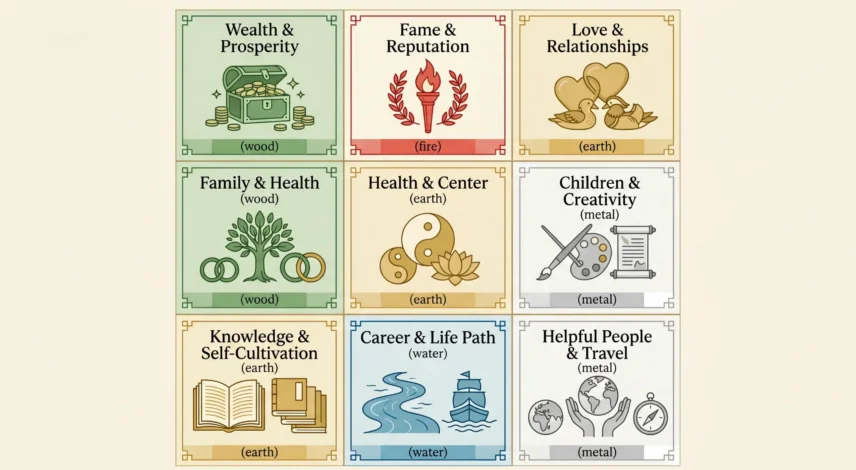
A bagua energy map is a tool used in feng shui to overlay a home, room, or workspace and reveal how each section influences a different part of your life — from career to relationships to prosperity. Think of it as a tic-tac-toe board laid on top of your floor plan: nine squares, each with its own element, color, and purpose.
The bagua grid originates from the I Ching, one of the oldest Chinese classical texts. Each of the eight outer sections corresponds to a trigram — a three-line symbol representing natural forces like water, fire, mountain, and wind. The ninth section sits at the center and represents the tai chi, the balancing point where all energy meets.
What makes the bagua practical is its simplicity. You don’t need to study years of Chinese metaphysics. You need a floor plan, a basic understanding of the nine zones (covered in the next section), and a method for aligning the grid — either the Western front-door approach or the traditional compass method.
The terms “bagua map,” “feng shui energy map,” and “ba gua” all refer to the same tool. Some practitioners also call it a “life station map.” Regardless of the name, the function is identical: map your space, identify which life areas occupy which rooms, and use intentional adjustments — called cures — to shift the energy.
The 9 Zones of the Bagua Map (and What Each One Means)
The bagua map has nine zones — eight around the edges for areas like wealth, love, and career, plus a center for overall health and balance. Each zone connects to a compass direction, one of the five elements (wood, fire, earth, metal, water), and a set of colors traditionally believed to strengthen that area.
Here is the complete reference:
| Life Area | Direction | Degrees | Element | Colors | Sample Cure |
|---|---|---|---|---|---|
| Career & Life Path | North | 337.5°–22.5° | Water | Black, dark blue | Small fountain, mirror |
| Knowledge & Self-Cultivation | Northeast | 22.5°–67.5° | Earth | Blue, green, beige | Books, crystals, meditation cushion |
| Family & Health | East | 67.5°–112.5° | Wood | Green | Healthy plants, family photos |
| Wealth & Prosperity | Southeast | 112.5°–157.5° | Wood | Purple, green, gold | Citrine crystal, money tree, flowing water |
| Fame & Reputation | South | 157.5°–202.5° | Fire | Red | Candles, red artwork, lighting |
| Love & Relationships | Southwest | 202.5°–247.5° | Earth | Pink, red, white | Paired objects, rose quartz |
| Children & Creativity | West | 247.5°–292.5° | Metal | White, gray | Art supplies, metallic accents |
| Helpful People & Travel | Northwest | 292.5°–337.5° | Metal | Gray, white, black | Travel images, metal bell |
| Health & Center (Tai Chi) | Center | — | Earth | Yellow, earth tones | Keep open and clutter-free |
Each compass sector spans exactly 45°. On a traditional luopan (feng shui compass), those 45° sectors subdivide further into three 15° “mountains” — 24 in total — but for home-level bagua reading, the eight major directions are all you need.
Notice that two zones share the wood element (Family and Wealth) and two share metal (Children and Helpful People). When the same element appears in adjacent areas, it creates a natural flow — the generative cycle in five-element theory, where wood feeds fire, fire creates earth, earth yields metal, metal enriches water, and water nourishes wood.
💡 Ready to activate a specific zone? Browse wealth-attraction crystals and cures matched to your bagua area — from citrine for the southeast corner to rose quartz for the southwest.
Western (Front-Door) vs. Traditional Compass Bagua
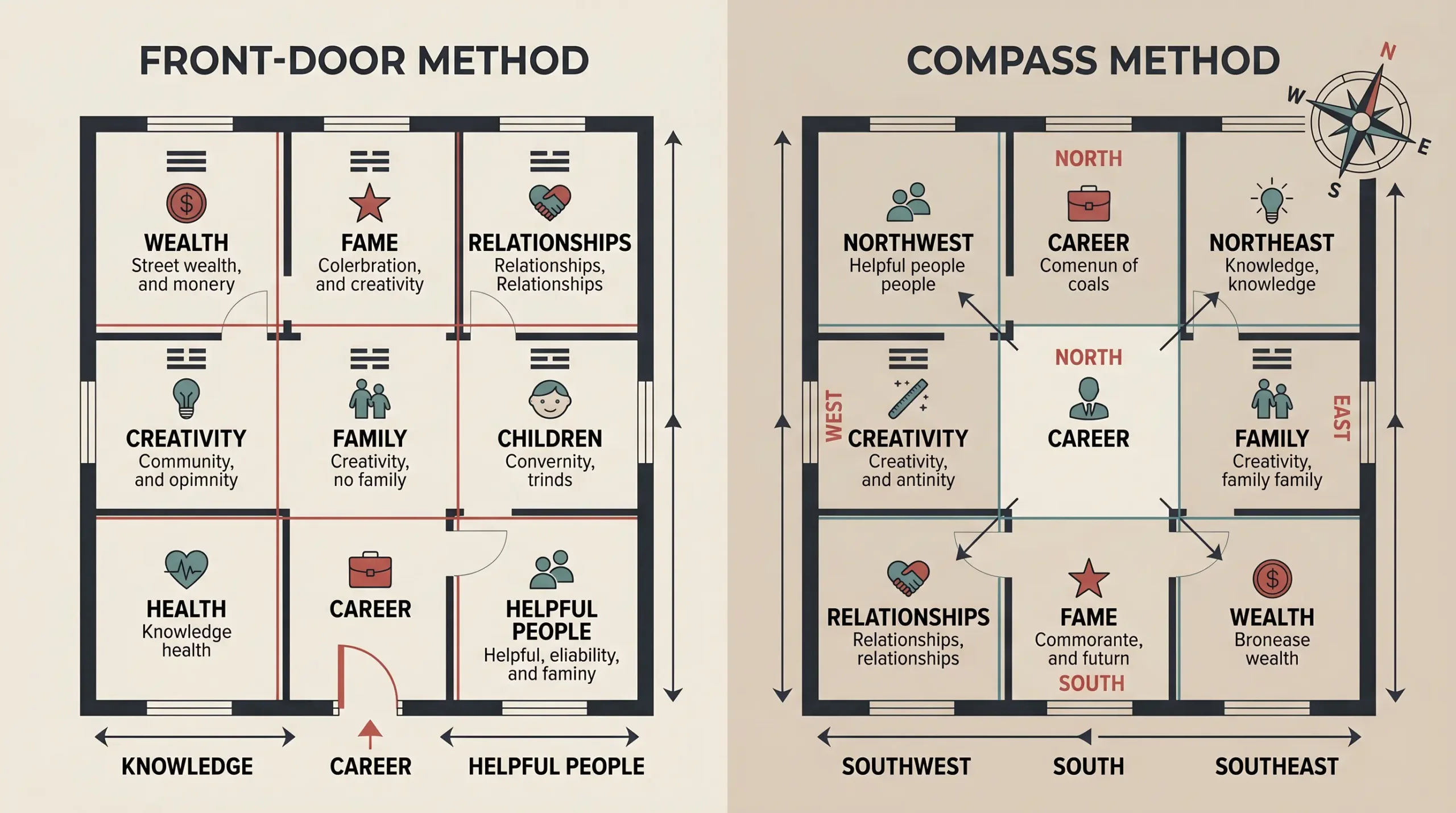
There are two main ways to place a bagua map: the Western front-door method, where you align it to your entry wall, and the classical compass method, which uses true north. Both are legitimate schools. The key is to pick one and use it consistently.
The Western method — also called BTB (Black Sect Tantric Buddhist) or Black Hat feng shui — was popularized in the United States by Professor Lin Yun beginning in 1977. In this approach, the bottom row of the bagua grid always aligns with the wall that holds your front door (known as the “mouth of chi,” the point where energy enters). You don’t need a compass. Your front door is always in the Career, Knowledge, or Helpful People zone.
The compass method uses the actual magnetic directions of your space. You take a reading at your front door with a compass app or a traditional luopan, then orient the grid so that north on the map matches true north in your home. This is the older approach, rooted in classical Chinese feng shui, and it can place your wealth corner in any room — depending on your home’s orientation.
Most U.S.-based practitioners, including architects like Anjie Cho (author of Holistic Spaces and Mindful Homes), teach the BTB front-door method because it’s accessible for beginners. If you’re mapping your home for the first time, we recommend starting with the front-door method. You can always add compass refinements later.
How to Read Your Bagua Map in 5 Steps
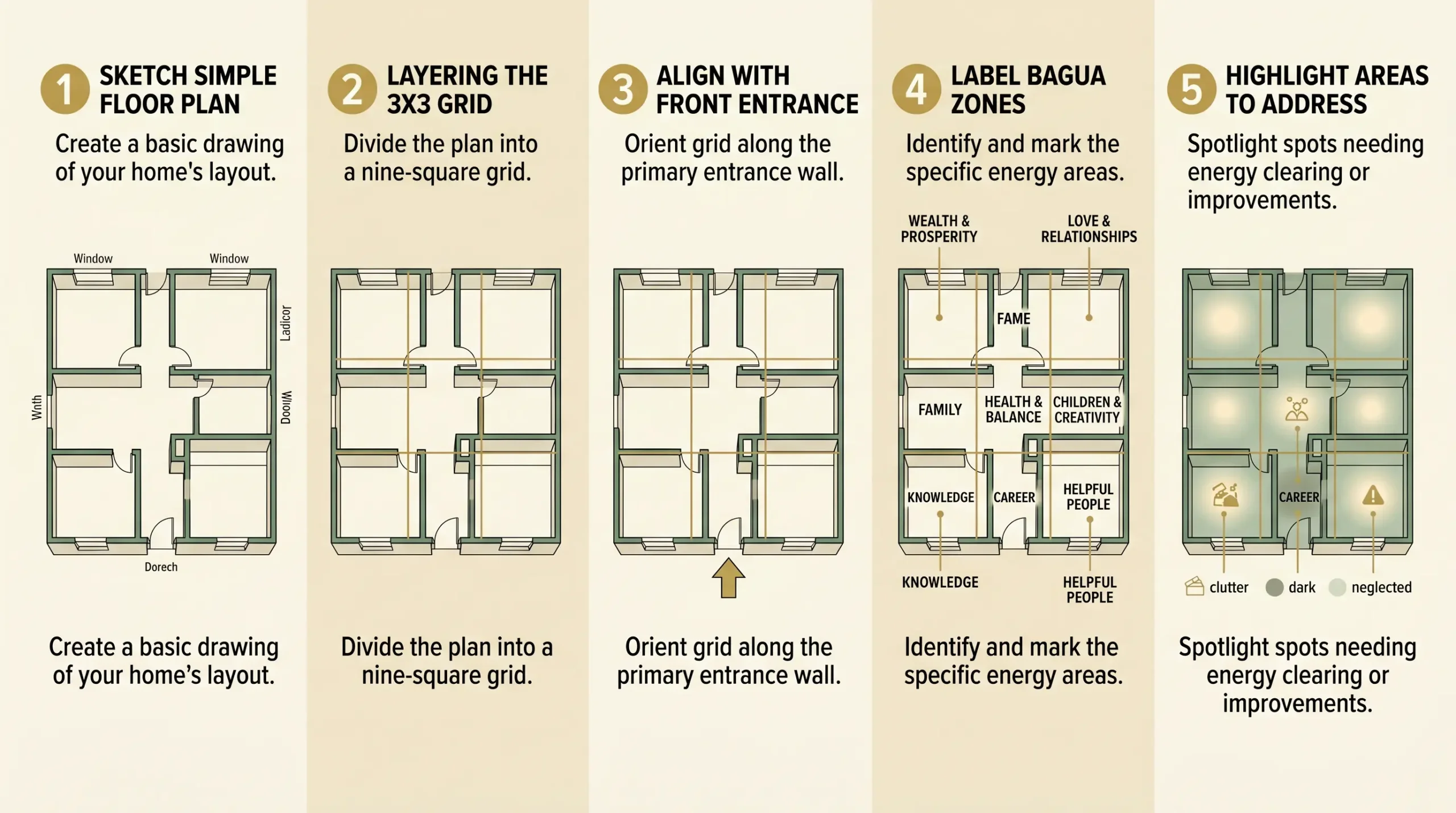
To read your bagua map, get a floor plan, divide it into a 3×3 grid, align the bottom with your front door, identify each zone, then spot areas that need attention. The whole process takes about 10 minutes.
- Get or sketch your floor plan. A rough, to-scale drawing works. Include walls, doors, and windows — skip furniture for now. If you live in a multi-level home, start with the main floor.
- Draw a 3×3 grid over the plan. Divide the floor plan into nine roughly equal rectangles, like a tic-tac-toe board. The grid should cover the full footprint of your home, including any garage attached to the main structure.
- Align the bottom row with your front door wall. Stand at your front door, facing inward. The wall behind you (the entry wall) is the bottom of the grid. Your front door falls into one of three bottom squares: Knowledge (left), Career (center), or Helpful People (right).
- Label each of the nine zones. Using the table above, assign a life area to each square. The far-back-left corner is always Wealth. The far-back-right is Love. The center is Health.
- Walk through and observe. Which zones feel cluttered, dark, or neglected? A piled-up corner in the Wealth zone or a broken fixture in the Career zone could signal stagnant chi. Note these — they’re your starting points for cures.
Don’t worry if this feels imprecise at first — we hear this from Potala Store customers all the time, and the answer is always the same: start small. Feng shui teacher Laura Cerrano agrees, suggesting you begin with just one room or even a desk. You can apply a micro-bagua — the same 3×3 grid, scaled down — to any single space by standing in its doorway and mapping from there.
What to Do About Missing Corners and Odd Layouts
If part of your floor plan is cut out or recessed — like an L-shaped home — that’s called a “missing corner,” and you can cure it with mirrors, light, plants, or by mapping a single room instead.
Here’s how to tell whether you have a missing corner or just an extension. This is the 50% rule: overlay your 3×3 grid on the full rectangular footprint of your home (including the space that’s “missing”). If the protruding section is less than 50% of the wall it sits on, you have an extension — a beneficial projection that strengthens that zone. If the void is more than 50%, you have a missing corner that weakens the life area it belongs to.
Some practitioners use an even stricter threshold of one-third (33%). Either way, the diagnostic approach is the same: compare the protruding section to the full wall length.
Common cures for missing corners:
- Mirrors: Place a mirror on the wall adjacent to the missing area to visually “expand” the space back to full.
- Outdoor anchors: If the missing corner faces outside (a yard, patio, or balcony), place a plant, light, or heavy stone at the spot where the corner would be — anchoring the energy outdoors.
- Room-level bagua: If your apartment’s shape is truly irregular, skip the whole-home grid and apply a micro-bagua to each important room individually. Stand in each doorway, align the bottom row, and map from there.
If you’re a renter and can’t make structural changes, the room-level approach is your best friend. Your wealth-corner kit — a citrine crystal, a small plant, and a purple accent — travels with you to every apartment.
How to Activate Your Wealth Corner (and Other Life Zones)
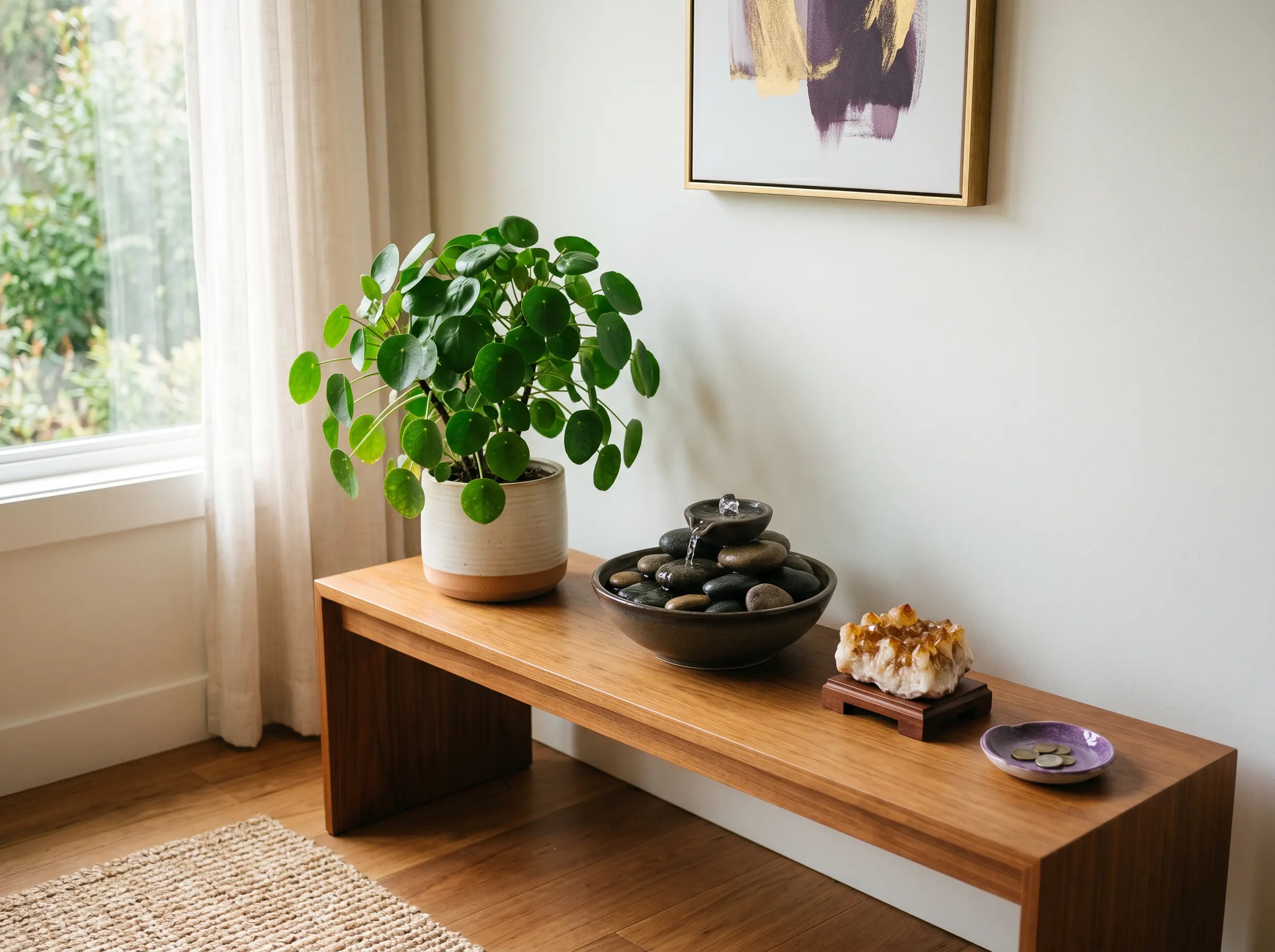
Your wealth corner sits in the southeast sector (about 112.5°–157.5°) or the far back-left from your front door, and it’s traditionally activated with wood, water, and the colors purple or green.
In five-element theory, the wealth zone (called Xun) belongs to the wood element. Water nourishes wood, so adding a small fountain or images of flowing water is believed to energize this corner. Purple, green, and gold are the traditional color associations. A healthy plant — one that’s actually thriving, not wilting — is one of the simplest and most effective cures practitioners recommend.
We’ve found that pairing a living plant with a natural citrine wealth crystal creates a tangible focal point. Citrine has been used in feng shui practice for centuries as a stone traditionally believed to attract abundance. In our experience, customers respond most when they can see and touch the cure — it’s a daily reminder of the intention they’ve set, which is ultimately what feng shui is about.
The same principle applies to other zones. Want to strengthen your career area (north, water element)? A small mirror or dark-colored bowl of water can represent that element. For the love corner (southwest, earth element), paired objects — two candles, two stones, two framed photos — reinforce the relationship energy.
One common mistake: placing a cure and forgetting about it. Cures work best when you notice them regularly. If a crystal gets buried under paperwork or a plant dies, the energy signal dulls. Treat your cures like any other intentional practice — check in on them.
⚠️ Important Note: The information about energy properties and feng shui cures is based on traditional beliefs and practitioner experience, not scientific evidence. Feng shui is a centuries-old practice rooted in Chinese cosmology. We encourage you to treat it as a tool for mindful space design rather than a substitute for professional medical, financial, or psychological advice.
💡 Go deeper: See our guide to the feng shui money corner for a full breakdown of what to place in your wealth zone — and what to avoid.
Frequently Asked Questions
Bagua (八卦) literally translates to “eight trigrams” in Chinese. The term comes from the I Ching, where eight three-line symbols represent fundamental natural forces. In feng shui, “bagua” refers to the map built from these trigrams — a nine-section grid (eight outer areas plus a center) used to analyze the energy of a space.
Not necessarily. The Western (BTB) front-door method requires no compass at all — you simply align the bottom of the grid with your entry wall. The classical compass method does require a compass or smartphone compass app to find true north. For beginners, the front-door method is the easiest starting point.
Yes. Stand in the doorway of the room, face inward, and overlay the 3×3 grid from that door. This is called a micro-bagua (or “Small Tai Chi”). It’s especially useful for apartments with irregular layouts, dorm rooms, or even a single desk at work — your wealth sector scales down to any space.
Feng shui is a traditional practice, not a scientifically tested system. That said, many people find value in it as a framework for intentional space design — decluttering, organizing by priority, and creating visual reminders of personal goals. You don’t need to believe in “energy flow” to benefit from a more thoughtful arrangement of your home.
📚 References
- Bagua (Eight Trigrams): Overview of the eight trigrams, their origins in the I Ching, and the Later Heaven arrangement used in feng shui. Wikipedia — Bagua
- I Ching (Book of Changes): The ancient Chinese divination text from which the bagua trigrams are derived. Wikipedia — I Ching
- The Feng Shui Bagua: Professional practitioner resource explaining the nine guas, their elements, and mapping methods. International Feng Shui Guild (IFSG)
- Wuxing (Five Elements): The five-phase system (wood, fire, earth, metal, water) central to Chinese cosmology and feng shui practice. Wikipedia — Wuxing (Chinese philosophy)
Start With One Corner Today
You don’t need to rearrange your entire home. Pick the zone that matters most, choose one cure, and see how it feels. Browse monk-blessed crystals, feng shui tools, and intentional home accents at Potala Store.Shop Feng Shui Cures →