
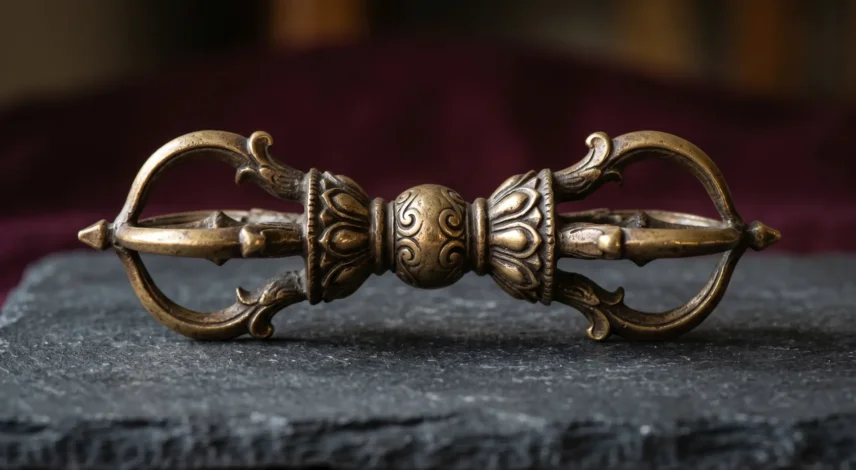

The dorje — known as vajra in Sanskrit — is far more than a decorative object. It is one of the most potent symbols in Tibetan Buddhism, carrying a dual meaning that has shaped an entire spiritual tradition: the unstoppable force of a thunderbolt and the unbreakable strength of a diamond.
At Potala Store, we work directly with Himalayan artisans who craft dorjes for monastery ceremonies and personal devotion. Through these partnerships, we have come to appreciate how deeply this sacred ritual implement connects ancient philosophy to everyday spiritual practice.
In the simplest terms, a dorje (vajra) is a handheld ritual scepter used in Vajrayana Buddhist ceremonies. It represents enlightened wisdom that cannot be destroyed by ignorance or doubt. The word “vajra” itself translates from Sanskrit as both “thunderbolt” and “diamond” — two seemingly unrelated concepts united by a single idea: absolute, indestructible power.
This guide walks you through what each part of the dorje means, how this symbol traveled from Hindu mythology into the heart of Buddhist practice, and why it continues to resonate with spiritual seekers today. Whether you have encountered the dorje at a museum, in meditation, or on a piece of jewelry, you will find the deeper story here.
Table of Contents
What Does Dorje (Vajra) Mean? The Dual Symbol of Thunder and Diamond
A dorje (Tibetan) or vajra (Sanskrit) is a ritual implement in Tibetan Buddhism that symbolizes both the indestructibility of a diamond and the irresistible force of a thunderbolt — representing the unbreakable nature of enlightened wisdom. This dual meaning is not a coincidence. It is the philosophical foundation of an entire branch of Buddhism.
The Sanskrit word “vajra” carries two simultaneous definitions. As thunderbolt, it refers to a force that nothing can resist — a power that shatters obstacles instantly. As diamond, it points to a substance that nothing can destroy — the hardest material known to the ancient world. Together, these two qualities describe the nature of awakened consciousness: a truth so powerful it cuts through all confusion, and so durable it can never be diminished.
The Tibetan translation “dorje” means “lord of stones,” referring directly to the diamond’s supremacy among all minerals. In everyday Tibetan Buddhist life, the dorje appears across art, architecture, sacred jewelry, and ceremony. It sits at the center of the tantric tradition so completely that the entire path is named after it: Vajrayana, the “Diamond Vehicle” or “Thunderbolt Vehicle.”
This is not a symbol of physical force. It is a symbol of spiritual clarity — the kind that, once achieved, cannot be reversed or broken.
From Indra’s Weapon to Buddhist Ritual: The Ancient Origins
Long before the dorje became a sacred Buddhist implement, the vajra was the legendary weapon of Indra — the king of the gods in Hindu mythology. According to the Rigveda, Indra wielded the vajra to defeat the serpent demon Vritra, who had trapped the world’s waters. The thunderbolt split the demon apart and released rivers across the earth.
Hindu texts describe the vajra as forged from the bones of the sage Dadhichi, who sacrificed his own body so that the gods could craft an invincible weapon. This origin story carries a message that Buddhism would later transform: true power comes from selfless sacrifice, not brute strength.
When Buddhist teachers adopted the vajra symbol, they shifted its meaning entirely. The thunderbolt was no longer a weapon that destroys enemies — it became a spiritual tool that destroys ignorance. The physical force became metaphorical: the vajra cuts through delusion the way a thunderbolt splits the sky.
This transformation gave rise to Vajrayana Buddhism — literally, the “Thunderbolt Path to enlightenment.” The entire esoteric tradition, practiced across Tibet, Nepal, Mongolia, and parts of Japan, takes its name from this one symbol. In Vajrayana philosophy, the vajra represents the fastest, most direct route to enlightenment: a path that transforms ordinary experience into awakened wisdom.
The shift from Hindu weapon to Buddhist ritual object mirrors a core Buddhist principle: destructive energy can be redirected toward liberation.
Anatomy of the Dorje: What Each Part Represents
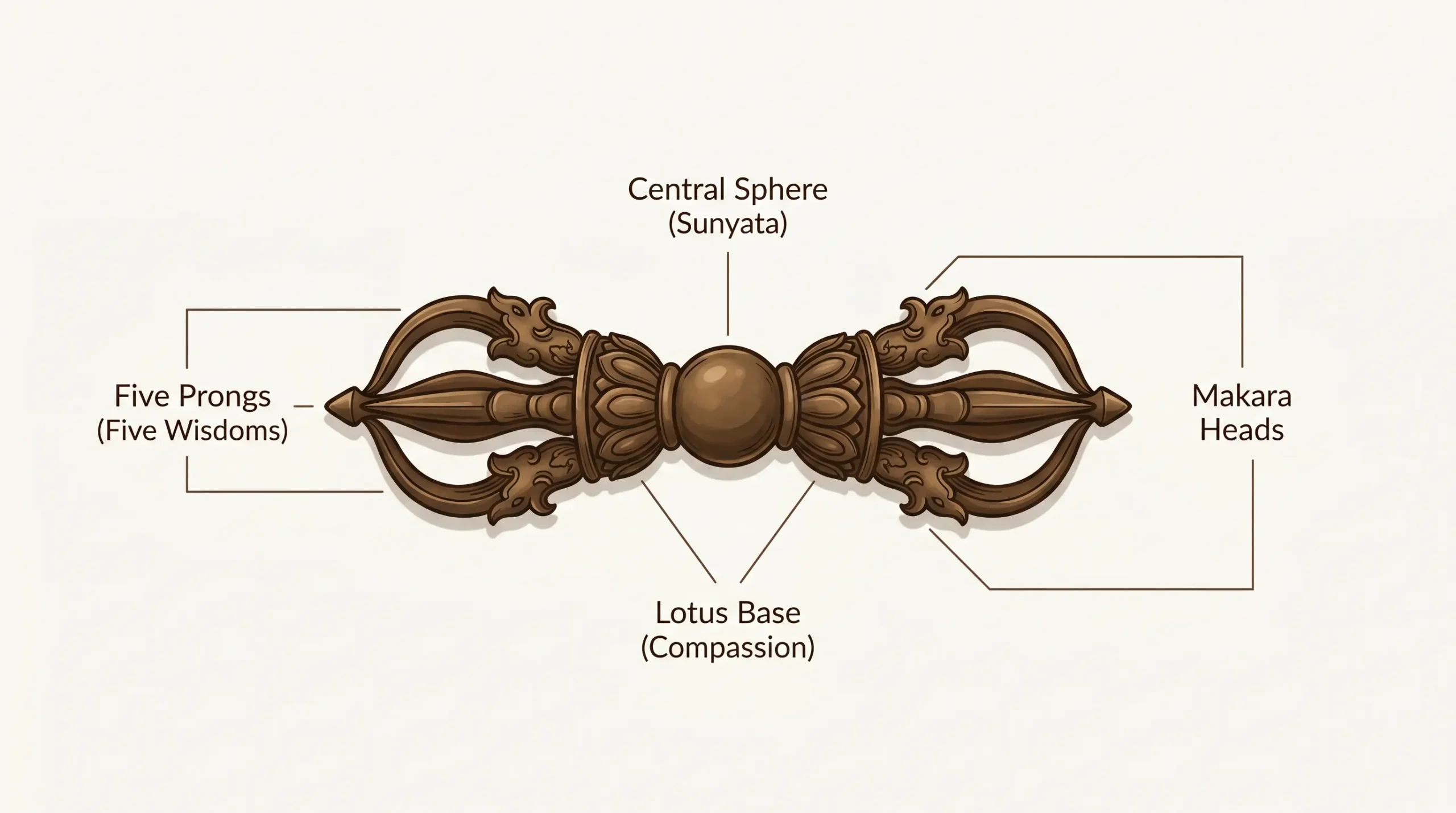
Every part of the dorje carries specific symbolic meaning — from the central sphere representing sunyata (emptiness) to the prongs that embody the Five Wisdoms of Buddhism. Understanding the anatomy of this ritual implement reveals an entire cosmology compressed into a handheld object.
The central sphere at the heart of the dorje represents sunyata (emptiness) — the foundational Buddhist teaching that all phenomena are interdependent and without fixed essence. From this sphere, two symmetrical halves extend outward, each crowned by a lotus base symbolizing the purity of compassion.
The prongs that rise from each lotus base represent specific aspects of Buddhist philosophy. The number of prongs determines the dorje’s classification and ritual purpose. Traditional dorjes range from 4 to 12 inches (10–30 cm) for ceremonial use, while pendant-sized versions measure 1 to 2 inches (2.5–5 cm). Most are cast in bronze or brass alloy, with ceremonial pieces sometimes finished in silver or gold plating.
Types of Dorje by Prong Count
| Prong Count | Buddhist Symbolism | Common Use |
|---|---|---|
| 1 (single) | Unity of all phenomena | Visualization practice |
| 3 (triple) | Three bodies of Buddha (trikaya): dharmakaya, sambhogakaya, nirmanakaya | Blessing ceremonies |
| 5 (five) | Five Dhyani Buddhas and Five Wisdoms; central prong = sunyata | Most common form; daily ritual and meditation |
| 9 (nine) | Five Buddhas plus Four Consorts (complete mandala) | Advanced tantric practice |
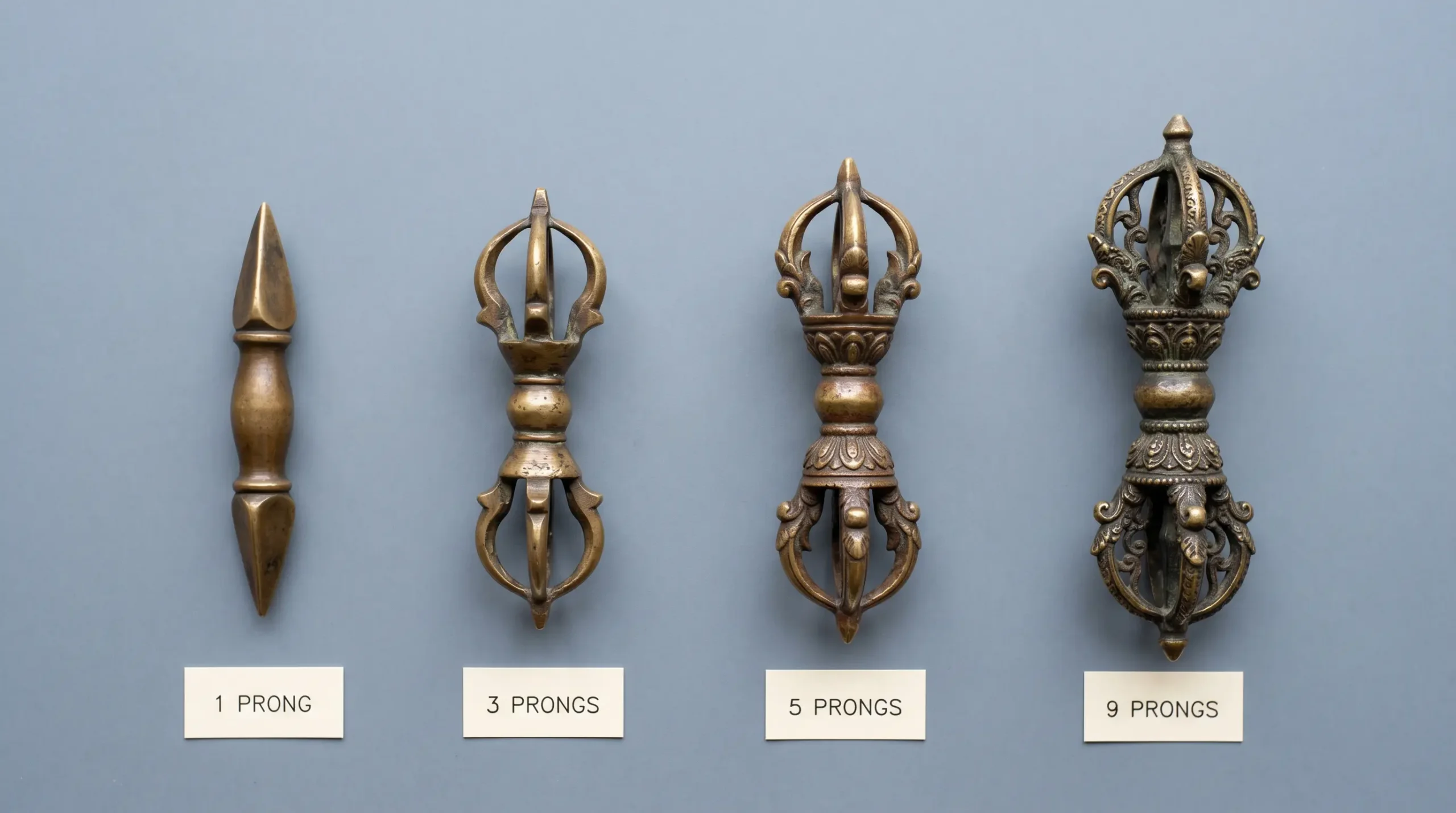
The five-pronged dorje is by far the most widely used. Its five prongs on each side represent the Five Dhyani Buddhas — Vairochana, Akshobhya, Ratnasambhava, Amitabha, and Amoghasiddhi — and their corresponding Five Wisdoms. The central prong stands alone, symbolizing the wisdom of emptiness from which all other wisdoms emerge.
When you examine a handcrafted dorje up close, you will notice the prongs are never perfectly symmetrical. This is intentional, not a flaw. Traditional artisans believe slight variations hold the maker’s spiritual energy, distinguishing a hand-cast piece from a factory reproduction.
The Double Dorje (Vishvavajra): Symbol of Absolute Stability
The vishvavajra (also called a double dorje or crossed vajra) consists of two vajras intersecting at right angles, forming a cross shape. It represents absolute stability — the indestructible foundation of the physical world. You will find the vishvavajra carved beneath the thrones of Buddhist deities in temple sculpture, stamped on monastery floors, and embroidered on ceremonial cushions. Wherever it appears, it signals an unshakable spiritual ground.
The Sacred Pairing: Why the Dorje and Bell Are Never Separated
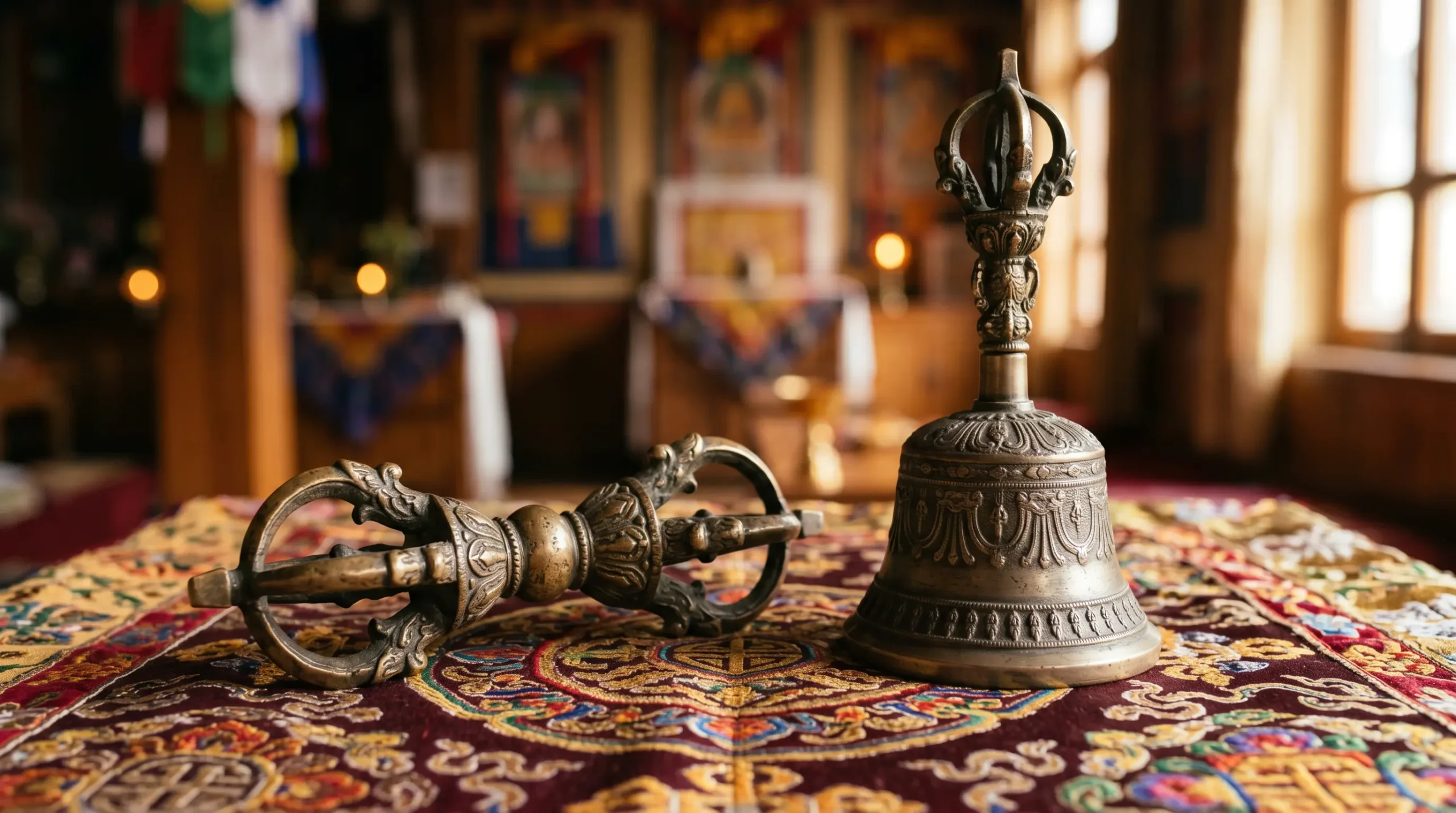
In Vajrayana ceremony, the dorje is never used alone — it is always paired with a bell (ghanta), representing the inseparable union of wisdom and compassion that defines the path to awakening.
The practitioner holds the dorje in the right hand and the bell in the left. The dorje represents upaya (skillful means, often associated with compassion), while the bell embodies prajna (transcendent wisdom). This pairing reflects a central Mahayana teaching: neither wisdom nor compassion alone is sufficient. Only their union leads to complete liberation.
The bell’s sound carries its own symbolism. Each ring expresses the voice of emptiness — a sonic reminder that all phenomena are impermanent. During consecration ceremonies, the practitioner alternates between ringing the bell and gesturing with the dorje, creating a rhythm that unifies the two qualities.
Working with Tibetan monasteries, we have learned that artisans always craft the dorje and bell as a matched set. The proportions are calibrated so the bell’s tone harmonizes with the dorje’s weight in the practitioner’s hands — a detail invisible to outsiders but essential to the monks who use them daily.
For those drawn to the vajra’s symbolism, wearing a dorje pendant offers a way to carry this meaning as a personal reminder of inner balance. Many practitioners choose pendants that pair the vajra motif with sacred mantras like Om Mani Padme Hum.
How Is the Dorje Used in Spiritual Practice Today?
A vajra dorje serves multiple roles in Buddhist practice: as a meditation focus object, a ritual tool for blessing ceremonies, and a tangible reminder of one’s commitment to spiritual awakening. Here are the primary ways it is used today:
- Meditation focus: Holding a dorje during seated meditation creates a physical anchor. The weight in your hand helps maintain present-moment awareness, especially during mantra recitation.
- Consecration and blessing: In empowerment ceremonies (wang), a lama touches the dorje to the crown of a student’s head to transmit spiritual blessings. This is one of the most sacred uses of the ritual implement.
- Daily mindfulness: Wearing a vajra pendant serves as a constant reminder of one’s spiritual commitments. It is not a fashion accessory but a portable symbol of the practitioner’s intention.
- Altar placement: Many practitioners place a dorje and bell set on their home meditation altar as the central ritual objects, alongside offerings of water, incense, and light.
- Mudra practice: The vajra mudra (a specific hand gesture mimicking the dorje’s form) is used in visualization practices to invoke the qualities of indestructible wisdom.
What surprised us most at Potala Store is how many yoga and mindfulness practitioners — not just practicing Buddhists — seek out dorje pendants and symbols. The vajra resonates across spiritual traditions as a representation of inner strength and mental clarity.
The vajra’s reach into popular culture has grown, too. When Elon Musk was spotted with a vajra, it sparked widespread curiosity about this ancient symbol’s relevance in the modern world. While individual motivations vary, the trend reflects a broader interest in symbols that represent resilience and clarity of purpose.
If you are exploring how the dorje relates to other Buddhist protective symbols and amulets, or wondering how to choose between a dorje pendant and other Buddhist talismans, those guides can help you find what resonates with your own practice.
Why Is the Vajra So Powerful? The Philosophy Behind the Symbol
The vajra is considered powerful not because of physical force, but because it represents a state of mind that cannot be destroyed by ignorance, doubt, or suffering — the diamond-like nature of awakened consciousness.
In Buddhist philosophy, “power” does not mean dominance or destruction. It means stability — a quality of awareness so deeply rooted in truth that nothing can shake it. The vajra symbolizes this unshakable clarity.
At the heart of this teaching is the concept of transforming the Five Poisons (ignorance, attachment, aversion, pride, and jealousy) into the Five Wisdoms. The vajra does not destroy these mental afflictions by force. It represents the insight that transforms them at their root. Anger becomes mirror-like wisdom. Greed becomes the wisdom of equanimity. This alchemical process is why Vajrayana is sometimes called the “fast path” — it works with difficult emotions directly rather than suppressing them.
This is also why an entire branch of Buddhism carries the vajra’s name. Vajrayana practitioners see their tradition as the most direct route to realization: a path as swift as a thunderbolt and as enduring as a diamond.
The Buddhist concept of compassion connects to this strength as well. Genuine compassion, in this tradition, is not soft or passive. It is vajra-like — firm, clear, and unbreakable. Understanding this reframes the symbol entirely: the vajra’s power lies not in what it destroys, but in what it refuses to let crumble.
To explore how the number 108 connects to Buddhist symbolism and meditation practice, see our guide on why mala beads have 108 beads.
Important Note: The spiritual meanings and symbolic properties described in this article reflect traditional Buddhist teachings and practitioner experiences. They are presented for educational and cultural purposes and are not intended as claims of supernatural power or as substitutes for professional medical, psychological, or spiritual guidance.
Frequently Asked Questions About the Dorje (Vajra)
Dorje and vajra refer to the same object. “Dorje” is the Tibetan term, while “vajra” is its Sanskrit equivalent. In English, both words are used interchangeably. You will see “dorje” more often in discussions of Tibetan Buddhist practice, while “vajra” appears more frequently in academic texts and pan-Buddhist contexts covering Indian, Nepali, and Japanese traditions.
Yes. While the dorje holds deep significance in Tibetan Buddhism, wearing a dorje pendant or owning a ritual dorje is welcomed regardless of your background. Many people around the world connect with its universal symbolism of inner strength, clarity, and resilience. The key is approaching it with respect for its cultural origins — not as a trend, but as a meaningful symbol you genuinely connect with.
In Buddhist philosophy, the vajra’s power comes from what it represents: a state of consciousness that cannot be shaken by ignorance or suffering. It symbolizes the transformation of mental afflictions into wisdom — making it the central symbol of Vajrayana Buddhism, the “Diamond Vehicle” path to enlightenment. Its strength is spiritual, not physical.
A vishvavajra (double or crossed dorje) consists of two vajras intersecting at right angles. It represents absolute stability and the indestructible foundation of the physical world. You will find it as the base of Buddhist deity thrones, stamped on monastery floors, and used in rituals that establish sacred boundaries. It signals an unshakable spiritual ground in both art and ceremony.
Carry the Symbol of Indestructible Wisdom
Explore our collection of authentic dorje and vajra pendants, each hand-cast by Himalayan artisans using traditional lost-wax methods.Explore Dorje Pendants
References
- Vajra — Etymology, Symbolism, and Cultural History: Comprehensive overview of the vajra’s origins in Hindu and Buddhist traditions, including Rigveda references and Vajrayana symbolism. Wikipedia
- Sacred Art among Hidden Treasures — Dorje in Himalayan Art: Scholarly essay on the dorje’s role in Tibetan Buddhist art and ritual, from the Rubin Museum’s Himalayan Art collection. Rubin Museum of Art
- Buddhist Symbols — The Vajra (Thunder Bolt): Educational resource on the vajra as a core Buddhist symbol, its ritual significance, and its relationship to other sacred objects. BuddhaNet
- The Vajra (Dorje) as a Symbol in Buddhism: Accessible explanation of the vajra’s role in Tibetan Buddhist practice, including its pairing with the bell and use in tantric iconography. Learn Religions