
From Skeptic to Believer: Real Stories of Transformation with Spiritual Jewelry
 by Yang Tso
0 comments
by Yang Tso
0 comments
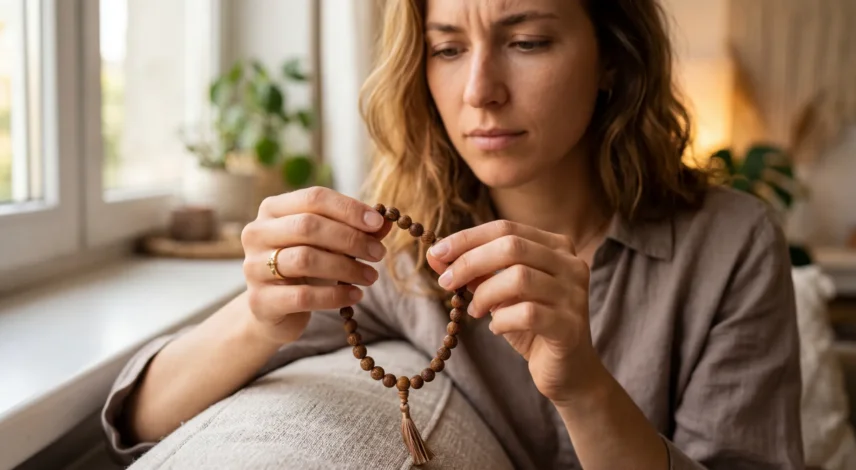
The first time someone handed me a mala, I almost laughed. I’m a spreadsheet person — I trust evidence, not energy. So I tucked the beads in a drawer and felt a little ridiculous for even owning them.
If that sounds familiar, you’re in very good company. More skeptics than you’d think have stood exactly where you are: rational, curious, and mildly embarrassed about it. This isn’t an article that asks you to believe in magic. It’s a collection of honest, real-life accounts about everyday doubters who became quiet believers in spiritual jewelry — supported by what the science actually says about healing crystals, intention, and genuine transformation.
At Potala Store, we source each piece directly from Tibetan artisans and monastery-blessed workshops. Because honesty matters more than hype, we’ll give you the science straight too — including the parts that complicate the story. By the end, you’ll understand why so many lifelong doubters ended up wearing their piece every single day. Not because a stone is magic, but because of what it reminded them to do.
⚠️ Important Note: Information about spiritual and energy properties in this article is based on traditional beliefs and reported user experiences, not peer-reviewed scientific evidence. This content is for educational and cultural purposes only and is not a substitute for professional medical or mental health advice.
Curious where to start?
Browse our collection of authentic, monastery-blessed Tibetan mala beads and sacred jewelry — each piece handcrafted by Tibetan artisans with materials you can trust.Explore the Tibetan Mala & Necklace Collection →
Table of Contents
Spiritual Jewelry, Honestly: What It Is and Why Skeptics Are Curious
Spiritual jewelry is any piece worn with intention — a bracelet, mala, or pendant chosen to serve as a daily reminder of a value or goal, such as calm, protection, or self-love, rather than purely for decoration. The stone or material may carry traditional associations; the intention you set is entirely your own.
The skeptic’s appeal makes sense once you understand this framing. You’re not being asked to believe a rock has supernatural power. You’re using a physical object as a mindfulness cue — a practice supported by behavioral psychology research on “implementation intentions,” which shows that pairing a goal with a consistent, tangible trigger measurably increases follow-through.
The scale of interest is also telling. The global crystal bracelet market was valued at more than $1.86 billion USD in 2024 and is projected to approach $3 billion by 2035 (Market Research Future). That’s not a fringe interest — it reflects a mainstream shift in how millions of Americans choose to carry their intentions with them each day.
For many skeptics, the initial draw is entirely practical: anxiety. According to World Health Organization data from the Global Burden of Disease 2019 study, approximately 301 million people worldwide were living with an anxiety disorder — the most common mental health condition on earth. When conventional stress management isn’t enough, people reach for anchors. A meaningful piece worn every day can become one of them.
You don’t need to be religious, spiritual, or even fully convinced. You only need to be curious enough to give it a fair, deliberate try.
Do Healing Crystals Actually Work? An Honest Look at the Science
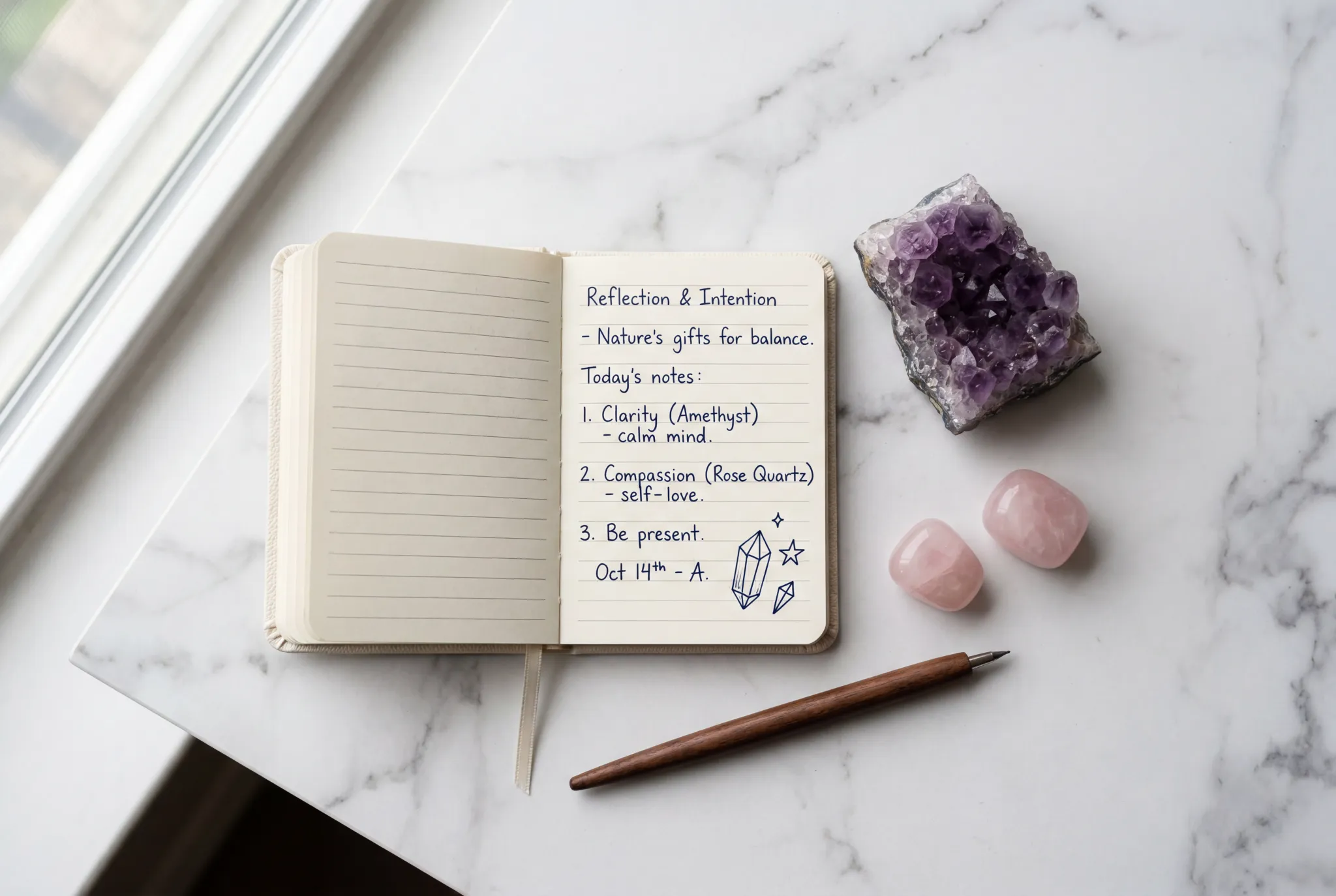
Here’s the honest answer: there is no peer-reviewed scientific evidence that crystals heal the body directly — but that doesn’t mean wearing them does nothing meaningful.
In one of the most controlled studies on the subject, psychologist Dr. Christopher C.C. French and colleagues at the Goldsmiths, University of London, gave 80 volunteers either genuine crystals or fake glass stones — without disclosing which was which — and asked them to record any physical sensations during a meditation session. Both groups reported identical tingling, warmth, and calm. The research team concluded the effects were a product of suggestion and expectation, not the physical properties of the stones. (This study was presented at the British Psychological Society Centenary Annual Conference in Glasgow, 2001.)
That’s important to know. But here’s what the same science confirms about the placebo effect: it is real, measurable, and clinically meaningful — especially when combined with deliberate intention. And when it comes to wearing sacred jewelry, the ritual practices that typically accompany it — setting a purpose when you put the piece on, touching it during a difficult moment, removing it mindfully at the end of the day — activate well-documented psychological pathways. Mindfulness-based practices reduce cortisol, interrupt anxious thought loops, and build attentional focus over time. The ritual works. The stone is the anchor that makes the ritual stick.
🔍 The Skeptic’s Honesty Box
What science does support: Mindfulness, ritual, and intention-based practices are associated with real, measurable reductions in stress and anxiety — operating through psychological mechanisms, not physical ones.
What science does not support: The idea that crystals emit energy fields, interact with chakra systems, or heal tissue through any physical process. No peer-reviewed study has demonstrated this.
What this means for you: Wearing spiritual jewelry may genuinely support your wellbeing — through psychology, not physics. That’s still real value. And it is not a replacement for professional medical or mental health care.
The most common thing we hear from former skeptics isn’t “the crystal healed me.” It’s “it reminded me to breathe, and that changed everything.” That framing is honest — and it’s exactly why this conversation deserves more nuance than most spiritual jewelry content provides.
For a deeper look at what research and tradition say about wearing crystal bracelets daily, see our expert guide to the healing properties and benefits of crystal bracelets.
How Sacred Stones Became Daily Anchors: Real Stories from Former Skeptics

The most convincing evidence for most people isn’t a study — it’s recognizing themselves in someone else’s story. The accounts below are drawn from the experiences of Potala Store customers and the broader community of former skeptics who now wear their pieces every day.
The Burnout Skeptic Who Needed an Anchor
Maya, a 34-year-old project manager, describes herself as “the last person anyone expected to own a crystal bracelet.” When a close friend gave her a rose quartz piece during a severe stretch of burnout, she accepted it politely and dropped it into her laptop bag. Two weeks later, on a particularly hard morning before a board presentation, she found herself putting it on — not because she believed in its traditional association with self-love and emotional healing, but because touching something familiar helped her feel grounded.
“The stone didn’t change the meeting. But I was calmer going in. I noticed that. I started asking myself why.”
That question led her to read about intention-setting and the psychology of physical anchors. Within six weeks, she had built a brief morning ritual around the bracelet — a pause to name a specific intention before putting it on. She now describes the piece as “stupid but essential” and hasn’t taken it off since.
The Grief Season That Found Its Anchor
James, 41, purchased a black obsidian bracelet after losing his father. He was drawn to its traditional association with protection and grounding — “and honestly, I just wanted to hold something dark and solid.” He was upfront about not believing in crystal energy as a measurable personal experience. What he found was that running his thumb across the stone gave his hands something deliberate to do during waves of grief, and removing the bracelet each night became a ritual that marked the end of another hard day.
“It was a physical anchor in a very unmoored time. I can’t explain it scientifically. I know what it did for me.”
In summary: what these accounts share is a consistent pattern. The piece creates a behavioral cue, the cue creates a moment of awareness, and the awareness — over days and weeks — accumulates into genuine felt change. That’s not magic. That’s how human behavior actually works.
One of our customers recently left this review: “I noticed an inner shift as soon as I wore it. It feels protective against negative energy — and it reminds me to slow down whenever I touch it.” (5/5, May 2025)
✨ Rose Quartz Bracelet for Love & Healing — $43.95
Handcrafted with genuine rose quartz — traditionally associated with self-love and emotional healing. One of our most commonly chosen first pieces for skeptics and beginners.Shop the Rose Quartz Bracelet →
Mala Beads & Prayer Jewelry: A Skeptic’s Surprising Anchor
A mala is a string of 108 counting beads plus one uncounted guru bead, traditionally used in Tibetan Buddhism and Hindu practice to count mantras or breaths during japa meditation. Each time you touch a bead, you complete one repetition; the guru bead marks the end of the cycle, and you reverse direction rather than crossing it.
That tactile structure turns out to work remarkably well for analytical minds. Running your thumb deliberately across each bead gives you a concrete, countable action during meditation — which quiets the mental chatter that derails most beginners. The rhythmic, repetitive contact activates the parasympathetic nervous system (the body’s rest-and-digest response), which is why mala beads practice in japa meditation often produces a rapid sense of calm that pure visualization techniques sometimes don’t.
A question we hear constantly: I’m not Buddhist — can I even use this? Yes. The Tibetan Nuns Project notes that malas are widely and respectfully used today across multiple traditions and by people with no formal religious affiliation. What matters is handling them with awareness rather than purely as a fashion statement.
One detail that matters more than most people expect: provenance. Authentic Tibetan malas are hand-knotted between each bead, with a specific tassel and guru bead construction tied to the maker’s lineage. Many of the malas in Potala Store’s collection are blessed at traditional Tibetan monasteries before arriving with us — a detail that matters to many wearers even when they can’t fully articulate why. We’ve found, in our experience working with Tibetan artisans, that wearers who know where their piece came from tend to use it more deliberately — and report stronger results.
🧘 108 Mala Beads Bracelet — Prayer & Meditation — $25.95
A traditional sandalwood mala with a 108-bead count, monastery-blessed and hand-knotted. One of our most accessible starting pieces for first-time skeptics — and a low-risk way to begin.Shop the 108 Mala Bracelet →
Choosing Authentic, Meaningful Pieces You’ll Actually Trust
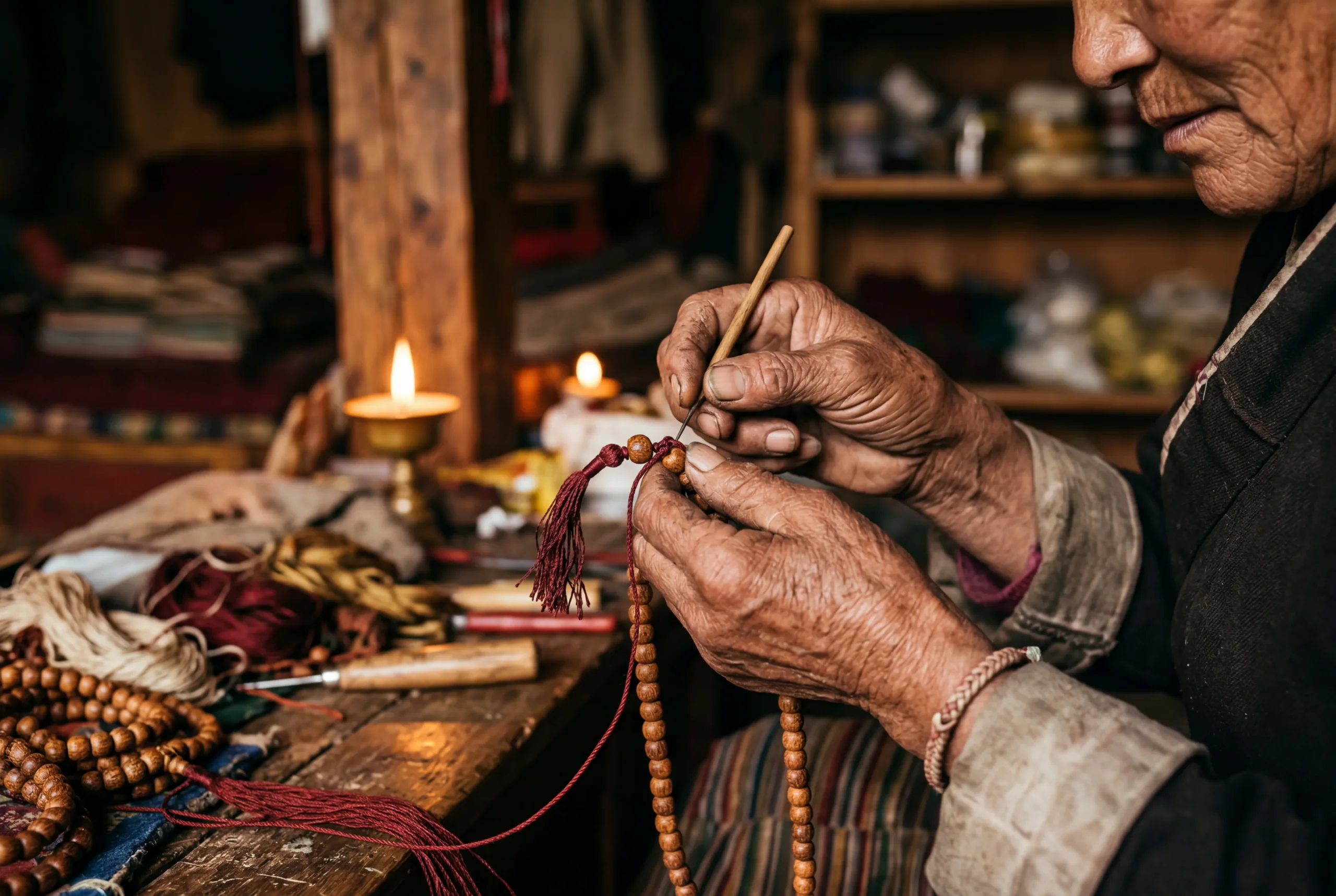
To choose a piece you’ll trust, start with intention, then verify authenticity: genuine Tibetan silver is stamped 925 (sterling silver) or 999 (fine silver) and shows hand-made, slightly irregular craftsmanship — small imperfections in the engraving are a sign of genuine handwork, not a flaw. Much of what’s sold as “Tibetan silver” in mass-market shops contains no silver at all; some older versions historically included problematic metals. A hallmark stamp and an honest sourcing story are non-negotiables for a piece you’ll wear against your skin every day.
Match your stone to your intention. Here’s a practical reference guide based on traditional associations:
| Stone | Traditional Association | Best For |
|---|---|---|
| Amethyst | Calm, stress relief, intuition; crown & third-eye chakra | Anxiety, sleep disruption, mental overwhelm |
| Rose Quartz | Self-love, emotional healing; heart chakra | Grief, self-criticism, new beginnings |
| Black Obsidian | Grounding, protection from negative energy | Hard seasons, major transitions, loss |
| Citrine | Confidence, creativity, abundance | Career focus, creative blocks, motivation |
| Tiger Eye + Hematite | Triple protection, grounding, stability | Boundary-setting, energy work, daily stress |
Once you have your piece, the most important first step is to cleanse and charge it with a clear intention before wearing it deliberately for the first time. Common methods include placing it under moonlight overnight, resting it on a selenite plate for a few hours, or briefly passing it through sage smoke. These rituals are not about removing physical contamination — they’re about resetting your own mental relationship with the piece and marking the start of something intentional.
One thing I wish I’d known before my first purchase: a cheaper piece you feel nothing toward is far less useful than a piece that felt meaningful to you at first glance. Trust that pull — it’s your own discernment at work.
🛡️ Triple Protection Bracelet | Tiger Eye, Obsidian & Hematite — $38.95
Three of the most grounding stones combined — traditionally believed to support protection, stability, and energy work. Handcrafted with genuine stones and authentic Tibetan silver.Shop the Triple Protection Bracelet →
Wearable Intentions: Why Potala Store Curates Authentic Tibetan Pieces — and How to Begin
You don’t have to be certain to begin. You only have to be curious, and to choose a piece made with real care.
Potala Store was built around a single premise: authentic, ethically sourced Tibetan sacred jewelry should be accessible to people in the West, and the story of how a piece was made matters as much as how it looks. Every piece in our collection is handcrafted by Tibetan artisans using traditional methods. Many are blessed at traditional monasteries before arriving with us — a provenance that no amount of mass production can replicate. With every purchase, $2 is donated to support Tibetan communities and cultural preservation efforts.
We’re not here to sell you certainty. We know — because we’ve had the honest conversation about the science — that the meaningful change most wearers experience through spiritual jewelry comes from what they bring to it: the intention they set, the ritual they build, the small pause that a beautiful, authentic piece creates each day. What we can offer is assurance that the piece itself is real, made with integrity, and worth that daily contact.
The key takeaway is this: transformation through wearable intentions rarely announces itself. It accumulates in small, unremarkable moments — a slower breath before a difficult email, a pause before a hard conversation, a ritual at the end of a long day that says quietly: I am more than this moment.
The skeptic who tucked their mala in a drawer — and then quietly started wearing it every morning — shows up in more inboxes than you’d expect. Maybe that person is you. Begin where you are. One piece, one intention, one day.
Begin Your Own Story
Every purchase supports Tibetan artisans and cultural preservation.
Each piece is monastery-blessed, hand-knotted, and made to last.Explore Authentic Tibetan Jewelry →
Frequently Asked Questions
There is no scientific evidence that crystals heal the body through physical mechanisms. A 2001 controlled study at Goldsmiths, University of London (Dr. Christopher C.C. French) found that participants reported identical sensations from fake glass crystals as from genuine stones — the effect is attributed to suggestion and expectation. That said, many wearers report genuine, lasting benefits: wearing a piece with deliberate intention supports mindfulness and daily ritual, both of which are documented to reduce stress and anxiety. The benefit is psychological, not physical — and that’s still meaningfully real.
There is no fixed timeline. Some people notice a shift in mood or focus within a day or two of wearing a piece deliberately with intention; most who report meaningful change describe it building over one to three weeks of consistent daily wear. Setting a specific intention each morning when you put the piece on — rather than wearing it passively — tends to produce results faster. The piece works best as an active daily reminder, not passive decoration.
No. While malas originated in Tibetan Buddhist and Hindu traditions, they are widely and respectfully used today by people of all backgrounds and none. The Tibetan Nuns Project acknowledges secular use as appropriate, provided the piece is handled with care and awareness. What matters most is wearing them mindfully — touching them deliberately rather than treating them as a purely decorative fashion trend.
Look for genuine materials first: authentic Tibetan silver is stamped 925 (sterling) or 999 (fine silver) and shows hand-made, slightly irregular craftsmanship. Mass-produced “Tibetan silver” often contains no silver at all. For a low-risk, well-sourced starting point, explore Potala Store’s authenticated Tibetan mala & necklace collection — monastery-blessed pieces start at $25.95, and each comes with clear provenance information. Choose based on the stone or traditional meaning that speaks most to where you are right now.
📚 References
- Crystal Healing & the Placebo Effect: Dr. Christopher C.C. French, Anomalistic Psychology Research Unit, Goldsmiths, University of London. Study on crystal healing and suggestion presented at the British Psychological Society Centenary Annual Conference, Glasgow, March 2001.
British Psychological Society (bps.org.uk) - Global Anxiety Disorder Prevalence (2019 GBD Data): Santomauro, D.F. et al. “Global prevalence and burden of depressive and anxiety disorders.” The Lancet, 2021. Background GBD 2019 statistics on anxiety disorder prevalence across 204 countries.
NIH / PubMed Central - Tibetan Mala Bead Traditions & Respectful Use: Guidance on mala bead count, construction, and use across traditions — including secular use — from a recognized Tibetan Buddhist institution.
Tibetan Nuns Project (tnp.org) - Gemstone Authenticity & Identification Standards: Comprehensive gemstone education, grading standards, and natural vs. synthetic stone identification.
Gemological Institute of America — GIA (gia.edu)