

Buy from a seller who can prove the painting was made by hand — macro photographs of the brushwork, images of the canvas back, and a named workshop or artist. That single rule protects you from the biggest risk in this market: a machine-printed reproduction sold at hand-painted prices. A genuine hand-painted thangka is a Tibetan Buddhist scroll painting made on cotton canvas with natural mineral pigments and 24k gold, used as a support for meditation and visualization. A printed copy of one is a poster.
Honestly, the fear is reasonable. Most buyers looking for their first thangka are not art specialists, and online you cannot lift the canvas, tilt it toward the light, or feel whether the gold sits raised on the surface. We have spent years visiting workshops in Tibet and Nepal for Potala Store, and the mistakes we see are almost always the same three: trusting a price that is too good, accepting photos that are too small, and never asking who painted it.
This guide gives you what you actually need to decide — the visual tells that separate hand-painted from printed, real US dollar price ranges with sources, a checklist for verifying a piece you can only see through a screen, and how to choose a deity that fits your intention.
New here? You can browse our authentic hand-painted Thangka collection — every piece ships free worldwide, and we are upfront about exactly what each one is.
Table of Contents
What Is a Thangka — and Why Does “Hand-Painted” Matter?
A thangka is a Tibetan Buddhist scroll painting on cotton canvas, mounted in silk brocade, used as a visual aid for meditation, visualization, and teaching. It is not decoration that happens to be religious. It is a working instrument: a practitioner uses the image to hold a deity’s form in mind with precision, which is why proportions are governed by rules rather than by an artist’s mood.
Those proportion rules have a name. Iconometry is the grid-based system of measurements that fixes the height, width, and placement of every feature of a deity’s body. A painter who ignores it produces a picture; a painter who follows it produces an object a practitioner can use. The Rubin Museum, which holds one of the largest collections of Himalayan art in the West, treats this measured drawing stage as the foundation of the entire painting process.
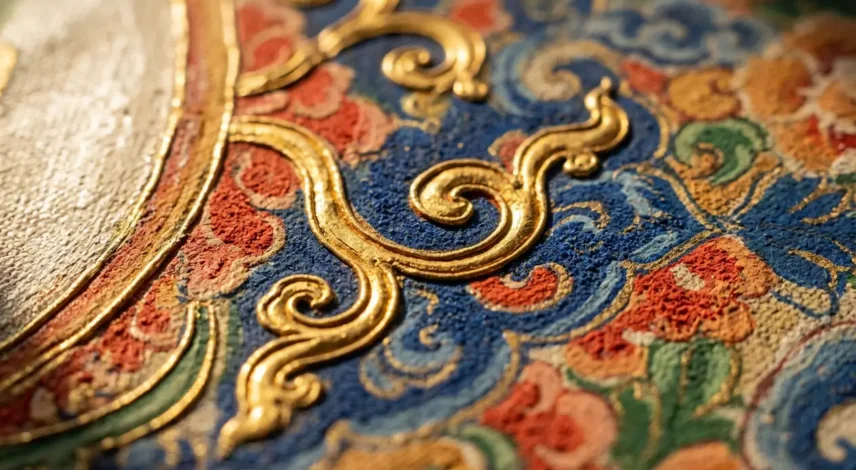
Hand-painting matters for a practical reason and a traditional one. Practically, mineral pigment sits in layers with visible depth, and burnished 24k gold catches light at an angle that flat ink cannot imitate. Traditionally, the painting is understood as an act of merit performed by a trained artist, often following a period of study and apprenticeship measured in years rather than months. A print carries the image. It does not carry the making.
We remember the detail that convinced us, in a Kathmandu Valley workshop: the smell. Ground mineral pigment mixed with animal-hide glue has a faint chalky, slightly gamey scent that no printer produces. You cannot photograph it, and you cannot fake it in person.
How Can You Tell If a Thangka Is Authentic?
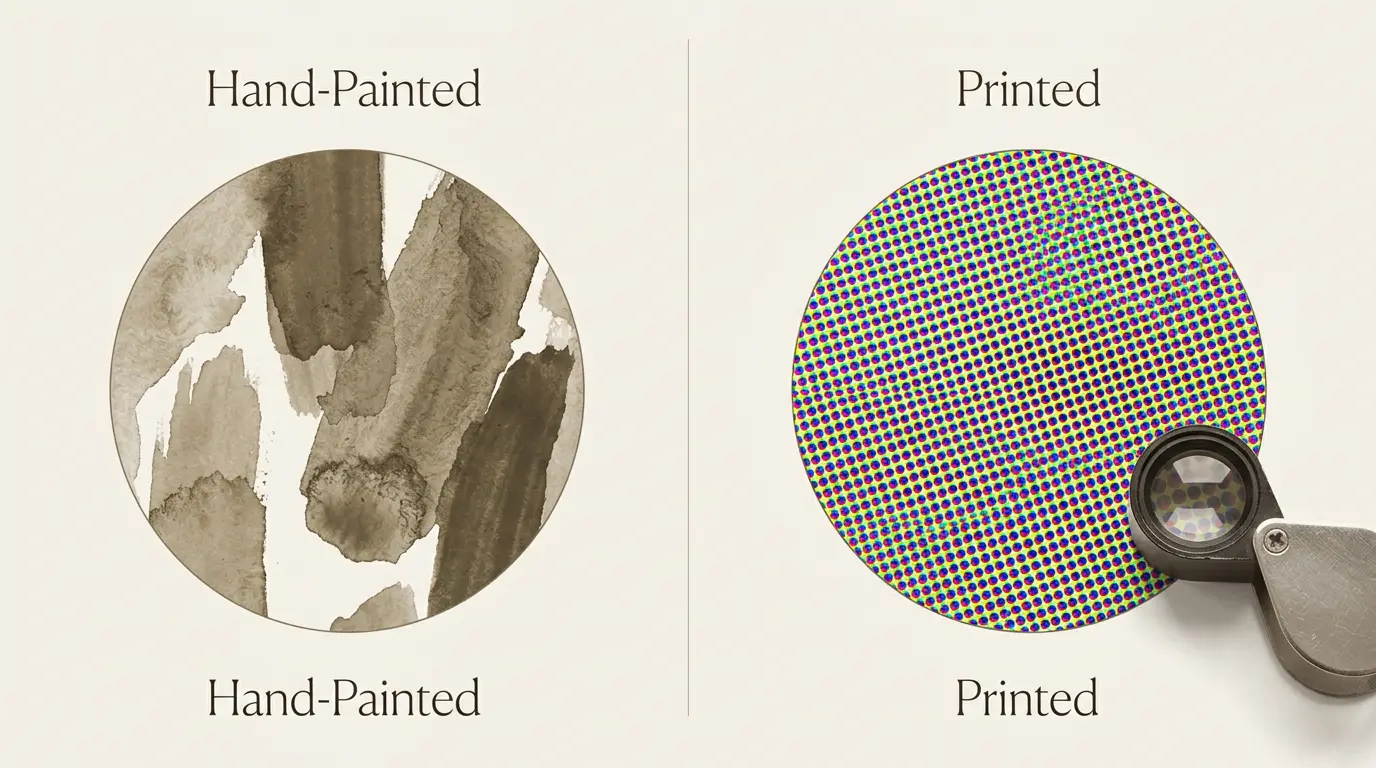
To confirm a thangka is genuinely hand-painted, look for visible brushstrokes and slight color variation under raking light, raised 24k gold detail, hand-stitched silk brocade, and mineral-pigment depth. Printed replicas show flat, uniform color and a regular dot pattern under magnification.
The single most reliable tell is the dot. Commercial printing builds color from a grid of tiny CMYK dots. Under a jeweler’s loupe or a zoomed phone photo, a printed thangka dissolves into that grid, while a hand-painted thangka resolves into individual brushstrokes and uneven pigment edges. Conservation researchers use exactly this kind of magnification — alongside X-ray imaging — to study brushwork and gold distribution in historical thangkas, so the method is not folklore.
| What to check | Hand-painted | Printed reproduction |
|---|---|---|
| Line work | Slightly irregular; brushstrokes visible under magnification | Perfectly uniform; dissolves into a dot grid |
| Color | Layered mineral pigment with depth and subtle variation | Flat, even, mechanically consistent |
| Gold | 24k gold sits raised; shifts as you tilt the piece | Yellow ink or foil; flat at every angle |
| Canvas | Cotton with a visible weave under a gesso ground | Coated paper or smooth synthetic canvas |
| Brocade mount | Hand-stitched silk, minor asymmetry | Machine-stitched, or printed to imitate a border |
| Price | Reflects size, detail, gold, and artist time | Often $10–$50, sometimes marked up dishonestly |
Two cautions, from experience. First, “gold” is where sellers cut corners most quietly — gold-colored paint photographs almost identically to real burnished gold, so ask for a tilted, angled shot rather than a flat one. Second, be skeptical of anyone selling certainty about the back of the canvas. Inscriptions, seed syllables, or seals on the reverse are traditional and common, but their absence does not prove a fake, and their presence is easy to add. Treat the back as supporting evidence, not a verdict.
How to Verify a Hand-Painted Thangka When Buying Online
You cannot touch the canvas through a screen, so shift the burden of proof to the seller. Ask for these five things before you pay:
- A macro photograph of one small area at high zoom — enough to show brushstrokes rather than dots.
- A raking-light or tilted photo of the gold areas, so you can see whether the gold catches light in relief.
- A photo of the canvas back, showing weave and any inscription, plus the edges of the brocade stitching.
- The artist’s name, workshop, or region. A seller who cannot name a source is selling an unknown object.
- A written return policy and insured shipping. Anyone confident in a piece will accept it back.
If a seller refuses any of the first three, walk away. It costs an honest workshop about ninety seconds to take those photos. We ask the same of every artisan we work with, and the ones who hesitate are the ones we stop working with.
How Much Does a Hand-Painted Thangka Cost?
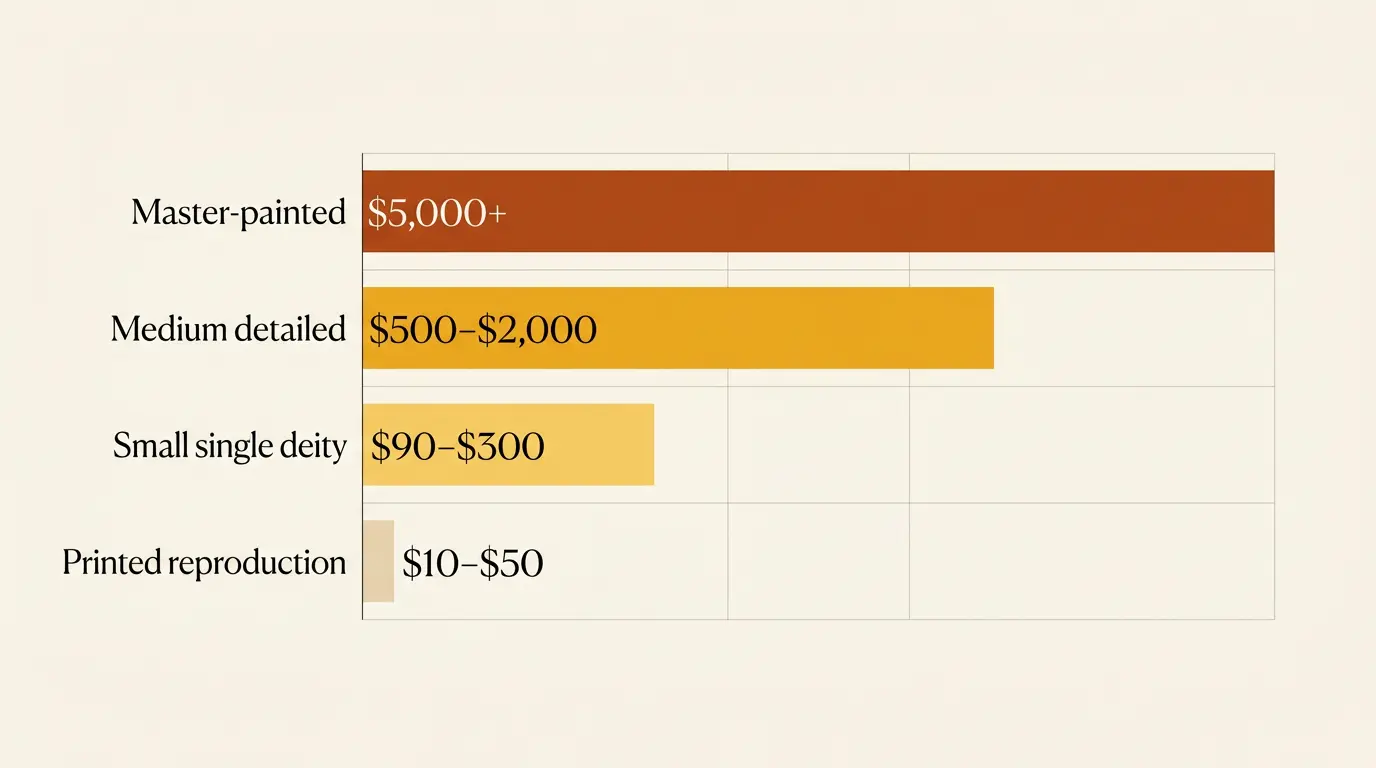
An authentic hand-painted thangka typically costs $90–$300 for a small single-deity piece, $500–$2,000 for a medium detailed painting, and $5,000 or more for master-painted work. Price is driven by size, detail, pigments, gold content, and the artist’s skill — not by how sacred a listing claims the piece to be.
For the collector end of the market, the numbers are documented. On 1stDibs, the “Thangka Painting” category listed 179 pieces on 07/10/2026, with prices starting at $308, topping out at $195,000, and an average selling price of $3,680. That $195,000 figure is an antique auction-grade outlier, not the market for a newly painted piece — do not let it distort your sense of what is normal.
| Tier | Typical US price | What drives it |
|---|---|---|
| Small, single deity | $90–$300 | Roughly 12″ x 16″; limited gold; simpler background |
| Medium, detailed | $500–$2,000 | 18″ x 24″; dense iconography; substantial 24k gold |
| Master-painted | $5,000+ | Named senior artist; months of work; complex mandala |
| Printed reproduction | $10–$50 | Machine output; no artist time |
The reason a real thangka costs what it does is time. The Norbulingka Institute, a Tibetan cultural institution in Dharamshala, notes that a standard thangka of about 18 x 12 in. “takes an artist about six weeks to complete.” Larger or more intricate compositions run far longer — the Tretyakov Gallery Magazine, describing a major thangka project, puts the range at three months to a year depending on size and complexity. At six weeks of skilled labor, a $150 painting is arithmetically impossible unless something in the story is untrue.
If that math makes your budget feel small, it shouldn’t. Starting with a modest single-deity piece — or a hand-painted pendant — is a completely legitimate way in. A smaller authentic object serves practice better than a large printed one, and no tradition rewards overspending.
Can You Wear a Thangka? The Ga Wu Box Pendant Alternative
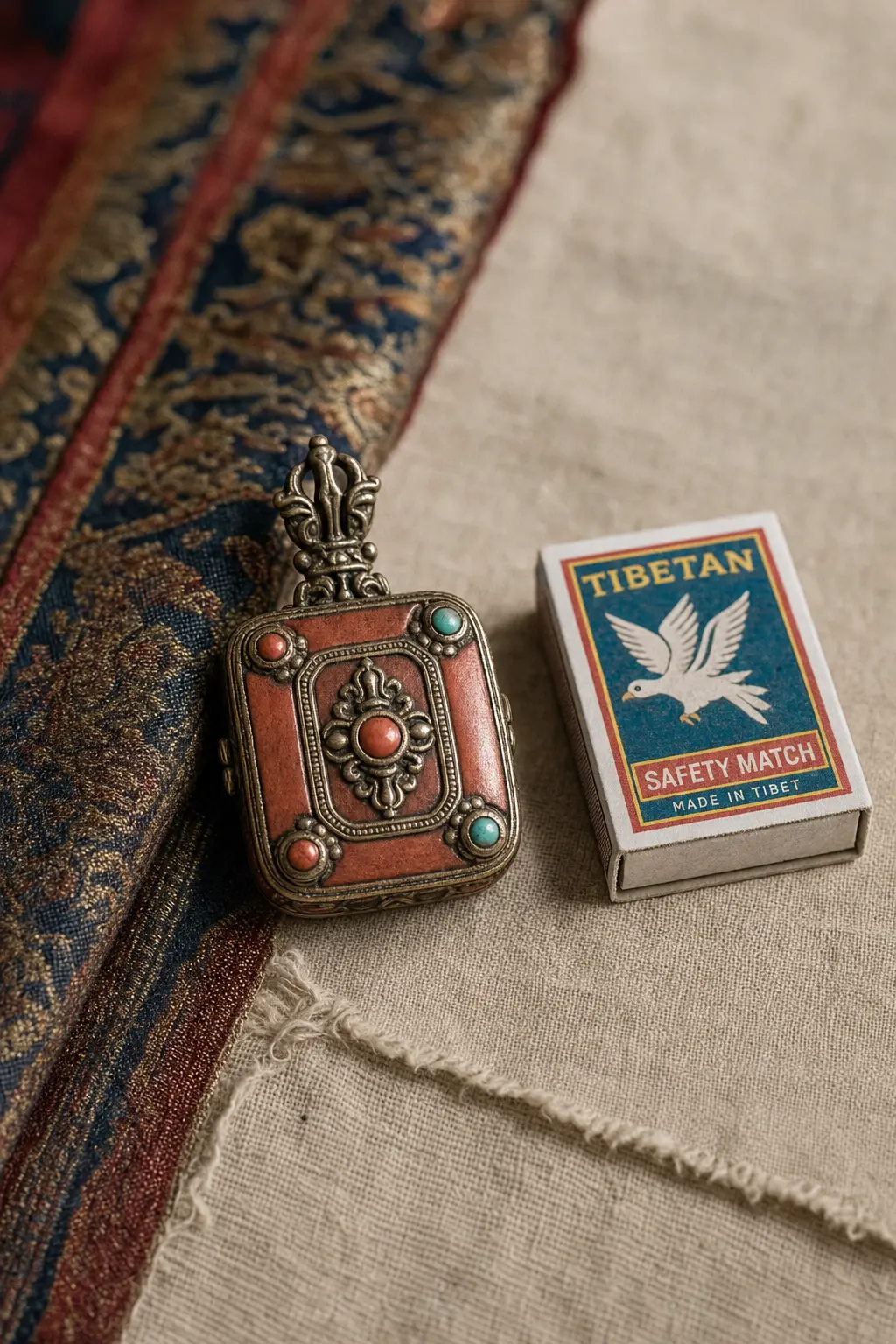
Yes — a hand-painted miniature thangka set inside a Ga Wu box is a wearable, authentic alternative to a full-size scroll, priced at $68.95 with free worldwide shipping. A gau (Tibetan ga’u) is a portable shrine or amulet box, traditionally worn or carried to protect the wearer, with a central window revealing a precious object inside. The Rubin Museum describes exactly this function in its collection of Himalayan amulet boxes, and Himalayan Art Resources notes that small gau are worn around the neck, often for protection while traveling.
Placing a painted image inside is traditional, not a modern invention — miniature painted panels have long been housed in gau windows alongside relics and small sculptures. The two pieces we carry follow that format:
- Hand-painted Ga Wu box thangka pendant — $68.95 (originally $93.95). White copper with a cinnabar finish, coral and turquoise accents, a vajra-motif bail, and a painted panel measuring 47 mm x 56.3 mm. Available in 14 deity variants, including Green Tara, Manjushri, Medicine Buddha, and Amitabha.
- 3D hand-painted thangka Buddha pendant — $68.95, in 16 deity variants, with a leather gau housing and an adjustable hand-knotted cord. It currently holds a 4.0-star average from two customer reviews.
Now the honest part, because you will not find it on most product pages. A pendant is not a substitute for a full-size scroll. The painted panel is roughly the size of a matchbox. It is made for daily wear, for travel, and for gifting — not to serve as the central image on an altar. If your goal is a focal object for a shrine room, buy a scroll, and buy it from a gallery that sells scrolls. Our thangka category currently holds these two pendants and no wall scrolls, and we would rather tell you that than let you order the wrong thing.
One more distinction worth naming: the free Reiki and mantra blessing we include with orders is a gesture of goodwill. It is not a traditional rabné consecration performed by a lama. Those are different things, and we will not blur them.
Gifting for a holiday? The Ga Wu box pendant is our most-requested spiritual gift, and at $68.95 it lands well below the price of a scroll. See the 14 deity variants →
How Do You Choose the Right Deity — and Where Should You Buy?
Choose your deity by intention — Green Tara for protection, Manjushri for wisdom, Medicine Buddha for healing — then buy from a seller who shows hand-painted proof, ships insured to the US, and stands behind returns. There is no wrong choice here, and no deity is a beginner’s deity. Most people simply find that one figure keeps drawing them back.
| If your intention is… | Consider | Traditional association |
|---|---|---|
| Protection, swift help | Green Tara | Traditionally regarded as quick to aid and protect those who call on her |
| Wisdom, study, clarity | Manjushri | Bodhisattva of wisdom; his sword is said to cut through ignorance |
| Healing, recovery | Medicine Buddha | Lapis-blue Buddha associated with healing and the science of medicine |
| Compassion | Avalokiteshvara | Embodiment of compassion; associated with the mantra Om Mani Padme Hum |
| Purification | Vajrasattva | Associated with purification practice and the hundred-syllable mantra |
Once you know what you want, judge the seller. Use this checklist:
- Proof of hand-painting: macro and back photographs, provided without argument.
- Named sourcing: a workshop, region, or artist you can look up.
- Insured shipping and a real returns window — not “final sale” on a $2,000 painting.
- Clear customs disclosure: see the note below. A seller who tells you US buyers “never pay duties” is out of date.
- Artisan accountability: some indication of what reaches the people who painted it.
On that last point: Potala Store directs 10% of sales to Tibetan artisan communities and monastery partners, including Sera Jhe Monastery in Bylakuppe and Kopan Monastery in Kathmandu, where our founder Yang Tso first visited in 2015. You can read the specifics — including the limits of what we can verify — in our monastery partnerships and artisan support model.
⚠️ US buyers, note on duties (current as of 07/10/2026): Original paintings executed entirely by hand generally enter the United States duty-free under HTS heading 9701. However, the $800 de minimis exemption ended on 08/29/2025, so parcels from Nepal or India may now require formal customs entry regardless of value, and hand-painted manufactured articles such as pendants may not qualify for 9701 treatment. Rules are changing; confirm current CBP guidance before ordering. For Christmas delivery, order by early December — thangka work is slow, and customs is slower.
Start with a piece you can actually verify
Every hand-painted thangka piece at Potala Store ships free worldwide, arrives with a 60-day return window, and comes from workshops we visit in person.Shop hand-painted Thangka pieces →
⚠️ Important Note: Information about spiritual meaning, blessing, and energy in this article reflects traditional Tibetan Buddhist belief and practitioner experience, not scientific evidence. It is offered for educational purposes and is not a substitute for professional medical, psychological, or financial advice.
Frequently Asked Questions
In Tibetan Buddhist tradition, the final step of painting is “opening the eyes,” after which the thangka is considered sacred. According to Rigpa Wiki, however, the painting “does not become an object of practice until a lama has performed the consecration” — the ritual known as rabné. A hand-painted thangka carries meaning from the moment you receive it; if you have access to a teacher, requesting a consecration is a meaningful next step.
Authentic thangkas are painted on cotton canvas coated with a gesso ground, using natural mineral and organic pigments bound in animal-hide glue, frequently with 24k gold, then mounted in hand-stitched silk brocade. The Norbulingka Institute describes grinding mineral and vegetable pigments into powder and mixing them with water and adhesive to make paint.
It depends on size and detail. Norbulingka reports roughly six weeks for a standard piece of about 18 x 12 in. Larger or more intricate works commonly take from three months up to a year, according to the Tretyakov Gallery Magazine’s account of a major thangka commission.
Buy from sellers who show hand-painted proof through macro and reverse-side photographs, disclose their artisan sourcing, and ship insured with a real returns window. For full-size scrolls, established galleries and specialist dealers are the safer route. For a wearable, lower-cost entry point, browse Potala Store’s hand-painted thangka pendants from $68.95 with free worldwide shipping.
📚 References
- Thangka — materials and technique: Overview of cotton and silk supports, animal-glue distemper, mineral and organic pigments, and 24 carat gold. Wikipedia
- Process of Thangka Painting: Museum account of iconometry, cotton canvas preparation, and silk brocade mounting. Rubin Museum of Himalayan Art
- Consecration (rabné) and “opening the eyes”: Explanation of when a thangka becomes an object of practice. Rigpa Wiki
- Thangka production time and pigments: Institutional description of pigment preparation, 24kt gold highlights, and completion time. Norbulingka Institute