
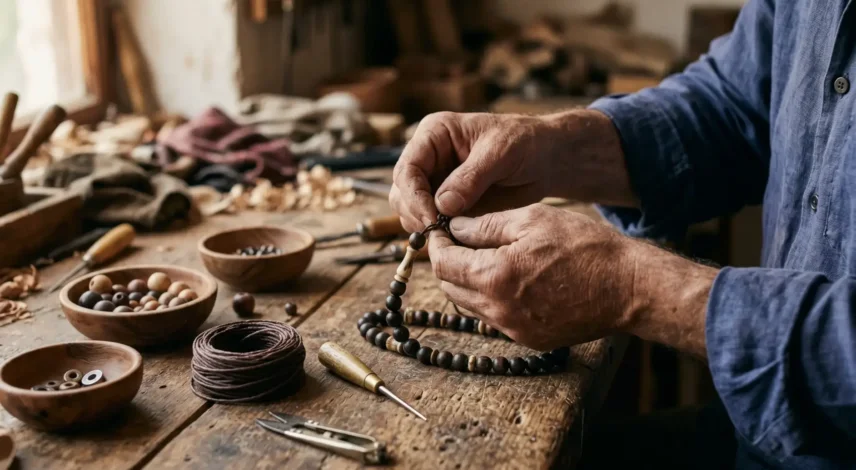

The room smells faintly of raw seed dust and sandalwood oil. On a low wooden bench, a craftsman sits cross-legged with a coil of waxed cotton cord, a small brass awl, and a bowl of bone-white beads worn smooth by hand. He is not decorating anything. He is not carving a statue or painting a scroll. He is tying knots — 108 of them, one bead at a time — and somewhere around bead sixty, without breaking rhythm, he starts murmuring a mantra under his breath.
Most people who wear a Tibetan mala around their wrist have never seen this moment. Search “how mala beads are made” and you mostly get DIY jewelry tutorials or generic explainers on what the beads mean. Almost nobody shows the actual workshop floor — the seed processing, the drilling, the specific knot, the blessing that turns a strand of beads into a sacred object. This is that walkthrough.
Table of Contents
What Is a Mala, Exactly?
A mala (Tibetan: threngwa) is a string of prayer beads used to count mantra repetitions during meditation. A full mala has 108 beads plus one guru bead — a slightly larger, often three-holed bead where the two cord ends meet. In the Tibetan tradition, the 108 counting beads are frequently divided into four sections of 27, separated by three smaller marker beads. The number 108 itself carries centuries of symbolic weight, which we’ll get to below.
What most descriptions skip is that a mala isn’t assembled the way a commercial bracelet is. It’s built bead by bead, by hand, usually while the maker is reciting the very mantra the finished mala will later be used to count.
Where Real Malas Are Made
Authentic malas come out of a fairly small number of places. Kathmandu, Nepal — especially the neighborhood around Boudhanath Stupa — is a major hub, home to bead-stringers and Buddhist supply workshops that have operated for generations. Dharamsala, India, is another: the Tibetan Nuns Project’s Dolma Ling Nunnery is one of the better-documented examples, where nuns hand-string, knot, and bless malas as part of daily monastic life. Further out, the Temal region of Nepal’s Kavrepalanchok district is where the raw seed trade begins — more on that below. And in Lhasa, along Barkhor Street, mala-making remains a living street craft.
Potala Store’s own pieces are sourced this same way. Founder Yang Tso has spent years traveling to Tibet and Nepal to work directly with artisan families and small workshops rather than buying from anonymous factory suppliers — the kind of relationship that’s necessary if you actually want to know how a mala was made, not just what it’s supposed to mean.
Step 1: Sourcing the Materials

Before any knotting happens, someone has to source and prepare the beads themselves — and this stage varies enormously depending on the material.
Bodhi Seed (Buddha Chitta)
This is where the biggest myth in the mala world lives. Beads marketed as “bodhi seed” are commonly assumed to come from the Bodhi tree under which the Buddha attained enlightenment — botanically, Ficus religiosa. They don’t. Real fig seeds are under a millimeter across, far too small to bead. The seeds actually used, known as Buddha Chitta, come from Ziziphus budhensis, a jujube-family tree formally described by Nepali botanists in 2015 and native almost exclusively to the Timal area of Kavrepalanchok, Nepal.
The processing is genuinely laborious. Farmers hand-harvest the fruit each June and July, dry it in the sun for a day or two, then soak the seeds in cold water for roughly 24 hours to loosen the tough outer husk. That husk is stripped either with a traditional foot-powered mill called a dhiki or by boiling, after which the beads are washed and sun-dried again for several days. They’re then graded by size and by the number of natural “faces,” or facets, on the seed — smaller, rarer, more sharply faceted beads command far higher prices. Potala Store’s 108-bead bodhi seed mala with a jade lotus pendant uses beads sourced through this same supply chain.
Sandalwood and Other Woods
Aromatic woods like sandalwood, rosewood, and wenge are turned and shaped into round beads, prized for their scent, weight, and grain. Because true sandalwood (Santalum album) has been over-harvested to the point of being listed as vulnerable, and its trade is regulated under CITES, many workshops — including the Tibetan Nuns Project — now describe their wood malas as symbolic representations of the tradition rather than claiming pure old-growth sandalwood. Potala Store’s own 108-bead wood prayer mala is offered in ebony, wenge, and tiger-grain wood for this same reason.
Yak Bone
Bone malas — traditionally carved from yak or water buffalo bone, sometimes into small skull (kapala) shapes as a reminder of impermanence — are typically made from animals that died naturally or were raised for food, not harvested for the bead trade. The bone is cleaned, cut into rough cylinders, then hand-carved and polished. It’s slightly porous, faintly earthy in scent, and shows natural color variation — details that matter later when telling handmade from factory-made.
Gemstones
Turquoise, red coral, lapis lazuli, and amethyst are all common in Tibetan malas, with turquoise holding particular significance in Tibetan Buddhist culture as a stone believed to accrue merit for the wearer. Gemstone beads are shaped and then drilled — a precise, slow process, since a cracked stone at bead 90 means starting that section over. Potala Store’s red turquoise 108-bead mala uses this same stone-and-brass construction. (If you’re buying turquoise specifically, it’s worth reading how to tell real Tibetan turquoise from dyed howlite before you shop.)
Step 2: Shaping the Beads
Once raw material is ready, each bead is drilled — traditionally with a hand or bow drill, working from both ends toward the center to avoid cracking the material — then sanded and polished. Seed and bone beads are typically finished with a light coat of natural oil, both to protect the material and bring out its grain. Standard finished bead diameters run 6mm, 8mm, or 10mm, with 8mm being the most common size for a full 108-bead strand; an 8mm sandalwood-style mala typically weighs around 25 grams once fully strung.
Step 3: Hand-Stringing and Knotting the 108 Beads

This is the part almost no retail page shows. A real 108-bead mala is not simply threaded — it’s knotted between every single bead, a technique with its own name in the tradition: the Brahmagranti, or “knot of creation.” Here’s roughly how it goes:
- Thread the first bead onto silk, cotton, or nylon cord and tie an overhand knot snug against it.
- Add the next bead, sliding it down the cord until it sits against the first knot, then tie another knot directly against that bead — using a needle or awl-tip to seat the knot tightly so there’s no gap or slack.
- Repeat this 108 times, one knot per bead, keeping tension consistent so the finished mala hangs evenly.
- Join both cord ends through the guru bead — usually a three-holed bead, sometimes topped with a small stupa-shaped bead — which becomes the 109th bead and the mala’s fixed reference point.
- Attach the tassel, traditionally cotton or silk, symbolizing the unity of all beads (and all mantra recitations) into one continuous practice.
Hand-knotting a full mala this way — not counting the time spent preparing the beads themselves — typically takes a beginner somewhere in the range of one to two hours; an experienced stringer is faster, but the knot-per-bead method itself doesn’t get shortcut. It’s slower than simply threading beads onto elastic, and that’s the point: the knots keep beads from clicking against each other, prevent a single broken cord from scattering the entire mala, and give the maker 108 small pauses for the mantra.
Step 4: The Blessing — How a Mala Becomes Sacred

In Tibetan Buddhist tradition, a finished mala isn’t considered fully complete until it’s been consecrated. This ritual is called rabné (Tibetan: རབ་གནས), and it typically involves a lama or monk reciting mantras over the beads — sometimes a specific “multiplying” mantra believed to amplify the merit of each future recitation — and blessing them, often with a touch of sandalwood oil. This is a matter of religious belief and practice, not a claim of measurable physical effect, and it’s worth being upfront about that distinction. Some workshops build in a two-step version of this: materials are blessed before construction begins, and the finished mala is blessed again once complete.
Handmade vs. Factory-Made: How to Tell the Difference
Mass-produced “malas” — usually strung on elastic or fishing line with no knots at all — are common online. Here’s what actually separates them from a hand-knotted piece:
| Detail | Hand-Knotted Mala | Factory-Made “Mala” |
|---|---|---|
| Beads | Slight natural variation in size, color, grain | Perfectly uniform |
| Stringing | Individually knotted between each bead | Strung on elastic or fishing line, no knots |
| Material feel | Natural weight, often cool to the touch (stone) or faintly scented (wood, seed) | Light, often warm plastic or resin |
| Guru bead | Distinct, often hand-finished, three-holed | Sometimes missing or purely decorative |
| Origin | Traceable to a workshop, nunnery, or artisan family | Anonymous bulk supplier |
Why 108 Beads?
The number 108 shows up across Buddhist and Hindu traditions, and there are several explanations that all get repeated together rather than one single “correct” one. The most common Buddhist framing ties it to the 108 kleshas, or worldly afflictions, that a practitioner works to purify through mantra recitation. Some traditions also connect it to the 108 volumes of the Kangyur, the canonical collection of the Buddha’s teachings in Tibetan Buddhism. Practically speaking, malas are also sometimes counted in rounds of 100, with the extra 8 beads accounting for mantras recited imperfectly or absent-mindedly during practice. (For a deeper dive into the different explanations, see our full breakdown of why malas have 108 beads.)
How Long Does It Actually Take?
It’s worth being straightforward here, because this is where a lot of marketing copy exaggerates. There’s no single verified “hours per mala” figure that applies across the board — it depends heavily on the material. A seed or gemstone mala’s real time cost is mostly upstream, in growing, harvesting, husking, drying, and grading the raw beads over days or weeks before anyone even threads a cord. The hand-knotting itself, as noted above, generally runs one to two hours for a full 108-bead strand. You may see wholesale listings claiming figures like “80 hours per mala” — treat that as a marketing claim about hand-carved decorative beadwork specifically, not a general fact about mala construction, since no independent source confirms it as typical.
Frequently Asked Questions
No — this is the most common misconception in the mala world. Most “bodhi seed” beads come from Ziziphus budhensis, a jujube-family tree native to Nepal’s Timal region, not from Ficus religiosa (the actual Bodhi fig), whose seeds are far too small to bead.
It’s the 109th bead — typically larger, often three-holed, sometimes topped with a small stupa shape — where both cord ends are joined. It marks the start and end point of a full round of mantra recitation.
Look for individual knots between each bead (not elastic or fishing line), slight natural variation in bead size and color, natural material weight or scent, and a traceable origin — a named workshop, nunnery, or artisan source rather than an anonymous bulk listing.
Through a consecration ritual called rabné, typically performed by a monk or lama who recites mantras over the finished mala, sometimes with a touch of sandalwood oil. This is a religious practice and belief, not a scientifically measurable process.
Can anyone wear a mala, even if they’re not Buddhist?
Generally yes — many people wear malas as a meditation tool or meaningful accessory without following Buddhist practice formally. It’s worth approaching the tradition with some respect for its origins rather than treating it as a purely decorative trend.
See the Craft in the Beads
Every mala in our collection is sourced the way this article describes — through direct artisan relationships in Tibet and Nepal, not anonymous bulk suppliers.Shop Tibetan Malas
If you’re just starting to build a meditation practice and want a plainer-language starting point before diving into materials and construction, our guide to choosing the best Tibetan mala beads for meditation is a good next stop.
References
- Tibetan Nuns Project — How to Use and Choose a Tibetan Mala. tnp.org
- Rubin Museum of Himalayan Art — Prayer Beads collection object, and Count Your Blessings: The Art of Prayer Beads in Asia exhibition. rubinmuseum.org
- Nepal Forest Research and Training Center (FRTC) — Bodhichitta: An Introduction, Ministry of Forests and Environment.
- CITES — Convention on International Trade in Endangered Species, sandalwood (Santalum album) listing documentation. cites.org
- Li, F., Li, J., Liu, B., Zhuo, J., & Long, C. (2014). Seeds used for Bodhi beads in China. Journal of Ethnobiology and Ethnomedicine, 10(15). ethnobiomed.biomedcentral.com