

That heavy, can’t-quite-name-it feeling after an argument, an illness, or moving into a new place? A few minutes of smudging your house with sage can help your home feel lighter, calmer, and truly yours again. Smudging is the practice of slowly burning a white sage smudge stick and guiding its smoke through your space to clear stagnant energy and reset the room.
Here’s the honest version most guides skip: your first smudge is simpler than it looks, but a few small mistakes (a stick that won’t stay lit, the wrong room order, skipping ventilation) can turn a calming ritual into a frustrating one. At Potala Store, we’ve spent years sourcing ethical spiritual tools and testing them in our own homes, so this guide covers the smoke cleansing steps and the safety and cultural respect that most articles gloss over.
The short version: light the bundle, let it smolder, and waft the smoke from your front door clockwise through every room while setting a clear intention — then extinguish it safely in sand. The whole thing takes about 15–20 minutes for a typical home. Below, we’ll walk through exactly what you need, how to prepare, and how to do it right the first time.
Table of Contents
What You’ll Need to Clear Your Space
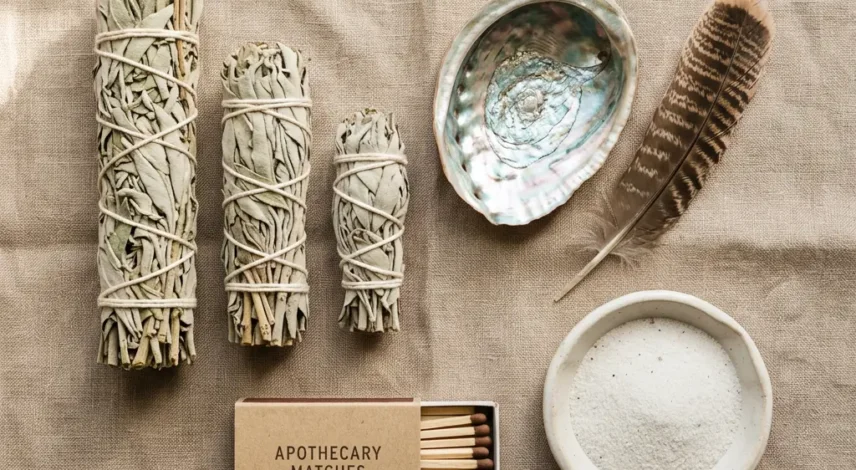
You only need five simple things to smudge your home safely. Everything on this list is inexpensive, reusable, and easy to find:
- White sage smudge stick (4″–9″): a bundle of dried white sage (Salvia apiana), the classic aromatic herb used for smoke cleansing. A 4″ mini works for one home; a 9″ jumbo lasts through many sessions.
- A fireproof bowl or abalone shell: catches falling embers and ash so nothing scorches your floor or table.
- Matches or a long lighter: to light the bundle at an angle.
- A feather or your hand: to gently waft and direct the smoke.
- A small dish of sand: the safest way to press out and fully extinguish the stick when you’re done.
The one tool beginners skip — a fireproof dish — is the one we never smudge without. Sage burns hotter and drops more embers than people expect, and a shell or ceramic bowl catches every one of them. An abalone shell is the traditional choice because it holds embers while adding the element of water to the ritual, though any fireproof, heat-safe dish does the job.
When you choose your sage, look for a sustainably sourced bundle. Wild white sage faces real overharvesting pressure, so buying from a responsible supplier matters as much as the ritual itself — more on that near the end.
Start With Ethically Sourced White Sage
Our handmade California White Sage Smudge Stick (4″, 100% Salvia apiana, no fillers) is sustainably sourced and ready for your first cleansing.Shop the White Sage Smudge Stick →
Getting Yourself and Your Home Ready
Preparation is what separates a rushed wave of smoke from a genuine reset. Before you light anything, spend five minutes setting the scene — it makes the whole ritual work better.
Start by tidying the space. Smudging isn’t a substitute for cleaning; the two work together, and clutter holds the “stuck” feeling you’re trying to move. Next, open a window in each room you plan to smudge. Open windows give both the smoke and the energy an exit path, and they keep the air comfortable while you work.
Then quiet the environment: silence your phone, turn off the TV, and take a few slow breaths. Finally, set a clear intention — a single sentence naming what you want to release and what you want to invite. Something as plain as “I clear this space of tension and welcome calm” works perfectly.
The first time we smudged a new apartment, we jotted the intention on a sticky note before lighting up. It sounds small, but naming it out loud kept the whole walk-through focused instead of feeling like we were just wandering around with a smoking bundle.
How to Smudge Your House With Sage, Step by Step
To smudge your house with sage, light the bundle, let it smolder, and waft the smoke from your front door clockwise through every room while setting a clear intention — then extinguish it safely in sand. Here is the full ritual in eight steps:
- Declutter and open your windows. Tidy each room and crack a window so smoke and energy can leave.
- Set a clear intention. Say aloud what you want to release and invite before you light anything.
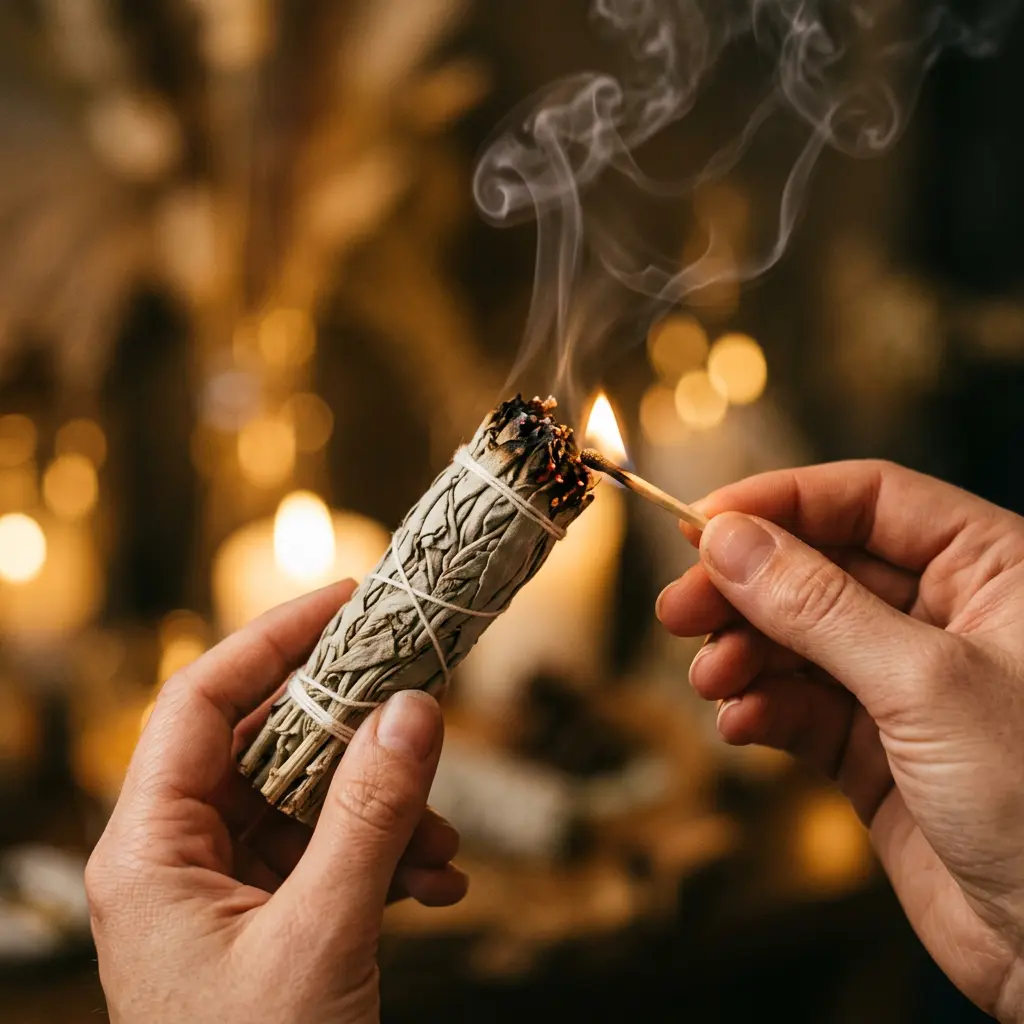
- Light the sage at a 45° angle. Hold the flame to the tip and let it catch, then blow it out so the bundle smolders for 20–30 seconds.
- Cleanse yourself first. Gently waft the smoke around your own body, head to toe, before moving through the home.
- Start at the front door. Begin at your main entrance, the threshold where energy enters and exits.
- Move room to room, clockwise. Guide the smoke into corners, closets, and doorways where energy tends to settle.
- Return to your starting point. Close the loop at the front door and restate your intention.
- Extinguish it in sand. Press the lit end into sand or an abalone shell until the smoke stops completely.
A few details make these steps work. Hold the bundle at a 45-degree angle when lighting, and let it smolder for 20–30 seconds — you want glowing embers and steady smoke, not an open flame. Direction is a matter of intention: move clockwise to invite positive energy in, or counterclockwise to banish heavy energy out. Either is correct; just be consistent and deliberate.
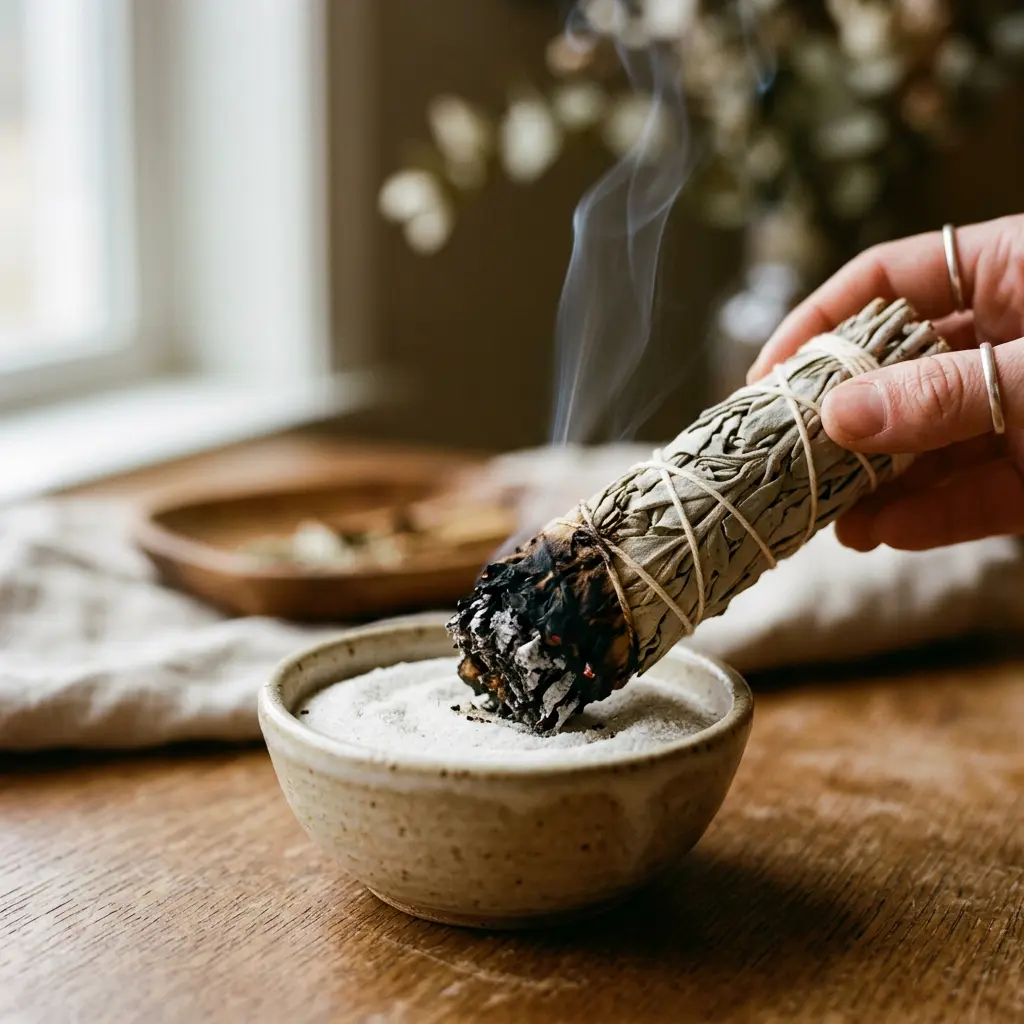
Timing helps you plan. A whole-home smudge takes about 15–20 minutes, or roughly 2 minutes per room. Here’s how that breaks down for a typical home:
| Area | Approx. time | Focus points |
|---|---|---|
| Front entrance | ~2 min | Threshold, doorframe, coat area |
| Living room | ~3 min | Corners, behind furniture, windows |
| Each bedroom | ~2 min | Corners, closet, under the bed |
| Kitchen | ~2 min | Corners, pantry, sink area |
| Bathroom & hallways | ~1 min each | Corners, mirror, doorways |
| Closets & small nooks | ~1 min | Waft smoke inside, then close |
Our first time, the bundle kept going out — the classic beginner problem. The fix: fluff the leaves at the tip, relight, and hold it at a steady angle for a full 15–20 seconds before blowing out the flame. Tightly wrapped or slightly damp sage almost always needs that extra patience.
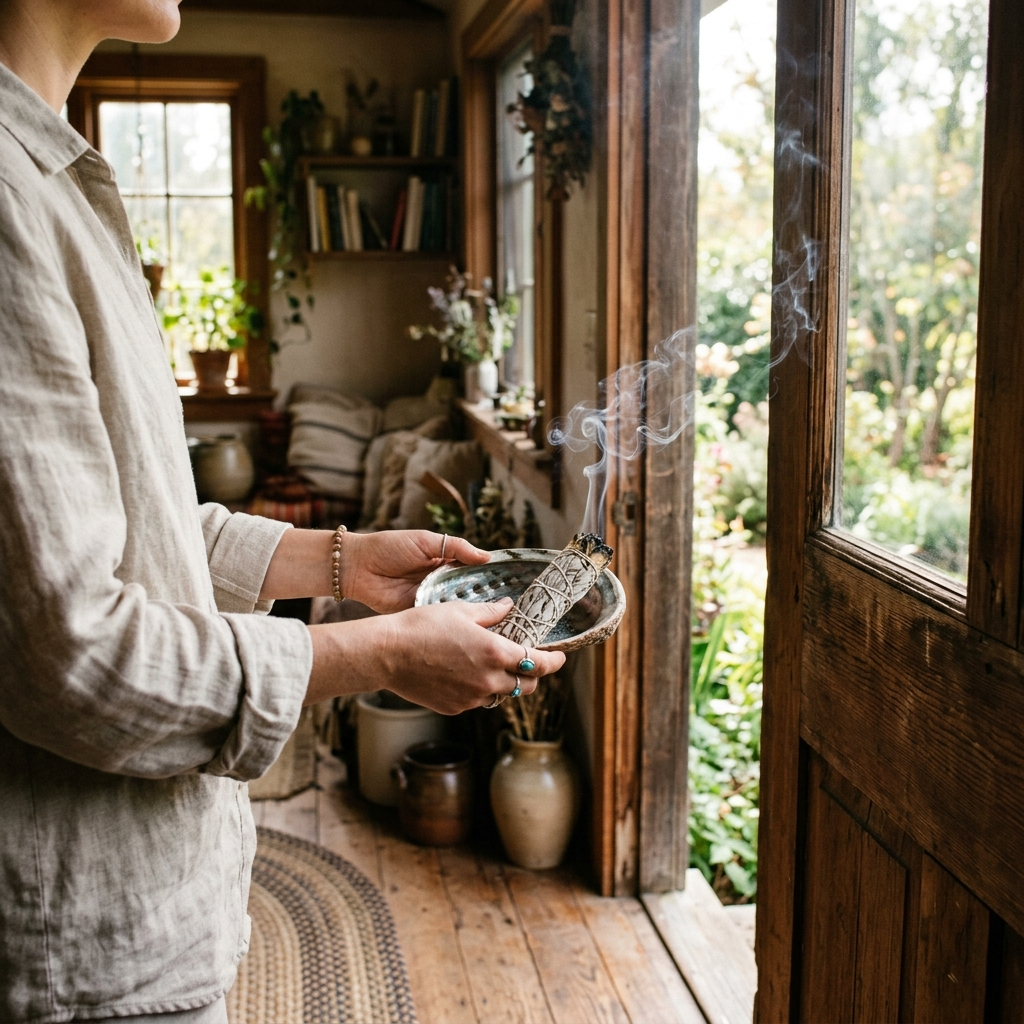
💡 Pro tip: Keep your fireproof dish in your non-dominant hand and hold it directly under the bundle as you walk. It catches embers before they hit the floor and makes the whole ritual feel calmer and more controlled.
Staying Safe While the Smoke Does Its Work
Sage is safe to burn at home as long as you treat it like any open flame. Smoke cleansing carries real fire and air-quality considerations, so a little care keeps the ritual relaxing instead of risky. Here’s the safety checklist we follow every single time:
- Never leave burning sage unattended. Keep it in your hand or resting in the fireproof dish at all times.
- Ventilate as you go. Open windows reduce smoke buildup and give the energy somewhere to exit.
- Keep pets and birds in another room. Birds have highly sensitive respiratory systems and react to smoke fastest, so they should always be moved and the air cleared before they return.
- Be cautious with asthma or respiratory conditions. If anyone in the home has asthma, heart, or lung issues, keep sessions short or choose a lower-smoke alternative.
- Mind your smoke detectors. Heavy smoke near a detector can trigger it, so ventilate well and keep the bundle away from ceiling sensors.
- Cool the ashes for 30–45 minutes. After extinguishing in sand, let everything cool fully before disposing of ash.
We move our cat to another room and crack a window every single time — it takes thirty seconds and removes all the worry. It’s worth being honest here: experts note that while smoke has known irritant effects, the antibacterial benefits of sage smoke are uncertain, so people with pre-existing respiratory or heart conditions may prefer to skip the smoke altogether.
That’s where lower-smoke options help. If heavy smoke isn’t right for your home — because of pets, sensitivities, or a rental full of smoke detectors — gentler tools can still mark the same intention. Our Tibetan Backflow Incense Cones offer a softer, more controlled scent for daily upkeep between full smudging sessions.
When and How Often to Reset Your Home’s Energy
There’s no strict rule — smudge whenever your home feels heavy, and on a seasonal rhythm for upkeep. Most people land somewhere between weekly during stressful stretches and seasonal (at least 4 times a year) for general maintenance.
Certain moments practically ask for a reset. Reach for your sage bundle when you’re moving into a new home, after a conflict or illness, once houseguests leave, or at a natural turning point like the New Year or a new moon. Each of these marks a shift, and smoke cleansing gives that shift a physical ritual to anchor it.
Moving day is the most popular trigger we hear about — clearing the energy of previous occupants before you unpack is a meaningful way to make a place feel like yours. If you’re settling into a new space, our guide to the best housewarming gifts with spiritual meaning pairs naturally with a first smudge.
How do you know it worked? Most people simply notice the room feels lighter, calmer, and less “stuffy,” and their own mood lifts a little. We like to pair smudging with our spring clean each year — the fresh-start feeling doubles when the space is both physically and energetically clear.
Smudging With Respect: Origins, Ethics & the Evidence
Smudging comes from Indigenous traditions, so practicing it respectfully — and sourcing sage sustainably — matters as much as the ritual itself. Honoring where the practice comes from is part of doing it well.
The ceremonial burning of white sage is rooted in the traditions of Native American peoples, including the Lakota, Cheyenne, and Navajo. It’s worth knowing that “smudging” specifically refers to these sacred Indigenous ceremonies, while the broader act many of us do at home is more accurately called smoke cleansing. As scholar Dr. Adrienne Keene (Cherokee Nation) has written, the smudge stick “represents a continuing legacy of marginalizing and punishing Native spirituality” — a reminder to approach the practice with gratitude rather than casual appropriation. Buying from Native-owned or clearly sustainable sources is one concrete way to show that respect. Learning that history genuinely changed how we buy our sage.
Sourcing matters environmentally, too. White sage overharvesting is a documented concern; as Dr. Andrew Weil notes, the plant “may now be at risk… where it was once prolific” because commercial demand outpaces wild supply. Choosing cultivated, ethically harvested sage protects the plant’s future.
An honest look at the “94%” claim
You’ll see it everywhere: “burning sage kills 94% of airborne bacteria.” That number traces to a single 2007 study in the Journal of Ethnopharmacology (Nautiyal et al.) — but the researchers burned havan sámagri, a blend of medicinal herbs, not sage. Fact-checkers at Science Feedback have flagged that the popular claim rests on this one low-quality study whose plant mix didn’t even include sage.
Experts urge caution. Dr. Sten Vermund, former Dean of the Yale School of Public Health, put it plainly: breathing in smoke has known harms, while the antibacterial benefits remain uncertain. In short: enjoy smudging for its ritual, focus, and fresh-start feeling — but don’t treat it as a proven way to disinfect your air.
None of this diminishes the practice. Smudging your house with sage is a centuries-old ritual with real psychological and spiritual value; being honest about the science only makes the tradition more trustworthy. When you’re ready to begin, start with a bundle you can feel good about.
Ready to Cleanse Your Space?
Begin with an ethically sourced California White Sage Smudge Stick from Potala Store — handmade, sustainably sourced, and free of fillers.Shop White Sage →
⚠️ Important note: The information about spiritual and energy properties in this guide is based on traditional beliefs and personal experience, not scientific evidence. Sage smoke is not a proven air disinfectant, and this content is not medical or fire-safety-professional advice. People with respiratory or heart conditions may wish to avoid smoke; when in doubt, consult a qualified professional.
Frequently Asked Questions About Smudging With Sage
Say a short, heartfelt intention or prayer that names what you want to release and invite — for example, “I clear this space of all negativity and welcome peace and light.” The exact words matter less than speaking with sincerity and focus. Say it aloud or hold it silently as you move through each room.
Start at your front door and move clockwise to invite positive energy, or counterclockwise if your focus is banishing heavy energy. Either is fine — the key is to be consistent and guide the smoke into every corner, closet, and doorway.
Yes — palo santo, cedar, sweetgrass, or cleansing incense all work, and they make helpful lower-smoke or sustainable alternatives if you’re sensitive to heavy smoke. Browse the incense burners & incense collection to find one that suits your space.
Most people notice the room instantly feels lighter, calmer, and less “stuffy,” and their own mood lifts. If it still feels off, ventilate fully and try again with a clearer intention.
Bringing It All Together
Smudging your house with sage comes down to a simple, repeatable ritual: gather five basic tools, prepare your space with open windows and a clear intention, then light the bundle and guide the smoke clockwise from your front door through every room before extinguishing it safely in sand. Do it seasonally, honor its Indigenous roots, source your sage responsibly, and keep your expectations honest about the science.
The bottom line: you’ve got this. Your first smoke cleansing may feel a little awkward, and that’s completely normal — the ritual gets smoother and more meaningful every time. When you’re ready to make your home feel lighter and truly yours, a good bundle of white sage is all you need to begin.
Looking to build a fuller sacred-space practice? Explore Potala Store’s incense burners & incense collection for the tools that complement smoke cleansing, from sage bundles to lower-smoke daily options.
📚 References
- Medicinal Smoke & Airborne Bacteria (primary study): Nautiyal, Chauhan & Nene, “Medicinal smoke reduces airborne bacteria,” Journal of Ethnopharmacology, 114(3):446–451 (2007). Note: the study burned havan sámagri, not sage. PubMed (PMID 17913417)
- Fact-check on the “94% bacteria” claim: Independent review of the widely shared statement that burning sage purifies indoor air. Science Feedback
- Complementary & Integrative Health Guidance: Background on evidence standards for traditional and herbal practices. NIH National Center for Complementary and Integrative Health
- American Indian Religious Freedom Act (1978): Legal-historical protection of the right to worship “through ceremonials and traditional rites” (Public Law 95-341, 42 U.S.C. § 1996). U.S. Congress