
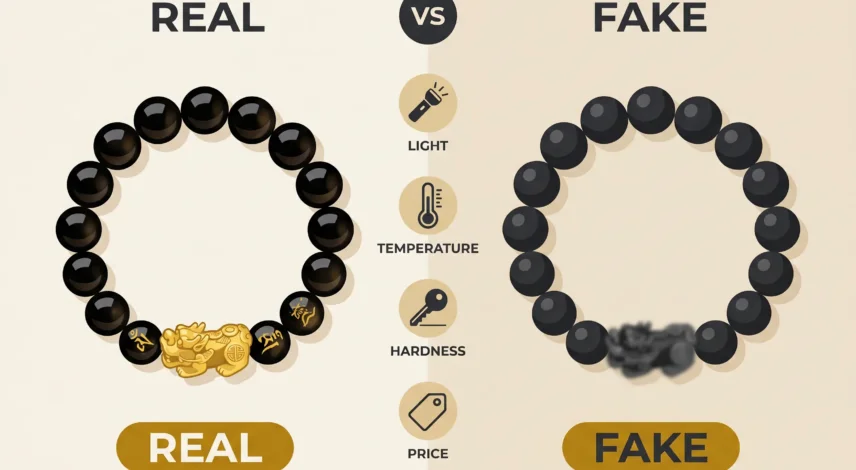

If you’re staring at a Pixiu bracelet and wondering whether you paid real money for dyed glass, you’re right to check. Most cheap Pixiu bracelets sold online are imitations — molded resin, dyed glass, or coated beads dressed up as genuine black obsidian. The good news: you can tell a real feng shui bracelet from a fake in about 60 seconds, using six simple tests you can do at home with a flashlight and a steel key. At PotalaStore, we run these exact tests on every bracelet before it ships, so this guide reflects what actually separates authentic stone from a convincing fake — not just what looks good in a product photo.
Table of Contents
Why Fake Feng Shui Bracelets Flood the Market (the “Obsidian Glass” Trick)
Fake Pixiu bracelets flood the market because real black obsidian is itself a natural glass — and dishonest sellers exploit that fact. Obsidian is volcanic glass, formed when lava cools too fast for crystals to grow, with a silica content above 70%. So when a listing says “obsidian glass,” it’s technically true of the genuine stone — which is exactly what makes the phrase such an effective trap.
The economics make fakes irresistible to mass sellers. Raw obsidian costs only a few dollars, while molded resin and dyed glass cost even less and look nearly identical in a photo. Add a gold-colored Pixiu charm, and a $2 bracelet becomes a “wealth talisman” listed at $9.99. Industry watchers estimate that most cheap Pixiu listings online are imitations — though that figure comes from sellers, not an independent lab, so treat it as a warning rather than a hard statistic.
Here’s the thing: a fake rarely looks fake on a screen. The dyed beads photograph beautifully and the plating shines. That’s why you don’t judge a Pixiu bracelet by its listing — you test it in your hand.
6 Ways to Tell a Real Pixiu Bracelet From a Fake
A real Pixiu bracelet passes six physical tests — light, temperature, hardness, weight, chatoyancy, and price. Fail two or more, and you’re almost certainly holding a fake.
| Test | Real obsidian / stone | Fake (glass or resin) |
|---|---|---|
| Light | Smoky tea-brown or faint green glow at thin edges | Uniform cobalt, purple, or green — or dead-opaque |
| Temperature | Cool to the touch; warms slowly | Resin warms instantly, feels slightly tacky |
| Hardness | Obsidian Mohs 5–5.5; tiger’s eye Mohs 7 scratches glass | Soft plastic gouges with a steel key |
| Weight | Dense — obsidian 2.3–2.6 g/cm³ | Hollow, suspiciously light |
| Chatoyancy | Cat’s-eye band rolls as you tilt the bead | Static, painted, oily-looking stripe |
| Price & seller | ~$30–$45; states natural, untreated stone | Under $20; stock photos; vague “authentic” |
Here’s how to run each test.
The Light Test
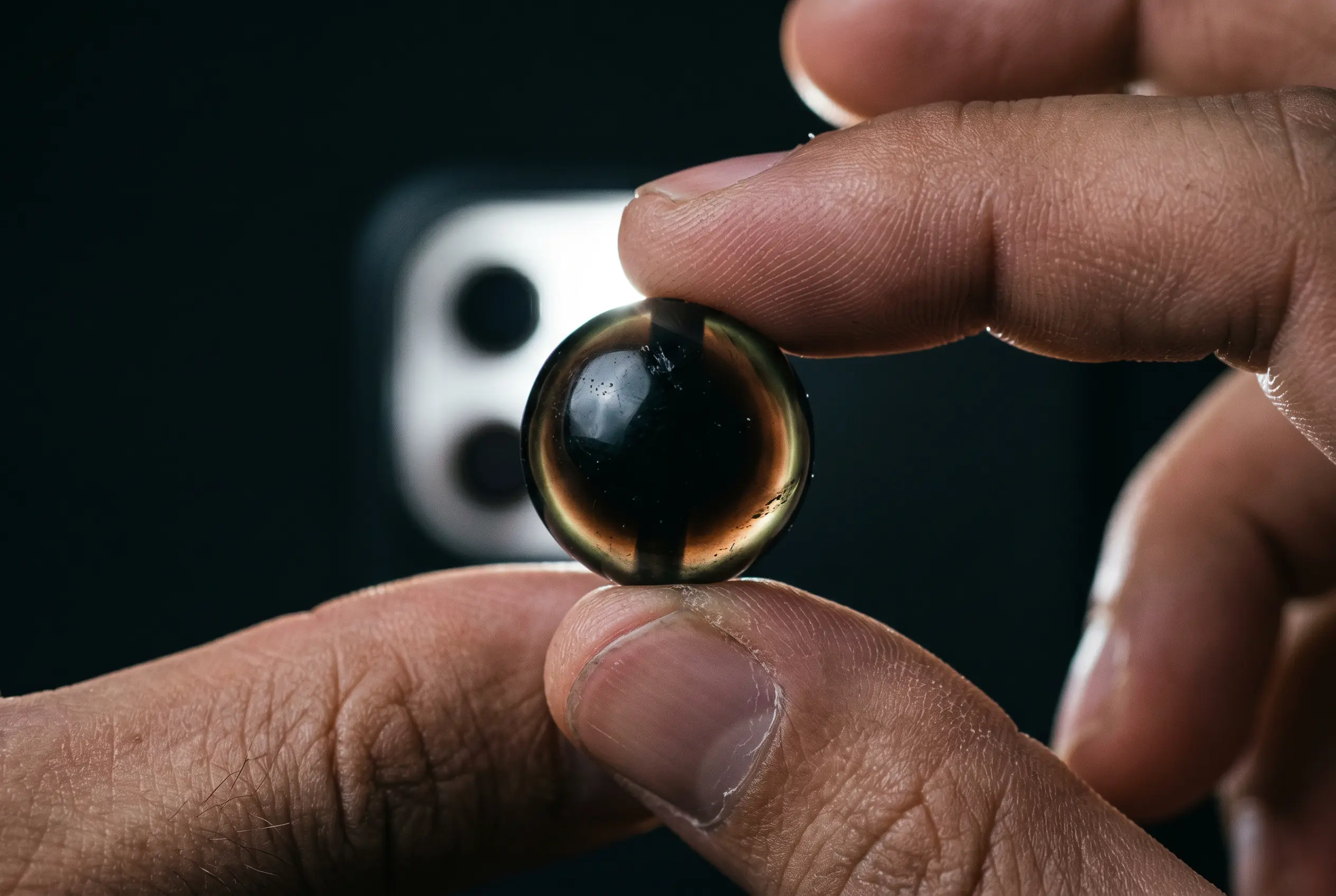
Shine a strong flashlight through a single bead: real obsidian shows a smoky tea-brown or faint green glow at its thin edges, while the light transmission through dyed glass looks uniformly colored or stays dead-opaque. Natural obsidian is translucent at the rim, not truly black, so a cobalt-blue, purple, or neon-green glow is an instant giveaway. Hold the bead against your phone flashlight in a dark room for the clearest read.
The Temperature Test
Press the beads against the inside of your wrist for 10 seconds: a natural stone stays noticeably cool and the temperature climbs slowly, because stone has low thermal conductivity. Resin and plastic warm up almost instantly and feel slightly tacky. The first time you try this, compare it to a stone you trust — a quartz countertop works — so you learn what “cool” actually feels like. This single test catches most resin fakes.
The Hardness and Scratch Test
Try to scratch a hidden spot near the drill hole with a steel key: black obsidian rates 5 to 5.5 on the Mohs hardness scale, so steel (about 5.5) leaves only a faint mark, while soft resin gouges easily. Tiger’s eye, a quartz variety, rates about 7 and will actually scratch glass. We learned this the hard way early on — test only a hidden bead, because a visible scratch ruins the piece. If your key carves a deep groove, you’re holding plastic.
The Weight and Density Test
Bounce the bracelet in your palm: real stone feels dense and substantial, while hollow resin feels suspiciously light. Black obsidian has a density of roughly 2.3 to 2.6 g/cm³, and tiger’s eye is heavier still, with a specific gravity of 2.64 to 2.71. A genuine 10mm obsidian bracelet has real heft. If it feels like a toy, trust that instinct.
Chatoyancy in Tiger Eye
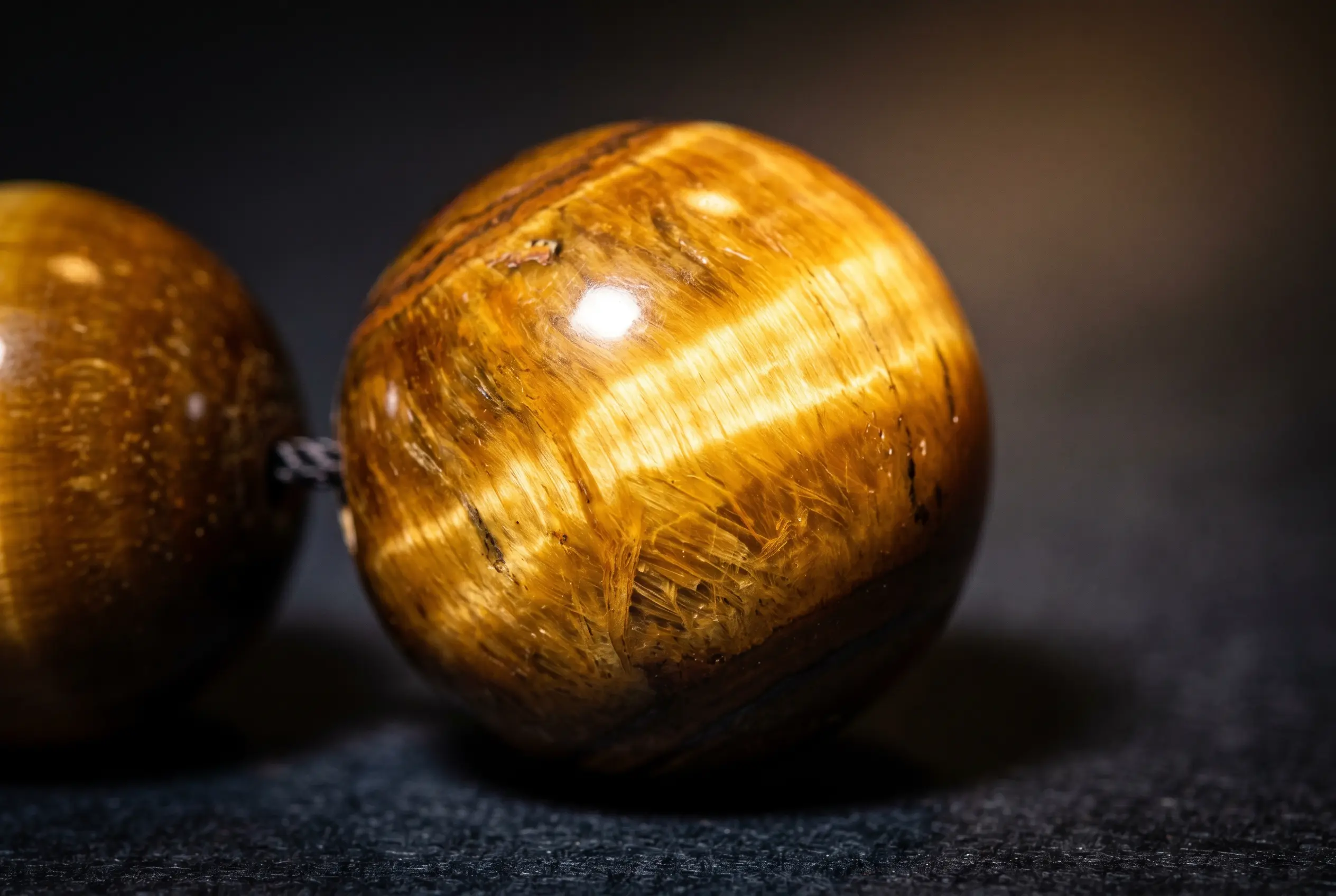
If your bracelet uses tiger’s eye, tilt it under light and watch the chatoyancy — the silky cat’s-eye band should roll and shift across the bead as it moves. That band comes from parallel crocidolite fibers that were gradually replaced by silica, an effect that’s nearly impossible to fake. Painted or fiber-optic imitations show a static, oily-looking stripe that doesn’t move. When the cat’s eye stays frozen, the stone isn’t real.
Price and Seller Red Flags
A real obsidian Pixiu bracelet usually costs $30 to $45 in the US, so a “90% off” listing under $20 is the loudest red flag of all. Watch for stock photos reused across dozens of stores, vague claims like “authentic” with no material details, and no certificate of authenticity. That said, a high price alone never guarantees a real stone — plenty of overpriced fakes exist. Price tells you where to look harder, not what to believe.
How to Check the Pixiu Charm Itself
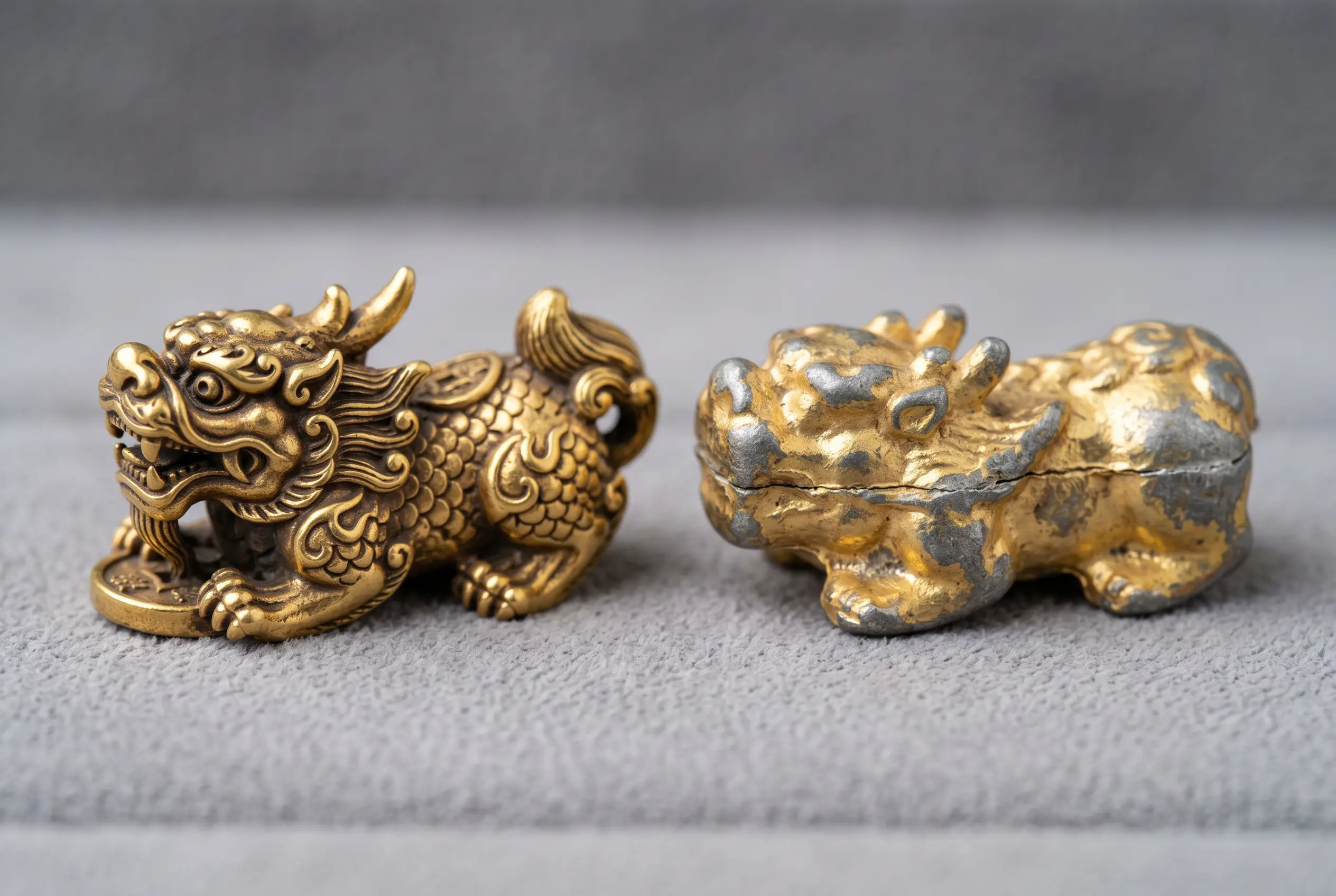
Flip the bracelet over and study the little beast, because the Pixiu charm is where mass-produced fakes give themselves away fastest. Look for a mold line running around the charm — a visible seam means it was cast in bulk, not hand-carved. Genuine charms have crisp, defined features: you can clearly see the eyes, teeth, and mane, while fakes look soft or “melted.”
Check the metal next. Cheap charms are thinly gold-plated and tarnish or flake within weeks, exposing a gray base metal underneath. Solid brass, bronze, or silver charms hold their finish and feel heavy for their size.
One detail collectors rely on: a single-horned Pixiu is called Tian Lu, the wealth-gatherer, while the double-horned form is Bixie, the protector. Authentic makers carve these distinctions deliberately; fakes tend to blur them. If you want the full breakdown, our guide on single and double Pixiu designs explains which one suits your intention.
What to Ask the Seller Before You Buy
The smartest anti-scam move is to make the seller answer four direct questions before you pay. Honest sellers respond clearly; scammers dodge or go quiet. Ask these:
- Is the stone natural and untreated? The answer you want is “natural, untreated black obsidian” — not “obsidian glass” or “obsidian-style.”
- Is the charm solid metal or plated? Solid metal lasts for years; thin plating tarnishes fast.
- Do you include a certificate of authenticity? A reputable seller can document exactly what the bracelet is made of.
- What’s your return policy? A no-returns “final sale” on a “wealth bracelet” is a warning sign.
This matters because buying a genuine feng shui bracelet is partly an emotional purchase — you want to trust what sits on your wrist every day. We get that, which is why every PotalaStore bracelet ships with its materials stated up front, a certificate of authenticity, and free shipping on orders over $50.
💡 Skip the guesswork: browse PotalaStore’s authentic Pixiu bracelet collection — every piece is made with natural, untreated stones and passes the six tests above before it ever leaves the workshop.
Final Verdict: Is Your Pixiu Bracelet Real?
Run all six tests, and the verdict is simple: if your Pixiu bracelet fails two or more, treat it as a fake. A genuine piece glows tea-brown under light, stays cool to the touch, resists a steel scratch, feels dense in the hand, shows moving chatoyancy in any tiger’s eye, and comes from a seller who’ll tell you exactly what it’s made of.
The bottom line: a real feng shui bracelet doesn’t have to be expensive — $30 to $45 buys an authentic obsidian Pixiu — but it does have to be honest stone. In traditional belief, only natural, untreated material is thought to carry the energy the Pixiu is meant to channel, so authenticity is about more than money. Test before you trust, and buy from someone who welcomes the questions.
Want a Pixiu bracelet you don’t have to test?
Every PotalaStore Pixiu is made with genuine volcanic black obsidian, hand-finished charms, and a certificate of authenticity — blessed before shipping and backed by free delivery over $50.Shop the Black Obsidian Pixiu Bracelet →
Frequently Asked Questions
In traditional feng shui, only natural, untreated stone is believed to carry and conduct energy (Qi); dyed glass or resin is considered an empty vessel. A fake can still serve as a personal reminder or a fashion piece, but practitioners hold that genuine black obsidian is needed for the protective, wealth-attracting purpose the Pixiu is meant to serve. You can read more about what obsidian Pixiu bracelets are traditionally believed to do in our guide to obsidian Pixiu bracelet benefits.
A quality natural-obsidian Pixiu bracelet typically costs $30 to $45 in the US. Raw obsidian is only a few dollars, so the price reflects the carving, the charm, and the finishing. Listings under $20 are a strong fake signal — but remember, a high price alone never guarantees authenticity either.
Shine a strong light through a bead: real obsidian glows smoky tea-brown or faint green at the thin edges, while dyed glass looks uniformly colored or stays dead-opaque. Confirm with the temperature test — real stone stays cool — and a Mohs 5–5.5 scratch test on a hidden spot near the drill hole.
Reputable sellers can state the exact material and often include a certificate of authenticity. A vague “blessed” or “authentic” claim with no material details — and no certificate — is a red flag worth walking away from.
⚠️ A note on energy claims: Information about the spiritual, protective, and wealth-attracting properties of Pixiu bracelets and black obsidian is based on traditional feng shui beliefs and cultural practice, not scientific evidence. It is shared for educational purposes and is not financial, medical, or psychological advice. The physical identification tests in this guide are based on standard gemological properties and are stated as fact.
📚 References
- Obsidian formation & properties: Overview of how volcanic glass forms, its silica content, and its Mohs hardness of 5–5.5. Volcano World, Oregon State University
- Obsidian mineral data: Composition, density, and mineraloid classification of natural obsidian. Mindat.org
- Gemstone identification & chatoyancy: How gemologists identify natural stones and the cat’s-eye effect. Gemological Institute of America (GIA)
- Tiger’s eye properties: Mohs hardness, specific gravity, and the silica-replacement origin of chatoyancy. Geology.com