
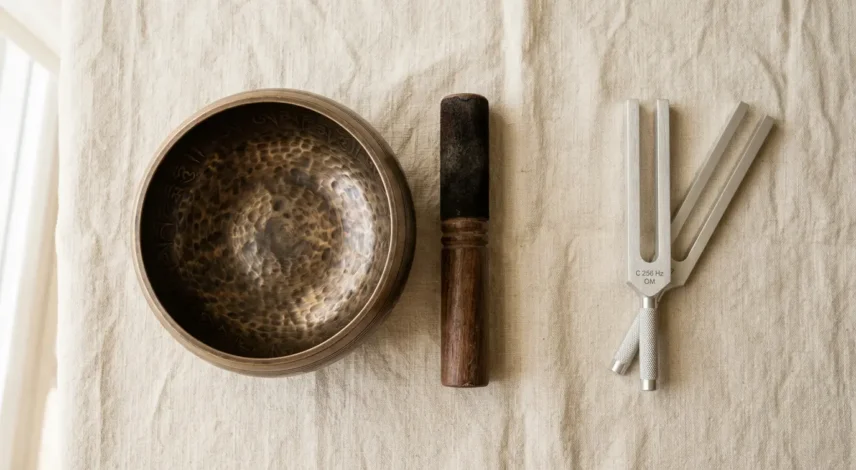

Still torn between a singing bowl and a tuning fork for your sound healing practice? Here’s the short version: a singing bowl — a hand-hammered bronze or quartz bowl that “sings” when struck or rimmed — is your pick for immersive, room-filling meditation and group sound baths. A tuning fork — a two-pronged metal instrument calibrated to one exact pitch — wins for precise, portable, on-body work. Both create healing vibration through resonance and entrainment, but they do it in opposite ways: one is a sonic blanket, the other a scalpel.
At Potala Store, we’ve spent over a decade sourcing both directly from Himalayan artisans and monastery partners in Nepal and Lhasa — we’ve handled thousands of bowls and forks. This guide gives you the honest, practical breakdown so you pick the right first instrument for stress relief and meditation without wasting money or buying a fake. There’s genuinely no wrong choice here — you don’t need to be an expert to start.
Table of Contents
Singing Bowl vs Tuning Fork: The Quick-Answer Comparison
The short answer: choose a singing bowl for immersive, room-filling meditation, and a tuning fork for precise, portable, on-body work. Below is the at-a-glance comparison most beginners are looking for.
| Feature | Singing Bowl | Tuning Fork |
|---|---|---|
| Frequency | Wide range, ~110–660 Hz fundamental with layered overtones (can reach the 800s–900s Hz) | One fixed, calibrated pitch (e.g., 128 Hz, 136.1 Hz Om, 432 Hz, 528 Hz) |
| Target area | The whole room and body — immersive, all-directional | A single point on or near the body — targeted |
| Portability | Bulkier; 4–12+ inch diameter; needs a cushion | Pocket-sized; travels anywhere |
| Price | Small metal bowls affordable; quality crystal $100+ each | $25–$60 for a decent starter fork |
| Best for | Meditation, group sound baths, space clearing | Targeted tension, chakra scanning, travel, budget beginners |
Both are beginner-friendly. Bowls take a little more finesse to coax a smooth, consistent tone; forks are more plug-and-play. Keep reading for the “why” behind each row — and our final verdict.
How Each Tool Works: Resonance, Overtones, and Entrainment
Both tools work through resonance — but a bowl layers many overtones at once, while a fork delivers one clean, calibrated frequency. Resonance sets your body’s tissues and the surrounding air vibrating, and through entrainment your slower brainwaves and breathing gradually sync to that steady external rhythm, nudging you toward calmer alpha and theta states. Many people report this shift activates the parasympathetic nervous system — the body’s “rest and digest” mode — often via gentle stimulation of the vagus nerve. In our sessions, first-timers describe the bowl as a “sonic blanket” and the fork as a “laser.”
How singing bowls create layered overtones
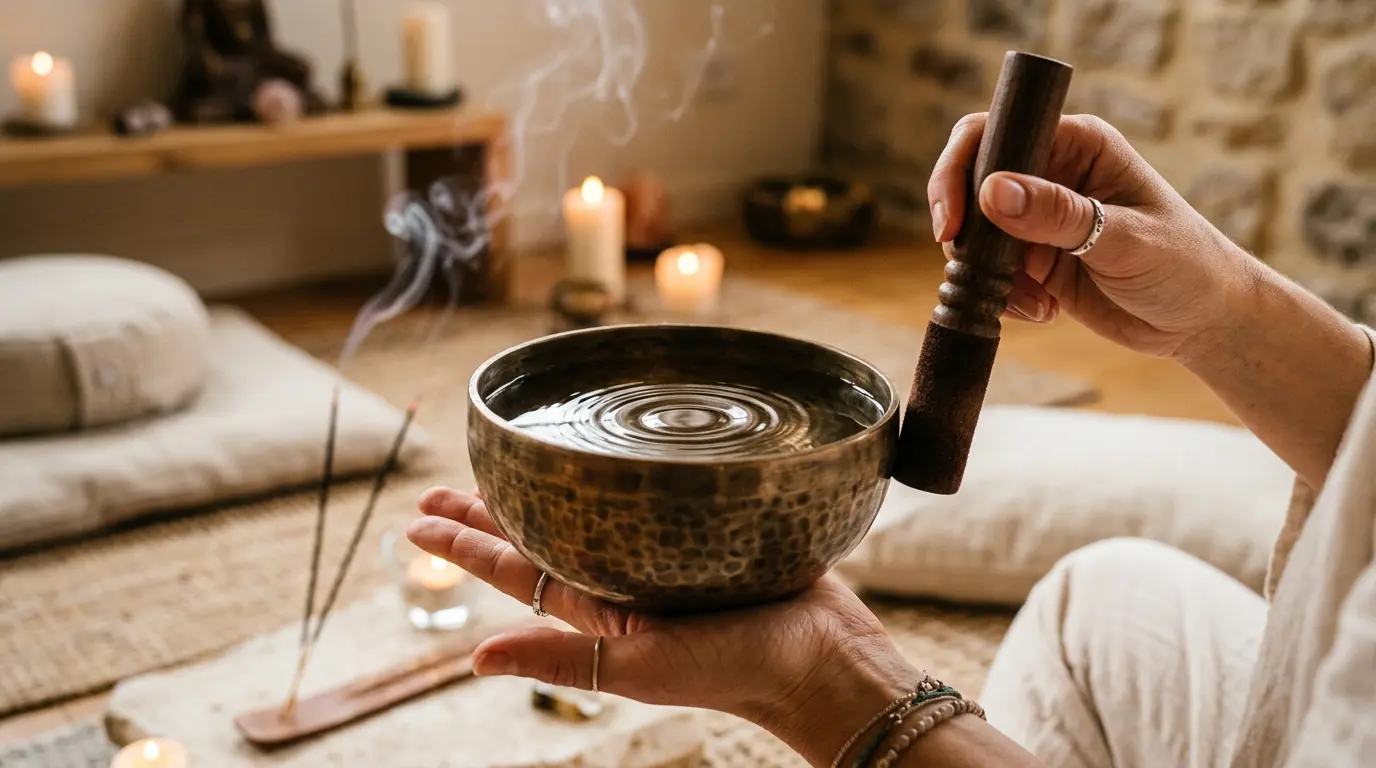
A singing bowl produces a fundamental tone plus several layered overtones at the same time — that’s the source of its rich, swirling sound. Singing bowls typically range from about 110 Hz to 660 Hz on the fundamental and can reach the 800s or even 900s Hz, depending on size, thickness, and material. The physics are well documented: in their peer-reviewed study “Tibetan singing bowls,” Terwagne and Bush (2011) describe a bowl as “a type of standing bell” whose rim vibrates in a fundamental mode “associated with four nodes and four anti-nodes along the rim,” with their tested bowl ringing at a fundamental of 188 Hz. Strike it or drag a mallet around the rim, and those combined tones create the enveloping quality that makes a sound bath feel immersive.
How tuning forks deliver one fixed frequency
A tuning fork does the opposite: it delivers one pure tone at a single fixed frequency. Popular healing calibrations include 128 Hz (grounding and pain relief), 136.1 Hz (the “Om” frequency associated with the heart chakra), 432 Hz, and 528 Hz (the Solfeggio “love frequency”). The fork’s shape cancels its higher overtones within seconds — its first overtone sits about 6.25 times above the fundamental (roughly 2½ octaves up) and dies out fast — so you’re left with an almost ideally pure sine wave. That gives you a clean, focused vibration you can aim exactly where you want it.
Does the science back this up? A 2017 observational study from researchers at the University of California, San Diego is the most-cited evidence. As Goldsby et al. report, “Sixty-two women and men (mean age 49.7 years) participated. As compared with pre-meditation, following the sound meditation participants reported significantly less tension, anger, fatigue, and depressed mood (all Ps <.001).” It’s promising — but it’s observational, not proof of medical treatment. For the full picture, see our pillar guide on what sound healing is and how it works.
What a Singing Bowl Does Best (and Its Trade-offs)
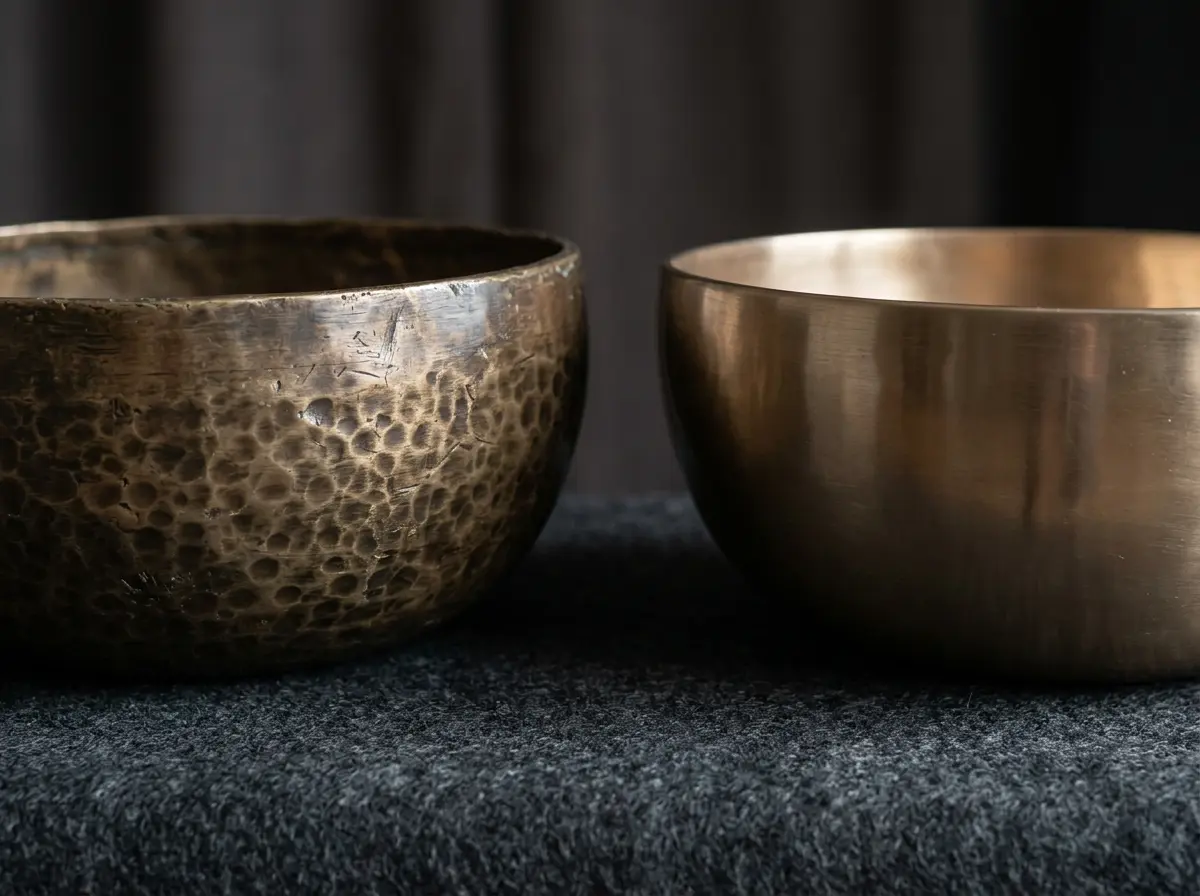
Reach for a singing bowl when you want to fill a room — or a whole group — with immersive, enveloping sound. Its layered overtones spread in every direction, which is exactly why a bowl is the heart of almost every sound bath. That all-directional wash of overtones is what makes bowls unmatched for shifting the mood of an entire space.
Best uses for a singing bowl
- Meditation and wind-down: a steady, sustained tone anchors your attention.
- Group sound baths and yoga classes: larger bowls (9–12+ inches) project sound to fill a room.
- Emotional release: long, lingering tones help the body soften and let go.
- Space clearing: the sustained vibration refreshes the energy of a room.
Trade-offs to know
A bowl is bulkier and less travel-friendly than a fork. Crystal (quartz) bowls are fragile and need careful handling. Bowls are also less precise for targeted, on-body work, and rimming one smoothly takes a little practice. Honestly, none of this is a dealbreaker — it’s just the nature of a room-filling instrument. For a first home bowl, a 4–5.5 inch metal bowl hits the sweet spot of tone, playability, and price.
Authentic vs mass-market: don’t buy a fake
This is where beginners lose money. Authentic Himalayan bowls are hand-hammered by artisans, leaving subtle irregularities and hammer marks that enrich the overtones. Mass-market bowls are machine-stamped or cast, producing a thinner, less layered tone. Traditional bowls are bronze — a bell-metal alloy of roughly 80% copper and 20% tin; as Terwagne and Bush note, Tibetan bowls are hand made and “generally they are made of a bronze alloy that can include copper, tin, zinc, iron, silver, gold and nickel.” The romantic “seven-metal alloy” story is largely marketing, since metallurgical testing usually finds mainly copper and tin. One reliable red flag: a “hand-hammered” bowl priced around $30 almost certainly isn’t. At Potala Store, our bowls are hand-hammered by artisan families in Nepal, and many pass through a short consecration by monks in Lhasa before they ship — a tradition our team has witnessed firsthand on sourcing trips.
Ready to feel the difference an authentic, monastery-blessed bowl makes?Shop Singing Bowls
What a Tuning Fork Does Best (and Its Trade-offs)
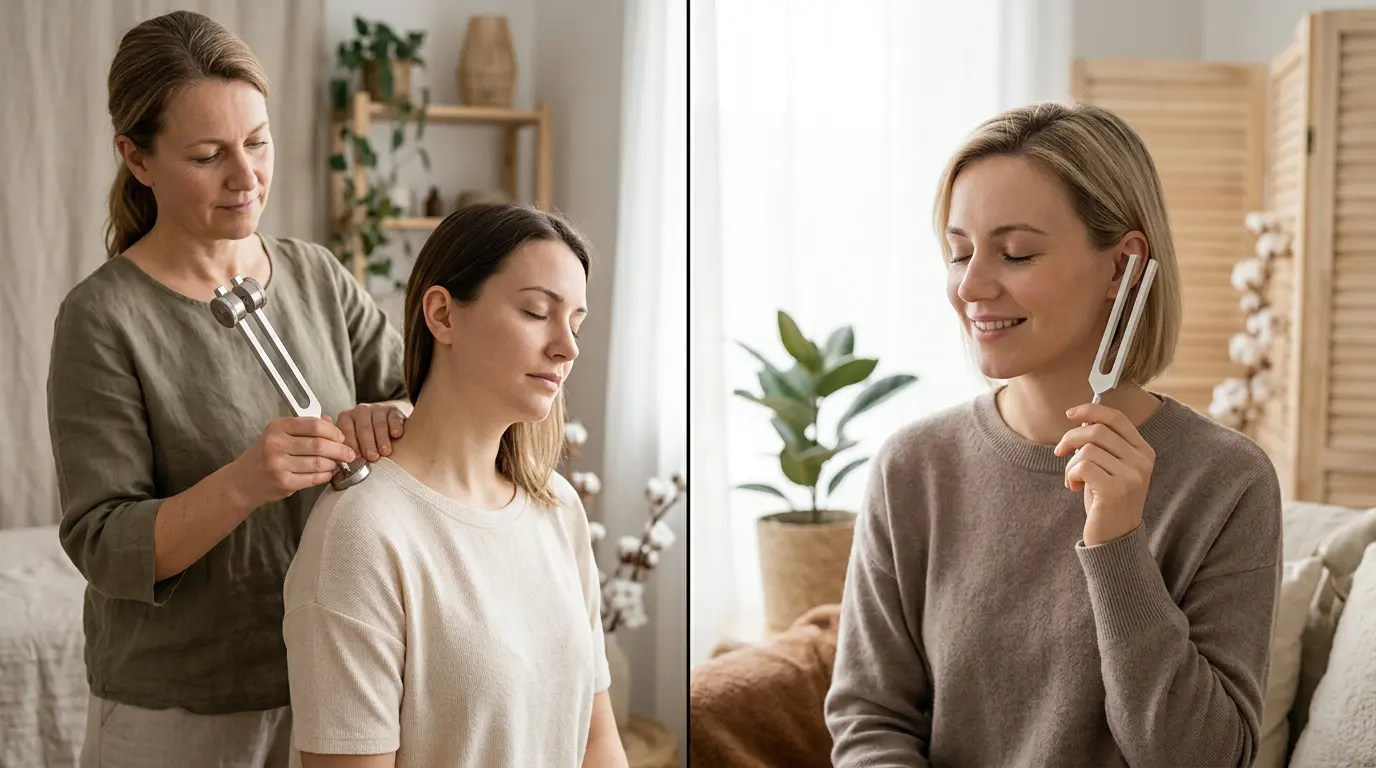
Choose a tuning fork when you want pinpoint precision — targeted, portable, on-body vibration you can take anywhere. Where a bowl surrounds you, a fork touches you. First, understand the two types you’ll see when shopping.
Weighted vs unweighted
A weighted tuning fork has small weights on the tines that drive the vibration deeper, so it’s used on-body — the stem pressed against a muscle, joint, or acupressure point for physical tension relief. An unweighted tuning fork is lighter, carries its clear sound through the air, and is used off-body/aura — swept near the ears or through the biofield for meditation, mental clarity, and chakra scanning.
Best uses for a tuning fork
- Targeted tension: press a weighted fork on a shoulder knot or the sternum.
- Chakra scanning and energy work: sweep an unweighted fork through the aura.
- Travel and small spaces: it fits in a bag and needs no cushion.
- HSP-friendly, trauma-informed practice: for a highly sensitive person (HSP), a low-amplitude fork can feel far gentler than a loud bowl bath.
- Budget beginners: $25–$60 gets you a quality starter fork.
Trade-offs to know
A fork’s field is small — it won’t fill a room or wow a group the way a bowl can. And honestly, many beginners worry that “forks feel weak compared to bowls.” They’re not weak; they’re focused. A weighted fork on the right point delivers a surprisingly deep vibration you feel in the bone. It’s simply precision instead of immersion.
A quick bit of history
The tuning fork has a longer pedigree than you might guess. According to the Whipple Museum of the History of Science at the University of Cambridge, “The tuning fork was invented in 1711 by John Shore (d. 1752), the renowned musician, instrument maker and trumpeter to the English Royal Court and favorite of George Frideric Handel.” It was built as a reliable pitch standard, and that prized purity of tone is exactly what makes it so useful for sound work today.
Want plug-and-play precision? A 528 Hz fork is a lovely place to begin.Shop Tuning Forks
Which Should You Buy? Match the Tool to Your Goal
Honestly, the best tool is the one that matches how and where you’ll actually use it — here’s the 30-second picker.
| Your goal | Recommended tool |
|---|---|
| Meditation, group sessions, room-filling calm | Singing bowl |
| Targeted pain or tension relief | Tuning fork (weighted) |
| Travel and small spaces | Tuning fork |
| You’re an HSP or want the gentlest start | Tuning fork (low amplitude) |
| Smallest budget | Tuning fork ($25–$60) |
| You want it all eventually | Start with one, add the other later |
You don’t need to be an expert to start. If you crave an immersive, atmospheric experience, begin with a bowl. If you want quiet, precise, on-body relief, begin with a fork. There’s no wrong choice — only the one that fits your routine. Browse our full meditation collection at Potala Store to build your kit at your own pace.
Can You Use a Singing Bowl and Tuning Fork Together?
Yes — many practitioners use both: forks first to target and align, then a bowl to expand and integrate, ending in silence. This mirrors the arc of many healing arts: focused adjustment, whole-system coherence, then quiet integration. Start with a fork on or near the body to assess and release specific tension. Then play a bowl or two around the torso and head to flood the space with harmonic sound. Finally, rest in two to three minutes of silence to let the shift settle. Sound isn’t a rivalry — it’s a symphony. If you’re building toward both, browse our Tibetan singing bowls and forks, chosen to sound beautiful side by side.
The Verdict: Our Honest Recommendation
So, singing bowl vs tuning fork? Our honest verdict: choose a singing bowl for immersive, room-filling meditation and group sound baths, and a tuning fork for precise, portable, on-body work — and if you fall in love with sound healing, you’ll likely end up with both. Beginners on a budget or craving the gentlest entry point should start with a fork; anyone who wants that enveloping “sonic blanket” should start with a bowl. Whichever you choose, buy authentic, start small, and let your practice grow.
Start your sound healing journey with authentic, Himalayan-sourced tools.Shop Singing Bowls Shop Tuning Forks
A gentle note on wellness claims: Sound healing is traditionally used and widely believed to support relaxation and well-being. It is not a substitute for professional medical or mental-health care, and it is not intended to diagnose, treat, or cure any condition. If you have a serious medical condition, are pregnant, or live with epilepsy or an implanted device, please consult your doctor before strong vibration work.
Frequently Asked Questions
For most beginners, a tuning fork is the easier, more affordable start: it’s plug-and-play, pocket-sized, and $25–$60. But if you mainly want immersive meditation at home, a small metal singing bowl is just as beginner-friendly. There’s genuinely no wrong first choice.
It’s generally not recommended. Crystal (quartz) bowls are fragile and designed to be played on a stable surface, not balanced on the body. For direct on-body vibration, a weighted tuning fork is the safer, purpose-built tool — its stem is made to press gently against muscles or acupressure points.
Weighted forks have weights on the tines that push vibration deeper, so they’re used on-body for physical tension and grounding. Unweighted forks are lighter, carry their tone through the air, and are used off-body/aura for meditation, mental clarity, and chakra work. Many practitioners eventually keep both.
Many people report real relaxation, and a 2017 observational study (Goldsby et al., UC San Diego) found significantly reduced tension, anger, fatigue, and depressed mood after singing bowl meditation — with participants new to the practice reporting the greatest reduction in tension and a rise in spiritual well-being across the group. However, that study is observational, not a controlled medical trial. These tools are believed to support relaxation and well-being, not to treat or cure disease.
References
- Goldsby, T. L., Goldsby, M. E., McWalters, M., & Mills, P. J. (2017). “Effects of Singing Bowl Sound Meditation on Mood, Tension, and Well-being: An Observational Study.” Journal of Evidence-Based Complementary & Alternative Medicine, 22(3), 401–406. Read the study — Peer-reviewed observational evidence (62 participants) on singing bowl meditation outcomes.
- Terwagne, D., & Bush, J. W. M. (2011). “Tibetan singing bowls.” Nonlinearity, 24(8), R51–R66. View on IOPscience — Peer-reviewed physics of a bowl’s fundamental mode and harmonic overtones (MIT & Université de Liège).
- Whipple Museum of the History of Science, University of Cambridge. “Historical Notes: a Brief Chronicle of the Tuning Fork.” View source — Museum authority confirming John Shore’s 1711 invention and the fork’s pure tone.
- National Museum of American History (Smithsonian). “Tuning Forks.” View source — Institutional reference on tuning-fork acoustics, precision, and history.