
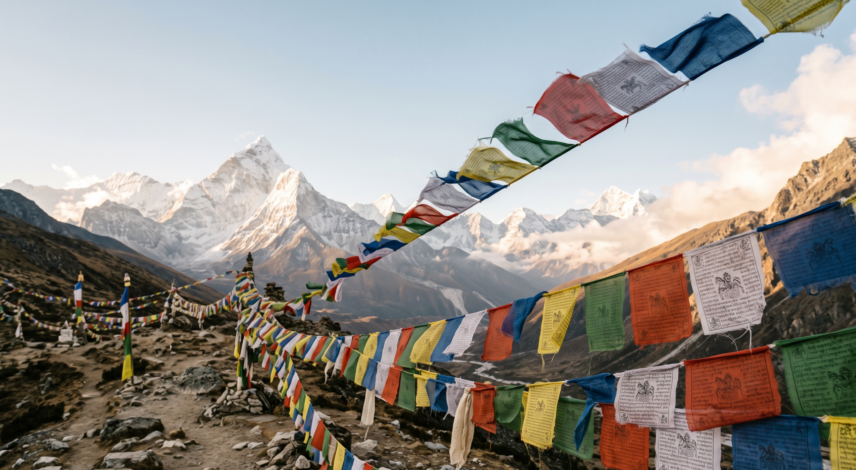

Those colorful flags fluttering on a Himalayan mountain pass — or on your neighbor’s front porch — aren’t just decoration. Each one is a prayer released on the wind. Tibetan prayer flags are rectangular cloth banners printed with sacred mantras and symbols, and in Tibetan Buddhism their purpose is to spread blessings of peace, compassion, and wisdom as the breeze passes through them.
If you’re about to hang a set at home or give them as a gift, you probably want the real meaning first — and you may quietly worry about doing it respectfully. That’s exactly what this guide covers: what the five colors symbolize, the wind horse and mantra printed on the cloth, how and where to hang them, and how to tell an authentic set from a mass-produced one.
At Potala Store, we work directly with Tibetan artisans and the monks at Sera Jhe and Kopan monasteries, and our founder, Yang Tso, has made repeated sourcing trips through Tibet and Nepal. That first-hand relationship with the people who make and bless these flags shapes everything below, so you can hang yours with confidence and care.
⚠️ A quick note: The spiritual meanings described here reflect traditional Tibetan Buddhist beliefs and cultural practice, not scientific or medical claims. This article is for educational purposes and uses respectful, hedged language throughout.
Table of Contents
What Do Tibetan Prayer Flags Symbolize?
Tibetan prayer flags are colorful cloth banners printed with sacred mantras and symbols; in Tibetan Buddhism their purpose is to spread blessings of peace, compassion, and wisdom on the wind. Each of the five colors represents an element, and together they are believed to bring harmony and good fortune to all beings within reach of the breeze.
You’ve probably seen these before without knowing what they carried. The tradition traces back to Bon, Tibet’s pre-Buddhist religion, and was later absorbed into Tibetan Buddhism, where the wind became the messenger that carries printed prayers outward. The flags don’t send prayers “up to gods.” Instead, the wind spreads goodwill and compassion to everyone it touches — a small but important distinction that many Western sources get wrong.
Two main types exist. Lung ta flags are the horizontal strings you see draped between poles or trees, while Darchog flags are vertical banners mounted on a single pole. Both share the same purpose: as the cloth moves, it is believed to release the blessings woven into its print. The takeaway is simple — a prayer flag is a wish for the world, set into motion by the wind.
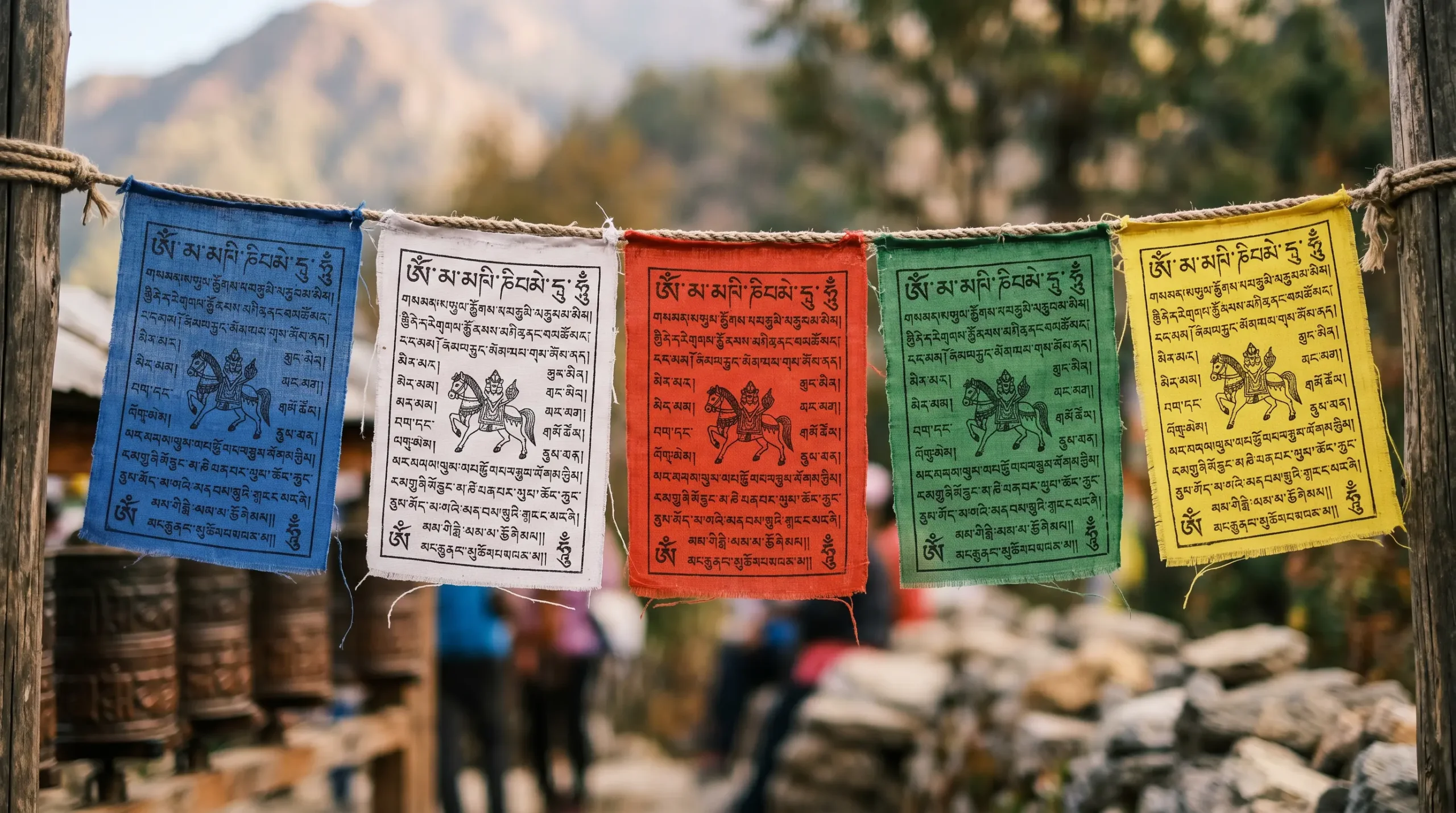
The Five Colors and Their Elements
Tibetan prayer flags always come in sets of five, hung left to right in a fixed order — blue, white, red, green, and yellow — with each color standing for one of the five elements. This order is never rearranged, because the balance among the elements is the whole point.BlueSky/SpaceWhiteAir/WindRedFireGreenWaterYellowEarthThe fixed left-to-right color order of a five-flag set.
Here is what each of the five colors maps to among the five elements:
| Color (in order) | Element | Association |
|---|---|---|
| Blue | Sky / Space | Openness, the vastness above |
| White | Air / Wind | Purity, the moving breath |
| Red | Fire | Warmth, life force |
| Green | Water | Balance, flow |
| Yellow | Earth | Grounding, stability |
These are sometimes called the five pure lights. When the elements sit in balance, the tradition holds that harmony and health follow — which is why you should never separate or reorder the set. Keep all five together, in sequence, and the symbolism stays intact.
Sacred Symbols and the Om Mani Padme Hum Mantra
At the center of most prayer flags gallops the Lungta, or “wind horse,” carrying three flaming jewels on its back — and around it are printed mantras, most famously Om Mani Padme Hum. The wind that moves the cloth is what carries these mantras and blessings outward to all beings.
The Lungta transforms misfortune into good fortune, and the three jewels it bears represent the Three Jewels of Buddhism: the Buddha, the Dharma (his teaching), and the Sangha (the community). In the four corners you’ll often find the Four Dignities — the garuda, dragon, tiger, and snow lion — protective animals that stand for wisdom, power, confidence, and fearless joy.
The mantra itself belongs to Avalokiteshvara (Chenrezig), the bodhisattva of compassion. It’s often translated loosely as “the jewel in the lotus,” but the 14th Dalai Lama offers a fuller framing. In Kindness, Clarity, and Insight (translated by Jeffrey Hopkins), he explains that the six syllables express how, through a path that unites method and wisdom, a practitioner can transform ordinary body, speech, and mind into those of a Buddha. In that reading, mani (jewel) points to method and compassion, padme (lotus) to wisdom, and hum to their indivisibility.
Want the syllable-by-syllable breakdown? Our guide to Om Mani Padme Hum meaning walks through each part in depth.
How and Where to Hang Prayer Flags Respectfully
Traditionally, prayer flags are hung high — across mountain passes, on rooftops, or between two trees — so the wind can carry their blessings, but you can also hang them on a porch, in a garden, or indoors near a window. The guiding idea is airflow and elevation: the more the wind reaches them, the more they do their work.
A few practical guidelines make hanging them straightforward:
- Choose a high, clean spot: a porch beam, a garden fence line, a balcony rail, or a stretch between two posts. Indoors, a spot near an open window works well.
- Keep the color order intact: string them left to right as blue, white, red, green, yellow — never rearranged.
- Never let them touch the ground: the flags are treated as sacred, so keep the cloth off the floor while you hang it.
- Mind the timing: the Tibetan Nuns Project notes it’s traditional to hang new flags at Losar (Tibetan New Year), and many practitioners favor sunny, windy mornings.
- Hang with good intention: pause for a positive wish before you tie the last knot — the intention matters as much as the placement.
In a U.S. home, that might mean a set stretched across a front porch, looped along a backyard garden trellis, or tacked above a dorm-room window. All of these are fine, as long as the flags stay high, clean, and treated with care.
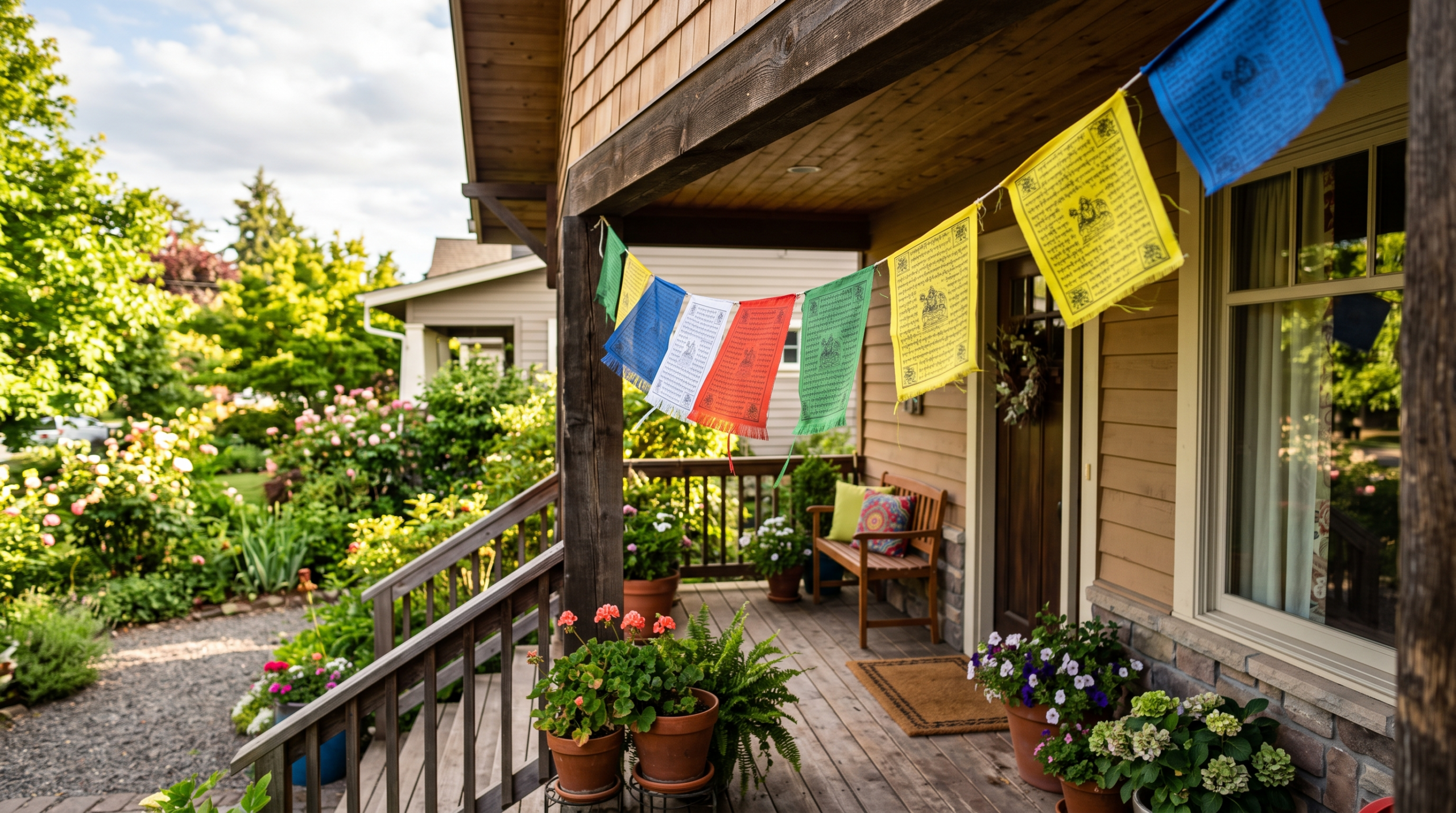
Looking for a set to hang? Potala Store’s windhorse prayer flag set is block-printed for outdoor use and sourced through our monastery partnerships — a respectful place to start.
Can Non-Buddhists Hang Prayer Flags? Etiquette, Fading, and Disposal
Yes — non-Buddhists may hang Tibetan prayer flags, as long as they are treated with respect and hung with good intention. This is the question we hear most, usually paired with a quiet worry about appropriation, so let’s answer it plainly and reassuringly.
Scholars and Tibetan cultural authorities agree. Donald S. Lopez Jr., a distinguished professor of Buddhist and Tibetan studies at the University of Michigan, told HowStuffWorks that in the West people hang the flags on or inside their homes both for the blessings and as a sign of solidarity with the Tibetan cause. Dawa Tsering, director of the Tibet Policy Institute, adds that the flags may be displayed freely as long as they are not desecrated, trampled on, or insulted. In other words, respect is the only real requirement.
What about fading? A fading flag is auspicious, not a sign of neglect. As the cloth weathers, the tradition holds that the wind has carried the prayers out into the world. The Tibetan Nuns Project explains that natural cotton flags fade faster than synthetic ones, and that this impermanence is itself part of the teaching — a living reminder that all things pass. So when your set fades, that’s the point.
On disposal, the etiquette is clear: never throw old flags in the trash. Instead, burn them respectfully, or let them disintegrate naturally where they hang. Faded flags are traditionally replaced with a fresh set, keeping the cycle of blessings going.
Choosing Authentic Prayer Flags and Giving Them as a Gift
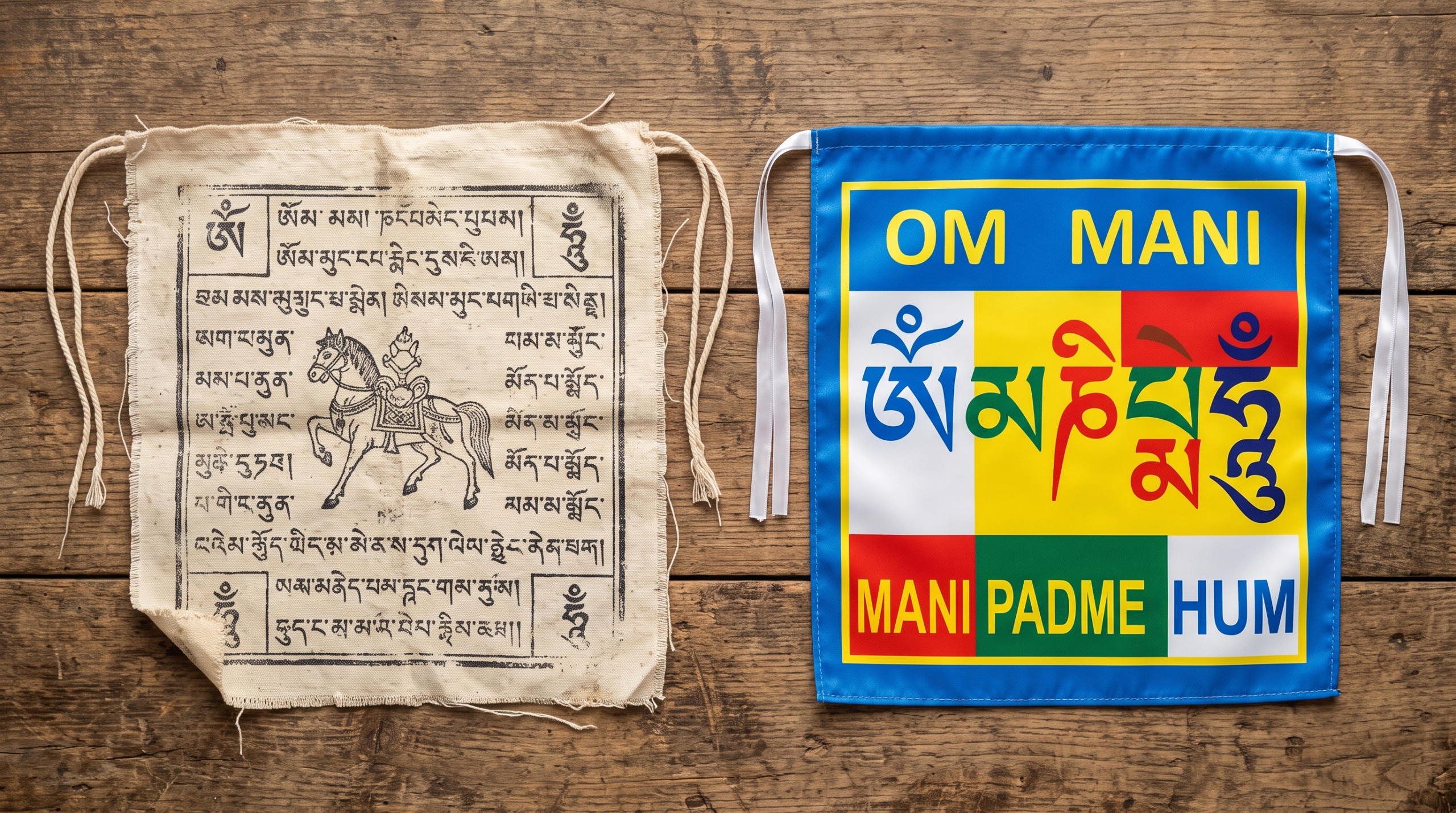
Authentic prayer flags are traditionally block-printed on cotton and, ideally, made and blessed by Tibetan artisans or nuns — not mass-produced polyester sold purely as decor. This is the single biggest difference between a meaningful set and a novelty one, and it’s easy to check once you know what to look for.
| Signal | Authentic set | Mass-produced set |
|---|---|---|
| Material | Natural cotton (fades over time) | Synthetic polyester (stays bright) |
| Printing | Woodblock / block-printed designs | Digital or screen print |
| Provenance | Monastery- or artisan-made and blessed | Factory decor, no provenance |
| Fading | Expected and auspicious | Marketed as “long-lasting” |
The block-print tradition runs deep. According to prayerflags.com (Radiant Heart Studios), woodblock printing for flags was introduced from China in the 15th century, which let artisans faithfully reproduce centuries-old designs onto cloth. When you buy from a source with genuine authentic Tibetan prayer flags, you’re getting that living lineage rather than a printed imitation.
Prayer flags also make a deeply meaningful gift. In Tibetan custom, it is considered auspicious to receive flags as a present, which makes them a thoughtful choice for a housewarming, a fresh start, or a friend beginning a mindfulness practice. If you’re gathering ideas, our roundup of spiritual housewarming gifts pairs well with a set of flags.
Bring the Blessings Home
Explore authentic, monastery-sourced windhorse prayer flags at Potala Store — block-printed, thoughtfully made, and ready to hang or gift.Shop Windhorse Prayer Flags →
Frequently Asked Questions
Each of the five colors represents an element — blue (sky/space), white (air/wind), red (fire), green (water), and yellow (earth). Hung left to right in that fixed order, together they symbolize balance and harmony among the elements.
No. Scholars and Tibetan cultural authorities agree it’s fine, provided you hang them with respect and good intention. That means keeping them off the ground and never throwing them in the trash.
Fading is auspicious: it signals that the wind has carried the prayers out into the world. Faded flags are traditionally replaced, often on Losar (Tibetan New Year), so browsing an authentic replacement set keeps the blessings flowing.
Hang them in high, clean spots where the wind can reach — a porch, garden, or between two trees outdoors, or near a window indoors. Always string them in the blue-white-red-green-yellow order and hang them with a positive wish for all beings.
The Bottom Line
Tibetan prayer flags are far more than pretty cloth: they’re printed prayers that the wind carries outward, colored to honor the five elements and centered on the wind horse and the Om Mani Padme Hum mantra. Hang them high and with care, welcome the fading as part of the tradition, and choose an authentic block-printed set — and whether you’re Buddhist or not, you can share in a practice that has spread goodwill across the Himalayas for centuries.
📚 References
- Prayer Flag (Overview): Encyclopedic background on the origins, types, and symbolism of Tibetan prayer flags. Wikipedia
- Meaning of the Colors and Care: Cultural explanation of the five colors, hanging customs, and the significance of fading. Tibetan Nuns Project
- Non-Buddhist Etiquette: Expert commentary from Donald S. Lopez Jr. and Dawa Tsering on displaying flags respectfully. Source: HowStuffWorks (readers may search the site for the current article on prayer flags)
- Om Mani Padme Hum: The 14th Dalai Lama’s explanation of the six-syllable mantra in Kindness, Clarity, and Insight, trans. Jeffrey Hopkins (Snow Lion Publications). (available through major booksellers and libraries)