
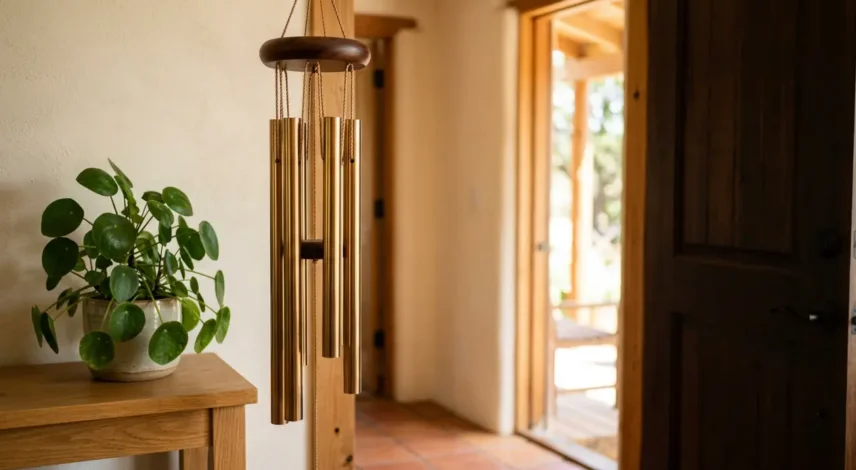

A feng shui wind chime is far more than a pretty piece of backyard decoration — in this tradition it is a sound-based tool used to move, slow, or refresh the flow of chi (life energy) in a space. If you want to hang one but feel unsure about the material, the number of rods, or the right spot, this guide gives you the full picture. At Potala Store, we source spiritual and feng shui pieces directly from Himalayan monastery artisans, and we have watched countless people place their first chime in the wrong corner — so we will show you where a wind chime helps, where it hurts, and the mistakes worth avoiding. The short version: hang it near your front door or in a hallway, match its material to the direction, favor 5, 6, or 8 rods, and keep it away from your bed.
⚠ A quick note: The energy and luck properties described here come from Chinese feng shui and Tibetan Buddhist tradition. They reflect cultural belief systems and the experiences of practitioners, not scientific fact, and are shared for educational purposes only.
Table of Contents
What Wind Chimes Mean in Feng Shui
In feng shui, a wind chime symbolizes harmony, protection, and the movement of energy: as moving air passes through it, the chime is believed to translate that air into sound that stirs stagnant chi and softens harsh energy in a home.
That symbolism is old. The wind chime’s ancestor is the Chinese fengling (literally “wind-bell”), which grew out of ancient clapperless bronze temple bells cast in China more than 3,000 years ago. Over centuries, the wind-bell moved from sacred structures onto private homes, and the same instrument traveled to Japan as the furin. So when you hang a chime today, you are echoing a practice with deep roots in Chinese ritual and craft — not a modern garden trend.
Here is the part most guides skip: a wind chime plays two different roles. Traditionally it is used both to attract and circulate beneficial energy and to cure or suppress negative energy. That double nature matters, because it means placement is not one-size-fits-all. The same brass chime that welcomes opportunity at a busy doorway can also be used to weaken an unlucky influence in a troubled corner. Understanding which job you are asking it to do is the first real step, and it is why the rest of this guide focuses so heavily on where and which rather than just “buy one and hang it.”
How the Chime Works: Chi, Sound, and the Five Elements
Feng shui treats sound as vibration, and a wind chime’s tones are believed to break up stuck chi and slow energy that rushes through a space too fast. Two ideas drive everything here. Sheng qi is smooth, nourishing energy you want to invite in and keep circulating. Sha qi is sharp, rushing, or “cutting” energy — the kind created by a long straight hallway or a corner pointing at your seat, sometimes called a poison arrow. A chime works by intercepting fast-moving air and dispersing its force into gentle sound, so energy meanders instead of shooting straight through.
The chime’s build changes its effect. Hollow rods are the classic feng shui choice because their open tubes are thought to lift and circulate chi upward, while solid rods press energy down. Match that to the five elements — metal, wood, water, fire, and earth — and you get the logic behind material choice: a metal chime carries Metal energy, a bamboo chime carries Wood energy, and each element supports certain areas of your home.
One caution almost no beginner guide mentions: because a wind chime is an active cure, it amplifies whatever it sits on top of. Experienced practitioners warn that if the energy at a particular spot is already weak or unfavorable in a given year, adding an active, sound-making object there can stir up the unwanted influence rather than fix it. In other words, a chime is a tool with a direction — use it on purpose, not just because a spot looks empty.
💡 Prefer a metal cure without the chime? A brass singing bowl does similar Metal-element work through sound and is easier to control indoors. Explore Potala Store’s singing bowls and feng shui tools if a ringing bowl suits your space better than a hanging chime.
Choosing the Right Wind Chime: Material and Number of Rods
Choose a wind chime by matching its material to the element of the area you want to support, then pick a rod count that fits your goal. Metal chimes belong in the west, northwest, and north; wood or bamboo chimes belong in the east and southeast. Get those two decisions right and placement becomes simple.
Match the Material to the Element and Direction
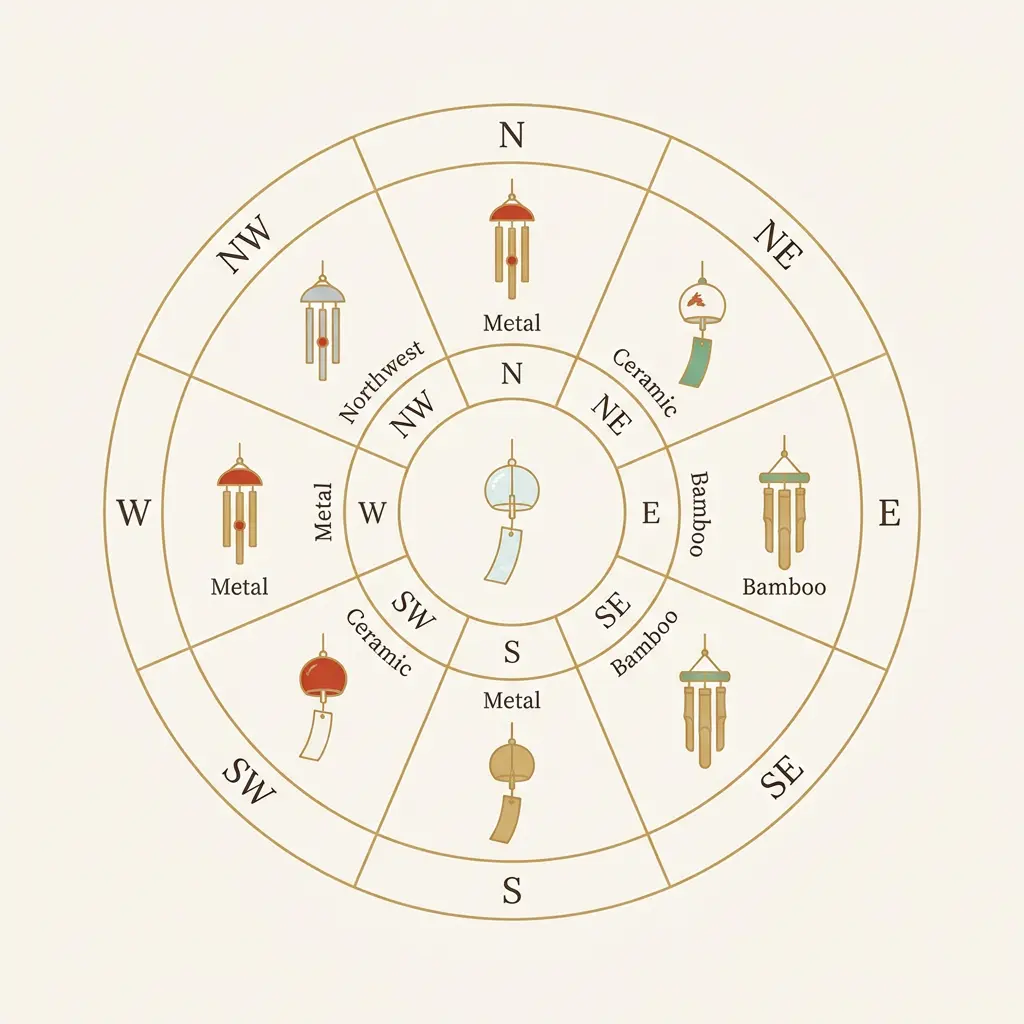
| Material | Element | Best directions / areas | Supports |
|---|---|---|---|
| Metal, brass, copper, aluminum | Metal | West, Northwest, North | Helpful people, career, mentors |
| Bamboo, wood | Wood | East, Southeast, South | Family, health, wealth, growth |
| Ceramic, clay, stone | Earth | Southwest, Northeast, center | Relationships, learning, stability |
| Glass, crystal | subtle / all | Indoors, low-wind spots | Gentle light and energy activation |
Original Potala Store reference chart. When Metal-element chimes are used as an annual cure, the northwest and north are the classic positions.
What the Number of Rods Means
Rod count carries its own meaning, and there is no single “correct” number — you match it to intention:
- 5 rods: represent the five elements; used for balance and protection.
- 6 rods: tied to Metal and the northwest; a classic choice for helpful people, mentors, and career, and the standard count for a metal cure.
- 7 rods: associated with creativity and relationships.
- 8 rods: linked to wealth and abundance; a favorite for the southeast money area.
- 9 rods: connected to fame, recognition, and completion.
The 2–4 Second Sound Test
Here is a buying trick we use ourselves that you will not find on most product pages: before you commit, strike a single tube and listen. A quality brass or bronze chime rings clearly for about 2 to 4 seconds with a sustained, resonant tone. A cheap alloy chime gives a flat “tink” that dies in under a second. In feng shui the sound is the cure, so tone quality is not a luxury — it is the whole point. When we first started sourcing chimes, we assumed heavier always meant better; it does not. Some thin, well-tuned brass tubes outperformed chunky decorative ones every time.
Where to Hang Wind Chimes for Good Feng Shui
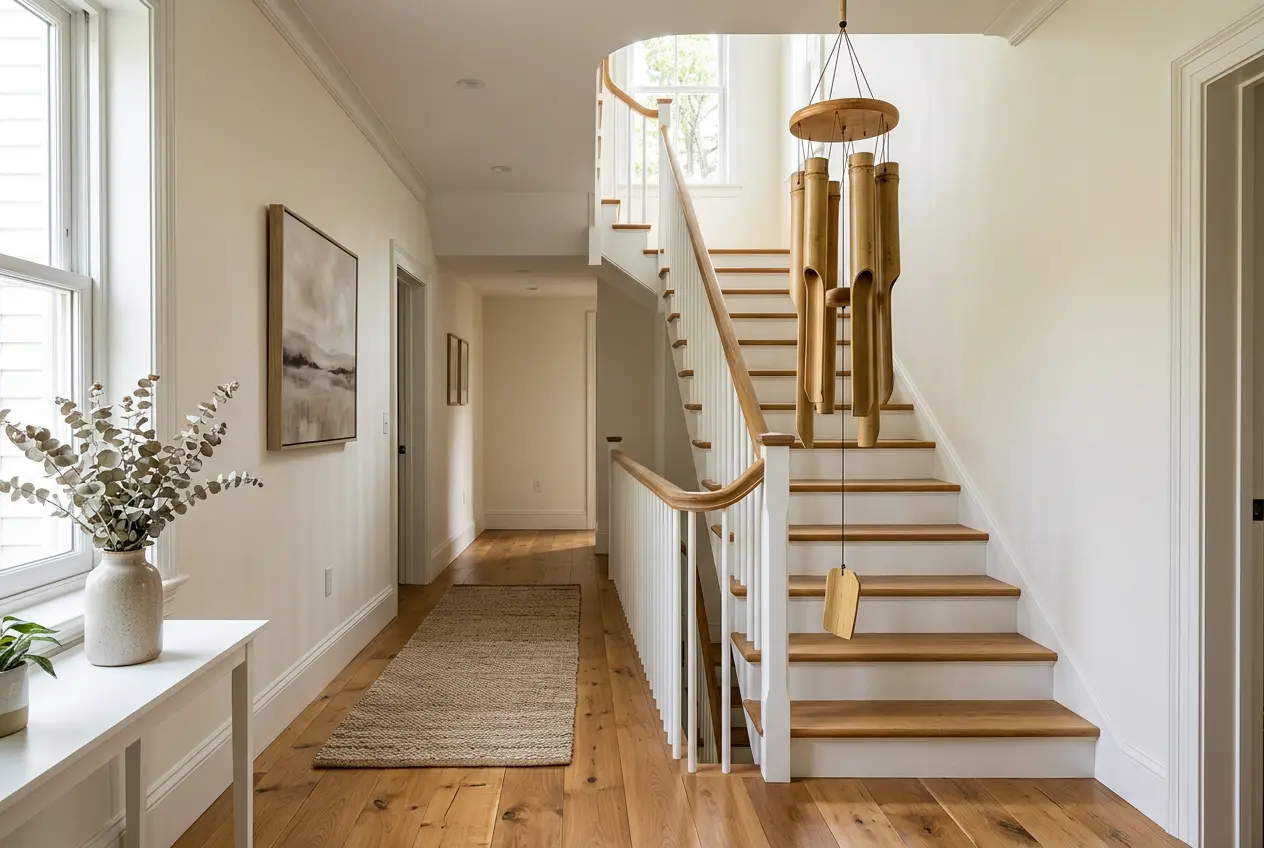
The best places to hang a wind chime are just inside or outside the front door to welcome energy, in a long hallway or at the top of a staircase to slow rushing chi, and in a bagua area whose element matches the chime’s material — while keeping it out of bedrooms and away from spots directly overhead.
Work through these placements in order of impact:
- The front door (the “mouth of chi”): This is the most classic spot. A chime just inside or outside the entry announces and circulates energy as people come and go. If your entry feels weak or you already know the sector is afflicted this year, use a gentler chime so you support the space rather than stir up trouble.
- Long hallways and staircases: Straight corridors let chi rush like water down a chute. A chime hung in the hall or near the top of the stairs breaks that momentum and keeps energy calm and even.
- Facing a poison arrow: If a sharp corner, roof line, or straight path points at your door or window, a chime helps deflect that cutting sha qi.
- The southeast (wealth) area: A wood or crystal chime here supports growth and abundance. This is also where feng shui places your home’s wealth corner — see our guide to activating your home’s wealth corner for the full setup.
- As an annual Metal cure: A 6-rod metal wind chime is the traditional remedy for the shifting “misfortune” and “illness” stars, because Metal drains their Earth energy. If you follow the yearly chart, our breakdown of the annual Flying Star cures shows exactly which sectors need it.
How to Hang It (and the Indoor “No Wind” Fix)
Use a sturdy hook so the chime hangs freely and can actually move — a chime that cannot swing cannot do its job. Do not add a long extension chain that leaves it dangling awkwardly. And if you want a chime indoors where there is no breeze, that is fine: activate it intentionally by giving the clapper a gentle tap when you pass, or hang it where an open window or an air vent moves it. The point is motion and sound, not weather.
Where Should You Not Hang Wind Chimes? Common Mistakes
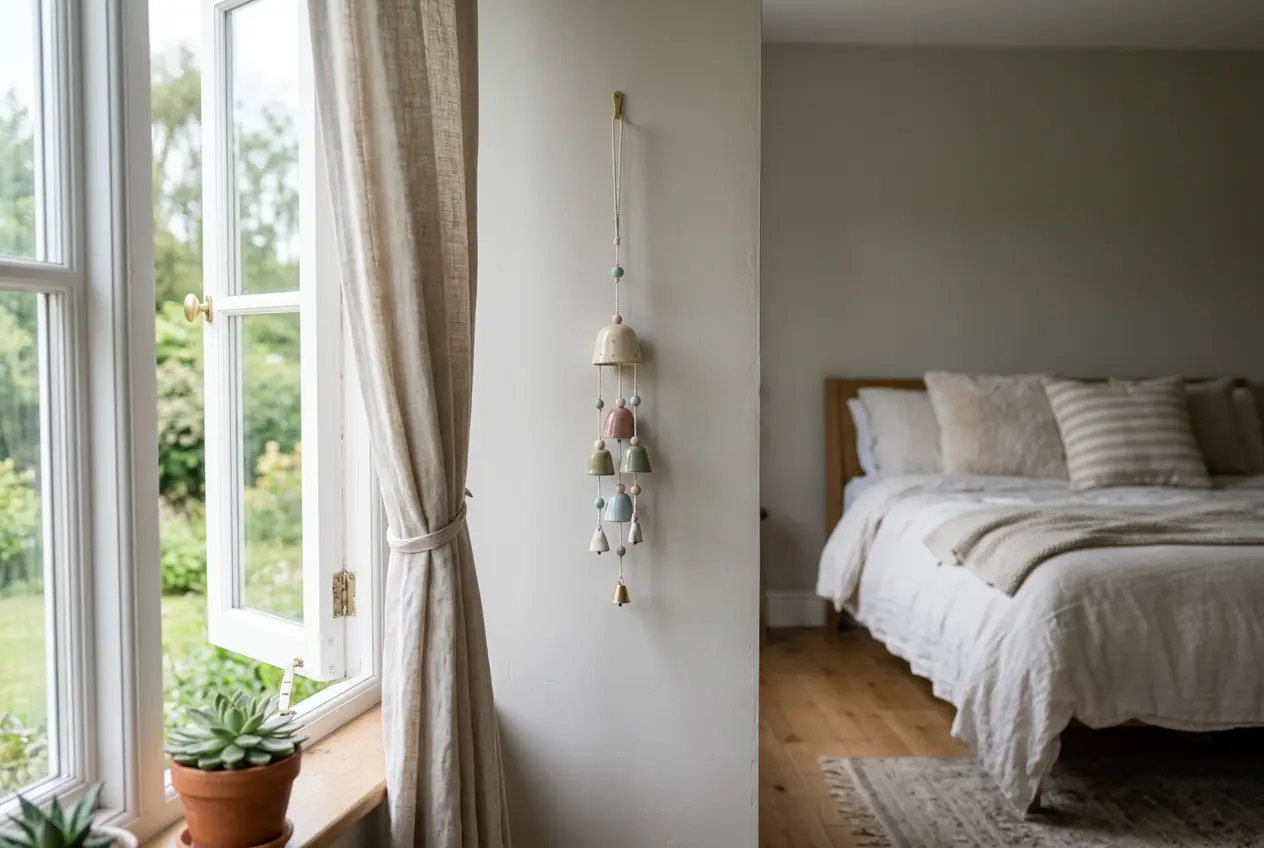
Avoid hanging a wind chime directly over your bed, desk, or any spot where you sit or sleep still, since the constant downward sound is considered oppressive rather than supportive. These are the placements that quietly work against you:
- Directly overhead: Never hang a chime above where you sleep, work, or eat. The downward pressure of sound on a still body is draining, not calming.
- In the bedroom: Bedrooms are for rest, and a chime’s active, moving energy can disturb sleep. If you truly want one, choose a small, soft ceramic chime near a window — never over the bed. For a full room-by-room approach, see how we set up your bedroom’s energy.
- A metal chime in the southwest: The southwest governs relationships and belongs to Earth. Because Metal drains Earth, a metal chime here can weaken the very energy you want to protect. Use ceramic instead.
- On a moving door: Mounting a chime on a door that swings turns gentle activation into constant clatter, which reads as agitation, not harmony.
- In cluttered corners: A chime cannot fix a space where chi is already blocked by mess. Clear the clutter first.
- Too many at once: Several competing chimes create noise, not flow. One well-placed chime beats three fighting for the same air.
💡 A real-world reminder: If you live in an apartment or a condo with a shared balcony, remember that deep metal chimes carry. We have heard from more than one customer whose beautiful brass chime became a neighbor dispute. Check your building rules, and pick softer bamboo or ceramic for shared walls — good feng shui should not cost you good relationships.
Wind Chime Myths and Beginner Tips
Despite a stubborn superstition, mainstream feng shui practitioners do not treat a well-placed wind chime as a magnet for ghosts. The old caution comes from folklore about dark, damp, poorly ventilated spaces, not from a clean chime hung with intention. In practice, a bright, well-tuned chime near an active doorway is considered protective. It is also worth knowing that the decorative Japanese furin and a feng shui cure chime share an ancestor but serve slightly different roles — one is largely seasonal decoration, the other is placed for energy work.
Do wind chimes “really work”? Within the tradition, they are a nudge, not a miracle. Think of a chime the way a practitioner does: a small, intentional adjustment to how energy and attention move through a room. If you are just starting out, do not overthink it. Pick one chime whose sound you genuinely like, match its material to the direction, and hang it near an active doorway. That single, mindful placement matters more than owning a shelf full of chimes.
A wind chime also makes a thoughtful, low-pressure gift — for a housewarming, a new chapter, or a home that needs a little calm. Choose the material for the recipient’s space, and you are giving both an object and a small blessing.
Bring Intentional Sound Into Your Space
Potala Store offers monastery-blessed singing bowls, bells, and feng shui tools crafted in the classical tradition — a grounded way to begin your own setup, whether or not a wind chime is the right fit.Shop Feng Shui & Sound Tools →
Frequently Asked Questions
Five rods are traditionally used for balance and protection, while six and eight are the most popular for helpful-people/career and wealth. There is no rigid rule — match the rod count to your goal and to the sector where you plan to hang it.
Yes, the front door is the most classic placement, just inside or outside the entry to welcome and circulate chi. If your entry energy is already weak in a given year, choose a gentler chime so you do not amplify an unfavorable influence.
Generally avoid it, because a chime’s active, moving energy can disrupt sleep. If you really want one, use a small, soft ceramic chime near a window and never directly over the bed.
In mainstream feng shui, no. The superstition traces back to folklore about dark, damp, poorly ventilated rooms; a clean, well-placed, well-tuned chime is considered protective rather than a magnet for negative energy.
📚 References
- Feng Shui: Meaning, Qi & the Five Elements: Overview of feng shui as an ancient Chinese practice rooted in Daoism, qi, yin-yang, and the five elements. Encyclopaedia Britannica
- Feng-ling (Wind-Bell): History of the Chinese wind-bell and its Japanese counterpart, the furin, and their spread from sacred structures to private homes. Encyclopaedia Britannica
- Zhong (Bronze Bells): Background on ancient Chinese clapperless bronze bells, the acoustic ancestors of later wind-bells. Encyclopaedia Britannica
- Chinese Bronzes: Context on early Chinese bronze casting, dating back roughly 3,700 years, including ritual bells. Encyclopaedia Britannica