
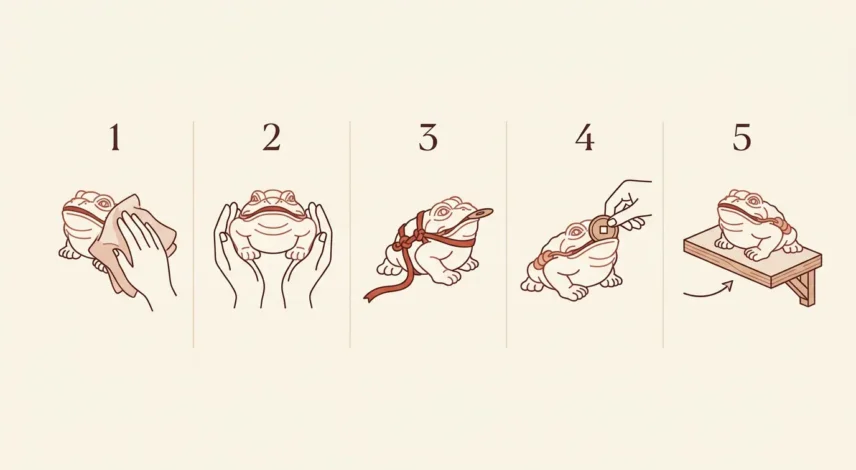

If your feng shui money frog has been sitting on a shelf doing nothing, it is probably because nobody told you it arrives dormant. Activating it takes about 10 minutes and five steps: cleanse the statue, set your intention, tie a red ribbon, seat an I-Ching coin in its mouth, and place it facing into your home. That last step is where most people get it wrong.
At Potala Store, we work with Himalayan artisans and write about Chinese and Tibetan wealth symbols year-round, and the same question reaches us every Lunar New Year: “I followed a guide online, so why does mine feel like an ornament?” Usually the ribbon is missing, the coin is upside down, or the toad is staring out the front door — quietly showing your prosperity the exit. This guide fixes all three, and adds the museum-documented history behind the ritual that most articles skip.
Table of Contents
What Is a Money Frog? The Chan Chu and Liu Hai Story
A money frog is a three-legged toad statue — Jin Chan (金蟾, “Golden Toad”) or Zhaocai Chanchu (招财蟾蜍, “wealth-beckoning toad”) — that Chinese tradition treats as a magnet for steady daily income. It usually sits on a bed of coins, wears seven raised spots on its back, and holds a coin in its mouth.
Those seven spots are not decoration. They map the Big Dipper, the constellation that anchors Chinese astrology — which is why a money frog is read as a cosmological object, not a cute animal.
The toad belongs to a specific person. The Daoist immortal Liu Hai (also called Liu Haichan), a Five Dynasties minister later venerated as an immortal, is “always depicted unkempt, unshod, and carrying a three-legged toad,” according to the Metropolitan Museum of Art. He baited the creature with a string of coins whenever it escaped down a well, and the Smithsonian’s National Museum of Asian Art records that “Liu and his toad symbolize wealth and good fortune.”
Here is the layer almost no online guide mentions. In Daoist internal alchemy, the Smithsonian notes, the magic toad “represents the ‘essence’ (zhenjing) in internal elixir (neidan) practices” and was believed to appear whenever Liu swung his string of coins. Translated: the toad is your own cultivated essence answering the sound of money — which reframes the whole ritual. You are not bribing a statue. You are rehearsing attention. That is why the intention step below matters more than the ribbon.
Not sure the toad is even your best match? Our comparison of Pixiu, Money Frog, and Dragon Tortoise wealth symbols breaks down which one suits windfalls versus steady income.
Do You Actually Need to Activate It?
Yes — unless your statue arrived with a red ribbon already tied and a coin already seated, in which case the seller activated it for you. Activation is the step that converts a decorative object into a working talisman in the tradition’s own logic.
“Activation” means three things at once, and each has a job:
- Cleansing: clears residue from manufacturing, shipping, and every hand that touched it.
- Dedication: assigns the object one specific purpose in your words.
- Marking: the red ribbon and the coin declare it “in service” rather than “on display.”
One honest caveat before you start: in traditional practice a money frog is understood to support prosperity, not manufacture it. Treat activation as a focusing ritual — a daily, physical reminder of a financial intention you already hold. That framing is also the one the Daoist source material supports.
How to Activate Your Money Frog: 5 Steps
Here is the complete activation ritual, start to finish, in about 10 minutes:
- Cleanse the statue (3–5 minutes). Wipe it with a soft cloth dampened in clean or lightly salted water, then dry it completely. Or pass it through incense or sage smoke for about 30 seconds. Never soak a resin or gold-leaf toad — the finish lifts.
- Set your intention (1–2 minutes). Hold the toad in both hands, name one specific financial goal out loud, and keep it concrete: “steady income for this business,” not “money.” One goal, spoken once.
- Tie the red ribbon (2 minutes). Tie a red ribbon or red string around the statue — traditionally in three knots, red being the color of activated, protective yang energy. If yours came with a red jewel or ribbon attached, it is already marked; leave it alone.
- Seat the I-Ching coin (1 minute). Place a round Chinese coin in its mouth with the four-character (yang) side facing up and out. If the coin is glued in, do not pry it loose.
- Place it facing inward (1 minute). Set it on a raised surface — never the floor — angled into the room. Optionally do this during the Chen hour, 7–9 a.m., the traditional “dragon raises its head” window.
Which Way Should the Coin Face?
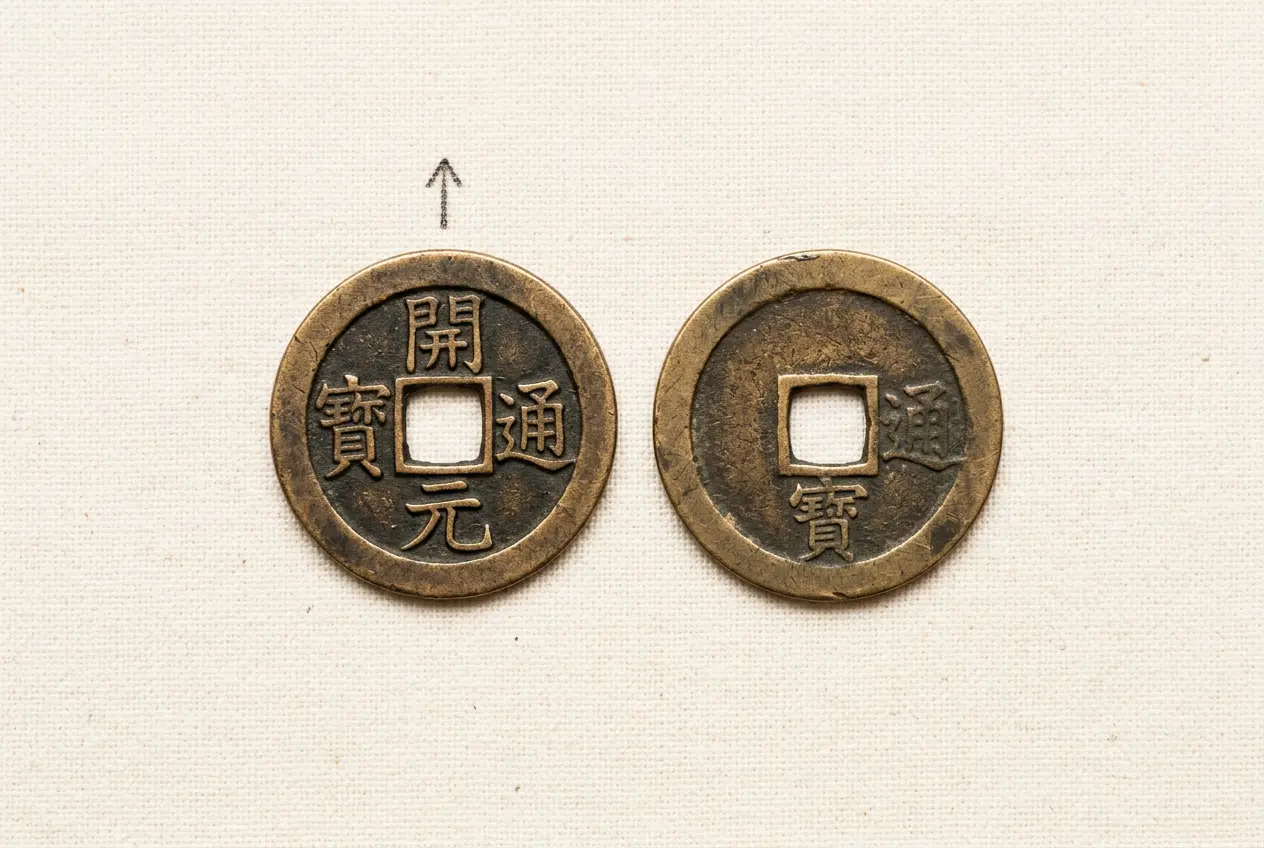
The four-character side faces up. An I-Ching coin has a yang side carrying four Chinese characters — a reign title plus tōng bǎo (“circulating treasure”) — and a yin side with two characters, often in Manchu script. Feng shui placement convention puts the active yang face up and outward.
Worth flagging, because it trips people up: the Wilhelm/Baynes I-Ching divination tradition counts that same inscribed side as yin (value 2) — the exact opposite reading. Both are correct within their own system. For a money frog you are doing placement, not divination, so four characters up. Our guide to what the three feng shui coins on red string mean covers coin anatomy in more depth.
💡 What we’ve noticed: The step people skip is drying. We’ve seen more toads ruined by a “quick rinse” than by any placement mistake — trapped water under a gold-leaf finish blisters it within weeks. If yours is resin, painted, or leafed, use a damp cloth, never a bath.
Where to Place the Jin Chan (and Where Never To)
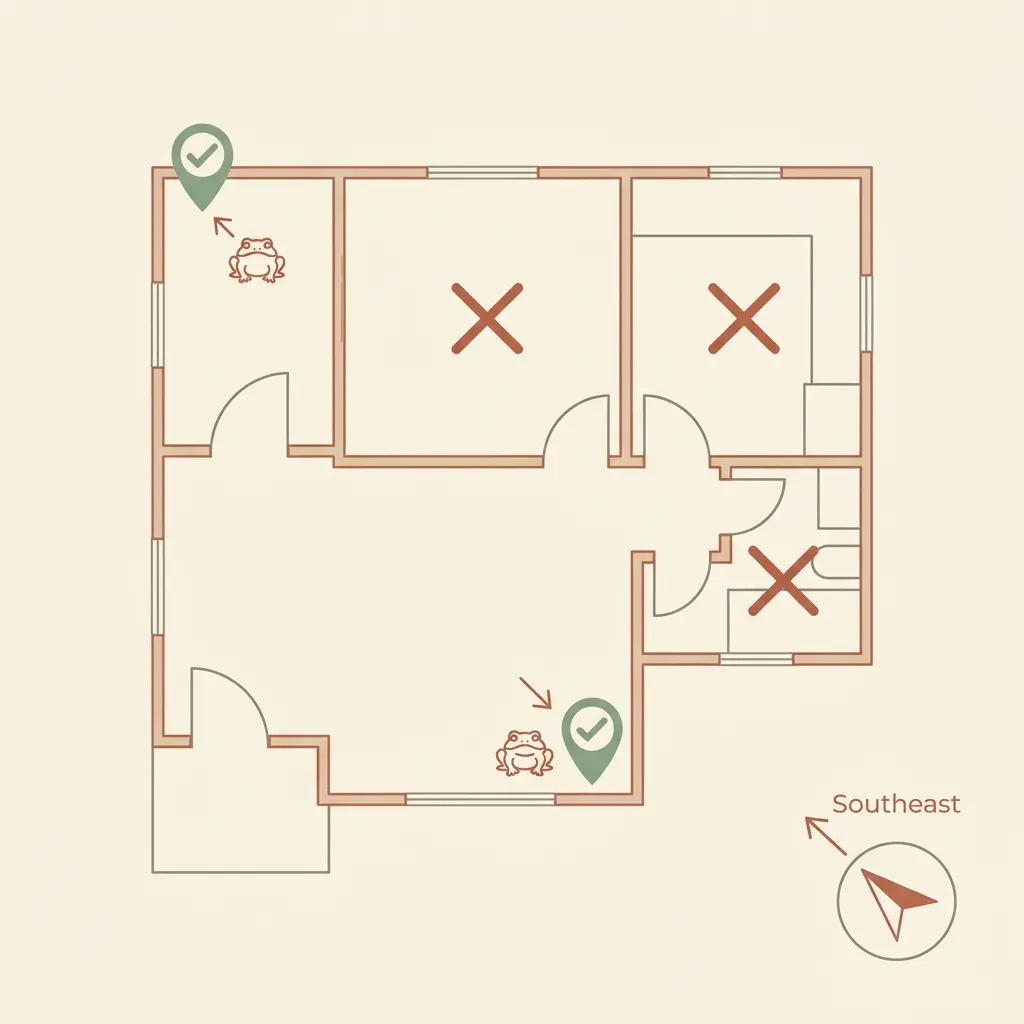
Place it diagonally across from your main entrance or in the southeast corner, always facing into the room. The southeast is the Xun gua (巽卦), the Wind/Wood trigram that traditional bagua practice assigns to wealth.
| Location | Verdict | Why |
|---|---|---|
| Diagonal from front door | ✅ Best | Catches incoming qi and turns it into the home |
| Southeast corner (Xun gua) | ✅ Best | The traditional wealth sector of the bagua map |
| Office desk or near a register | ✅ Good | Points at the spot where income actually arrives |
| Bedroom | ❌ Avoid | A wealth-seeking symbol disrupts a rest space |
| Kitchen or bathroom | ❌ Avoid | Fire and draining water are read as wealth loss |
| Directly on the floor | ❌ Avoid | Signals a demoted, inactive talisman |
| Under a beam or shelf | ❌ Avoid | Overhead weight is said to suppress its energy |
| Facing out a door or window | ❌ Never | Sends wealth out of the home — the classic error |
Two refinements. First, use one, three, six, or nine toads — never more than nine — facing different directions if you use several. Second, the facing rule has a documented split: most practitioners say always face inward, but a respected minority holds that a toad with an empty mouth may face outward to hunt for wealth, while a coin-in-mouth toad always faces in. We follow the coin-in, face-in rule, and we’d rather tell you the disagreement exists than pretend the tradition is unanimous.
For the full southeast setup, see our guide to building a feng shui money corner.
When to Activate It in 2026: Period 9 and the Fire Horse
The strongest 2026 window is the Chen hour (7–9 a.m.) on or just after the Lunar New Year, February 17, 2026. Timing won’t rescue bad placement, but the tradition treats fresh cycles as favorable starting points.
Two dates matter, and they are not the same. The Year of the Fire Horse (Bing Wu, 丙午) begins culturally at Lunar New Year on February 17, 2026, while the solar feng shui year turns at Lichun on February 4, 2026. Most classical practitioners use the February 4 turn for placement work.
Both sit inside Period 9, the 20-year cycle that began at Lichun on February 4, 2024 and runs to February 4, 2044. Period 9 is governed by the Li trigram (离) and the Fire element under the Nine Purple Star — which is why 2026’s Fire Horse year is read as a doubled-fire, high-momentum year. Our 2026 feng shui wealth sector guide maps which sectors the annual stars favor this year.
Beyond the Toad: Pairing With Tibetan Wealth Symbols
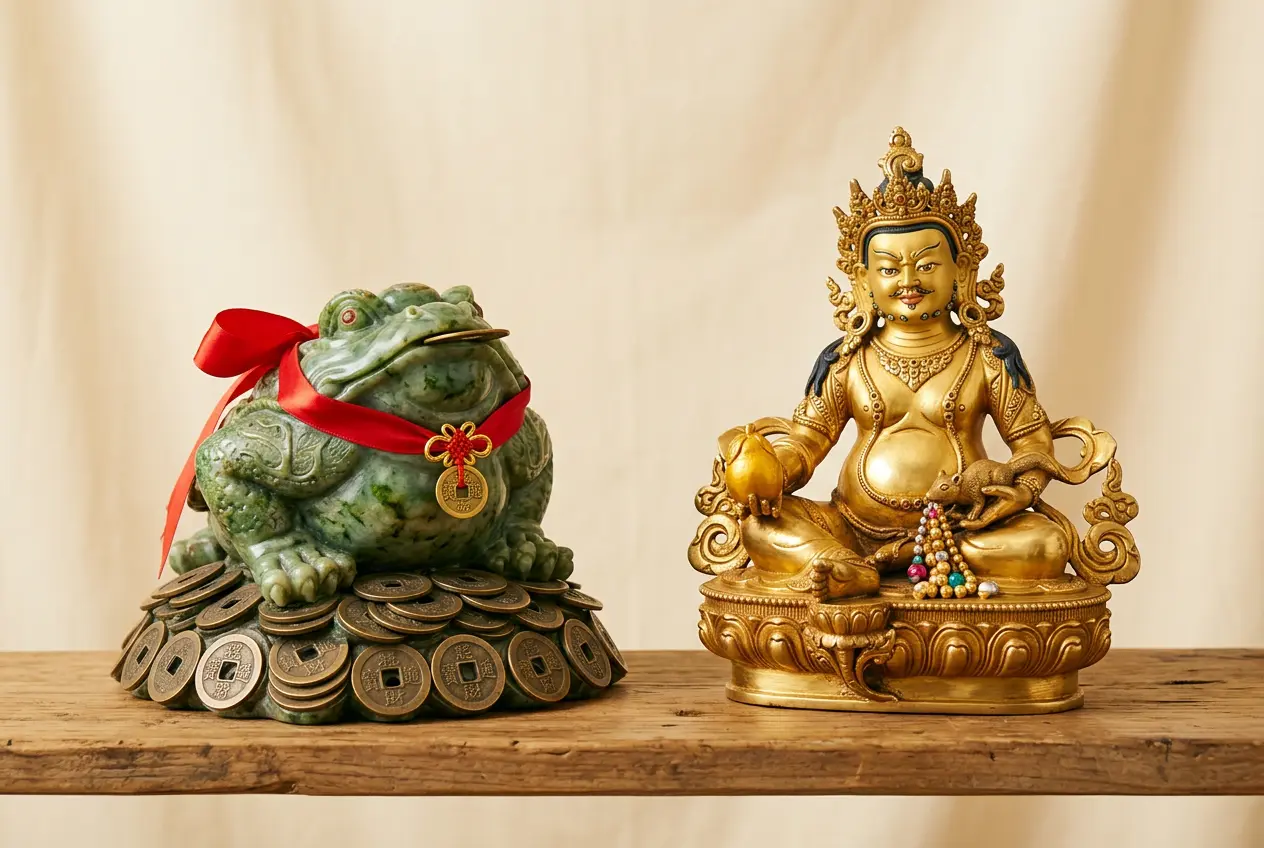
If the Daoist framing resonates, its Tibetan Buddhist counterpart is Jambhala (Dzambhala), the wealth deity whose most common form is Yellow Jambhala. He is recognized by the jewel-spitting mongoose (nakula) cradled in his left arm and a citron fruit in his right hand.
The pairing works because the two traditions ask for different things. Jin Chan is transactional and daily — it collects. Jambhala is aspirational — his wealth is meant to be redistributed, not hoarded. A money corner holding both reads, in symbolic terms, as “earn steadily, give generously.” That is a more durable intention than accumulation alone, and it’s the pairing we most often recommend.
⚠️ Important Note: Feng shui and the wealth associations described here are traditional cultural beliefs and folklore, not scientifically verified financial methods. This article is educational and is not financial advice. No object guarantees an outcome.
Frequently Asked Questions
Cleanse it with a damp cloth or incense smoke, hold it and state one financial intention, tie a red ribbon in three knots, seat an I-Ching coin four-character-side up in its mouth, and place it on a raised surface facing into your home. The full ritual takes about 10 minutes.
Inward, toward the interior of your home or office — never out a door or window, which tradition reads as sending wealth away. Diagonally across from the main entrance or in the southeast corner works best.
Avoid the bedroom, kitchen, and bathroom, and never set it directly on the floor or beneath an exposed beam. Each placement is traditionally understood to suppress or drain the symbol’s wealth energy.
Wipe it monthly, and do a full cleanse once a year — ideally before the Lunar New Year, which falls on February 17, 2026. Re-state your intention afterward, since cleansing is understood to reset the dedication. Our guide on cleansing and charging spiritual pieces covers the method for delicate finishes.
Build Your Wealth Corner
Potala Store’s wealth collection includes feng shui lucky coins, citrine, and hand-finished Pixiu pieces — blessed and shipped from our Himalayan partner artisans.Shop Wealth Talismans →
A note in the spirit of full disclosure: we don’t currently stock money frog statues. If you need the toad itself, buy it elsewhere — and come to us for the coin, the crystals, and the corner around it.
📚 References
- Daoist Toad Symbolism and the Internal Elixir: Museum documentation of the three-legged toad as the “essence” (zhenjing) in neidan practice, summoned by Liu’s string of coins. Smithsonian National Museum of Asian Art — “A Pair of Three-legged Toads” (F1916.571e)
- Liu Hai and the Wealth Association: Freer Gallery record establishing that Liu and his toad symbolize wealth and good fortune, and the coin-baiting legend. Smithsonian National Museum of Asian Art — “Liu Hai crossing the sea” (F1915.12)
- Liu Haichan’s Iconography: Curatorial note on Liu’s veneration as an immortal always depicted with a three-legged toad. The Metropolitan Museum of Art — Li Keran, “The Immortal Liu Haichan Playing with a Toad”
- Jin Chan Overview: Encyclopedic reference for the names 金蟾 / 招财蟾蜍, the seven Big Dipper spots, and the Liu Haichan connection. Wikipedia — Jin Chan