

Every pose on a Buddha statue is a fixed piece of visual language, not a decorative choice. The body posture tells you which moment of the Buddha’s life is being shown, and the hand gesture — called a mudra, Sanskrit for “seal” or “sign” — tells you what he is doing in that moment. Once you can read both, you can identify almost any Buddha image on sight.
Most guides stop at “the meditation Buddha means peace.” That is not wrong, but it is not how the tradition actually works. At PotalaStore, we source Buddhist statues from Himalayan workshops, and the question we hear most from customers is some version of “what am I actually looking at?” This guide answers that: the four postures, seven mudras used in Buddhist art, the Five Dhyani Buddhas, the figures people commonly confuse, and the placement customs worth knowing.
Table of Contents
What Do the Different Buddha Positions Mean?
The four body postures show four moments — awakening, teaching, blessing, and final passing — while the hands specify the exact act. Use this table to identify a statue in about ten seconds.
| What you see | Name | What it depicts |
|---|---|---|
| Seated, right hand touching the ground | Bhumisparsha mudra | The moment of awakening at Bodh Gaya; the earth is called as witness |
| Seated, both hands resting in the lap | Dhyana mudra | Meditation and deep concentration |
| Standing, right palm raised outward | Abhaya mudra | Fearlessness, protection, peace |
| Standing, right palm lowered outward | Varada mudra | Generosity, granting of wishes |
| Seated, both hands turning at the chest | Dharmachakra mudra | The first sermon at Sarnath |
| Lying on the right side | Parinirvana | The Buddha’s final passing, not sleep or rest |
| Mid-stride, one heel lifted | Walking Buddha | The Buddha moving among people; a Thai innovation |
The key takeaway: read the posture first for the scene, then the hands for the action. A seated figure with hands in the lap and a seated figure touching the ground are two entirely different stories in the same body position.
The Four Body Postures and the Moments They Show
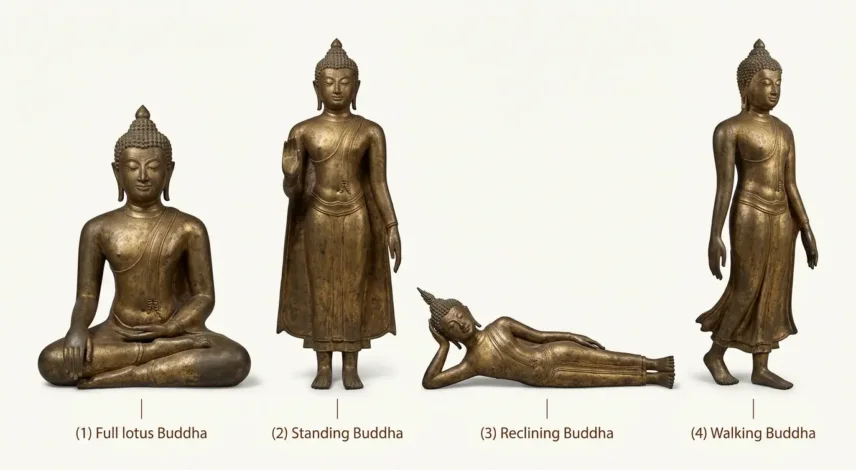
Buddhist sculpture recognizes four canonical postures: seated, standing, reclining, and walking. Each corresponds to a specific episode rather than a mood.
Seated (Padmasana and Vajrasana)
The seated Buddha is the most common form and shows meditation and the awakening itself. In padmasana — the full lotus — both legs cross with each sole turned upward. In the half-lotus, only one sole shows. The seat is almost always a lotus throne, a symbol tied to purity rising from muddy water, which we cover in our guide to what the lotus flower means in Buddhism.
Standing
The standing Buddha depicts the Buddha teaching, blessing, or descending after teaching. Standing images most often carry the abhaya mudra of protection in the right hand, sometimes paired with varada mudra in the left — a combination especially common in Thailand, Laos, and Sri Lanka.
Reclining (Parinirvana)
The reclining Buddha depicts death, not rest. He lies on his right side, right hand supporting the head, feet stacked evenly — the posture of the Buddha entering parinirvana, the final release from the cycle of rebirth. Southeast Asia produced the largest examples, and the detail worth knowing is the feet: when they are perfectly aligned, the Buddha has already passed; when slightly offset, he is still alive and resting.
Walking
The walking Buddha is the rarest of the four, and it is not Indian. According to Britannica, the walking Buddha was a Tai creation that did not exist in India as a canonical type; it emerged in Sukhothai, Thailand, between the 13th and 15th centuries. The body is fluid and almost boneless, the flame-shaped ushnisha rises from the crown, and one heel lifts mid-stride. It shows the Buddha walking among people, emphasizing his earthly presence.
Reading the Hands: Seven Mudras and What Each One Signals
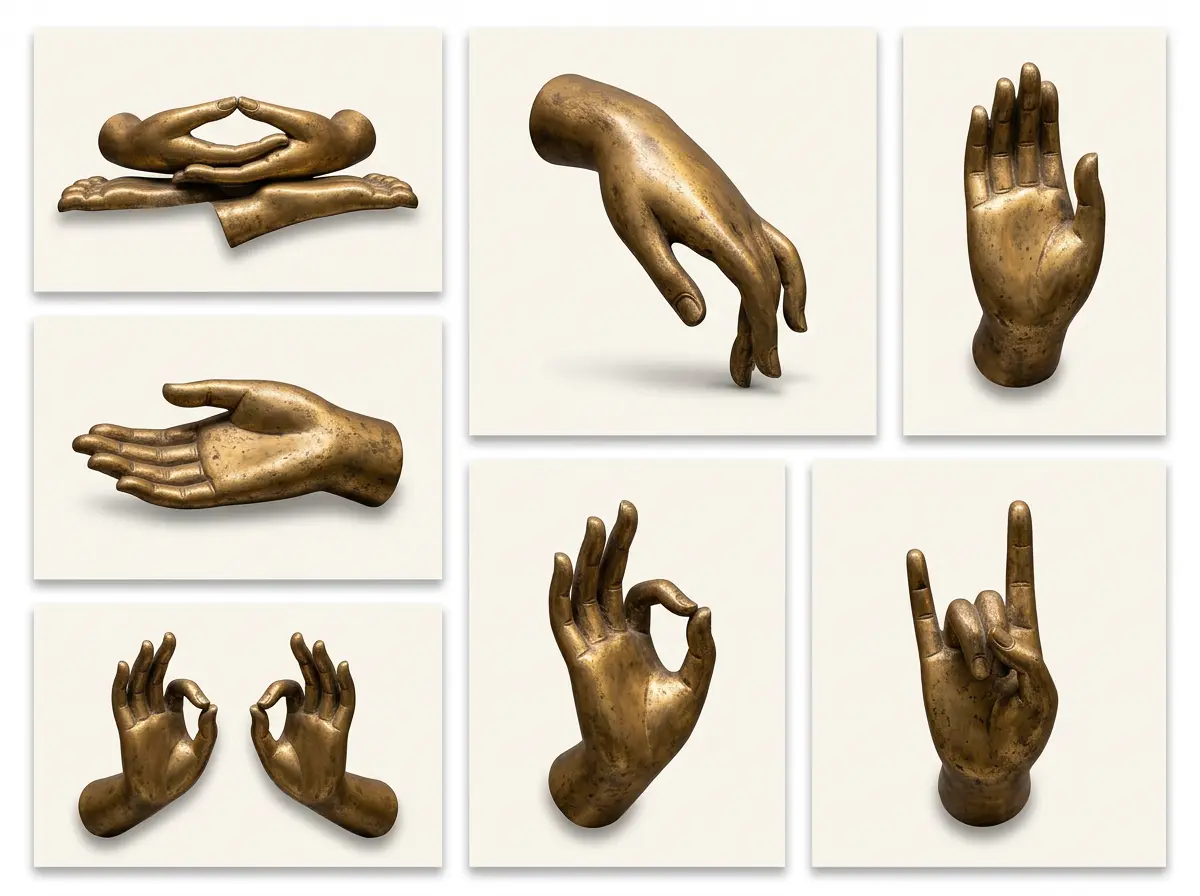
Seven mudras cover the overwhelming majority of Buddha statues you will encounter. They were first seen in statues from Gandhara in the first century and appear to have been codified by the third century.
- Dhyana (meditation): Both hands in the lap, right over left, palms up, thumb tips touching to form a triangle. The triangle is read as the Three Jewels — Buddha, Dharma, Sangha.
- Bhumisparsha (earth-touching): Left hand in the lap, right hand draped over the right knee with fingers touching the ground. It marks the moment the Buddha defeated Mara and called the earth to witness his awakening.
- Abhaya (fearlessness): Right hand raised to shoulder height, palm outward, fingers up. It signals protection and the removal of fear.
- Varada (generosity): Right arm lowered, palm outward. The five extended fingers are read as generosity, morality, patience, effort, and concentration.
- Dharmachakra (teaching): Both hands at chest height, thumb and index finger of each forming a circle. It refers to the first sermon at Sarnath and belongs to the historical Buddha.
- Vitarka (discussion): Thumb and index finger touching in a circle, right hand raised, other fingers extended. It represents the transmission of teaching.
- Karana (warding off): Index and little finger extended, middle fingers folded under the thumb. It expels obstacles and negative influences.
One honest caveat from our own catalog work: mudras are consistent, but they are not a global standard. The same hand position can carry a slightly different reading in Theravada Thailand than in Vajrayana Tibet, and workshop pieces sometimes blend forms. When a statue’s gesture does not match any textbook entry, it is usually regional variation rather than a mistake.
💡 Practical note: Choose the gesture that matches your intention — dhyana for a meditation seat, bhumisparsha for a study or altar, abhaya near an entryway. Our walkthrough on how to choose a Buddha statue by size, material, and pose maps each mudra to a room and purpose.
The Five Dhyani Buddhas: Direction, Color, and Gesture
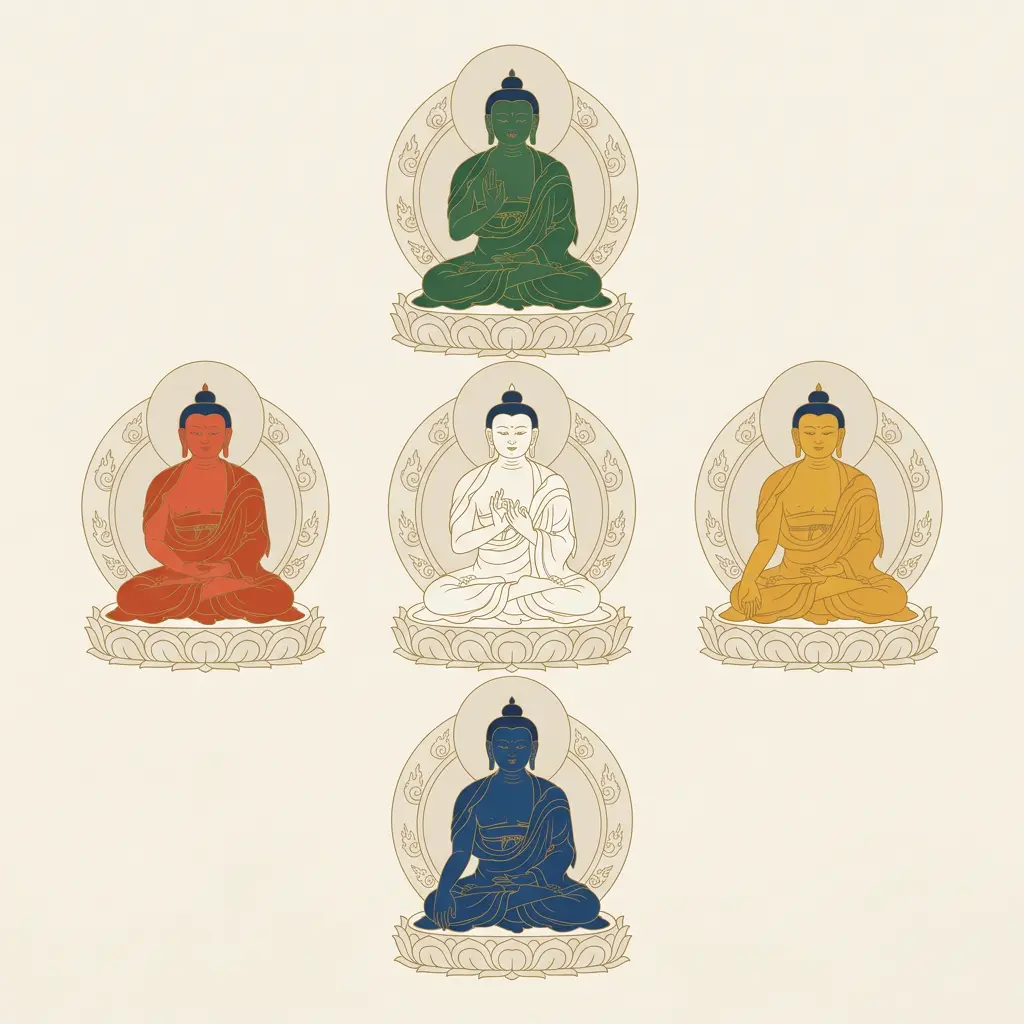
In Vajrayana Buddhism, five Buddhas form a single system, and each is identified by a fixed combination of direction, color, and mudra. This is the piece most English-language guides skip — and it explains why two blue-and-gold Tibetan statues with different hands are not the same figure.
| Buddha | Direction | Color | Mudra | Transforms |
|---|---|---|---|---|
| Vairocana | Center | White | Dharmachakra | Ignorance |
| Akshobhya | East | Blue | Bhumisparsha | Anger |
| Ratnasambhava | South | Yellow | Varada | Pride |
| Amitabha | West | Red | Dhyana | Attachment |
| Amoghasiddhi | North | Green | Abhaya | Envy |
Each Buddha is understood to transform a specific affliction into a corresponding wisdom. The center and east positions of Vairocana and Akshobhya are sometimes exchanged depending on the tantric system being followed, so treat the arrangement as school-dependent rather than absolute.
Marks That Appear on Almost Every Image
Three physical marks come from the 32 lakshanas, the traditional major marks of a great being enumerated in the Lakkhaṇa Sutta (DN 30). The ushnisha is the cranial bump signifying wisdom; the urna is the whorl of hair between the brows signifying insight; the elongated earlobes recall the heavy princely earrings the Buddha gave up. Snail-shell curls became standard from the Gupta period onward.
Telling Similar Figures Apart: Budai, Medicine Buddha, and Maitreya
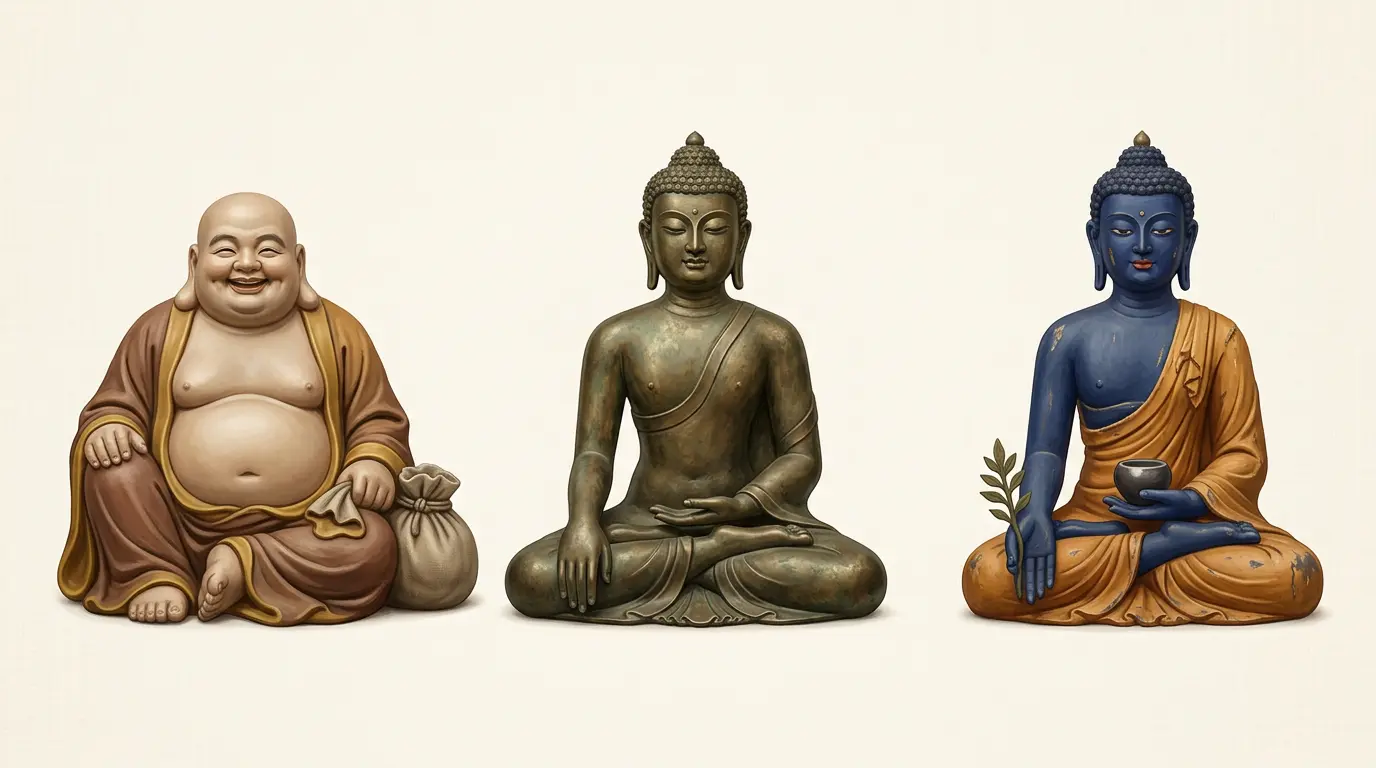
The most common misidentification in American homes is the Laughing Buddha, who is not the Buddha at all. Here is how the three most-confused figures separate.
- Budai (the Laughing Buddha): A round, smiling monk with a cloth sack and exposed belly. He was a 10th-century Chinese monk later associated with Maitreya, and he represents contentment and abundance. He is not Siddhartha Gautama. Rubbing his belly for luck is a folk custom, not a Buddhist practice.
- Medicine Buddha (Bhaisajyaguru): Deep lapis-blue body, left hand holding a bowl of healing nectar in dhyana mudra, right hand at the knee holding a sprig of myrobalan in varada mudra. He presides over the eastern pure land of “Pure Lapis Lazuli.”
- Maitreya: The future Buddha. Shown either as a monk or, before awakening, as a jeweled bodhisattva — and often seated in the European style with both feet down, a pose no Shakyamuni image uses.
- Shakyamuni: The historical Buddha. Monastic robe, no jewelry, no sack, most often in bhumisparsha or dhyana mudra.
The quick test: a belly and a sack mean Budai; a bowl and blue skin mean the Medicine Buddha; a plain robe and an earth-touching hand mean Shakyamuni.
What Consecration Adds — The Step Most Guides Never Mention
In the Tibetan tradition, a statue is not considered complete when the casting is finished. It is filled and sealed in a process called zung (filling) and then consecrated in a rabne ceremony, in which rolled mantras, relics, and juniper or sandalwood are placed inside the hollow body, the base is sealed with a plate, and monks perform the rite that invites the wisdom being to reside in the image. This is why a consecrated statue is treated as a presence rather than an object — and it is the main reason traditional practitioners never place one on the floor. We learned this the practical way: our earliest customer questions about “why is the base sealed” turned out to be questions about consecration, and we had been describing sealed bases as a manufacturing detail rather than a ritual one.
Where Should You Not Put a Buddha Statue?
Avoid the floor, the bathroom, the bedroom floor beside a bed, and any spot where feet point toward the image. These four are consistent across Buddhist cultures because they concern respect rather than luck.
- Not directly on the floor: Place the image at eye level or higher, on a stable shelf, table, or altar.
- Not in a bathroom or laundry area: These are considered unclean spaces in every tradition we work with.
- Not where feet point at it: In Thailand and much of Southeast Asia, pointing the soles of the feet at a Buddha image is a serious offense — worth remembering before setting a statue at the front of a yoga mat.
- Not as a decorative Buddha head: Detached heads are widely seen as disrespectful by practicing Buddhists, given their association with looted and decapitated antiquities.
Direction is a different category. Vastu and feng shui traditions favor east or northeast, and Japanese household altars simply face the room. These are traditional customs, not doctrinal requirements — a clean, elevated, undisturbed spot matters more than a compass reading. For gifting etiquette and material questions, our Buddha statue FAQ on placement, materials, and cultural respect goes further.
⚠️ Important note: Statements about spiritual influence, energy, and directional placement reflect traditional beliefs and cultural practice, not scientific findings. They are presented here for educational and cultural context. Buddhist practice does not require owning a statue, and non-Buddhists are generally welcome to keep one when it is treated with respect.
Frequently Asked Questions
No posture is considered more powerful than another in Buddhist doctrine. The bhumisparsha (earth-touching) pose is the most widely depicted because it marks the awakening itself, but power lies in the practice, not the pose. Choose the gesture that matches your intention.
Generally no, provided the statue is treated with respect. What causes offense is placement — on the floor, in a bathroom, or used as a purely ornamental object such as a detached head. Keeping an image elevated and undisturbed is what practitioners ask for.
The Laughing Buddha is Budai, a 10th-century Chinese monk associated with the future Buddha Maitreya, and he symbolizes contentment and abundance. The historical Buddha, Shakyamuni, is depicted slim, in a monastic robe, usually seated in meditation or touching the earth.
Traditional guidance favors placing the statue in the east or northeast and letting it face into the room, so it is visible to the household. This is custom drawn from Vastu and feng shui rather than Buddhist doctrine — height, cleanliness, and stability matter more than orientation.
Find a Buddha Statue You Can Actually Read
Browse handcrafted Buddha and spiritual statues from Himalayan workshops — each listing names the pose and mudra, so you know exactly which moment you are bringing home.Shop Buddha Statues →
Buddha statue meanings are not decoration — they are a language of poses and postures that has stayed consistent for nearly two thousand years. Learn the four postures and seven mudras, and every Buddha image you meet, from a museum gallery to a friend’s altar, becomes readable.
📚 References
- Mudras in Buddhist Art: Scholarly overview of how hand gestures were codified in Gandharan sculpture and what each signifies. Smarthistory / Khan Academy
- Sukhothai Style and the Walking Buddha: Reference entry establishing the walking Buddha as a Tai creation without an Indian canonical precedent. Encyclopædia Britannica
- Buddhist Sculpture Across Asia: Museum essays on Gandhara, Mathura, Gupta, and Himalayan imagery, including postures and iconographic marks. The Metropolitan Museum of Art, Heilbrunn Timeline
- The Five Tathāgatas: Reference overview of the Five Dhyani Buddhas and their directions, colors, and associated mudras. Wikipedia