
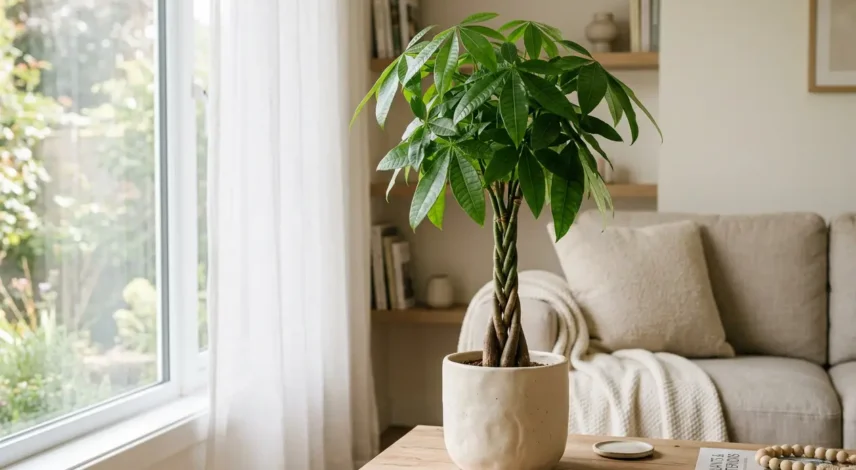

A feng shui money tree is the plant Pachira aquatica, and in feng shui tradition it is believed to attract wealth, abundance, and steady good fortune. Its five-leaf clusters are linked to the five elements, and its braided trunk is said to lock prosperity in place. Keep it in bright, indirect light, water it only when the top 2–3 inches of soil dry out, and place it in your southeast wealth corner.
That is the short version. The longer version matters, because most money tree owners get one of two things wrong: they place the plant beautifully and then slowly drown it, or they keep it alive and never understand what the tradition actually says it means.
At PotalaStore, we work with Tibetan and Himalayan artisan partners, and wealth symbolism is something we handle every day. We are also going to be honest with you about where tradition ends and horticulture begins. This guide covers what the money tree symbolizes, where the Bagua map says to put it, exactly how to care for it, and how to rescue it when the leaves turn yellow.
Table of Contents
What Is a Feng Shui Money Tree?
The feng shui money tree is Pachira aquatica, a tropical tree in the Malvaceae family that grows wild in the freshwater swamps and riverbanks of Central and South America. The braided trunk you see in stores is not how it grows in nature — it is shaped by hand while the stems are young and flexible.
The plant goes by several names: Malabar chestnut, Guiana chestnut, saba nut, and money tree. The University of Arizona Campus Arboretum notes that the number five runs through its botany — roughly five leaflets per leaf, five-petaled flowers, and seed capsules with five chambers. That botanical coincidence is a large part of why the symbolism stuck.
The lucky-plant story is surprisingly recent. According to the New York Botanical Garden, the braided money tree is rumored to have been created in the 1980s by a truck driver in Taiwan who cultivated it as a bonsai. Andrew Bunting, vice president of horticulture at the Pennsylvania Horticultural Society, tells the same story and adds that money tree cultivation “really only goes back to the 1980s.”
One detail almost every guide skips: many plants sold as Pachira aquatica are actually the near-identical Pachira glabra. True P. aquatica has reddish stamens and rough brown fruit; P. glabra has white stamens and smooth green fruit. Care is the same either way, so this is trivia rather than a problem — but it explains why plant labels disagree.
What a Money Tree Symbolizes in Feng Shui
In feng shui, the money tree is believed to attract wealth and balance because its five leaflets represent the five elements — water, earth, fire, wind, and metal — while its braided trunk is said to trap fortune rather than let it escape. It is one plant that carries the complete elemental set, which is why practitioners treat it as a wealth anchor rather than ordinary greenery.
What Do the Five Leaves and Seven Leaves Mean?
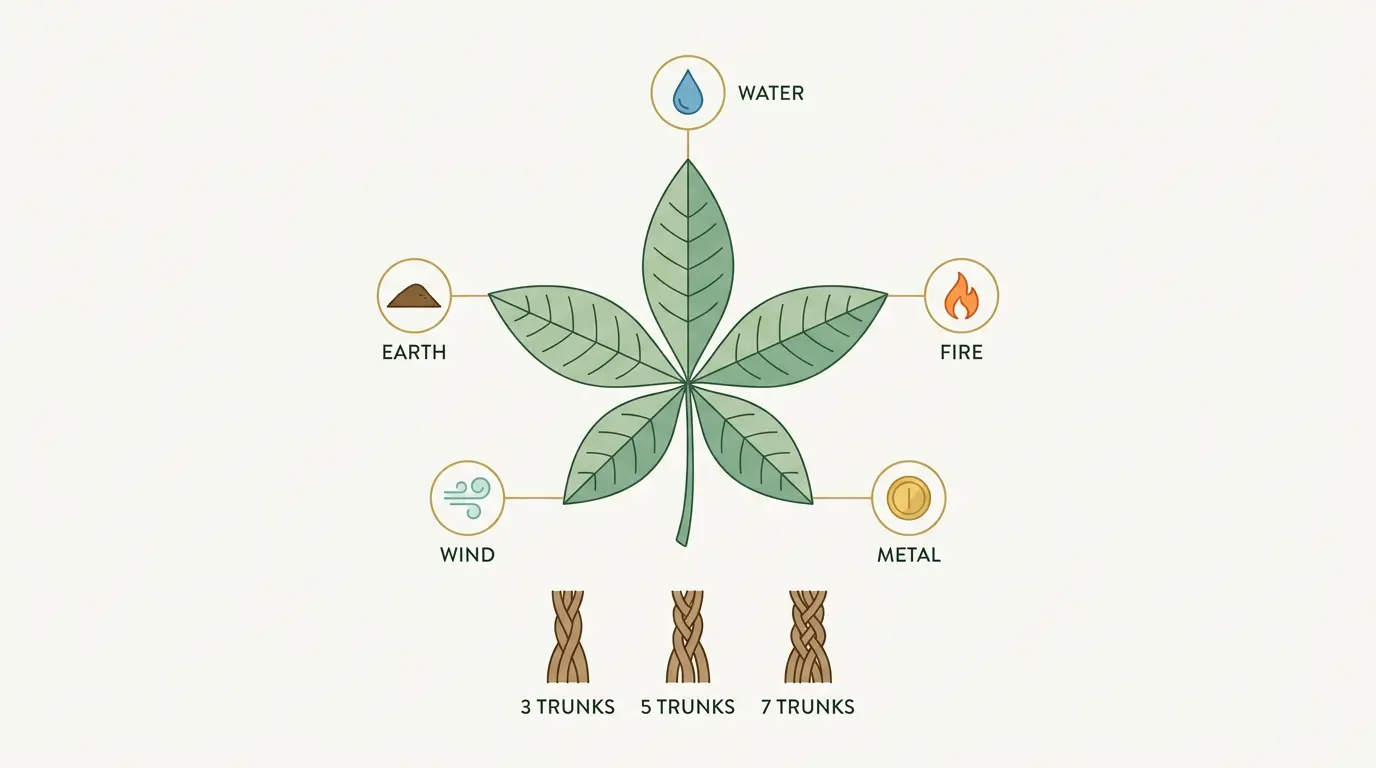
Five green leaves in a cluster are said to represent coins, and they are associated with the Chinese lucky number 5, which links to the five elements of feng shui. The New York Botanical Garden puts it plainly: in rare cases, plants produce stalks with seven leaves — considered a sign of immense good fortune.
If you find a seven-leaf stalk on your plant, tradition says leave it alone. Do not prune it, do not “even out” the canopy around it. It is the botanical equivalent of a four-leaf clover.
What Do the Number of Trunks Mean?
Trunk count carries its own reading, and braiders choose the number deliberately:
| Trunks | Traditional meaning | Commonly given for |
|---|---|---|
| 3 trunks | Happiness, wealth, longevity | Housewarmings |
| 5 trunks | The five blessings and five elements | New businesses |
| 7 trunks | All-round good luck | Rare, highly prized |
Four trunks is the one arrangement you will rarely see, because the number four sounds like the word for death in several Chinese dialects. Reputable growers avoid it.
The Tibetan Layer Most Guides Miss
Here is where our perspective differs from the standard plant-blog account. In Tibetan Buddhism, wealth is not attracted by an object — it is associated with Dzambhala (also written Jambhala), the wealth deity of the Jewel Family, often described as an emanation of Chenrezig. Practitioners recite his mantra, one common transliteration being Om Dzambhala Dzalim Dzaye Svaha, and the emphasis falls on generosity rather than accumulation.
We mention this because it reframes the money tree honestly. In the Tibetan traditions our artisan partners work within, a wealth object is a reminder of intention, not a machine that produces cash. That distinction is the difference between a practice and a superstition. If you want the full wealth-corner picture, our guide to what to place in the feng shui money corner covers the objects traditionally paired with it.
⚠️ Important Note: The wealth, luck, and energy properties described here are traditional beliefs drawn from feng shui and Tibetan Buddhist practice. They are not scientifically established, and no plant or object can be shown to change your finances. Treat this as cultural and decorative guidance, not financial advice.
Where to Place a Money Tree for Good Feng Shui
Place a money tree in the southeast wealth corner of your home — the far back-left area from your front door — where it also receives the bright, indirect light it needs to thrive. In the popular Bagua method, that southeast position corresponds to Xun, the trigram associated with wealth and abundance.
Two methods are in circulation, and they sometimes disagree. The compass method uses true southeast. The door method (BTB) overlays a nine-square grid on your floor plan with the entrance at the bottom, making the far back-left square your wealth area. Worth knowing: classical practitioners consider the fixed southeast wealth corner a Western simplification rather than orthodox Flying Star practice. Either method is a reasonable starting point — just pick one and stay consistent.
Good positions, in rough order of preference:
- Southeast corner of the living room — the classic wealth position, usually with workable light.
- Left side of a desk (as you sit) — the office equivalent of the wealth corner.
- Near an entryway, but off to the side — welcomes chi without blocking it.
- An east-facing room — associated with growth and family.
To pair the plant with a crystal in the same sector, our monk-blessed citrine wealth crystal is sized for exactly this placement, and the 2026 wealth sector guide maps the annual shifts.
Can a Money Tree Go in the Bedroom?
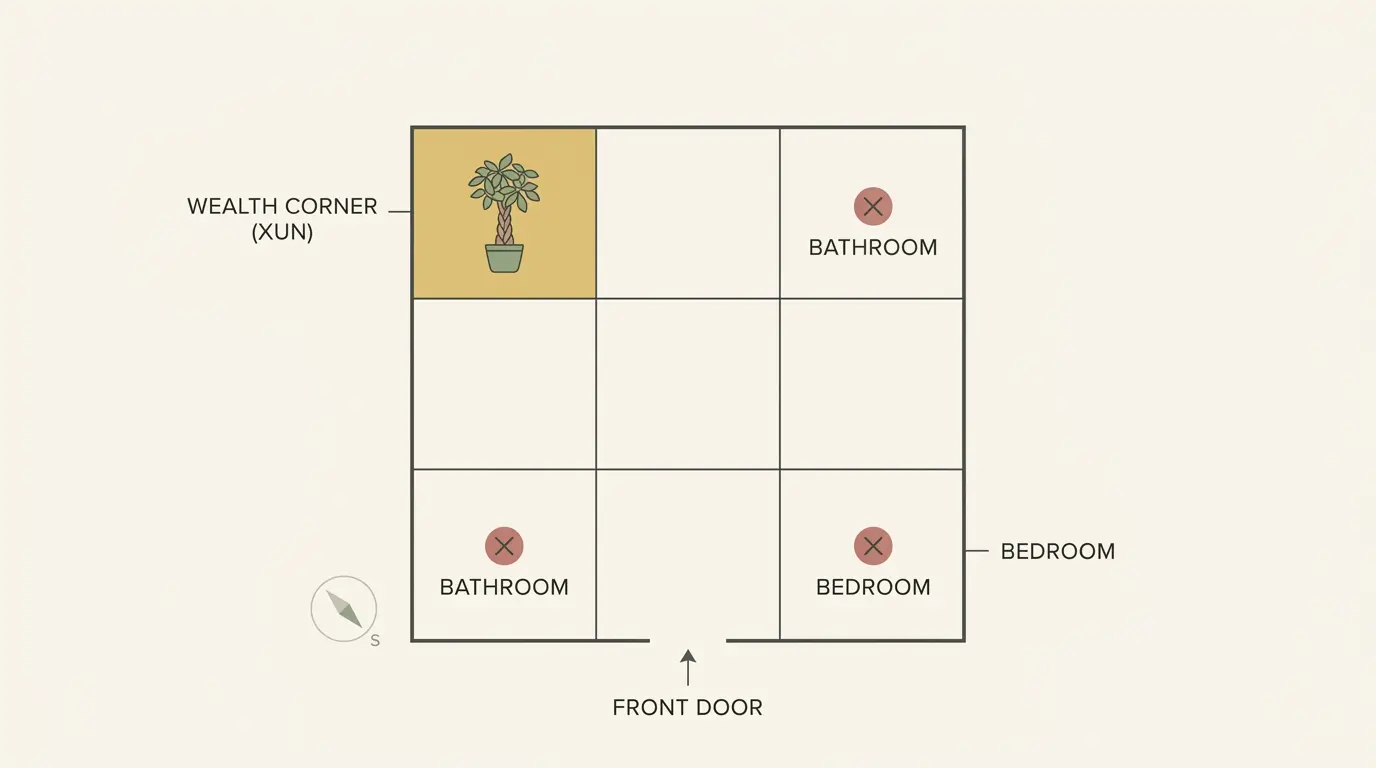
Traditionally, no. The money tree’s energy is considered active and upward-moving — useful in a living room or office, too stimulating for a room meant for rest. Feng shui practitioners generally steer wealth plants away from bedrooms and out of bathrooms entirely, where drains are said to carry prosperity away.
That said, we would rather you keep a thriving plant in a technically imperfect spot than a dying one in the perfect corner. A healthy plant is considered auspicious in every tradition we know of.
How to Care for a Money Tree: Light, Water, Humidity & Soil
Water a money tree only when the top 2–3 inches of soil feel dry — usually every 1–2 weeks — and give it bright, indirect light, around 50–60% humidity, and temperatures of 65–75°F. Get those four right and the plant is genuinely low-maintenance.
| Requirement | Target | Notes |
|---|---|---|
| Light | Bright, indirect | Direct sun scorches leaves; rotate quarterly for even growth |
| Water | When top 2–3 in. dry | Roughly every 1–2 weeks; never leave it in standing water |
| Humidity | Around 50–60% | Pebble tray or grouping plants works fine |
| Temperature | 65–75°F | Bring indoors below 50°F; keep away from drafts and vents |
| Soil | Well-draining mix | Wetland native, but pots must drain freely |
| Repotting | Every 2–3 years, in spring | Per New York Botanical Garden guidance |
| Fertilizer | Monthly, spring–summer | Liquid houseplant feed diluted to half strength |
The Old Farmer’s Almanac puts the ideal range at 65 to 75°F, which is simply ordinary household temperature — one reason the plant travels so well as a gift. Epic Gardening reports cold-hardiness down to about 45°F, though most sources treat 50°F as the practical floor.
How Often Should You Water a Money Tree?
Every 1–2 weeks is a rough guide, not a rule. Test with your finger instead: push it 2–3 inches into the soil, and water only if it comes out dry. Then water thoroughly until it drains from the bottom, and empty the saucer.
In our experience, the finger test is the single habit that separates money trees that live for years from money trees that die by March. Calendar watering ignores the season — the same plant that drinks weekly in July may want water every three weeks in January.
💡 One correction worth making: The wetland origin story fools people. Because Pachira aquatica grows in swamps, it seems like it should love standing water. In a pot it does not — wild specimens sit in moving water with oxygenated roots, while a saucer of stagnant water suffocates them. Wet in nature, well-drained in a pot.
Why Are My Money Tree Leaves Turning Yellow?
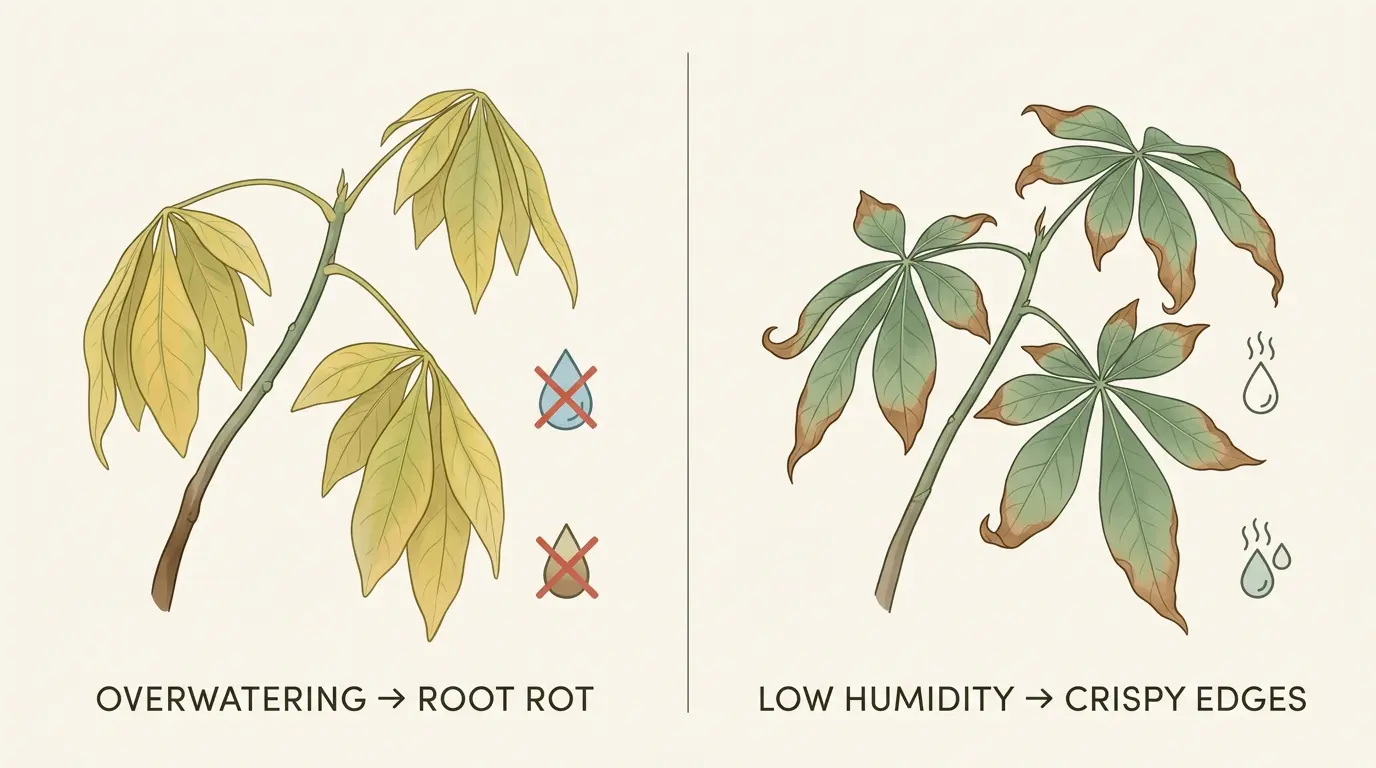
Yellow leaves on a money tree are most often a sign of overwatering and the root rot it causes — let the top 2–3 inches of soil dry out fully before watering again. Before you do anything drastic, read the pattern, because different symptoms point to different causes.
- Yellow, soft, drooping leaves: Overwatering. Stop watering, check that the pot drains, and let the soil dry down properly.
- Brown, crispy leaf edges: Low humidity. Add a pebble tray or move it away from a heating vent.
- Yellow leaves plus a sour smell: Root rot. Unpot it, trim any black mushy roots, and repot in fresh, well-draining mix.
- Pale, stretched growth: Not enough light. Move it closer to a bright window.
- Fine webbing or white cottony spots: Spider mites or mealybugs. Wipe the leaves and treat with insecticidal soap.
Losing a few lower leaves after you bring a plant home is normal — that is acclimation, not failure. If you are watching yours yellow right now and worrying you have ruined it, you probably have not. Money trees are forgiving once the water stops.
Is a Money Tree Toxic to Cats and Dogs?
No. The ASPCA lists the money tree (Pachira aquatica) as non-toxic to dogs, cats, and horses, with no toxic principles. A pet that chews the leaves may get nausea, vomiting, or loose stool — the same as eating any plant material — but it is not poisonous.
This is worth checking carefully if you have pets, because the plants people confuse with money trees are not all safe. The jade plant (Crassula ovata), often called a money plant, is listed by the ASPCA as toxic to cats and dogs.
What Does It Mean When a Money Tree Dies?
It means the plant had a care problem — almost always water. There is no tradition we are aware of that treats a dead money tree as a financial omen, and we would be skeptical of anyone selling that idea.
Feng shui practice is practical here: a wilting plant is considered stagnant energy, so you replace it. Compost it, thank it, get another one. That is the whole ritual.
How to Activate a Money Tree — and What to Give as a Gift
To activate a money tree in feng shui, place it in your wealth corner, tie three Chinese coins with a red ribbon to the trunk, and set a clear intention as you position it. The whole thing takes about five minutes.
- Clean the space first (2 minutes): Clear clutter from the corner. Stagnant clutter is said to block chi before any object can help.
- Position the plant (1 minute): Southeast corner or far back-left from your entrance, in bright indirect light.
- Add the coins (1 minute): Three, six, or nine Chinese coins on a red ribbon, tied to the trunk. Nine is considered strongest.
- Set the intention (1 minute): Name something specific — a debt cleared, a business launched. Vagueness is the enemy here.
- Maintain it (ongoing): Dust the leaves, prune dead growth. Neglect is the one thing every school agrees undoes the placement.
Money Tree vs. Money Plant: Are They the Same?
No — three different plants share the nickname, and only one is the feng shui money tree:
| Common name | Species | Pet-safe? |
|---|---|---|
| Money tree | Pachira aquatica (Malvaceae) | Yes (ASPCA) |
| Jade plant | Crassula ovata (Crassulaceae) | No — toxic |
| Chinese money plant | Pilea peperomioides (Urticaceae) | Yes |
Giving One as a Gift
Money trees are traditional gifts for housewarmings, new businesses, and Lunar New Year. Two rules of thumb: never give a wilting plant, and match the trunk count to the occasion — three for a new home, five for a new venture.
If your recipient travels constantly or has no decent light, a living plant is a burden dressed as a gift. That is where a crystal alternative makes more sense: our citrine money tree carries the same five-element tree structure and needs no watering.
Anchor Your Wealth Corner
Browse PotalaStore’s citrine money trees, wealth crystals, and prosperity pieces — sourced through our Tibetan and Himalayan artisan partners, and made to sit exactly where the Bagua says they belong.Shop Attract Wealth →
Frequently Asked Questions
Yes — the money tree (Pachira aquatica) is among the most popular feng shui wealth plants, because its five leaflets are linked to the five elements and its braided trunk is believed to hold fortune in place. A healthy, thriving plant is considered the most auspicious version of all.
Traditionally it is discouraged, since the money tree’s active, upward energy is thought too stimulating for a room meant for rest. If you love it there, keep it set back from the bed and keep it healthy — vitality matters more than position.
Place it in your southeast wealth corner, tie three, six, or nine Chinese coins with a red ribbon to the trunk, and set a specific intention. Many practitioners pair it with citrine to reinforce that intention.
Living Pachira aquatica is available from most plant nurseries. For a maintenance-free symbolic option, explore PotalaStore’s citrine wealth pieces and how to use them — each is sourced through our Tibetan artisan partners, and the brand contributes a portion of every order to monastery and artisan communities.
📚 References
- Money Tree Origin & Leaf Symbolism: Confirms the 1980s Taiwan braiding origin, the five-leaf/five-element association, and the rare seven-leaf stalk. New York Botanical Garden
- Pachira aquatica Cultural Requirements: Authoritative entry on hardiness zones, moisture needs, light, and native range. Missouri Botanical Garden Plant Finder
- Pet Safety: Lists the money tree as non-toxic to dogs, cats, and horses, with clinical signs if ingested. ASPCA Animal Poison Control
- Taxonomy & Native Habitat: University-level profile covering the Malvaceae family, swamp habitat, and the botanical number-five pattern. University of Arizona Campus Arboretum