
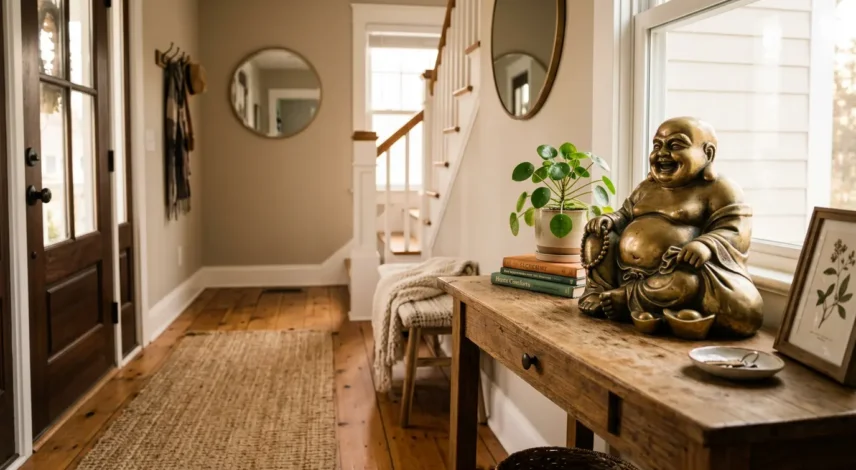

Place your Laughing Buddha diagonally across from your front door, at eye level on a table about 30 inches (76 cm) high, with his face turned into the room rather than out toward the street. If that spot isn’t available, the southeast corner of your home — the wealth sector of the Bagua map — is the next best position for prosperity and luck.
That’s the short answer. But most placement guides skip the part that makes the rest make sense: the round, grinning figure in your living room isn’t Siddhartha Gautama. He’s Budai, a 10th-century Chinese Chan monk whose money bag, bare belly, and open laugh each carry a specific meaning — and those meanings are what determine where the statue belongs.
At Potala Store, we source statues directly through artisan families and monastery partnerships, including Sera Jhe Monastery in South India and Kopan Monastery in Nepal. Our founder, Yang Tso, grew up around these figures rather than around a compass and a Bagua chart. That’s the perspective this guide is written from: what the symbolism actually says, what the feng shui consensus actually specifies in inches and directions, and where we’ve seen people get it wrong — including in our own studio.
⚠️ Important note: Feng shui and Vastu placement traditions are cultural belief systems, not scientifically verified methods for changing your finances. This guide explains what these traditions hold and why, so you can display your statue knowledgeably and respectfully. It isn’t financial advice.
Table of Contents
Where Should You Place a Laughing Buddha at Home?
The four positions traditionally considered most auspicious are the entryway, the southeast wealth corner, the living room, and a work desk — always above waist height and never on the floor. Here they are in priority order:
- Diagonally across from the main entrance: On a console or side table roughly 30 inches (76 cm) high, facing into the home.
- The southeast corner: The Bagua wealth sector, ideally paired with a money-bag or ingot pose.
- The living room: At eye level where guests naturally see him first.
- A desk or shop counter: Positioned to face you or the customer, not the wall.
The Entryway: Diagonally Across From the Front Door
The entry position works because of what the tradition calls chi — the flow of energy entering through your main door. The statue is placed to meet that energy and turn it inward rather than let it pass straight through. A table of about 30 to 35 inches puts him at or slightly above the eye level of a seated adult, which is the height most feng shui consultants specify.
Here’s where we got it wrong ourselves. When we first set up a Budai figure in our studio, we used a low console — around 18 inches — right beside the door. It looked good. It also broke the only rule that matters at an entrance: he sat below eye level, so every visitor’s gaze skated over him to the coat rack behind. Raising him about a foot changed how the whole entry read. Height isn’t decoration here; it’s the entire point of the position.
One honest limitation: in a lot of American apartments, the front door opens onto a wall or a narrow hallway, and there is no diagonal. Don’t force it. Move to the southeast corner instead — it’s a stronger placement than a cramped entry compromise.
The Southeast Corner: The Bagua Wealth Sector
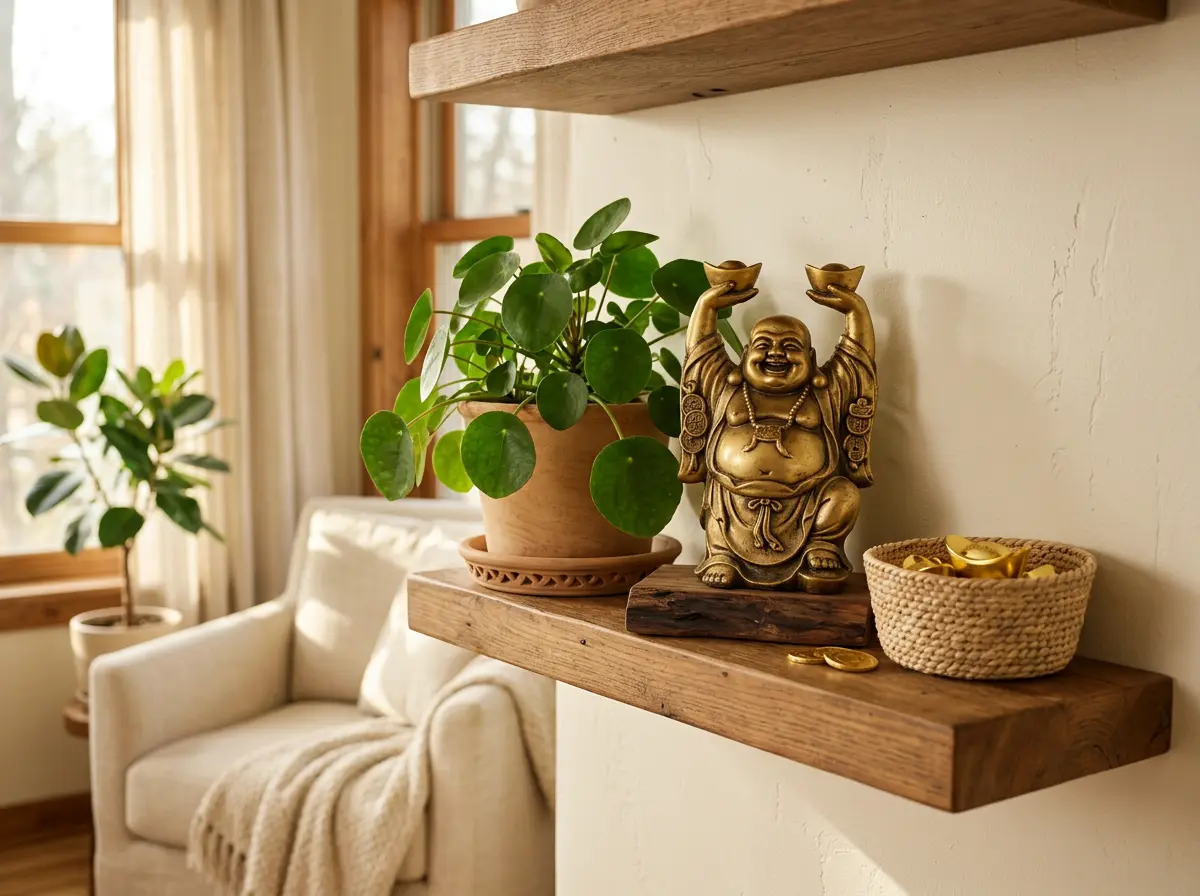
Southeast is the wealth corner in the Bagua map — the Xun sector — and it’s the most direct placement for prosperity symbolism. To locate it, stand at your front door facing in; the far back-left corner of the floor plan is the classic wealth corner. East governs family and health, and North governs career, which is why the same statue can be aimed at different goals depending on the wall you choose.
This corner does more work when it isn’t working alone. Our guide to the feng shui money corner and what belongs there covers how a wealth-sector statue pairs with wood-element objects and living plants, and why clutter in that corner undoes everything else you place in it.
The Living Room, the Office Desk, and the Shop Counter
In a living room, the statue belongs on a shelf, mantel, or cabinet at eye level — visible from the seating area, not tucked behind a lamp. On a desk, the traditional position is facing you as you work, or angled toward the door of the office. In a shop, he faces the customer, which is the same logic as the entryway scaled down: he greets what’s coming in.
The key takeaway across all four spots: elevation and line of sight matter more than the exact compass reading. A statue at eye level in the wrong sector is treated as better placed than one on the floor in the right one.
What Direction Should Budai Face in a Home?
Budai should face inward — into the room and toward the people using it — not outward at the street. This is where a lot of online advice contradicts itself. “Face the main door” is usually shorthand for “be visible from the main door and look back into the house.” A statue turned to stare out the doorway is understood, in the tradition, as sending energy away from the home rather than gathering it.
The specific compass directions map to specific goals:
- Southeast: Wealth and abundance — the Xun sector of the Bagua.
- East: Family harmony and health.
- North: Career progress and opportunity.
- Facing inward from the entry: General luck and welcome — the all-purpose default.
If you want to rub the belly — a folk custom, not a monastic one — choose a statue around 2 to 3 feet (24–36 inches) tall. Anything smaller gets knocked over, and anything much larger stops being a domestic object.
Who Was the Monk Behind the Money Bag?
He was a real person: a wandering Chan monk named Qieci, from Fenghua in Zhejiang province, who lived during China’s Later Liang dynasty (907–923 CE). He carried a cloth sack everywhere — Budai literally means “cloth sack” — and gave away whatever was in it. He was known for laughing, for sleeping outdoors, and for being kind to children.
According to tradition, he left a short death poem dated March 28, 917, identifying himself as an incarnation of Maitreya, the Buddha yet to come. That’s the theological claim behind every Laughing Buddha ever cast: he isn’t the Buddha of the past, he’s a folk-remembered glimpse of the Buddha of the future. In Japan he became Hotei, one of the Seven Lucky Gods.
Why this matters for placement: the money bag isn’t a wealth trophy. In the story it’s the sack of a man who owned nothing and handed out everything. When the tradition says to put him where he collects worries and gathers abundance, it’s drawing on a monk who was celebrated for generosity, not accumulation. Knowing that tends to change where people want to put him — and it’s the piece almost every placement article leaves out. If you want the fuller picture of respectful display, our Buddha statue FAQ on placement, materials, and cultural respect goes deeper on the etiquette.
Which Statue Pose Is Good for Attracting Money?
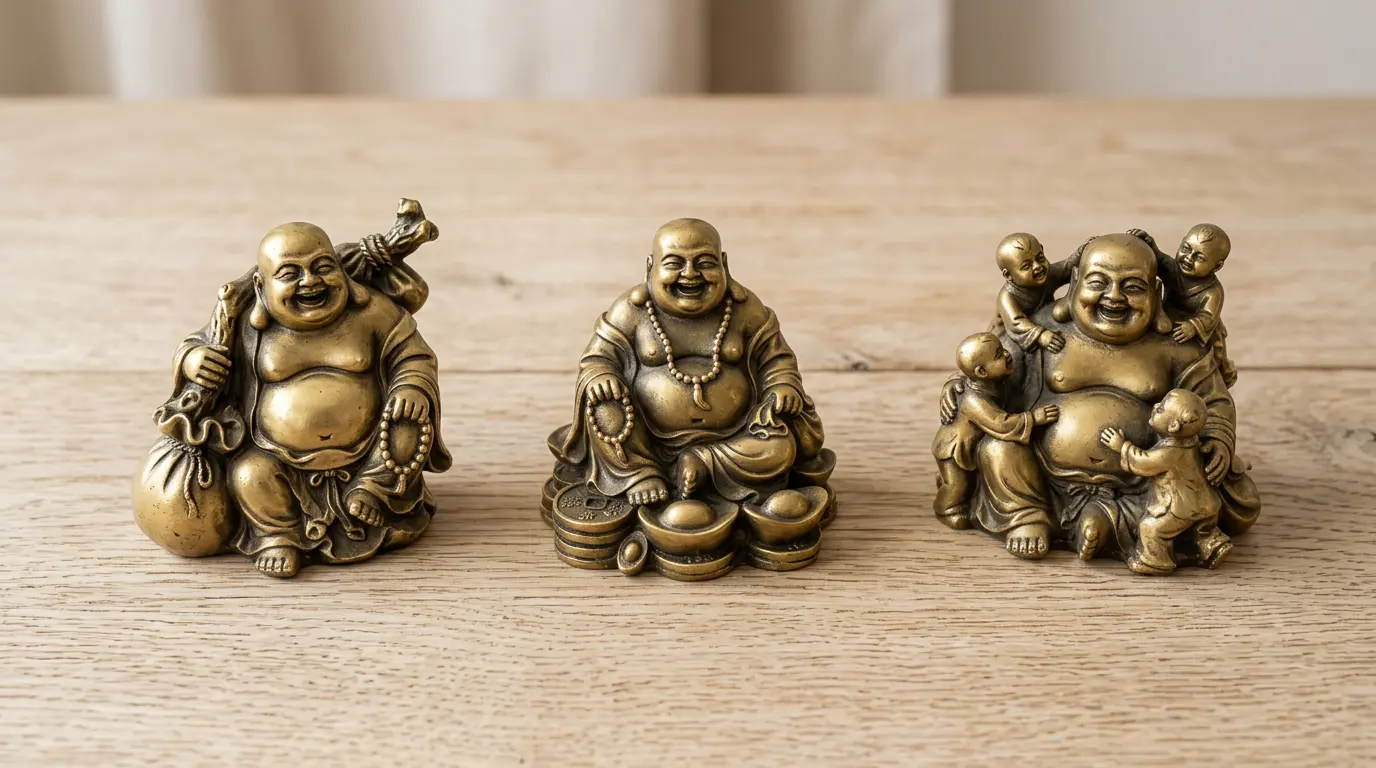
Each pose carries its own meaning and its own best position:
| Pose / Object | What It Represents | Best Room | Best Direction |
|---|---|---|---|
| Money bag (sack) | Collects worries, gathers abundance | Entryway | Facing inward from the door |
| Gold ingots or coins | Accumulated wealth, steady income | Home office | Southeast |
| Children (usually five) | Family harmony, descendants | Living room, kids’ room | East |
| Fan (oogi) | Sweeps away trouble, grants wishes | Any room needing calm | No fixed direction |
| Wu lou gourd | Health and long life | Bedroom-adjacent hallway | East |
| Beads or pearl | Wisdom, meditative focus | Study or reading nook | No fixed direction |
| Dragon tortoise / Ru Yi | Career support and authority | Behind your desk chair | North |
For money specifically, the money bag and ingot poses are the two the tradition points to. The money bag belongs at the entry, where it “receives”; the ingots belong in the southeast, where they “hold.”
Where You Should Never Keep the Statue: 6 Spots to Avoid
Avoid these six placements, which the tradition treats as either inauspicious or plainly disrespectful:
- The bathroom: Associated with drainage — energy, and by extension money, leaving the home.
- The kitchen: Heat, smoke, and food waste are considered incompatible with a sacred figure.
- The bedroom: A devotional image is traditionally kept out of a private, intimate space.
- The floor: The most common mistake we see. A figure at ground level receives the household’s foot traffic — never place him lower than waist height.
- Facing out a door or window: Read as sending energy away from the house rather than gathering it inward.
- Beside the TV, router, or a cluttered surface: Noise and clutter are held to scatter the calm the figure is meant to hold.
Also worth saying plainly: a shoe rack, the space under a staircase, and the top of a trash bin are all places we’ve seen small resin Budais end up. If a spot in your home would feel wrong for a photograph of someone you love, it’s the wrong spot for this too.
How to Choose Your Own Laughing Buddha Statue
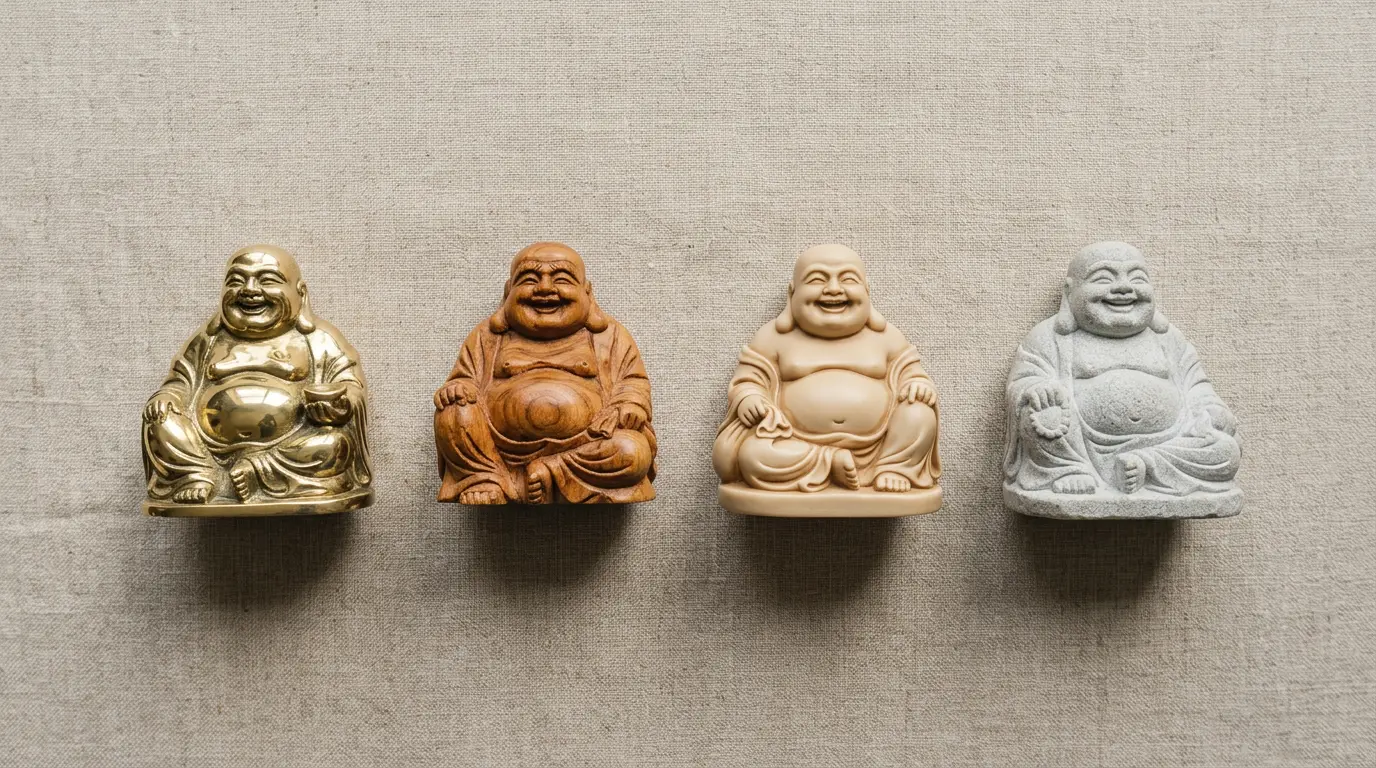
Match the material to the room, the size to the surface, and the pose to your goal — in that order. In the US market, small resin figures typically run $10–$30, solid brass or bronze pieces $25–$90, and hand-carved stone or art glass considerably more. Brass suits a formal entry, wood and stone read warmer in a living room, and resin is the practical choice if you have toddlers or cats and need something you won’t mourn.
If you’re buying this as a housewarming or new-business gift, one thing is worth knowing before you wrap it: a gifted Laughing Buddha is traditionally considered luckier than one bought for yourself, but the same tradition asks that it not be handed over casually. Include a line about who Budai actually was. It turns an ornament into something the recipient can place with intention — and it’s the difference between a gift that lands on a shelf and one that lands in the right corner.
💡 A note on figures we do and don’t carry: Budai and Shakyamuni are different figures with different placements. Our hand-carved green sandstone Tibetan Meditation Buddha ($42.95 USD) is Shakyamuni in meditation — he belongs in a quiet corner or a practice space, not by the front door doing prosperity work. If you’re setting up both a wealth corner and a meditation corner, they’re two different jobs. Our guide to choosing a Buddha statue by size, material, pose, and purpose walks through how to tell them apart.
Whatever you choose, clean the surface before you set the statue down, and keep the area around him uncluttered. In our experience, that habit does more for how a wealth corner feels than any compass reading — and it’s the one part of this entire tradition that everyone, believer or not, tends to agree is worth doing.
Bring a Hand-Carved Buddha Into Your Home
Every statue in our collection is sourced through artisan families and monastery partnerships in Nepal, India, and Tibet — not a factory catalog. Free worldwide shipping.Shop Buddha Statues →
Frequently Asked Questions
Traditionally, no. Feng shui and Vastu both treat the bedroom as a private, intimate space where a devotional figure doesn’t belong. If your studio apartment leaves no alternative, place him on a high shelf facing the room, not the bed, and keep the surface clear.
No. Siddhartha Gautama — the historical Buddha — is depicted slim, calm-faced, and in monastic robes. The Laughing Buddha is Budai, a separate Chinese folk figure from roughly 1,400 years later, understood as an incarnation of Maitreya, the future Buddha.
His personal name was Qieci, and he came from Fenghua in Zhejiang, China. “Budai” is a nickname meaning “cloth sack,” after the bag he carried. In Japan he’s known as Hotei, one of the Seven Lucky Gods.
A seated figure with gold ingots or a dragon tortoise, placed on your desk facing you or angled toward the door — north-facing if your layout allows, since north governs career. Keep him at or above eye level when you’re seated, using the same height rule that applies at an entryway.
📚 References
- Hotei and the Seven Gods of Luck: Encyclopedia entry linking the Chinese monk Pu-tai to Maitreya and to the “Laughing Buddha” caricature. Encyclopædia Britannica
- Budai in museum collections: Object notes on a Dehua porcelain Budai, dating him to the 10th century and identifying him with Maitreya. The Metropolitan Museum of Art
- Scholarly background on the figure: Prof. Megan Bryson, a scholar of East Asian Buddhism, explains how Budai differs from the historical Buddha and how his image spread West. University of Tennessee, Department of Religious Studies
- Biographical details: Source for the name Qieci, his origin in Fenghua, the Later Liang dynasty context, and the death note dated March 28, 917. Wikipedia: Budai