
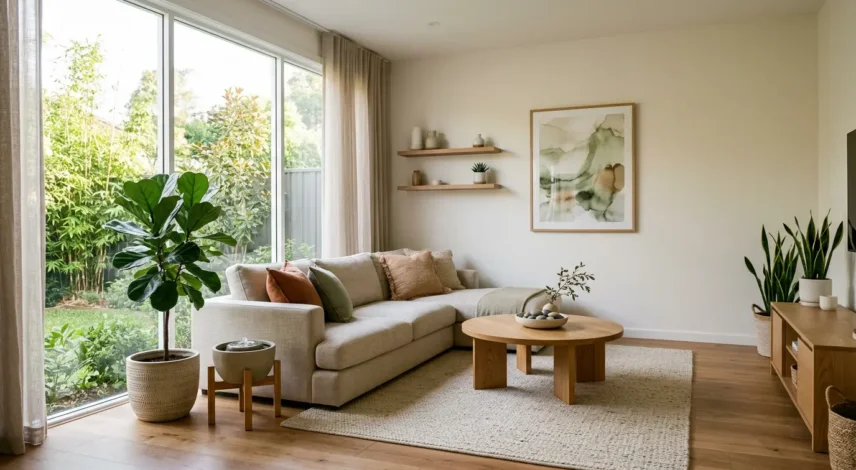

Feng shui for your home is the ancient Chinese practice of arranging your space so that chi, the flow of life energy, moves freely and leaves each room feeling balanced and calm. You do not need to remodel, spend a fortune, or believe in anything supernatural to feel the difference. You need a few core ideas and a willingness to move some furniture.
This guide walks through the five pillars beginners actually ask about: chi and energy flow, the five elements, the bagua map, the commanding position, and simple room-by-room shifts. At PotalaStore, we have spent years working with Tibetan monasteries such as Sera Jhe and Kopan, and that work taught us where feng shui creates real change and where it gets oversold. You will get the honest version, starting with the basics and ending with what to skip.
Table of Contents
What Is Feng Shui, and Does It Actually Work?
Feng shui is the ancient Chinese art of arranging your home so that chi, the flow of life energy, moves freely, creating a space that feels balanced, calm, and supportive. The name translates directly to “wind” (feng) and “water” (shui), the two natural forces that shape how energy travels through any environment. The practice is rooted in Taoist philosophy and developed in China over roughly 3,000 to 6,000 years.
The goal is simple to state and satisfying to apply: help good energy circulate through your home the way fresh air and clean water move through a healthy landscape.
The Meaning of “Wind and Water” (Chi and Qi)
Chi (also spelled qi) is the life energy that feng shui believes flows through every room, and the whole practice exists to keep that energy flow smooth instead of blocked or stagnant. Wind carries energy in, water gathers and holds it, so a home with clear pathways and fresh air is thought to support a clearer, calmer you. When furniture crowds a doorway or clutter piles up in a corner, practitioners say the chi slows down and the space starts to feel heavy.
Does Feng Shui Really Work? What Modern Research Suggests
You do not have to take feng shui on faith to benefit from it, because much of what it recommends lines up with environmental psychology. Researchers at the Princeton Neuroscience Institute found that visual clutter competes for your brain’s attention and makes it harder to focus, which mirrors the feng shui rule to clear clutter first. Natural light supports your circadian rhythm and mood, and an ordered room signals safety and lowers stress. None of this proves the metaphysical claims, but it does explain why a well arranged home genuinely feels better to live in.
The Five Elements, Your Home’s Energy Building Blocks
Feng shui works with five elements, wood, fire, earth, metal, and water, and each one carries a distinct energy you can add to a room through color, material, or shape. Balancing these five is the heart of feng shui decorating, and you rarely need more than small touches to shift the feeling of a space.
How the Productive and Destructive Cycles Work
The five elements interact in two cycles. In the productive cycle, wood feeds fire, fire creates earth (ash), earth yields metal, metal holds water, and water grows wood. In the controlling cycle, each element also keeps another in check, so water calms fire and metal cuts wood. The point is not to load a room with one element but to keep the five in balance. If a space feels cold and lifeless, a little fire (a few red accents) or wood (a healthy plant) often brings it back.
Element-and-Color Cheat Sheet for Every Room
Use this table to add whichever energy a room is missing:
| Element | Colors | Add it with | Energy it invites | Best for |
|---|---|---|---|---|
| Wood | Green, teal | Live plants, wooden furniture | Growth, fresh starts | Home office, entryway |
| Fire | Red, orange | Candles, warm-toned decor | Passion, recognition | Living and dining rooms |
| Earth | Yellow, brown | Ceramics, stones, crystals | Stability, grounding | Bedroom, home’s center |
| Metal | White, gray, metallic | Round mirrors, metal frames | Clarity, focus | Study, workspace |
| Water | Black, deep blue | Fountains, glass, mirrors | Flow, wisdom | Entryway, career area |
Crystals and natural stones are one of the easiest ways to bring in grounding earth energy. Our range of feng shui crystals for the five elements covers the stones most often used to balance a room.
Mapping Your Home with the Bagua (The Nine Life Areas)
The bagua is a nine-square energy map you lay over your home’s floor plan to see which area governs which part of your life, from wealth and relationships to career and health. Think of it as a lens that turns your layout into a map of what you want to grow.
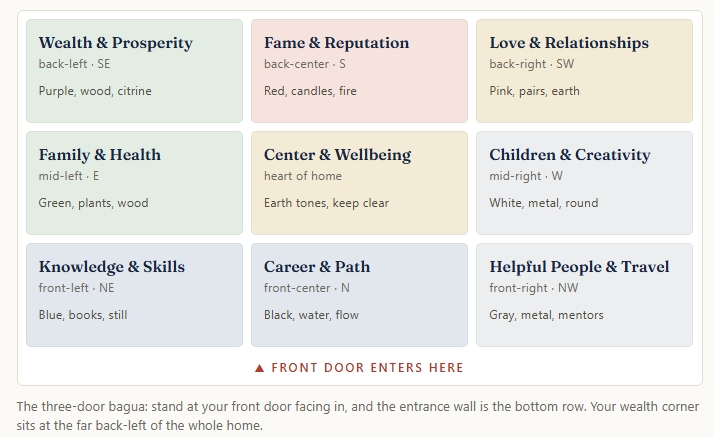
How to Lay the Bagua Over Your Floor Plan (The Easy Door Method)
The beginner-friendly way to use the bagua is the three-door method: stand in your front doorway facing into your home, and picture a three-by-three grid stretched over the floor plan. The wall with your front door becomes the bottom row, which always holds Knowledge, Career, and Helpful People. From there, the far back-left is Wealth, the far back-right is Love, and the center is left open for balance. A printed bagua map for your home makes this far easier than eyeballing it. Classical Compass School feng shui instead pins each area to a fixed direction, and that approach also shifts each year, which we cover in our 2026 Flying Star chart for your home.
Activating Your Wealth and Relationship Corners
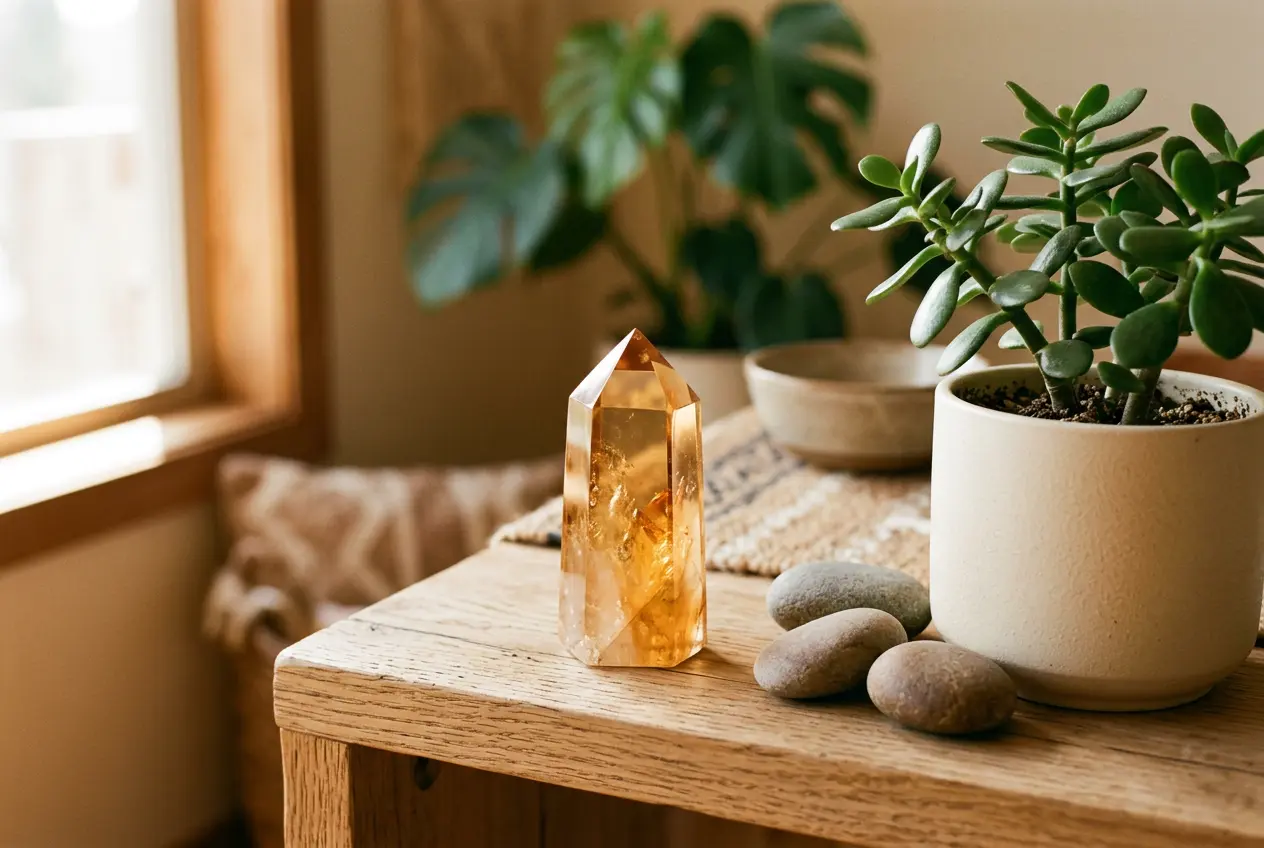
Once you find your wealth corner (far back-left in the door method, the southeast in the compass system), you activate it with wood and purple tones, a healthy plant, or a classic prosperity stone. Citrine is the stone most tied to wealth in feng shui, and a piece like a natural citrine wealth tower gives the corner a clear focal point that keeps your intention visible every day. The relationship corner sits diagonally opposite in the back-right, which classical feng shui places in the southwest, an earth-element sector. Anchor it with pairs of objects, soft pink or earthy tones, and rose quartz to invite warmth and connection.
The Commanding Position, Where to Place Your Bed, Desk, and Stove
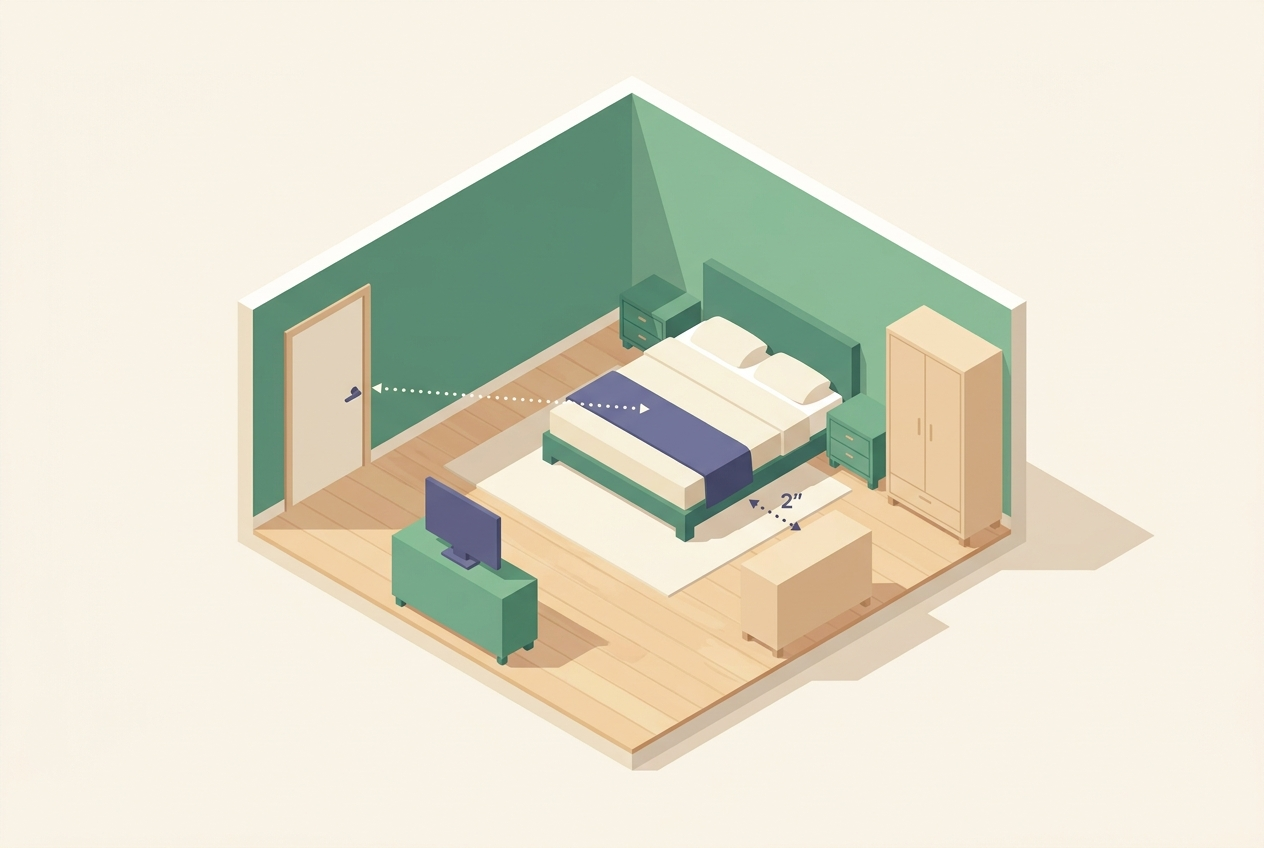
The commanding position means placing your bed, desk, and stove so you can see the room’s door without being directly in line with it, ideally set diagonally with a solid wall behind you. The door is called the “mouth of chi” because it is where energy enters, so you want to face that flow of energy from the front door and each room’s entrance, not have your back to it.
Placing Your Bed, Desk, and Stove
These three objects matter most because they map to how you rest, how you work, and how you are nourished. Your bed governs rest, so place it against a solid wall with a headboard and leave at least 2 feet of walking space on both sides. Your desk governs your career and focus, so it belongs in the command position too, facing the door. Your stove represents wealth and nourishment in feng shui, so keep it clean, in working order, and positioned so you are not startled from behind while cooking. The same command-position logic applies at work, which we break down in our guide to feng shui for your office desk.
What to Do When the Ideal Layout Isn’t Possible
If your layout makes the commanding position impossible, that is completely normal, especially in a rental or a small apartment. The simplest fix is a mirror placed so you can see the door’s reflection from your bed or desk, which restores that sense of oversight without moving a wall. You do not need to drill, repaint, or break your lease. Most of feng shui’s highest-impact changes are fully renter-friendly, and a well-placed mirror or a rearranged desk often does the job.
Room-by-Room, Simple Shifts That Make a Difference
You do not need to move a single wall to start, because small shifts to your entryway, bedroom, kitchen, and bathroom change how your whole home feels. Start with one room, notice what changes, and move on when you are ready.
The Entryway and Front Door (Your Home’s “Mouth of Chi”)
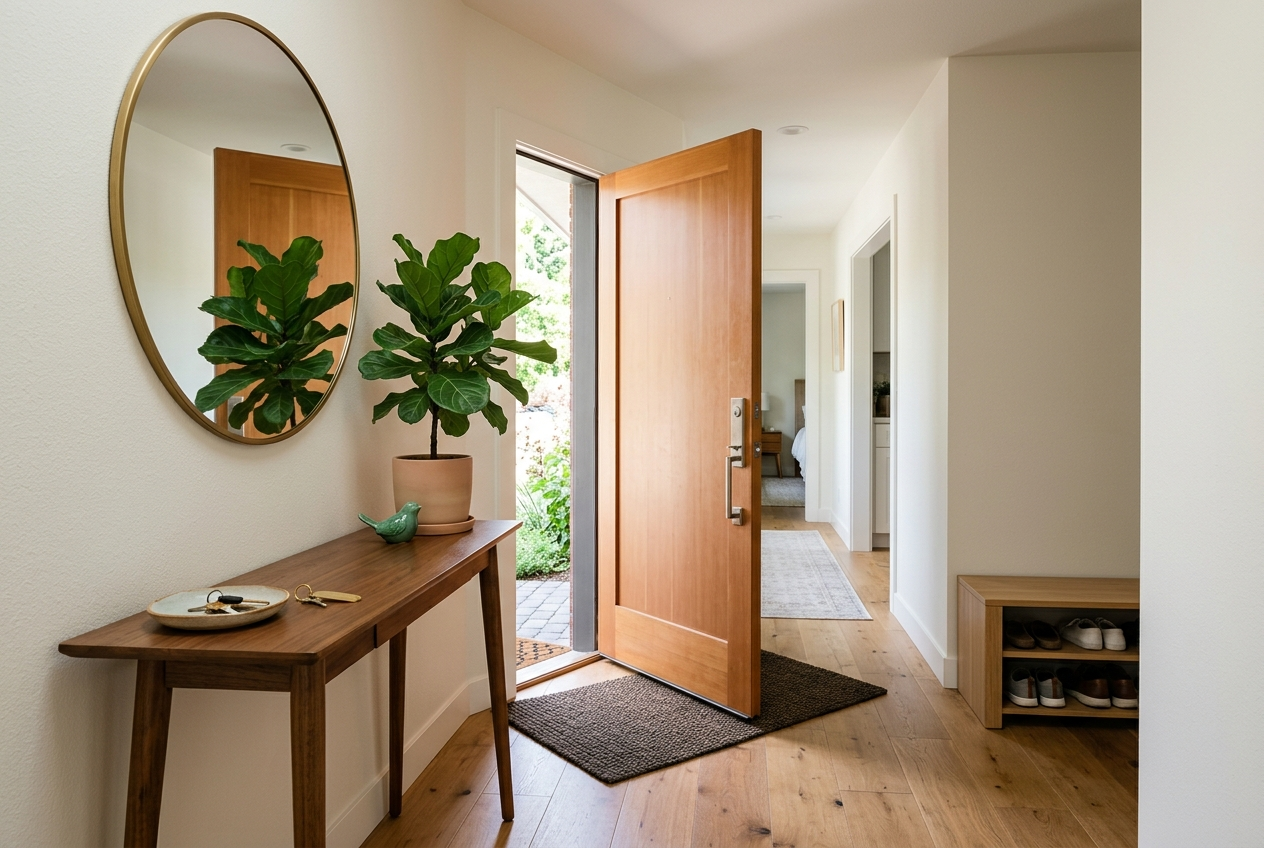
Your entryway sets the tone for every guest and for you, so keep it clear, well lit, and welcoming. Clear away the pile of shoes, bags, and mail that gathers by the door, because that clutter is exactly what feng shui says blocks incoming chi. Add bright, warm lighting and a clean welcome mat, and make sure the door can open fully without hitting anything. A tidy, open entrance is the single easiest feng shui upgrade you can make today.
Bedroom, Kitchen, Bathroom, and Living Room Essentials
Each room has one or two shifts that carry most of the benefit:
- Bedroom: Put the bed in the command position, add a solid headboard, and keep matching nightstands on both sides for balance and rest.
- Kitchen: Treat the stove as your wealth center. Keep it clean and repair any broken burners, since broken appliances are said to signal stalled resources.
- Bathroom: Because water drains here, energy is thought to leave the home, so keep the door closed and the toilet lid down to hold good energy in.
- Living room: Arrange seating to face inward so people naturally talk, and light the room with several lamps rather than one harsh overhead.
Lighting has a bigger effect than most people expect. For a warm, cohesive glow, choose bulbs rated between 2,700 and 3,000 Kelvin and use a few soft light sources instead of a single bright fixture.
Common Feng Shui Mistakes (and What to Do Instead)
The most common feng shui mistakes are easy to fix: clearing clutter, softening sharp “poison arrow” corners, and placing mirrors thoughtfully will do more for your home’s energy than any object you can buy. Get the basics right before you spend a single dollar on cures.
The Clutter, Poison Arrow, and Mirror Traps
A few habits quietly work against your home’s energy, and each has a straightforward fix:
- Clutter blocks the flow of chi and adds cognitive load, so clear pathways and surfaces first.
- Poison arrows are sharp corners or edges pointed at where you sit or sleep, and you soften them with a plant, a rounded object, or a small screen.
- Mirrors facing the front door are thought to bounce good energy straight back out, so move them to reflect light or a pleasant view instead.
- Broken objects, from a cracked vase to a dead plant, are said to hold you back, so repair them or let them go.
Do You Need Feng Shui Cures? (And How to Choose Authentic Ones)
You do not need to buy anything to practice feng shui, and the biggest mistake is spending on cures before fixing the foundation. If you do choose to use them, the source matters. In traditional practice, an un-consecrated object is primarily decorative, and a formal blessing is what practitioners believe activates it. At PotalaStore, every piece passes through a 3-day puja, the ceremony known in Chinese as kai guang (开光), at Sera Jhe Monastery in Bylakuppe, one of Tibet’s great seats of learning and home to more than 4,500 ordained monks. That consecration means you receive an object carrying a verifiable monastery blessing, not a trinket that spent its life in a warehouse. You can read exactly how these pieces are consecrated before you decide.
A note from our team
When we first started, we assumed a beautiful object was enough. Working alongside the monks at Sera Jhe changed that. The consecration, not the object itself, is what practitioners treat as the activating step, and it is the part most sellers skip entirely. Knowing who did not is worth considering before you buy.
The key takeaway is that feng shui for your home rewards clarity over shopping. Declutter, place your key furniture in the commanding position, balance the five elements, and use the bagua to focus on the corners that matter to you. Add a blessed cure only once the space itself is working, and let it support intentions you have already set.
⚠️ A note on energy claims: The information about chi, the five elements, and energy properties reflects traditional feng shui beliefs and cultural practice, not scientific fact. This guide is for educational purposes and is not medical, psychological, or financial advice.
Bring Balance Into Your Space
Once your home is arranged and clutter-free, explore our collection of authentic, monastery-blessed pieces to support your practice.Shop monastery-blessed feng shui home décor →
Frequently Asked Questions
The five foundations are chi (energy flow), yin and yang (balance), the five elements (wood, fire, earth, metal, and water), the bagua map (your home’s energy layout), and the commanding position (where you place key furniture). Master these and you have covered most of home feng shui.
Declutter first. Clutter blocks the flow of chi, so clearing pathways and surfaces is the single highest-impact change, and it costs nothing. Always fix the basics before buying any cures.
Yes. Most effective feng shui changes need no permanent alterations. Decluttering, rearranging furniture, improving lighting, adding plants, and balancing the five elements are all fully renter-friendly.
Simple shifts like decluttering or clearing your entryway often change how a space feels right away, while rebalancing elements or moving furniture may take a week or two to notice. Start with one room this week, then explore our blessed home décor collection to support your space.
📚 References
- Feng Shui Overview: Background on the practice, its Taoist roots, and core concepts. Encyclopaedia Britannica
- Clutter and Attention: McMains & Kastner, “Interactions of Top-Down and Bottom-Up Mechanisms in Human Visual Cortex,” showing how visual clutter competes for neural focus. Journal of Neuroscience (Princeton Neuroscience Institute)
- The Five Phases (Wuxing): Explanation of wood, fire, earth, metal, and water in Chinese cosmology. Encyclopaedia Britannica
- Daoism and Chinese Cosmology: Cultural and philosophical context for yin-yang and energy in traditional practice. Source: The Metropolitan Museum of Art, Heilbrunn Timeline of Art History (readers may search the museum’s Daoism essays for current resources)