
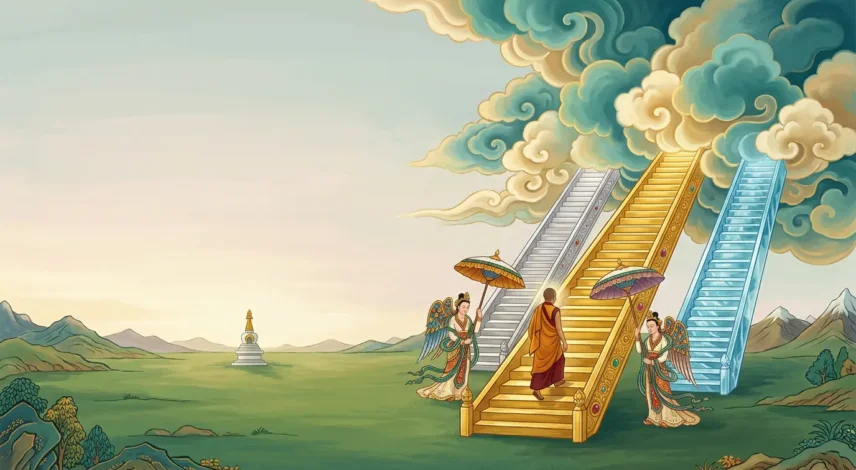

Lhabab Duchen is the Tibetan Buddhist festival that honors the Buddha’s descent from the Heaven of the Thirty-Three. In 2027, it is expected on Saturday, 11/20/2027. This guide gives you the date with U.S. time-zone notes, the story behind Buddha’s Descent Day, what traditions teach about merit, and a 20-minute way to observe it at home.
Online sources disagree on the date and on the famous merit multiplier. We compared Bhutan’s holiday calendar, Tibetan Buddhist center calendars, and teachings from three Dharma organizations. Every number below names its source.
At Potala Store, we carry handmade Buddha statues for a home altar and mala beads for mantra practice, in case you want a focal point for the day.
Date status: provisional. So far, we found 11/20/2027 only on holiday-calendar sites. We will update this page when Tibetan almanacs and Dharma centers publish their 2027 calendars.
Table of Contents
When Is Lhabab Duchen in 2027?
Lhabab Duchen 2027 is expected to fall on Saturday, 11/20/2027, the 22nd day of the ninth month of the Tibetan lunar calendar. Bhutan’s holiday calendar lists this date. We found no published Tibetan almanac or Dharma center calendar for 2027 yet, so treat the date as provisional and confirm it with your Dharma center.
Saturday, 11/20/2027 on the Tibetan Lunar Calendar
The date moves each year because the Tibetan calendar is lunar. From 2026 to 2027, the festival shifts 19 days later on the Gregorian calendar, from Sunday, 11/01/2026 to Saturday, 11/20/2027. A gap that size is consistent with a leap month in the Tibetan year.
While checking sources for this guide, we found that FPMT-affiliated centers and Bhutan’s holiday calendar agree on 11/01/2026. For 2027, we found a date only on holiday-calendar sites. Some lineages follow different calendar traditions, so a few centers may differ by a day. Follow your teacher’s calendar.
Should U.S. Practitioners Observe on 11/19 or 11/20?
Most U.S. centers hold events on the calendar date itself, Saturday 11/20/2027. Some practitioners follow the date in India, where Tibetan calendars are compiled. Midnight on 11/20 in India (India Standard Time, UTC+5:30) arrives on the afternoon of 11/19 in the United States.
| U.S. time zone | Midnight on 11/20 in India arrives at |
|---|---|
| Eastern (EST) | 1:30 PM on 11/19 |
| Central (CST) | 12:30 PM on 11/19 |
| Mountain (MST) | 11:30 AM on 11/19 |
| Pacific (PST) | 10:30 AM on 11/19 |
The simple rule: ask your center which date it follows, then practice on that day.
Lhabab Duchen Dates for 2025, 2026, and 2027
| Year | Weekday | Date | Status |
|---|---|---|---|
| 2025 | Tuesday | 11/11/2025 | Observed; listed by Bhutan’s holiday calendar |
| 2026 | Sunday | 11/01/2026 | Confirmed by Bhutan’s calendar and FPMT-affiliated centers |
| 2027 | Saturday | 11/20/2027 | Provisional; listed by holiday-calendar sites |
What Does “Lha Bab Düchen” Mean?
Lha Bab Düchen (Tibetan: lha babs dus chen) means “the great occasion of divine descent.” It marks the day Shakyamuni Buddha returned to earth after three months in the Heaven of the Thirty-Three, where tradition says he taught the Dharma to his late mother, Mayadevi.
Lha, Bab, Düchen: A Word-by-Word Translation
- Lha means god or divine.
- Bab means to descend, the way rain falls.
- Düchen means a great occasion or major festival.
Tibetan Buddhists also call the day Buddha’s Descent Day or the Descending Day of Lord Buddha. Centers and calendars use all three names.
A Teaching Trip to Repay a Mother’s Kindness
Mayadevi died a week after the Buddha’s birth and was reborn in the Heaven of the Thirty-Three. To repay her kindness, the Buddha spent three months there, the length of one rains retreat, teaching the Dharma to her and to the gods.
When he was ready to return, Indra and Brahma manifested three jeweled staircases. The Buddha walked down the central one and landed at Sankassa, modern Sankisa in India. Some accounts also name the disciple Maudgalyayana as the one who relayed the people’s longing for his return. Sources differ on the Buddha’s age at the time, giving 41 or 45.
Trayastrimsa vs. Tushita: Which Heaven Did the Buddha Descend From?
Most Tibetan Buddhist sources name Trayastrimsa, the Heaven of the Thirty-Three, as the realm the Buddha descended from. Some pages shorten the title to “descent from Tushita.” Tradition places Tushita earlier in the story, as the heaven the Buddha left before his final birth. The Heaven of the Thirty-Three is the more precise name for this festival.
How Does the Descent Festival Compare With the Other Three Great Holy Days?
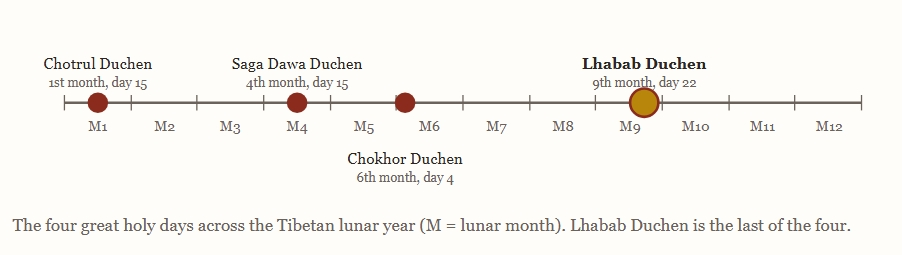
Lhabab Duchen is the last of the four great holy days in the Tibetan year, and the only one that celebrates the Buddha’s return to the human world.
The Four Great Düchen at a Glance
| Festival | Tibetan lunar date | What it commemorates | Usual season |
|---|---|---|---|
| Chötrul Düchen | 15th day, 1st month | The Buddha’s miracles at Shravasti | February to March |
| Saga Dawa Düchen | 15th day, 4th month | Birth, enlightenment, and parinirvana | May to June |
| Chökhor Düchen | 4th day, 6th month | The first sermon at Sarnath | July |
| Lhabab Düchen | 22nd day, 9th month | The descent from the Heaven of the Thirty-Three | October to November |
Why the Buddha’s Return Counts Among the Eight Great Deeds
Tibetan tradition counts the descent as one of the Eight Great Deeds of the Buddha. The return brought the teachings back to the human realm, where people could receive them directly. In this reading, the day belongs beside the first sermon and the parinirvana in the festival calendar.
Want more background on the symbols you will see on altars? Browse our guides to Tibetan Buddhist symbols and practice. Losar, the Tibetan New Year, follows a few months later, and our Losar 2027 gift guide for the Tibetan New Year helps you plan ahead.
Is Merit Really Multiplied 10 Million Times on a Buddha Multiplying Day?
Many Tibetan Buddhists believe that on Lhabab Duchen, a Buddha multiplying day, the results of both positive and negative actions are multiplied, but sources disagree on the number: 100,000, 10 million, or 100 million times, depending on the teacher and text cited.
| Source | Multiplier stated | What it says |
|---|---|---|
| Sravasti Abbey | 100,000 times | Merit created on this day is multiplied |
| Samye Institute; Wikipedia | 10,000,000 times | Effects of positive or negative actions are multiplied |
| FPMT (Lama Zopa Rinpoche) | 100,000,000 times | Merit multiplies, as cited from the vinaya text Treasure of Quotations and Logic |
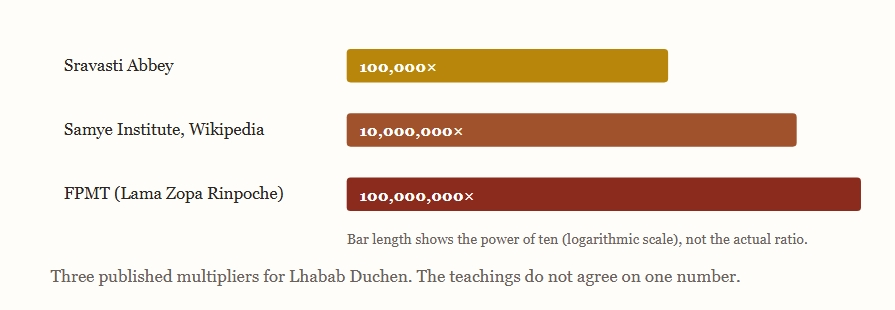
100,000 vs. 10 Million vs. 100 Million: What Each Source Says
Lama Zopa Rinpoche, whose teachings FPMT centers follow, cites the vinaya text Treasure of Quotations and Logic for the 100 million figure. Sravasti Abbey, a Tibetan Buddhist monastery in Washington State, states 100,000 times. Samye Institute and Wikipedia give 10 million.
We cannot audit any of these numbers, so we treat each as a statement of belief, not a measurement. Many teachers present the figure as encouragement to practice, not as exact arithmetic.
Why the Belief Applies to Negative Actions Too
Samye Institute and Wikipedia both say the multiplier covers positive and negative actions. That is why restraint matters as much as generosity on this day. Karma, in this view, works on intention and action, so a careful day matters more than a busy one.
If this sounds heavy, you are not alone. Many practitioners treat the belief as encouragement rather than pressure. If you lose your temper on the day, a common approach is to acknowledge it, restate your intention, and dedicate the merit of the rest of the day to others.
Important note: This section describes religious beliefs. It is not a promise of any outcome, and it does not replace guidance from a qualified Dharma teacher.
How Can You Observe Lhabab Duchen at Home in the U.S.?
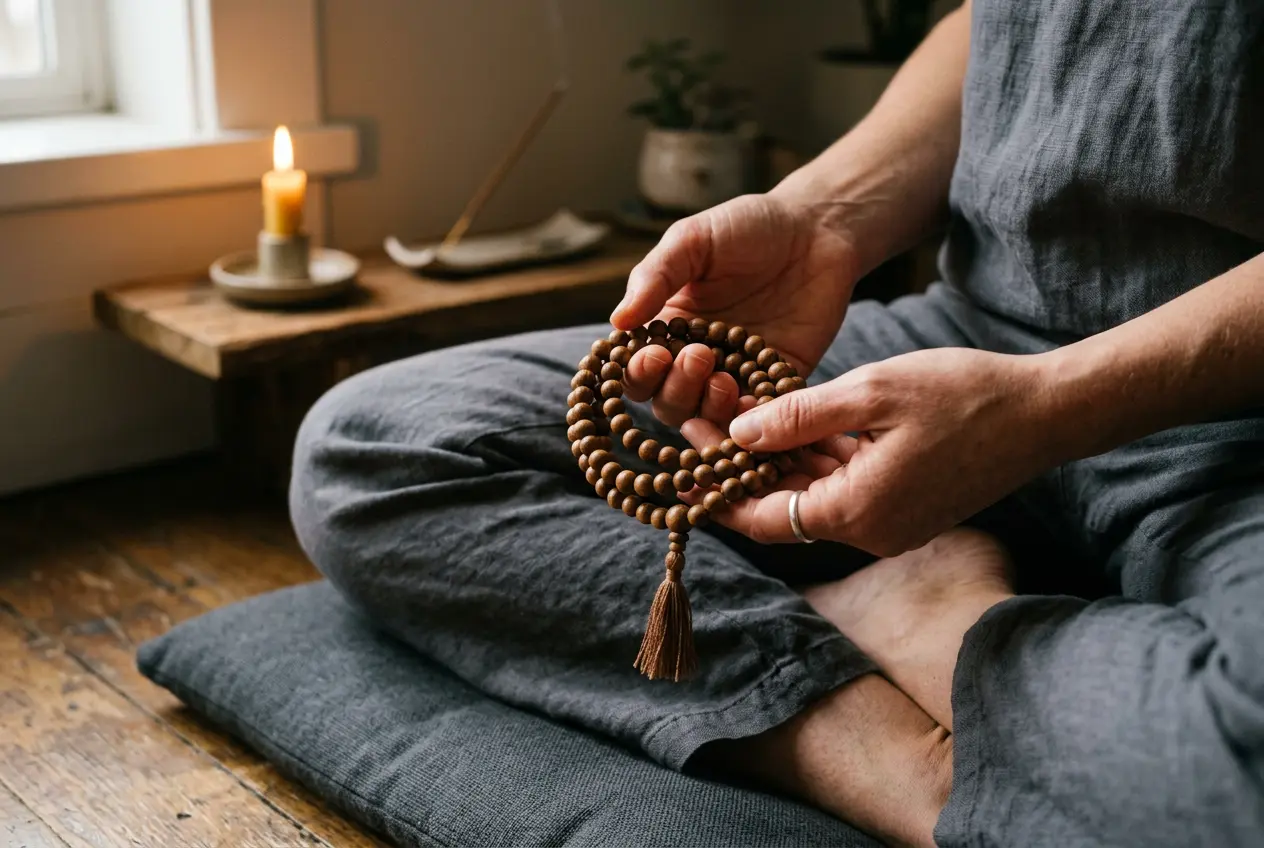
You can observe Lhabab Duchen at home in about 20 minutes with six steps: make a simple offering, bow or walk mindfully, recite a mantra, keep one ethical commitment, give something to others, and dedicate the merit to all beings.
- Make an offering (3 minutes). Place a small light and a bowl of clean water before a Buddha image. An LED tea light works if you cannot leave a flame burning.
- Bow or walk mindfully (4 minutes). Do three full prostrations, or walk slowly clockwise around your altar. This clockwise walk is called circumambulation. A standing bow is fine if your knees need it.
- Recite a mantra (6 minutes). Use a mala to count 108 recitations of Om Mani Padme Hum, or of the Shakyamuni mantra, Om Muni Muni Maha Muniye Soha. Some centers read The Sutra Remembering the Three Jewels on this day instead.
- Keep one commitment (3 minutes). The eight Mahayana precepts, a 24-hour set of vows, are traditionally received from a teacher. Beginners can choose one restraint for the day, such as avoiding harsh speech.
- Give something (2 minutes). Dana, the practice of giving, can mean a donation to a Dharma center or a food bank. Lama Zopa Rinpoche teaches that generous actions are especially powerful on merit multiplying days.
- Dedicate the merit (2 minutes). End by wishing that the good you created benefits all beings. This dedication of merit closes the practice.
Total time: 20 minutes. You will need: a Buddha image, a light, a bowl of clean water, and a mala (optional).
How to Set Up a Simple Home Altar for 11/20/2027
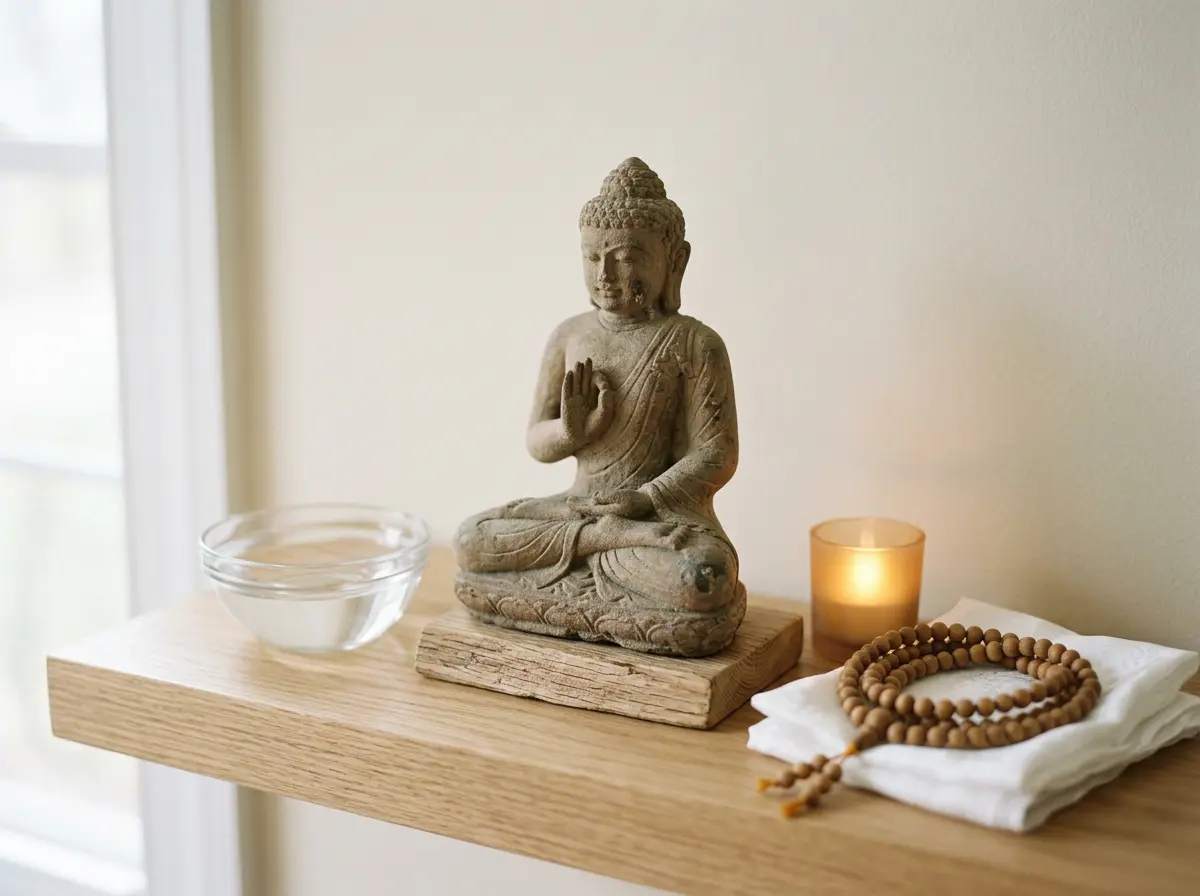
A beginner altar needs three things: a Buddha image, a light, and a bowl of clean water. Traditionally, a Buddha image sits on a clean, raised surface, never on the floor or in a bathroom. A white khata, a ceremonial scarf, is a common optional offering. For placement and handling, see our guide to Buddha statue etiquette and meaning.
Two items, if you want them. The Tibetan Meditation Buddha Statue ($42.95) is hand-carved sandstone, shows the meditation mudra, and stands about 4.7 inches (12 cm) tall. That height fits a bookshelf or windowsill, so a small apartment can hold a respectful focal point without a full shrine. See it in our Tibetan Buddha statue collection.
The 108 Mala Beads Bracelet ($25.95) has 108 natural wood beads, 8 mm each, plus a guru bead on an elastic cord. One pass through the beads equals one round of 108 recitations, so you can count mantras without losing your place. Details are on the 108-bead wooden mala bracelet for mantra counting page. Prices checked 10/10/2026.
What to Do if You Only Have Five Minutes
Light a lamp or candle, recite the Shakyamuni mantra 21 times, and dedicate the merit. That takes about five minutes. A short, steady practice is a good starting point if this is your first Lhabab Duchen. If you have taken vows with a teacher, follow their instructions first, because this plan is a general outline.
Finding a Lhabab Duchen Event at a U.S. Dharma Center
Many U.S. centers hold group practice on the day, in person or on Zoom. In past years, Land of Medicine Buddha in California offered an in-person and online celebration, and the Gyalwa Gyatso centers in the Bay Area held an online sutra recitation. Check your local center’s calendar in early November, confirm the time zone, and ask whether the event follows 11/19 or 11/20. Many events are free, and donations are appreciated.
How Is the Descending Day of Lord Buddha Celebrated in Bhutan, Tibet, and Nepal?
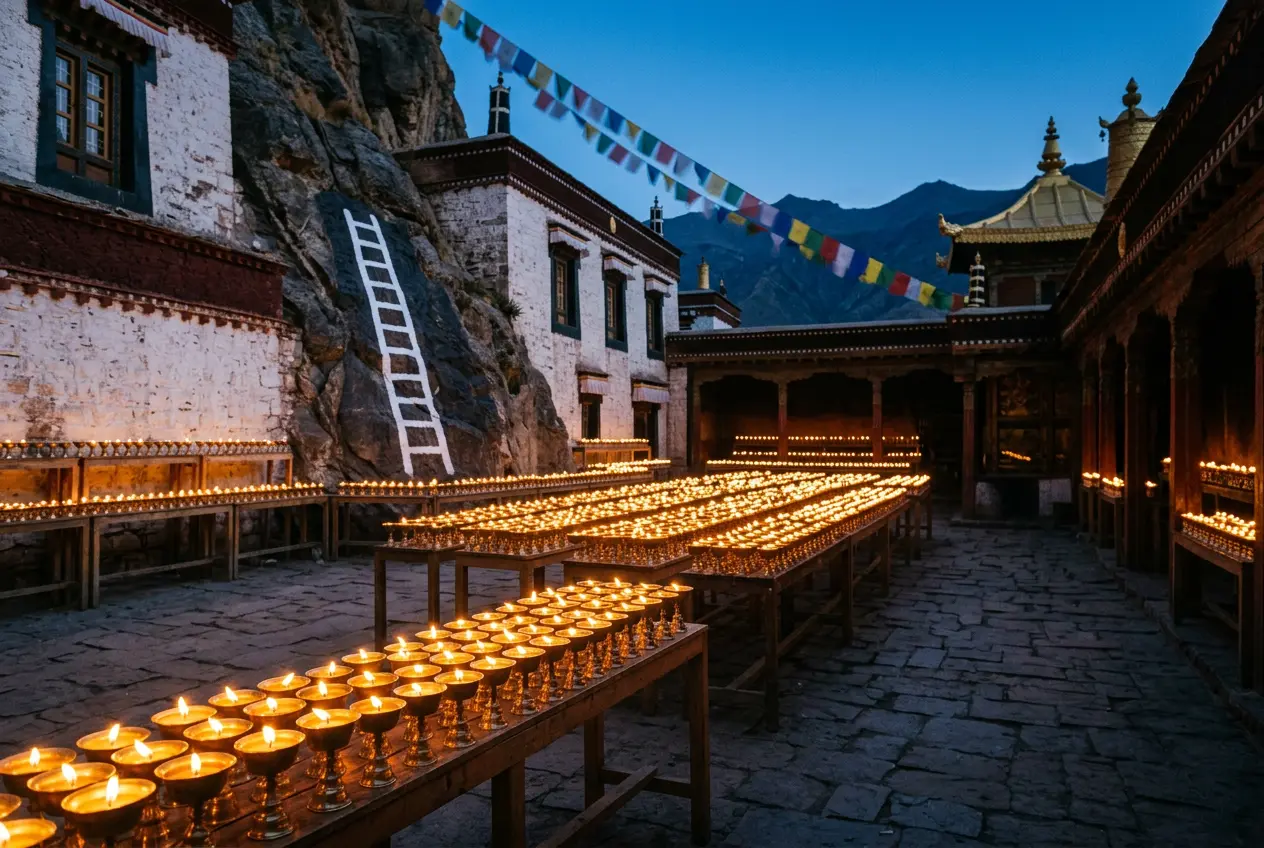
In Bhutan, the Descending Day of Lord Buddha is a public holiday, and across Tibetan Buddhist communities worshippers throng monasteries to light butter lamps, burn incense, and place freshly painted ladders on rocks near monasteries. The painted ladders symbolize the Buddha’s descent from the Heaven of the Thirty-Three.
Bhutan and Sikkim: A Public Holiday
Bhutan lists the day as a public holiday, and the Indian state of Sikkim observes it as a regional holiday. Monks and lamas spend the day reading scriptures and chanting mantras. Followers visit monasteries to light butter lamps, burn incense, and offer prayers.
Tibetan Monasteries: Fresh Ladders and Butter Lamps
Tibetan communities from Lhasa to Dharamsala mark the day with prayers and offerings at monasteries. The ladder custom turns the story into something you can see. Freshly painted ladders on the rocks beside monasteries recall the staircases the gods created for the Buddha’s descent.
Nepal: Lamps at Swayambhunath
In Nepal, Swayambhunath Stupa in Kathmandu is one of the sites where the day is observed. Monasteries offer butter lamp ceremonies and chanting. A few Theravada traditions keep related festivals at the end of the rains retreat, including Vap Poya in Sri Lanka and Thadingyut in Myanmar.
Lhabab Duchen 2027 arrives five days before Thanksgiving, which falls on 11/25/2027. The festival’s story is also about gratitude, because the Buddha taught to repay his mother’s kindness. Pausing on 11/20 to thank the people who cared for you is a practice any reader can share.
Prepare your practice for 11/20/2027
Potala Store offers a 108-bead mala bracelet for counting mantras and Buddha statues for your altar. Planning ahead for the new year? See our guide to meaningful Tibetan New Year presents for every budget.
Frequently Asked Questions About Lhabab Duchen 2027
Most U.S. centers observe on Saturday, 11/20/2027. Some practitioners follow the India date, which begins on the afternoon of 11/19 in U.S. time. Follow your own teacher’s or center’s calendar.
It is a public holiday in Bhutan and a regional holiday in the Indian state of Sikkim. It is not a U.S. federal holiday, so most readers observe it privately or at a local center.
Yes. Lighting a candle in gratitude, giving to charity, or sitting quietly are respectful ways to join in. Avoid placing Buddha images on floors or in bathrooms.
A small Buddha image, a light, and a bowl of clean water make a complete beginner altar. Browse Tibetan Buddha statues for a beginner altar to set up your space before 11/20/2027.
Educational note: This article explains Tibetan Buddhist traditions for educational purposes. Beliefs about merit vary by lineage and teacher. Please consult a qualified Dharma teacher for guidance on your own practice. Version 1.0, 10/10/2026: 2027 date provisional, pending Tibetan almanacs.
📚 References
- Date table for Bhutan, 2025 to 2027: Lists the Descending Day of Lord Buddha as Nov 11 (2025), Nov 1 (2026), and Nov 20 (2027). Office Holidays
- The 100 million times teaching: Lama Zopa Rinpoche’s note on Lhabab Duchen, citing the vinaya text Treasure of Quotations and Logic. Lama Yeshe Wisdom Archive (FPMT)
- The 100,000 times teaching and the meaning of the name: A Tibetan Buddhist monastery’s introduction to Lhabab Duchen and how to practice. Sravasti Abbey
- Story, staircases, and the 10 million times teaching: Overview of the festival, Sankassa, and related Asian Buddhist festivals. Wikipedia: Lhabab Duchen