
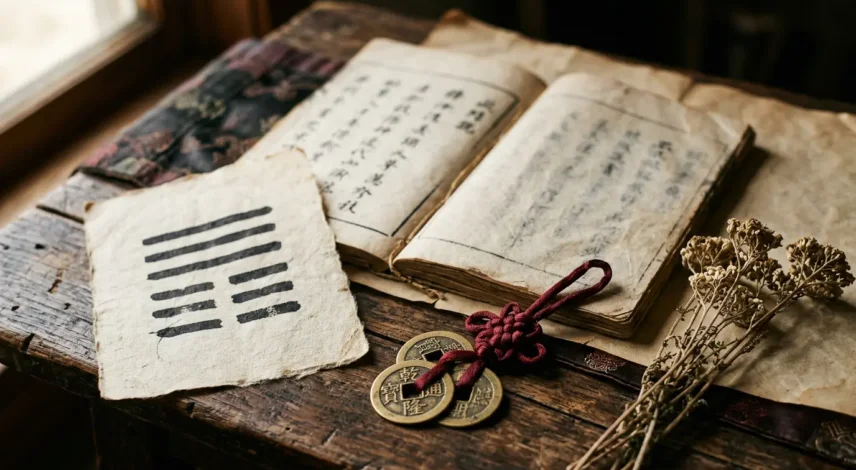

The 64 hexagrams look impossible to learn at first. They are built from only eight simple three-line shapes, so the whole system opens up the moment you learn that one key. The I Ching, or Book of Changes (Yijing), is a roughly 3,000-year-old Chinese divination classic, and its 64 hexagrams map recurring patterns of change in life, each one a stack of six lines of yin and yang. At Potala Store, we source authentic Chinese and Tibetan pieces, including the coins traditionally used to cast the I Ching, directly from artisan workshops, and the same question reaches us again and again: where do I even start? This guide shows you how a hexagram is built, why there are exactly 64, how a reading works, and what the oracle can and cannot tell you. No memorization required.
Table of Contents
What Is the I Ching?
The I Ching, or Book of Changes (Yijing), is an ancient Chinese oracle whose 64 hexagrams describe patterns of change rather than fixed predictions. People have consulted it for around 3,000 years for reflection, timing, and perspective, drawing on the play of yin and yang that runs through Chinese thought. Both Taoism and Confucianism trace part of their roots to this single book.
A 3,000-Year-Old Book of Change
The name itself means change, and the received text grew in layers over many centuries. Its oldest layer, the Zhouyi (the Changes of Zhou), dates to roughly 1000 to 750 BCE and holds the core hexagram statements and line statements. Later commentaries known as the Ten Wings were added on top, the ten Confucian texts that turned an omen manual into a work of philosophy. So when you open an I Ching today, you are reading a conversation between an ancient oracle and centuries of readers who studied it.
An Oracle, Not a Fortune-Telling Machine
The I Ching offers symbolic guidance, not a fixed forecast of events. A reading gives you an image of a situation, then asks where you stand inside it. The yin and yang lines, and the flow of qi that yin and yang describe, are what carry that meaning. This is why the same hexagram can read differently for a love question, a work question, or a question about waiting.
How a Hexagram Is Built: Six Lines of Yin and Yang
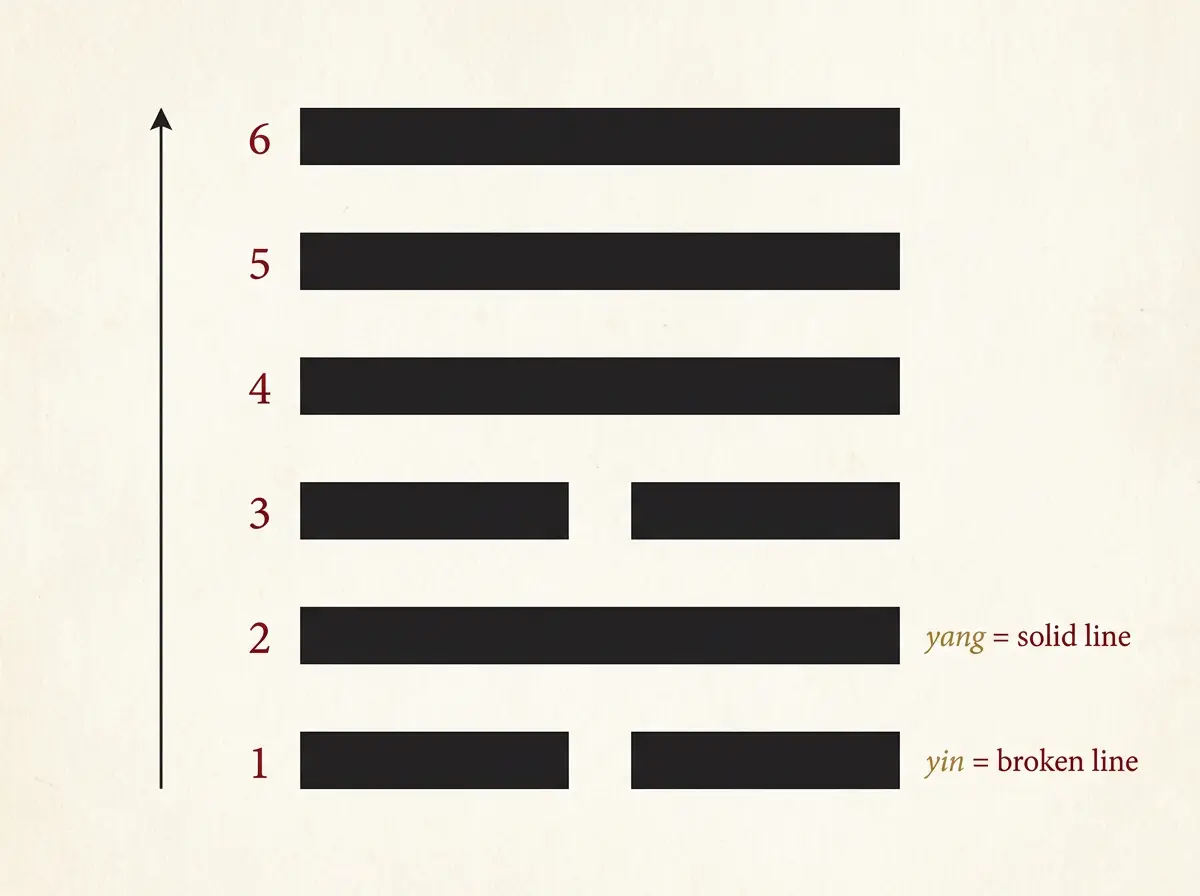
Every hexagram is a stack of six horizontal lines, and each line is either yin, a broken line, or yang, a solid line. That simple two-choice structure is the entire alphabet of the system. A hexagram (卦, guà) is one of these six-line figures, and it is the unit you actually read.
Broken and Solid Lines
A yang line represents active, creative, outgoing force. A yin line represents receptive, yielding, gathering force. Together, yin and yang describe how energy moves through a situation, where it pushes forward and where it draws back. Neither is good or bad on its own, and most real situations mix the two.
Reading a Hexagram From the Bottom Up
The lines are counted from the bottom up, so the lowest line is line one and the top line is line six. Lower lines describe the inner or earlier part of a matter, and upper lines describe the outer or later part. Reading in this direction keeps the story in order, from where a situation begins to where it is heading.
The Eight Trigrams: The Building Blocks of the 64
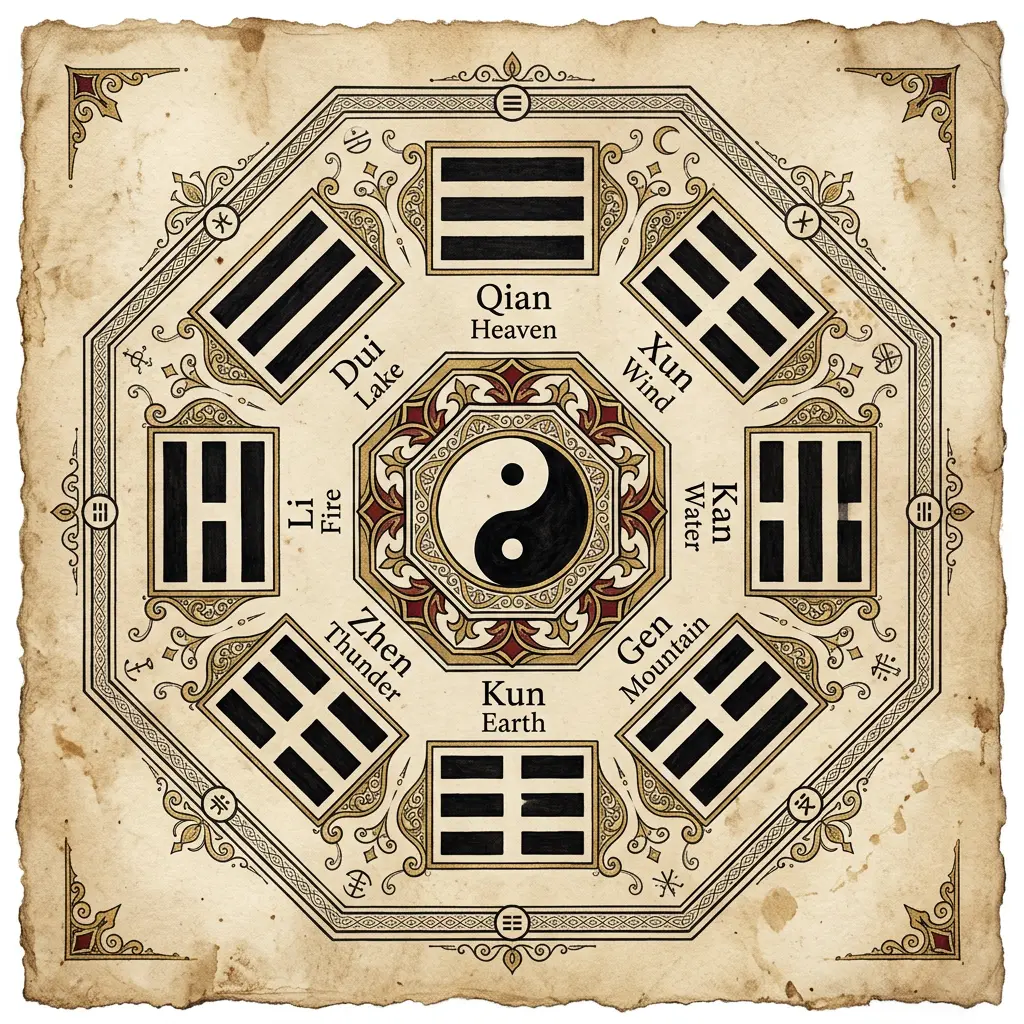
The 64 hexagrams all come from just eight three-line trigrams, stacked two at a time. A trigram (a three-line figure, part of the bagua) is the real key to the whole system. Learn these eight, and every hexagram becomes two familiar halves instead of one strange symbol.
The Eight Trigrams and What They Represent
| Trigram | Name | Image | Core quality |
|---|---|---|---|
| ☰ | Qian | Heaven | Creative, strong, initiating |
| ☷ | Kun | Earth | Receptive, yielding, supportive |
| ☳ | Zhen | Thunder | Arousing, sudden movement |
| ☴ | Xun | Wind | Gentle, gradual, penetrating |
| ☵ | Kan | Water | Danger, depth, flow |
| ☲ | Li | Fire | Clarity, light, awareness |
| ☶ | Gen | Mountain | Stillness, stopping, rest |
| ☱ | Dui | Lake | Joy, openness, pleasure |
These eight images cover the basic forces of nature and, by extension, of any situation. A physical study aid helps here: a bagua board turns this table into something you can hold, so you can match a hexagram at a glance instead of memorizing it. You can browse our bagua and eight-trigram collection if you want one on your desk, and our guide to the eight trigrams of the bagua goes deeper into how the same symbols appear in feng shui.
Inner and Outer Trigram
Every hexagram is two trigrams stacked, and each half carries meaning. The lower trigram (lines one to three) is the inner trigram, describing your inner situation or foundation. The upper trigram (lines four to six) is the outer trigram, describing the outer circumstances or how things appear. The relationship between these two halves, water sitting under fire, or heaven pressing on earth, is what gives each hexagram its character.
Why Are There Exactly 64 Hexagrams?
There are exactly 64 hexagrams because each of the six lines can be yin or yang, which gives 2 to the power of 6, or 64 possible combinations. That number is not a tradition or a choice. It is simply every way six binary lines can be arranged. You do not need to memorize all 64, because once you know the eight trigrams, any hexagram is just two halves you already recognize.
The Math: 2 to the Power of 6 Equals 64
Six lines, two options each, produce 64 unique figures. Multiply those 64 hexagrams by their six lines, and the full text carries 384 line statements, one short reading for every line in every hexagram. This is why the I Ching can speak to so many situations from such a compact structure.
How the 64 Pair Up: the King Wen Sequence
The classic order of the hexagrams is the King Wen sequence, traditionally attributed to King Wen of Zhou, which arranges the 64 into 32 pairs. In most pairs, the second hexagram is simply the first turned upside down, so the two sit together as mirror situations. Hexagram 11 and hexagram 12 show this clearly.
| Hexagram | Trigram arrangement | Meaning |
|---|---|---|
| Peace (11) | Earth over Heaven | Harmony; forces meet and things flow together |
| Standstill (12) | Heaven over Earth | Stagnation; forces separate and things drift apart |
Same two trigrams, flipped, opposite meaning. Seeing the 64 as pairs like this makes the sequence far easier to hold than a flat list of names.
How to Consult the I Ching: Casting and Changing Lines
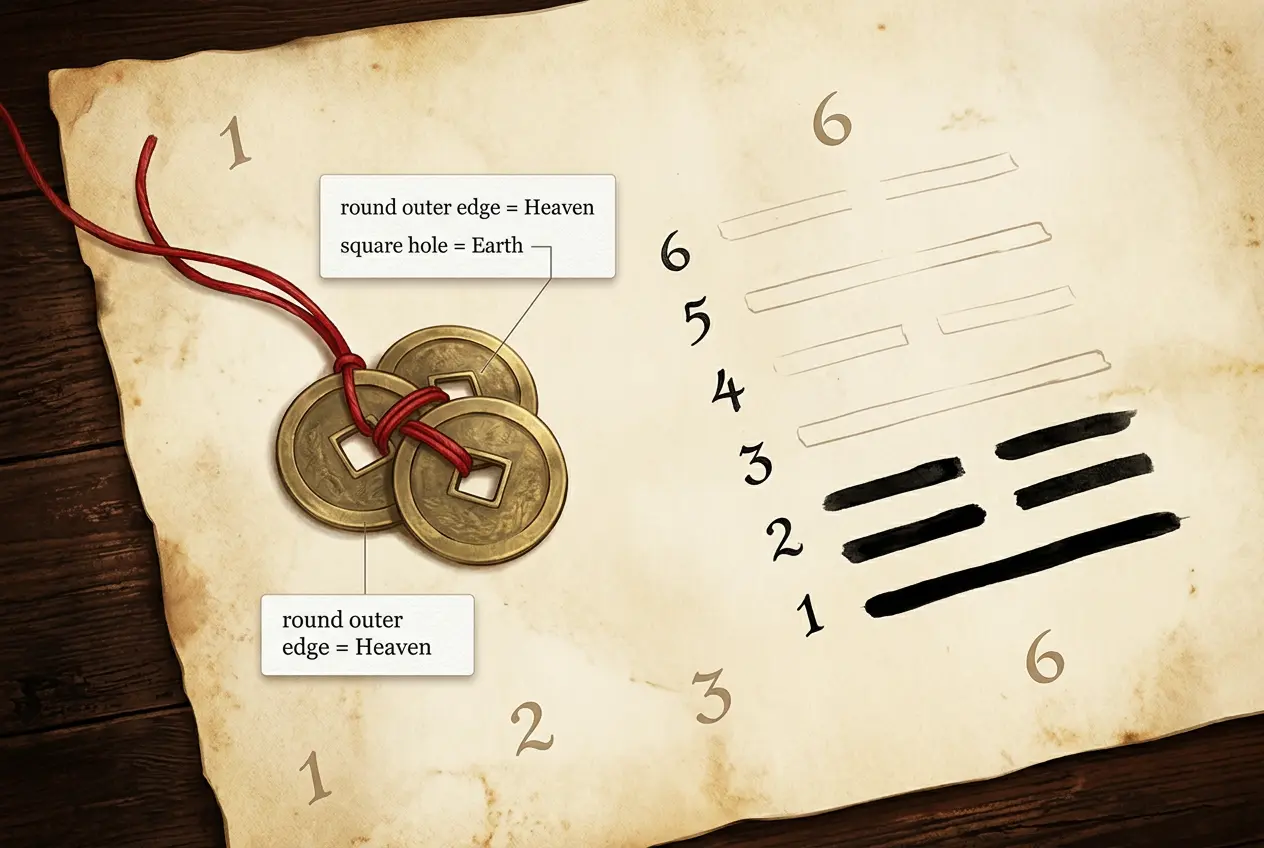
The most common way to consult the I Ching today is the three-coin method: you toss three coins six times to build a hexagram from the bottom up. The older yarrow-stalk method works too, but coins are faster and easier for a first reading.
The Three-Coin Method
Here is the basic sequence for casting a hexagram with three coins:
- Hold your question. Frame one clear, open question you can genuinely sit with.
- Toss three coins. Let them land, then note the mix of heads and tails.
- Record one line. Turn the toss into a yin or yang line; three of a kind marks a changing line.
- Repeat six times. Build the six lines in order, from the bottom line up to the top.
- Read the hexagram. Look up the figure you have drawn, then read any changing lines.
The coins carry their own symbolism. A traditional Chinese cash coin is round on the outside and square in the center, a shape called Tian yuan di fang (round Heaven, square Earth), so a single coin already models the cosmos the hexagrams describe. Its yang side carries four Chinese characters, and its yin side carries two. In our experience sourcing these coins from artisan workshops, the detail people miss is a genuine crossover point: the same four-character side that faces up for feng shui placement is counted as yin in the Wilhelm and Baynes casting tradition. Both readings are correct within their own system, which is exactly why it pays to know which one you are using. You can read more about the Chinese coins traditionally used to cast a hexagram and what each side means.
What Changing Lines Mean
A changing line is a line that is about to flip from yin to yang or back, and it turns your base hexagram into a second, transformed hexagram. The base hexagram shows the present shape of a matter, and the transformed hexagram shows where that movement is heading. A reading with one changing line is often the most useful of all, because the changing line points straight at the part of the situation that is actually moving.
What the I Ching Can (and Can’t) Tell You
Used well, the I Ching is a tool for reflection and timing, not a machine that predicts fixed outcomes. Its value is in returning you to your situation with clearer questions, not in handing you a verdict.
Using It for Reflection and Timing Today
Modern questions look different from ancient ones, yet the patterns rhyme. A delayed reply, a job offer, a family decision, or a choice about when to act and when to wait all map onto the same images of advance and retreat, trust and conflict, beginning and completion. Consulting the oracle helps you notice timing, weigh proportion, and see whether your role in a matter is too strong, too weak, too early, or too late.
Where a Reading’s Limits Are
The I Ching is traditionally used for reflection, and it is not a substitute for medical, legal, or financial advice. A reading should sharpen your own judgment, not replace it, and it should never remove your responsibility for a decision. Read this way, honestly and with care, the oracle stays useful without ever pretending to be more than it is.
A note on meaning: The divination and energy properties described here come from traditional Chinese belief and cultural practice, not scientific evidence. This guide is for educational and cultural purposes and is not a substitute for professional medical, legal, or financial advice.
Bring the eight trigrams home
If the eight trigrams behind the 64 hexagrams caught your interest, exploring them as real objects is a natural next step. Browse Potala Store’s bagua and eight-trigram collection for pieces sourced from Himalayan and Chinese artisans.
Want more guides to Chinese wisdom and symbols like this one? Join our newsletter for new explainers as we publish them.
Frequently Asked Questions
No. Most readers keep a reference at hand. Learn the eight trigrams first, and any hexagram becomes readable once you can recognize its two halves. Familiar hexagrams stick over time on their own.
A trigram has three lines. A hexagram has six. Every hexagram is simply two trigrams stacked, a lower (inner) trigram and an upper (outer) one, so eight trigrams combine into 64 hexagrams.
Either works. Yarrow stalks give a slower, ritual reading, while three coins are faster. Even three identical modern coins are fine, because the method matters more than the metal.
Not in the usual sense. It is a classical text, a divination system, and a tradition of reflection read within both Taoist and Confucian thought, and it is used by people of many beliefs.
📚 References
- The Chinese Philosophy of Change (Yijing): A scholarly overview of the I Ching’s three textual layers, its trigrams and hexagrams, and its place in Chinese thought. Stanford Encyclopedia of Philosophy
- Yijing (I Ching): Encyclopedic entry on the Book of Changes as one of the Five Classics of Confucianism, with its divinatory system and history. Encyclopaedia Britannica
- King Wen Sequence: Details of the classical ordering of the 64 hexagrams into 32 inverse and opposite pairs. Wikipedia
- Hexagram (I Ching): Reference on hexagram structure, the six yao lines, and how trigrams combine. Wikipedia