
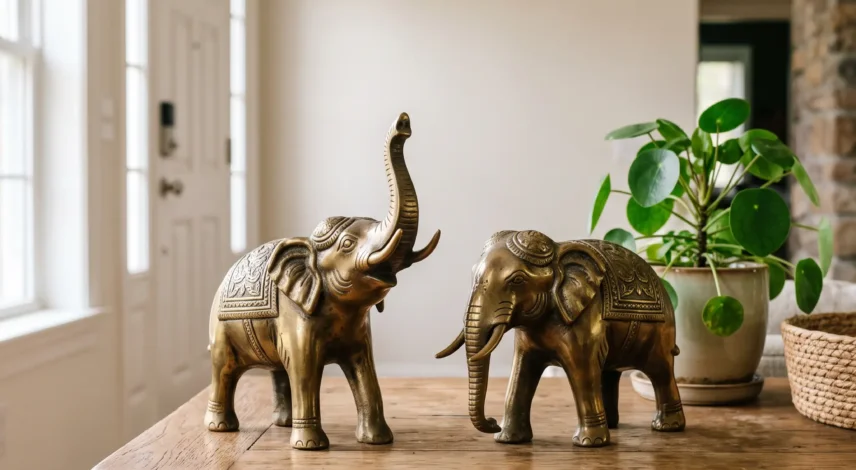

Both are lucky. In feng shui, a trunk-up elephant is traditionally believed to send good fortune outward. A trunk-down elephant is associated with guarding the luck you already have. If you’re holding a brass elephant statue with its trunk pointing down and worrying about bad luck, you can relax.
A feng shui elephant is a figurine or image of an elephant used as a good-luck symbol in Chinese and Buddhist-influenced homes. Its trunk position matters less than the direction it faces. We compared the headings and placement rules in 11 English-language guides. Then we checked the cultural claims against a museum journal, a Buddhist studies institute, and elephant-behavior research.
Below you’ll find a side-by-side table and the facing rule guides keep contradicting each other on. You’ll also get a room-by-room placement map and a simple way to choose your own.
Setting up an entryway as you read? Browse PotalaStore’s feng shui Liuli collectibles for display pieces that sit well beside an elephant.
Table of Contents
Trunk Up or Down: Which Feng Shui Elephant Is Lucky?
Both are considered lucky in feng shui. An elephant with its trunk up is traditionally believed to shower good fortune outward. A trunk-down elephant is associated with protecting and storing the luck you already have, plus fertility and longevity. Choose by intention, then face it into the room.
What Does an Elephant With Its Trunk Up Mean?
A raised trunk is traditionally read as luck and goodwill flowing outward. It is the most common feng shui elephant pose, so it’s the one you’ll see on most shelves. Guides tie it to success, celebration, and optimism, which is why it often sits in entryways and living rooms.
Is an Elephant With Its Trunk Down Bad Luck?
No. A trunk-down elephant is traditionally associated with keeping and protecting good fortune, gaining knowledge, and, in the bedroom, fertility and longevity. The guides we compared treat it as luck of a different kind, not as a bad omen.
If you already own one, there’s nothing to replace. Keep it, and spend your effort on where it faces.
Trunk Up vs. Trunk Down at a Glance
This table summarizes the traditional reading of each pose, as described across the guides we compared.
| What to compare | Trunk up | Trunk down |
|---|---|---|
| Traditional meaning | Good luck and goodwill flowing outward | Protecting good fortune, gaining knowledge, fertility, longevity |
| Direction of luck | Outward, welcoming | Inward, stabilizing |
| Common spots | Entryway, living room | Bedroom, home office, study desk |
| Choose it when | You want to invite luck and welcome people in | You want to hold onto what you have, study, or focus on family |
Where Does This Lucky Symbol Come From? Origins Most Guides Skip
The elephant’s lucky reputation in Chinese homes comes partly from wordplay. In the phrase taiping youxiang, “may there come peace,” the word for vase (ping) sounds like peace, and xiang means elephant as well as sign. Buddhist art and real elephant behavior add two more layers.
We went in expecting wealth to be the headline meaning. The museum journal pointed to peace instead.
Taiping Youxiang: The Elephant-and-Vase Rebus for Peace
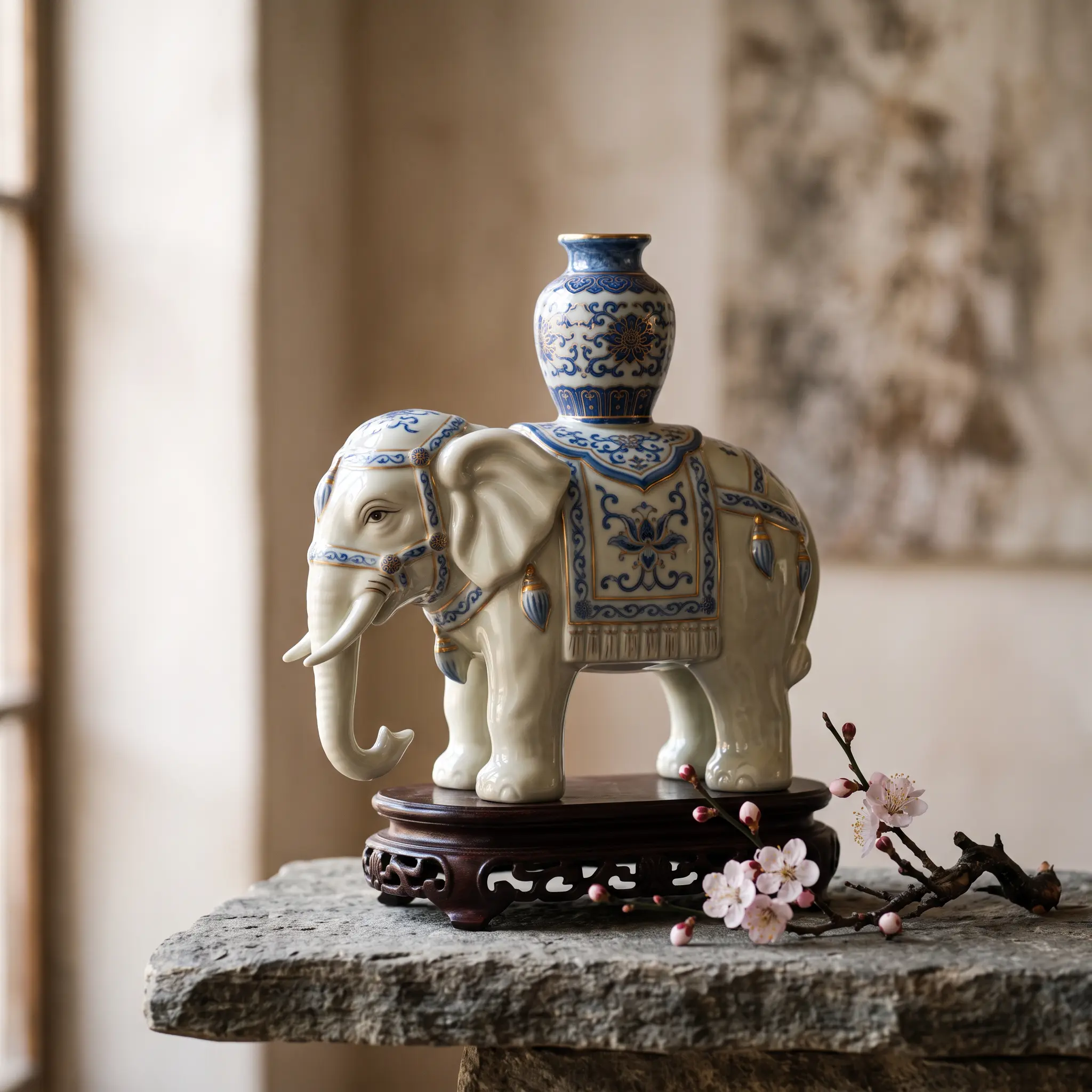
A rebus is a picture puzzle in which an image stands for a word that sounds the same. In Mandarin, ping (vase) sounds like ping (peace), and xiang (elephant) also means sign. Put an elephant beside a vase and you have written a wish for peace without a single character.
Scholar Chi-ming Yang describes this pairing in a 2021 essay in The Journal of the Walters Art Museum. She adds that another xiang means to think or ponder, which fits the elephant’s image of strength and intelligence.
If your goal is calm and harmony at home, look for an elephant carrying a vase. It makes your wish more specific than generic luck.
Samantabhadra’s Six-Tusked White Elephant
In Buddhist art, the bodhisattva Samantabhadra rides a white elephant with six tusks. According to the Samye Institute, he vows in Chapter 28 of the Lotus Sutra to appear on that elephant before people who uphold the teachings.
The six tusks stand for the six perfections: generosity, morality, patience, effort, meditation, and wisdom. The white color represents purity and steady strength.
If you choose a white or six-tusked piece, you’re choosing Buddhist iconography, not just décor. Give it a clean, raised spot and treat it with respect.
What a Raised Trunk Means in the Wild
In the wild, an elephant raises its trunk mainly to smell. ElephantVoices reports that elephants frequently lift their trunks to sample airborne scents. Their trunk is a fusion of nose and upper lip, built from about 150,000 muscle sub-units.
A peer-reviewed review on PubMed Central adds that the trunk samples chemicals from the air. It also carries scents from the ground to sensory organs for analysis. So a raised trunk is an animal gathering information about who and what is nearby.
That is our reading, not the researchers’ claim, but it suits a symbol of welcome. A trunk-up elephant is reaching out toward whoever walks in.
Which Direction Should an Elephant Statue Face?
Inside your home, face the elephant into the room with its back to the front door, so the good fortune it represents stays inside. Outside the entrance, some practitioners place a matching pair facing out as guardians, which is a protective job rather than a welcoming one.
Facing inward keeps luck near the front door, the “mouth of chi,” from flowing straight back out. For the bigger picture, read our guide on how chi enters through the front door.
Inside the Front Door: Face It Into the Room
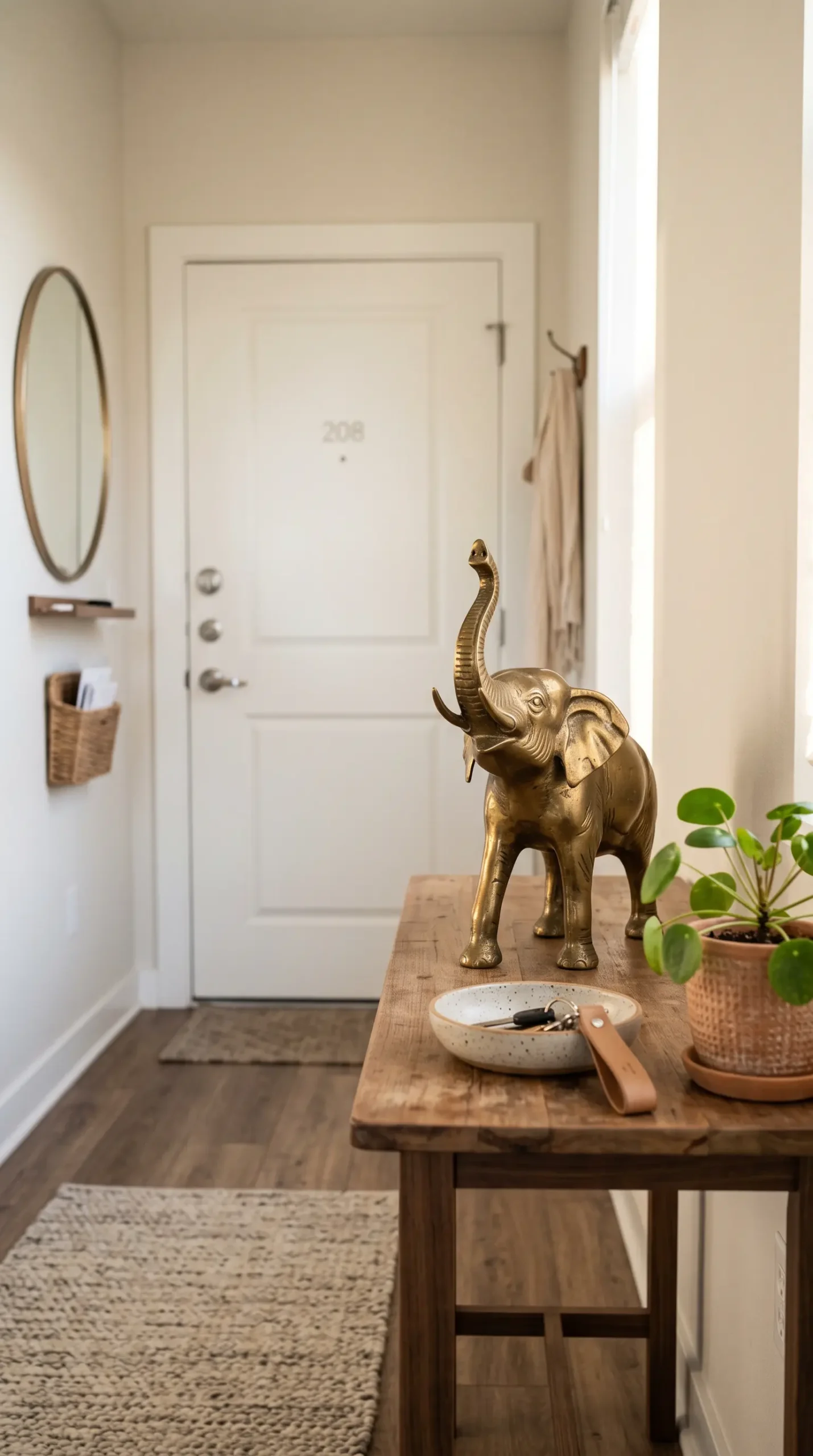
Place the elephant on a stable surface just inside the door. Its back should face the door and its face should look toward your living space. This is the rule LoveToKnow’s feng shui guide gives, and it keeps the symbol’s blessings inside.
Outside the Front Door: A Pair Facing Out for Protection
On a porch or beside an entrance, a matching pair facing outward takes on a guardian role. Some practitioners pair this with a single elephant indoors facing in.
If your apartment door opens onto a wall or a shared hallway, skip the outdoor pair and use the indoor rule. It’s simpler and just as traditional.
Why Sources Disagree, and a Simple Rule to Decide
Guides disagree because they give the elephant different jobs. Here is how three well-known voices line up.
| Source | Facing rule | The job it assigns |
|---|---|---|
| LoveToKnow | Back to the front door, facing into the room | Keep luck inside the home |
| Scripps News, citing Makaan | Face the door to protect; face away to draw luck in | Guard against negative energy, or welcome luck |
| What’s Your Sign, citing Lillian Too | Trunk-up elephant facing the front door | Welcome good chi through the door |
The first two agree once you read the jobs. Facing away from the door keeps luck in, and facing it guards the home. The third source is the outlier, because it uses the door-facing position to welcome chi.
Here’s the honest truth: feng shui sources genuinely disagree on this one, and that’s okay. Want to welcome luck in? Face the elephant into the room. Want to guard the home? Face it toward the door, or place a pair outside facing out. Give each elephant one job.
Where Should You Put Your Figurine, Room by Room?
Five spots work best: the entryway, living room, bedroom, home office, and kids’ study desk. Each one gives the elephant a different job:
- Entryway: trunk up, facing into the room, on a raised table inside the door.
- Living room: trunk up, in a spot guests see first.
- Bedroom: trunk down, as a pair or a mother-and-calf, for family and rest.
- Home office: trunk down, on the desk, for focus and learning.
- Kids’ study desk: a small trunk-down elephant, for steady study habits.
Entryway and Living Room: Welcome and Protection
Put the elephant on a stable, raised surface just inside the door, with its face toward your living space. A console table works well because you notice the figurine every time you walk in. If you want a second piece, the living room is the next natural home.
Classic compass feng shui places wealth in the southeast. The bagua map, a grid of life areas laid over your floor plan, places it in the far-left corner as you enter. Our guide shows you how to find your feng shui wealth corner with either method.
If a Laughing Buddha shares your entryway, see where to place a Laughing Buddha for wealth and luck so the two pieces don’t compete.
Bedroom: Pairs, Mother-and-Calf, and the Number Seven
In the bedroom, choose a trunk-down elephant, which feng shui guides associate with fertility and longevity. A pair stands for partnership, and a mother-and-calf group suits families. Some guides suggest seven elephants for children, since seven represents children in that tradition.
The most important rule still applies: face the elephant into the room, so its blessings stay with the people sleeping there. These are cultural symbols, not medical advice. If you’re trying to conceive, a doctor is the right place to start.
Home Office and Kids’ Desks: Wisdom and Study Luck
On a desk, a small trunk-down elephant is traditionally linked with gaining knowledge and steady focus. Some practitioners place it in the northeast, the sector feng shui ties to knowledge and wisdom.
In a child’s room, pick a small brass or wood piece that won’t shatter, and keep it on the desk, not the floor.
Where Not to Put an Elephant
Keep elephant figurines out of bathrooms and kitchens, off the floor, and away from windows they would face. Guides advise against these spots, and practitioners say a figurine facing a window lets its energy escape. Choose a raised place where you can actually see and enjoy it.
How to Choose a Feng Shui Elephant: Material, Color, and Number
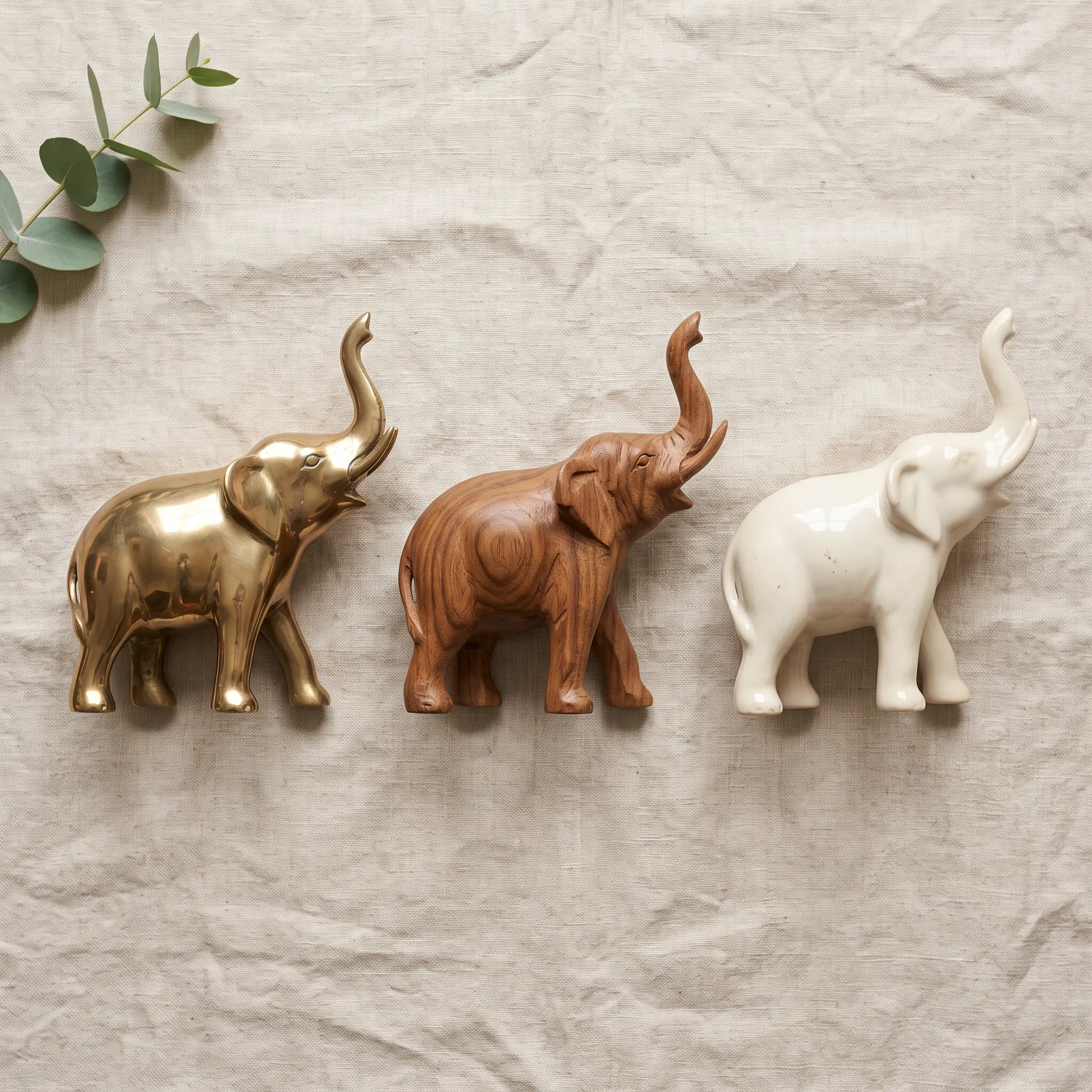
Start with your intention, then match the material to the element of the spot where it will sit. Brass is Metal, wood is Wood, and ceramic, stone, or jade is Earth.
| Material | Five element | Classic compass zones | What it gives you |
|---|---|---|---|
| Brass or bronze | Metal | West, northwest | Weight and stability on a busy console table |
| Wood | Wood | East, southeast | A warm look that suits living rooms and bedrooms |
| Ceramic, stone, or jade | Earth | Center, northeast, southwest | A grounded feel for desks and quiet corners |
Western bagua systems place zones by your front door instead of compass directions. If your layout doesn’t line up with the table, don’t stress. Matching the element to your intention is enough.
Material and Color Through the Five Elements
In the five elements system, every material belongs to one element, and each element supports or weakens another. Our guide to the Five Element Theory in feng shui explains those cycles in plain language.
Gold and white suit Metal. Green and brown suit Wood. Yellow and earth tones suit Earth.
Brass gives the piece enough weight to stay steady on a busy entry table. You also notice its warm glow every time you walk in. That means one less thing to knock over, and a daily reminder of the intention you set.
One, Two, or Seven Elephants?
One well-placed elephant is enough. Beyond that, the count follows your purpose:
- One: a single figurine carries the symbol, so start here.
- Two: a pair suits couples and wide entrances, facing the same direction.
- Seven: some guides link seven elephants with children, so it shows up in bedroom advice.
One meaningful elephant beats a crowded herd.
Pair it with a symbol you can carry. Our Feng Shui Lucky Coins for Wealth & Success are three brass coins on red string, worn as a pendant. They’re listed at $46.95 as of 10/28/2026. A statue stays on its shelf, but the coins take your intention with you to work.
FAQ: Gifts, Size, Paintings, and Luck
Yes. An elephant is a popular good-luck gift for housewarmings and new homes, and a matching pair suits couples. If you’re planning ahead for Thanksgiving (11/26/2026) and Black Friday (11/27/2026), our Black Friday 2026 gift guide sorts spiritual jewelry by budget.
We suggest a figurine about 6 to 10 inches tall for a standard console table. That is large enough to read from the doorway and small enough to leave room for keys and mail. Keep it raised and visible, never on the floor.
Many guides treat paintings and photos as equivalent to statues. Follow the same rules: the elephant should face into the room, and the trunk position should match your intention.
No scientific evidence shows that an object changes your luck, and these meanings come from cultural tradition. Many people find that a well-placed elephant works as a daily reminder of what they want to protect or build. That reminder is a real benefit.
The bottom line: A feng shui elephant is lucky whichever way its trunk points. Choose trunk up to welcome luck and trunk down to keep and protect it. Face it into the room unless you want it guarding the door. Then pick a material and a raised spot you’ll see every day.
Choose a protection piece that travels with you.
Explore PotalaStore’s Attract Protection collection for jewelry chosen with protection in mind, and bring your intention along wherever you go.
⚠️ Important Note: The meanings described here come from traditional feng shui and Buddhist beliefs and from cultural history, not from scientific evidence. This content is for educational purposes and should not replace professional medical advice.
📚 References
- Elephant-and-vase rebus (taiping youxiang): Scholarly essay on elephant imagery that explains the vase and peace wordplay. Chi-ming Yang, The Journal of the Walters Art Museum, 2021
- Why elephants raise their trunks: Field-based overview of how elephants sample scents, including the trunk’s structure. ElephantVoices, Chemical Communication
- Trunk scent sampling in research: Peer-reviewed review of how the trunk samples airborne chemicals and substances from the ground. The Chemical Ecology of Elephants, PubMed Central
- Samantabhadra and the six-tusked white elephant: Buddhist studies entry on the Lotus Sutra vow and the symbolism of the six tusks. Samye Institute, Samantabhadra Bodhisattva