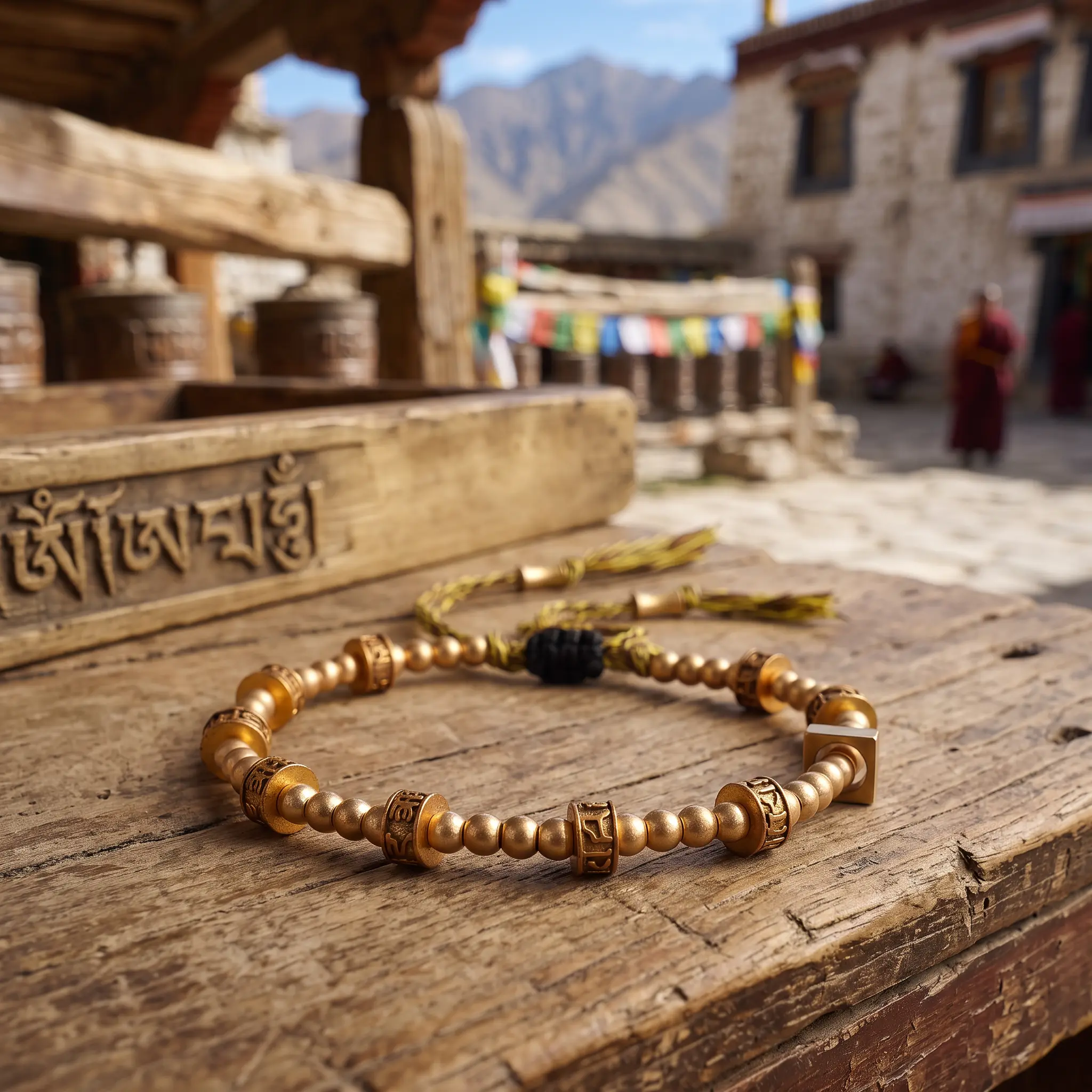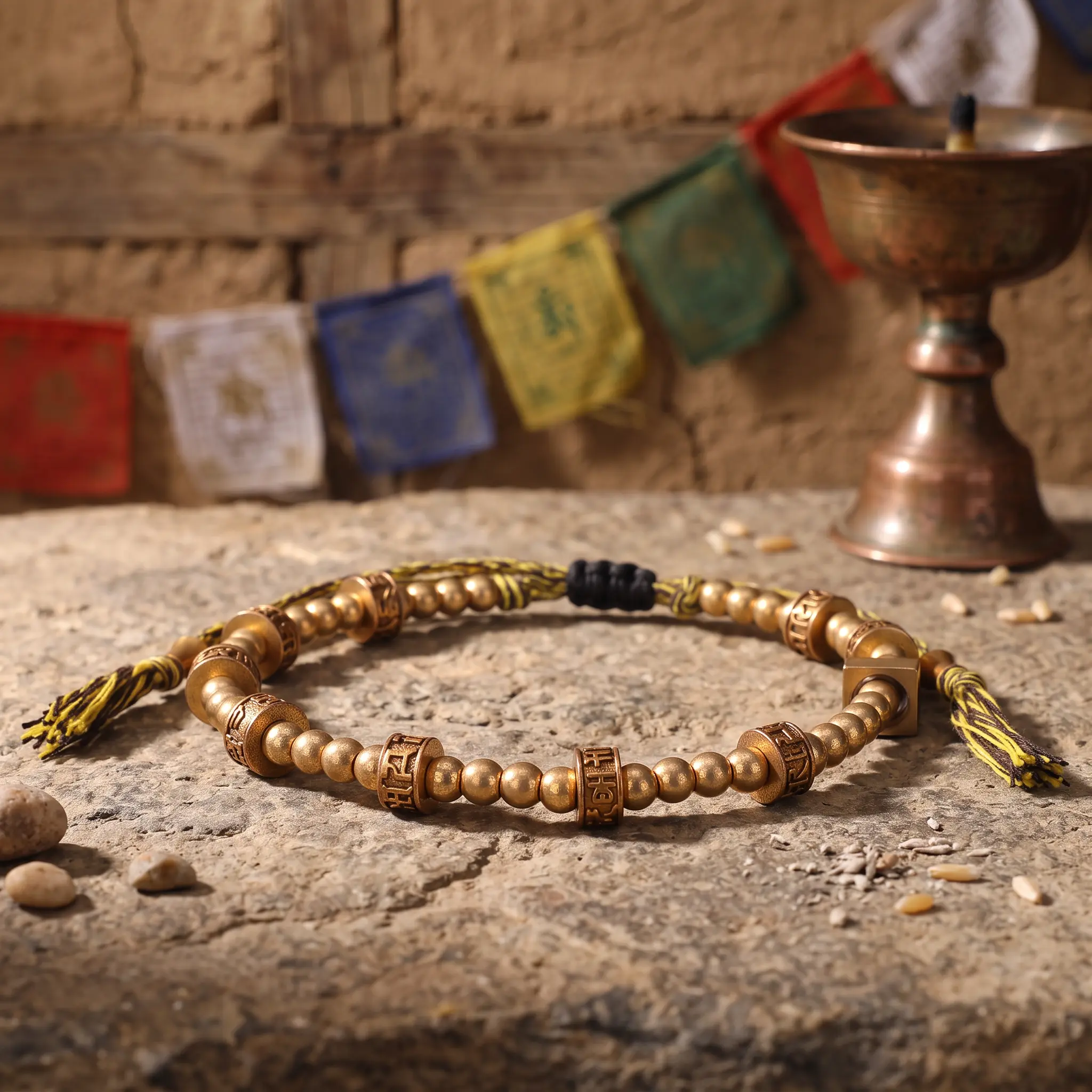

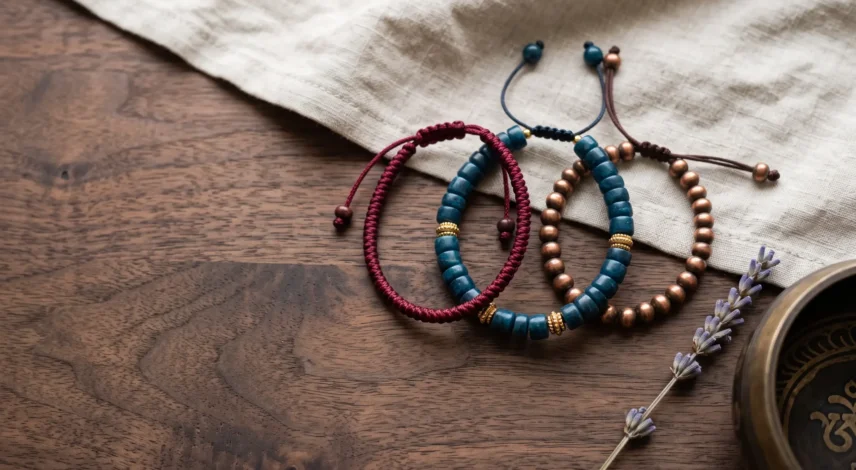

A bracelet bundle works when it follows three rules: one anchor bracelet, one contrast in texture or width, and one shared theme. Keep the set to three to five pieces and your bracelet stack will look planned instead of piled on.
Maybe you have three bracelets in your Black Friday cart and you are not sure they belong together. Cords can snag, soft stones can scratch, and too many symbols can make a bracelet set look random. A few simple checks solve all three.
At PotalaStore, we sell handmade Tibetan knot cords, copper bead bracelets, and natural stone strands. For this guide, we compared stacking advice from Jewelers Mutual and Mint & Lily with stone hardness data from GIA. You will find six combos that work, four to skip, and a gift plan for the holidays. To browse while you read, start with our handmade Tibetan bracelets for protection and luck.
Table of Contents
What Is a Bracelet Bundle (and How Is It Different From a Random Stack)?
A bracelet bundle is a pre-matched set of two to five bracelets designed to be worn together, so the anchor piece, the textures, and the meaning behind each bead are already balanced for you before you add a single extra piece. Unlike a stack you assemble one piece at a time, a bundle removes most of the guesswork about what goes with what.
Bundle vs. Stack vs. Set: What’s the Difference?
A bracelet stack is any group of bracelets you wear together, while a bundle or bracelet set is a stack that someone matched before you bought it. The terms overlap in everyday use. What matters is whether the anchor, the contrast, and the theme were chosen for you.
A bundle gives you a head start. A stack you build yourself gives you more control, and the same three rules in the next section apply to both. Mint & Lily reports that a three-piece stack is the most common configuration in its orders, so the habit is already mainstream.
How Many Bracelets Is Too Many to Stack?
Three to five bracelets is the sweet spot for most wrists, according to Mint & Lily’s stacking guide. Past five, the pieces crowd each other and hide the anchor. Most jewelers also suggest covering no more than about one-third of your forearm.
Leave roughly one finger’s width of space between each bracelet and your wrist, so the set can move without pinching. You do not need to buy all five at once. Start with an anchor and one cord, wear them for a week, and add a third piece only if the set feels light.
The Combos That Work: 3 Pairing Rules Behind Every Good Set
The combos that work share three traits: one anchor bracelet that leads, a texture contrast that keeps the eye moving, and a single theme that ties every strand together. Get those three right and a cord, a copper bracelet, and a stone strand will read as one intentional look instead of three random purchases.
Order data supports the contrast rule. Beaded plus chain is the most popular pairing at Mint & Lily, found in 47% of its multi-bracelet orders.
Rule 1: Choose One Anchor
The anchor is the piece that leads, usually the widest, boldest, or most meaningful bracelet in the set. It is the focal point your eye lands on first. Jewelers Mutual, a jewelry insurer, gives a simple example: one larger cuff with two smaller bracelets beside it.
Mint & Lily adds that five thin bracelets with no anchor look undecided. In a bundle of beaded strands, the anchor is often the one with the biggest beads or the strongest color. Pick it first, then choose everything else to support it.
Rule 2: Contrast Texture or Width in One Place
Contrast keeps a set interesting, so pair a smooth strand with a knotted one, or a thick piece with two slim ones. Change one variable at a time. A polished stone strand beside a matte knot cord reads as a deliberate texture contrast.
Change texture, width, and color all at once and the set loses its focus. A fiber cord also adds give. It settles against the wrist while beads and metal stay rigid.
Rule 3: Keep One Theme or Intention
A set looks intentional when every piece shares a color family or a purpose, such as calm or protection. In Tibetan Buddhism, the endless knot is one of the eight auspicious symbols, so many wearers let that one symbol lead and keep the other pieces quiet.
Tiger’s eye and hematite make an easy example. Both are traditionally linked to grounding and confidence, and their finishes differ enough to give you contrast. These meanings come from tradition, not scientific testing.
Which Pairings Clash? The 4 Stacks to Skip
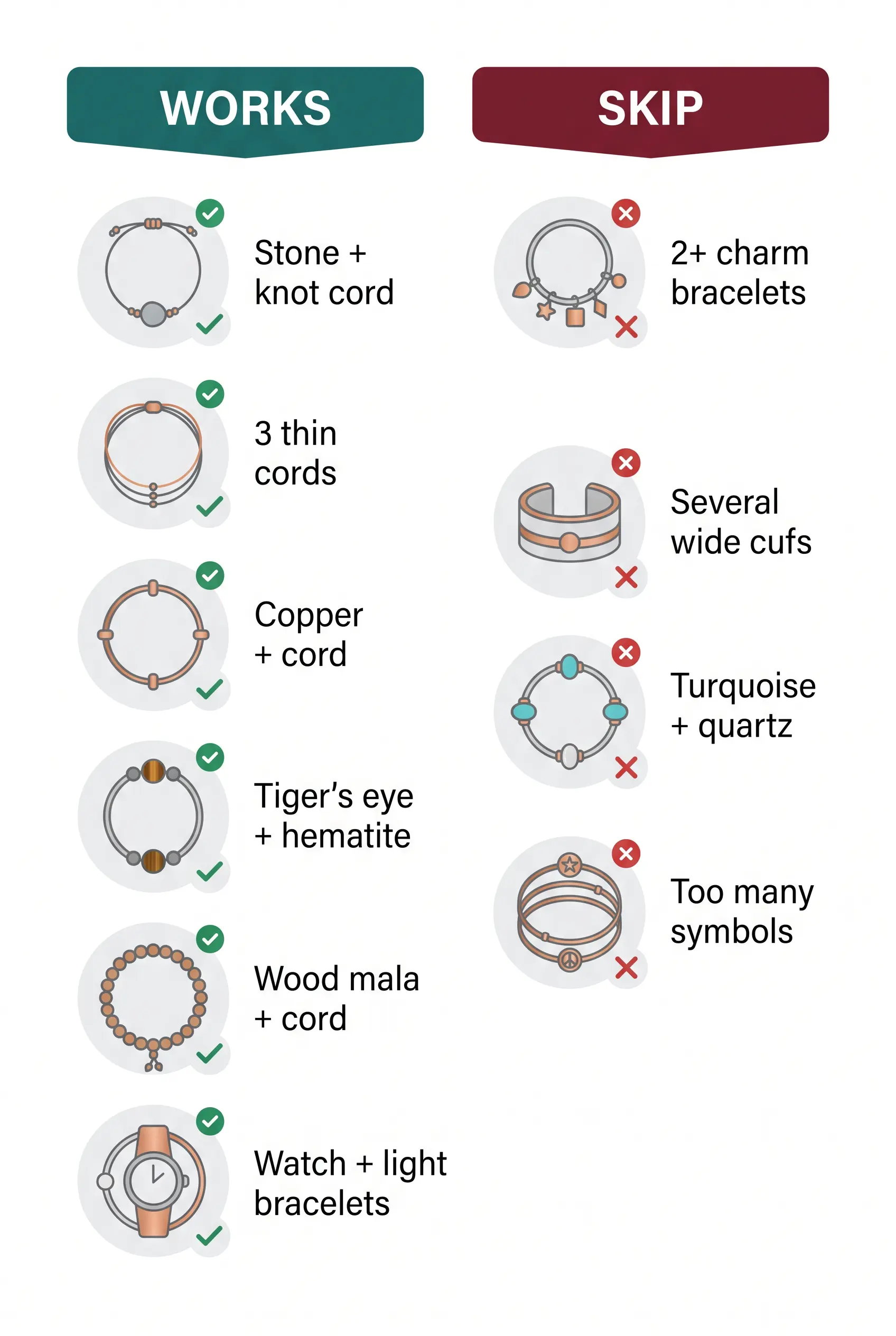
Pairings clash when bracelets fight for the same job or damage each other: two charm-heavy pieces that tangle, several wide cuffs that crowd the wrist, soft stones like turquoise (Mohs 5 to 6) rubbing against harder quartz beads, or symbols with competing meanings. Skip these four and most stacks fix themselves.
| Pairing | Verdict | Why |
|---|---|---|
| Stone anchor + slim knotted cord | Works | The stone adds weight and the cord adds softness. |
| Three thin knot cords in different colors | Works | Thin cords layer without bulk and share one texture. |
| Copper beads + cord | Works | Warm metal meets soft fiber for a clear contrast. |
| Tiger’s eye + hematite | Works | One theme, two finishes. |
| Wood wrist mala + one cord | Works | Matte wood beside braided fiber. |
| Watch + one or two light bracelets | Works | The watch stays the anchor. |
| Two or more charm-heavy bracelets | Skip | Charms catch on each other and tangle. |
| Several wide cuffs | Skip | They compete for the same stretch of wrist and limit movement. |
| Turquoise pressed against quartz beads | Skip | Mohs 5 to 6 scratches beside Mohs 7. |
| Many unrelated symbols | Skip | The set reads as random and the lead symbol gets lost. |
What Bracelet Styles Should You Never Stack Together?
Avoid stacking more than one charm bracelet or several wide cuffs, because charms catch on each other and cuffs crowd the same stretch of wrist. Loose chains and loose cords also tangle when they sit side by side.
Jewelers Mutual suggests placing a tighter bracelet between loose bracelets to cut down on tangles. A sliding-knot cord does this job well, since it can sit snug while looser pieces rest above it. Our rule is simple: one charm piece per set.
Hardness Clashes: Soft Stones Next to Hard Beads
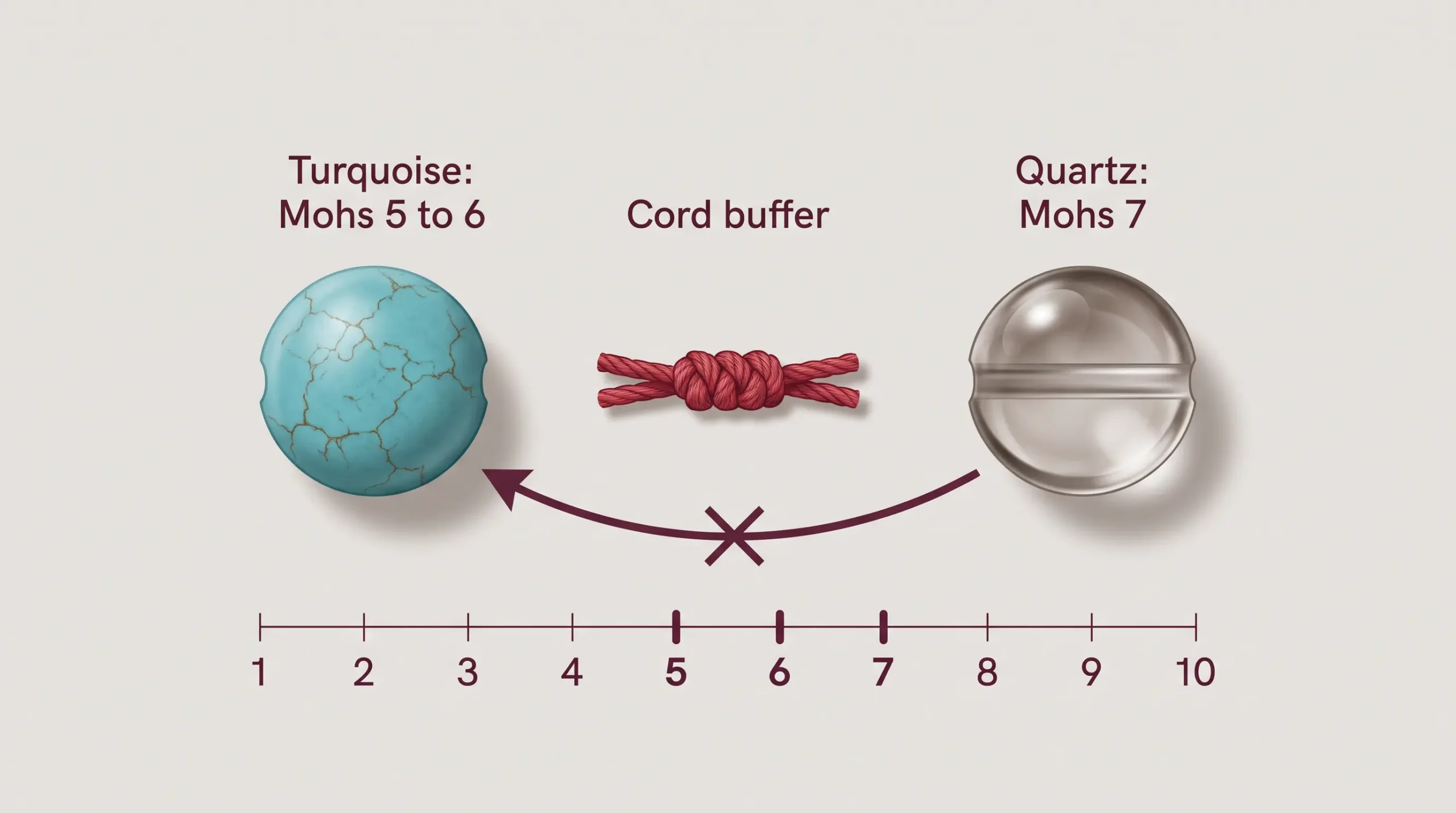
Turquoise rates 5 to 6 on the Mohs hardness scale, according to GIA, so it scratches when it rubs against harder stones such as quartz at Mohs 7. GIA also rates turquoise toughness as fair to good, and notes that skin oils, cosmetics, and perspiration can discolor it.
Tiger’s eye is a quartz variety that runs about 6.5 to 7 on the same scale. That makes it a poor neighbor for a bare turquoise strand.
The fix is cheap. Place the softer stone where it rubs least, and slide a fiber cord between it and any harder beads. Jewelers Mutual gives similar advice: put a different kind of bracelet between two gemstone bracelets so they do not scratch each other.
If your turquoise looks dull, stack order may be one reason, and skin oils may be another. For the hardness order of other stones, see our crystal bracelet stacking rules by Mohs hardness.
Symbol Overload: When Meanings Compete
A set with too many unrelated symbols reads as random. Traditional practice usually pairs one intention with one piece, so a set that mixes protection, wealth, love, and luck symbols can lose its focus.
Pick one lead symbol, such as the endless knot, and choose supporting pieces in plain cord or simple beads. If you want to carry more than one intention, you can spread them across both wrists, which the next section covers.
Building a Tibetan-Style Bracelet Set: Cord, Copper, and Stone
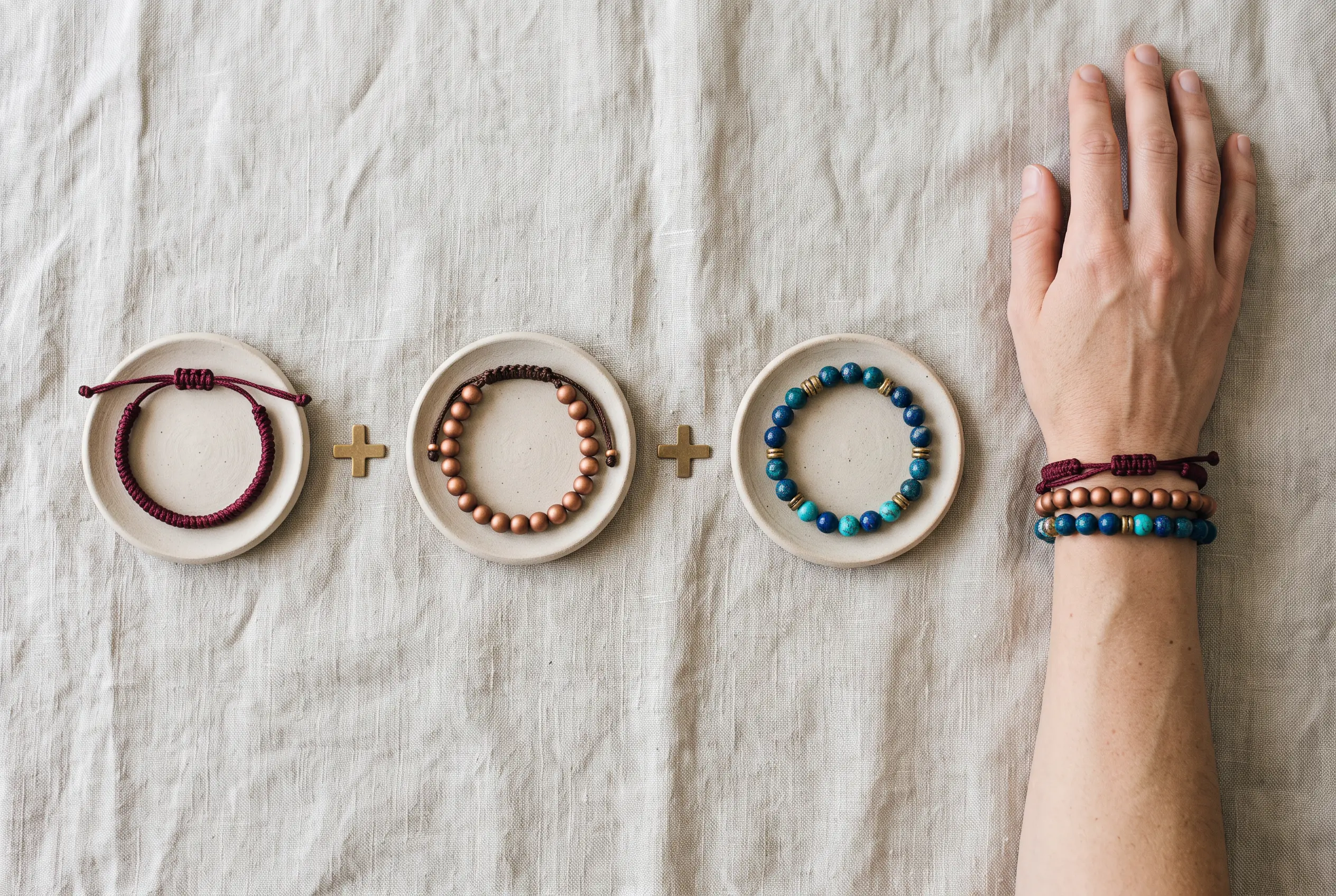
A Tibetan-style set usually layers three materials: a hand-knotted cord for softness and color, a copper bead bracelet for warmth and weight, and one stone strand as the focal point. The cord also works as a buffer, keeping harder beads from rubbing directly against softer stones. Here is how that looks with pieces we carry at PotalaStore.
The Three-Color Knot Set
Three thin knotted cords in different colors make the easiest bracelet bundle to wear, because thin cords stack without bulk. Our three-color Tibetan knot rope bracelet set is sold as the “Three Colors Combined (Buy 2 Get 1 Free)” style, alongside Red, Deep Red, and Gold. Prices run from $28.95 to $58.95 depending on style.
The product page says each bracelet takes 30 to 50 minutes to knot by hand, with artisans reciting the Om Mani Padme Hum mantra as they tie. The sliding knot adjusts to wrists from 6.3 to 9.4 inches (16 to 24 cm). The colors arrive already matched and one size covers a wide range, so you skip the sizing guesswork.
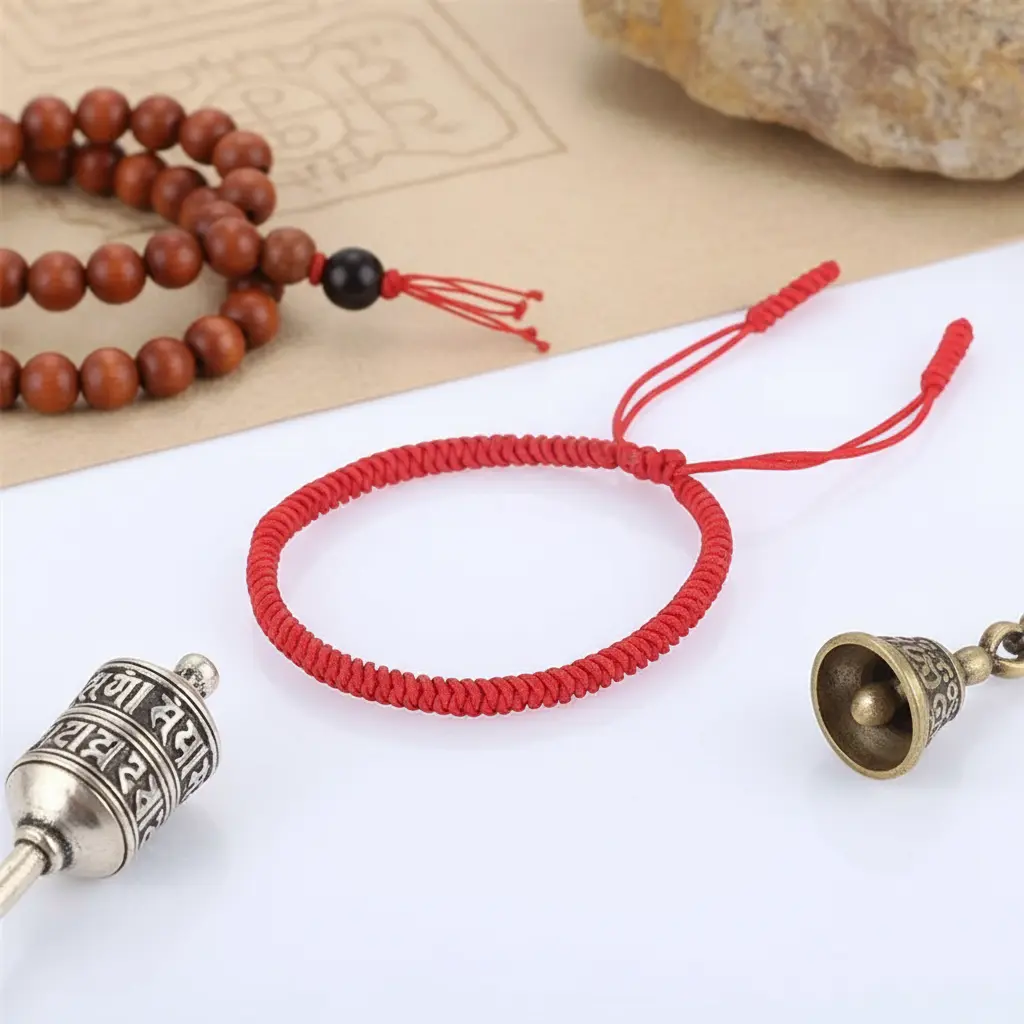
The three-color knot set: thin cords that layer without bulk.
Start with the set. If you only buy one thing for a first bundle, make it three knot cords in different colors.Shop the three-color knot set
Cord + Copper: Warm Metal, Soft Fiber
Copper beads add weight and a warm tone that a cord alone cannot, and the cord keeps the metal from feeling stiff. Our Tibetan Copper Bracelet costs $38.95 as of 10/28/2026.
Pair it with one thin cord and you have a two-piece bundle with a clear anchor. The copper gives the set presence on the wrist, so a slim cord does not look lost beside it.
Cord + Stone: Let the Strand Lead
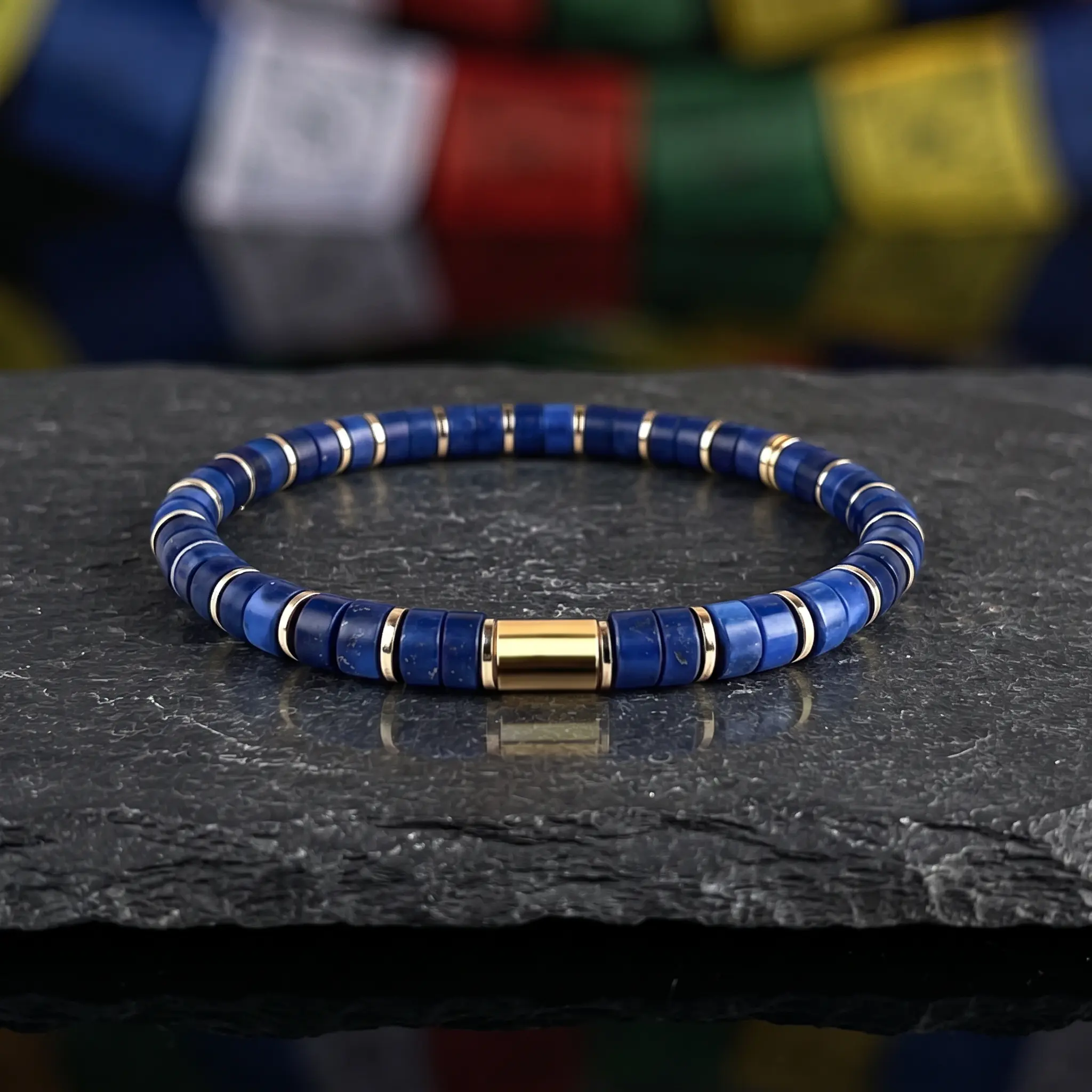
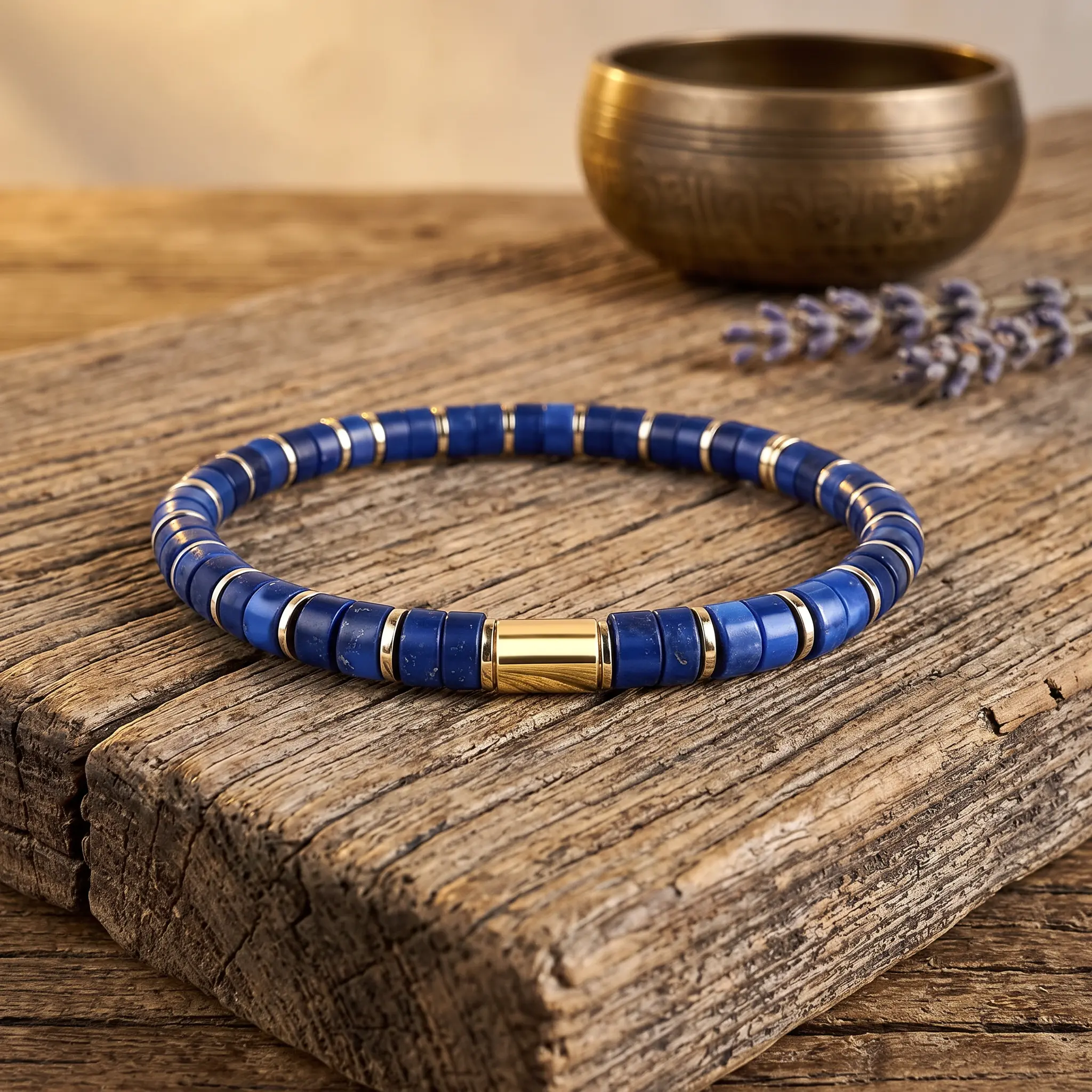
Make the stone strand the anchor and place a cord between it and any harder beads. The Lapis Lazuli Clarity Bracelet, with deep-blue heishi beads and gold-tone accents, costs $48.95 as of 10/28/2026.
Add a red string or burgundy cord beside it and the blue stone and warm red fiber give you color and texture contrast in two pieces. That is often enough for a first bundle, and you can add a third strand later.
Should You Stack Bracelets on One Wrist or Both?
Stack on one wrist if you want a focused, easy-to-wear look, and split the set across both wrists once you pass about five pieces or wear a watch. In Tibetan and feng shui tradition, the left wrist is believed to receive and the right to release, so many people place intention pieces accordingly.

A single knot cord on the left wrist, the traditional receiving side.
One Wrist: The Default for Most Sets
One wrist keeps the look focused and leaves your dominant hand free for typing and writing. Wear the set on your non-dominant wrist when you can. Most bundles of three to five pieces fit inside one-third of a forearm.
Try a quick test before you commit. Type for ten minutes with the full set on. If a piece clicks against your laptop or snags your sleeve, take it off.
Left to Receive, Right to Release: The Traditional View
In feng shui tradition, the left wrist is considered the receiving side and the right wrist the releasing side. Our product page notes that Buddhist tradition treats the left side as the receiving side, and some practitioners prefer the non-dominant hand.
If you want to follow the tradition, wear pieces meant to welcome something, such as calm, on the left. Keep the right for pieces you like for style alone. These are traditional beliefs, so treat them as a guide you can follow or skip. For a fuller breakdown, read about which wrist to wear a crystal bracelet.
How to Stack Bracelets With a Watch
Let the watch lead and keep the bracelets beside it light and soft, such as fiber cords, so nothing scratches the case. The watch is the anchor, so add only one or two slim pieces next to it.
If you want a bigger bundle, wear the watch on its usual wrist and put the rest of the set on the other wrist. That keeps both sides balanced.
Gifting a Bracelet Bundle This Holiday Season: Budget, Sizing, and Value
The easiest bracelet bundle to give as a gift has an adjustable fit: sliding-knot cords fit most wrists without a size, and a three-piece set leaves room to mix and match. You do not want to give a gift that does not fit, so start with adjustable pieces. Thanksgiving falls on 11/26/2026 and Black Friday on 11/27/2026, so holiday gifting is close.
Bundles by Budget: Under $40, $40–$60, and Under $100
You can build a meaningful set at three price points. The table below uses prices checked on 10/28/2026. Sale prices change, so confirm at checkout.
| Budget | Bundle idea | Price |
|---|---|---|
| Under $40 | One Tibetan knot cord, easy to adjust and easy to add to later | From $28.95 |
| $40–$60 | Lapis Lazuli Clarity Bracelet as a single stone anchor | $48.95 |
| Under $100 | Lapis Lazuli Clarity Bracelet plus Tibetan Copper Bracelet | $87.90 combined |
Want more ideas? Our Black Friday gift guide by budget lists options at $25, $50, and $100 and up.
Sizing a Gift When You Don’t Know Their Wrist
Choose a sliding-knot or adjustable style, because the Tibetan Buddhist Knot Lucky Rope Bracelet adjusts to wrists from 16 to 24 cm (6.3 to 9.4 inches), according to its product page. Stone strands usually need a measured wrist size, so pair a stone anchor with an adjustable cord if you are unsure.
Orders ship within 24 to 48 hours on business days and take 5 to 10 business days to reach the US, so order by early November for Thanksgiving week. The 60-day returns and exchanges on the product page mean a wrong guess is not final.
Frequently Asked Questions About Bracelet Bundles
Yes. Pick one dominant tone and use the other as an accent. Mint & Lily suggests a 70/30 split and reports that 62% of its multi-bracelet customers combine at least two metals.
Leave about one finger’s width of space under each bracelet, and add a snugger piece, such as a sliding-knot cord, between looser strands. If one piece still spins, size down or switch to an adjustable style.
Yes. Keep the set to the same three to five pieces and give the stones one shared intention. Place softer stones like turquoise where they rub least, and use a cord as a buffer.
Do not put two loose chains or two charm bracelets side by side. Place a solid or knotted piece between them, since thin knotted cords make easy spacers. Ready to try it? Start with a set of three Tibetan knot cords.
In summary, a good bracelet bundle needs one anchor, one contrast, and one theme, and it stays within three to five pieces. Keep soft stones away from hard beads, let a cord act as the buffer, and choose adjustable pieces when you give a gift. If you are starting this week, begin with one anchor and one cord, then add a third piece once the first two feel comfortable.
Important note: The meanings described in this guide reflect traditional beliefs and user experiences, not scientific evidence. Bracelets can support a mindful routine, but they are not a substitute for medical, financial, or mental-health care.
Build your holiday bundle
Pair a stone anchor with an adjustable cord and give a set that fits. Handmade Tibetan bracelets from PotalaStore ship free and come with 60-day returns.Shop the three-color knot setShop the lapis anchor
📚 References
- Turquoise hardness, toughness, and care: Mohs rating of 5 to 6, fair to good toughness, and cleaning limits for turquoise jewelry. GIA, Turquoise Care and Cleaning Guide
- Why turquoise scratches easily: Explains how everyday quartz dust at Mohs 7 can mark turquoise. International Gem Society, Turquoise Care Guide
- Bracelet stacking basics: Focal point, buffer pieces between gemstone bracelets, and tighter pieces between loose ones. Jewelers Mutual, How to Stack Bracelets
- Stacking data from retail orders: Three to five pieces, the 70/30 metal rule, and order statistics. These figures are Mint & Lily’s own order data. Mint & Lily, How to Stack Bracelets Like a Stylist