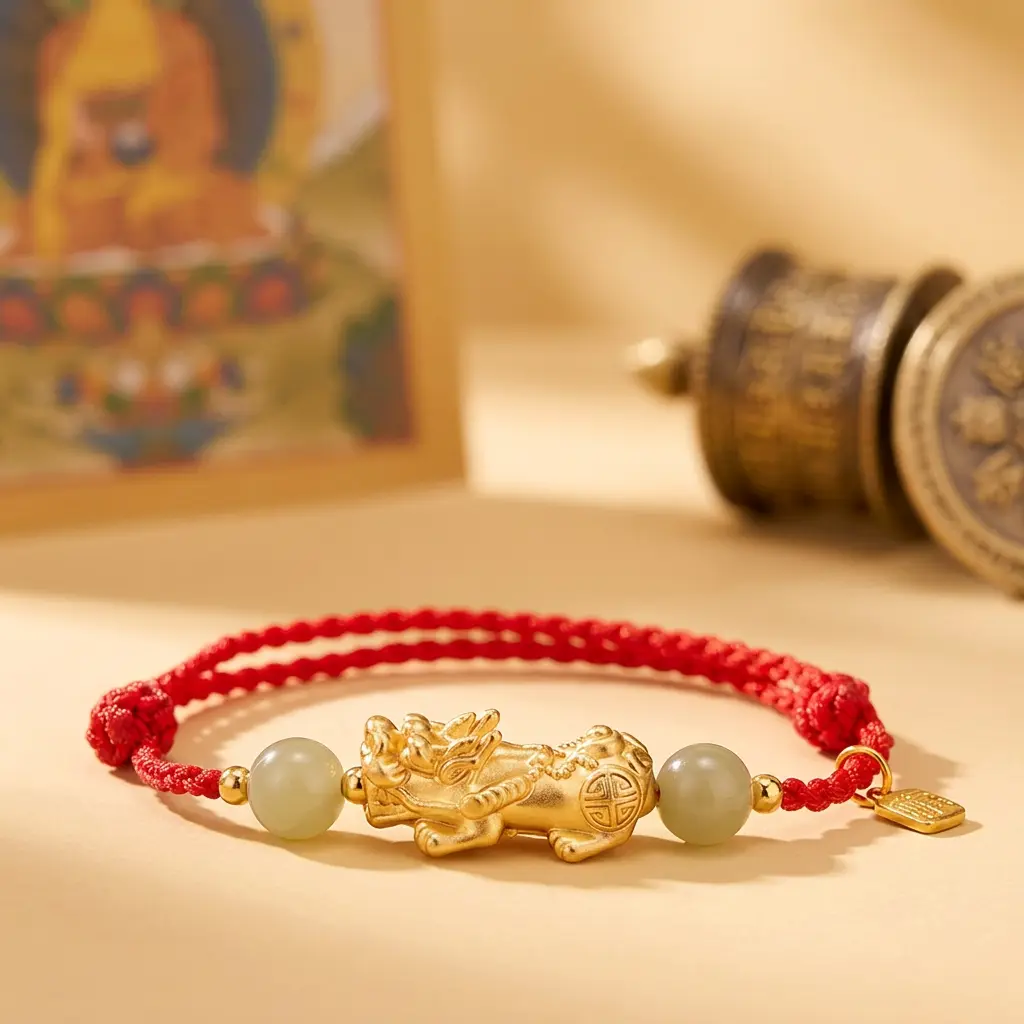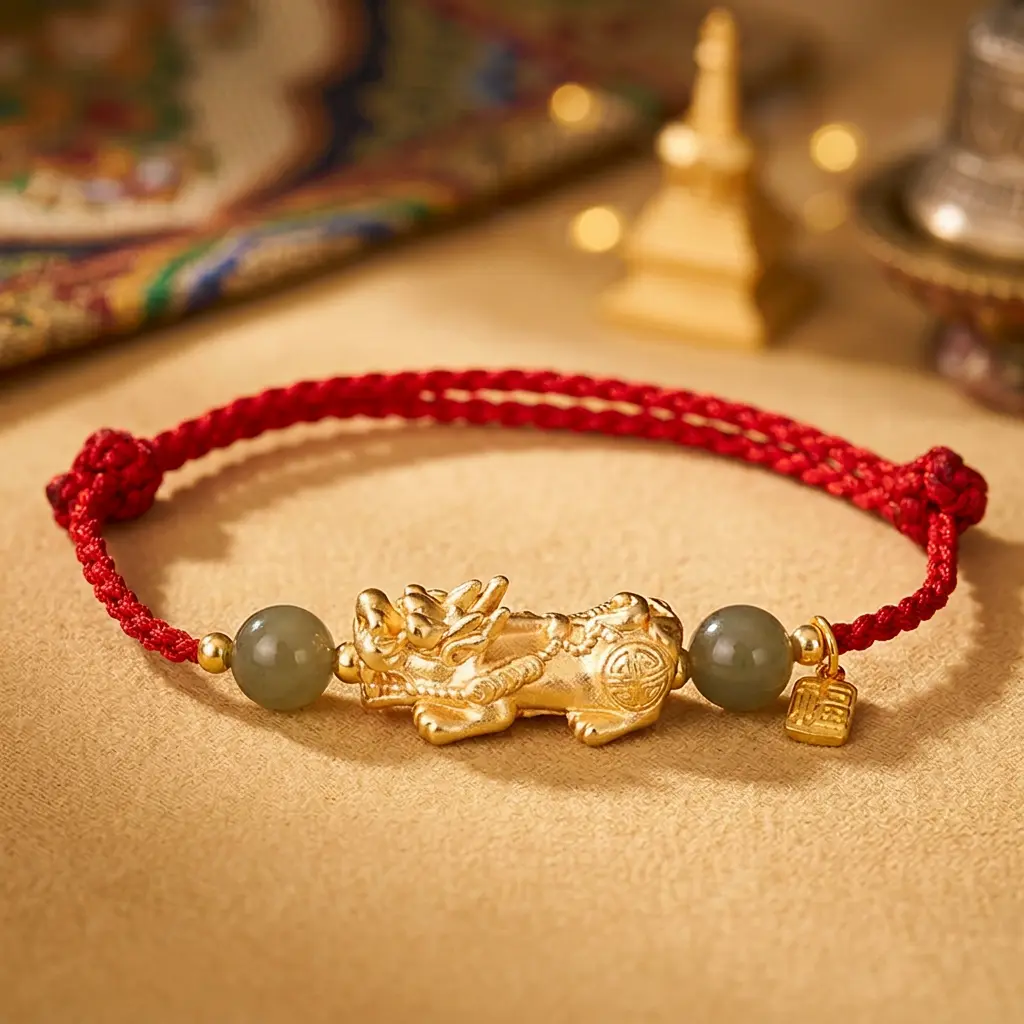


Seeing the same Buddha sold as a “charm” in one shop, a “pendant” in another, and an “amulet” in a third? Here is the short answer. A Buddhist pendant is a single focal piece that hangs from a necklace, while a Buddhist charm is a smaller accent worn on a bracelet, a red string, or a keychain. In Buddhist tradition, the deeper difference is blessing. A consecrated piece, often called an amulet, is traditionally believed to carry a protective role that ordinary jewelry does not.
At PotalaStore, we source Tibetan pendants and gau boxes through partnerships with the Sera Jhe and Kopan monasteries. Below you’ll find a side-by-side comparison, a three-question test for spotting a true amulet, and a decision matrix for gifts and daily wear.
Already leaning toward a pendant? Browse PotalaStore’s Tibetan Buddhist pendant necklaces, each listed with its size, material, and meaning.
⚠️ Important Note: The spiritual meanings in this guide reflect Tibetan and wider Buddhist traditions, not scientific or medical claims. This content is for educational purposes and should not replace professional medical or mental health advice.

Image slot 1
File name: buddhist-charm-vs-pendant-size-comparison.jpg
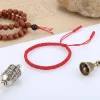
Alt text: A small red-string money bag charm next to a Tibetan copper vajra pendant, showing the size difference between a Buddhist charm and a pendant
Table of Contents
What Is a Charm, and What Is a Pendant?
A pendant is a single ornament that hangs from a chain as the focal point of a necklace, while a charm is a smaller piece, usually on its own jump ring, designed to be added, swapped, or collected. The two words describe a role more than an object, which is why one Buddha image can carry three labels.
How Jewelers Define a Charm
Jewelers use charm for a small piece sized to sit alongside others on a bracelet, anklet, or keychain. A jump ring, the small metal loop at the top, lets you clip a charm on or off in seconds. In the US, charms usually sell in sets or as single add-ons in the $15 to $40 range.
How Jewelers Define a Pendant
A pendant hangs from a bail, the loop that threads onto a chain or cord, and it is built to be seen. On an 18-inch chain it rests near the collarbone. On a 20- to 22-inch chain it drops toward the sternum, closer to the heart. Pendants usually sell as a complete necklace rather than as a loose add-on.
Where “Amulet” and “Talisman” Fit In
Encyclopaedia Britannica describes a talisman as an object believed to ward off harm and bring good fortune, and it points readers to its entry on amulets. For Buddhist jewelry, the useful split is simple. “Charm” and “pendant” describe how a piece is worn, while “amulet” describes what a piece is believed to do.
Buddhist Charms vs Pendants: Side-by-Side Comparison
Here is how the two forms compare on the points shoppers ask about most.
| Feature | Buddhist Charm | Buddhist Pendant |
|---|---|---|
| Typical size | Under 1 in (e.g., a 0.6 × 0.4 in money bag charm) | About 1 to 3 in (e.g., a 2 × 1.2 in citrine Buddha) |
| Where it’s worn | Wrist, red string, keychain, bag | Neck, at chest height near the heart |
| Role | Accent, often worn in groups | Single focal point |
| Common forms | Coins, money bags, knots, mini deities | Deity figures, vajras, gau boxes, Thangka lockets |
| Blessing | Sometimes | Often, especially Tibetan pieces |
| PotalaStore price range* | About $30 to $60 | About $33 to $85 |
| Care | Dry wipe; cords fray over time | Dry cloth for metal; keep leather gau cases dry |
*Prices checked on 09/28/2026 and may change during seasonal sales.
The key takeaway: a Buddhist charm is an accent you collect, while a Buddhist pendant is a centerpiece you wear over your heart. A pendant becomes the focal point of your outfit, while a charm usually shares space with other pieces on a charm bracelet or red string.
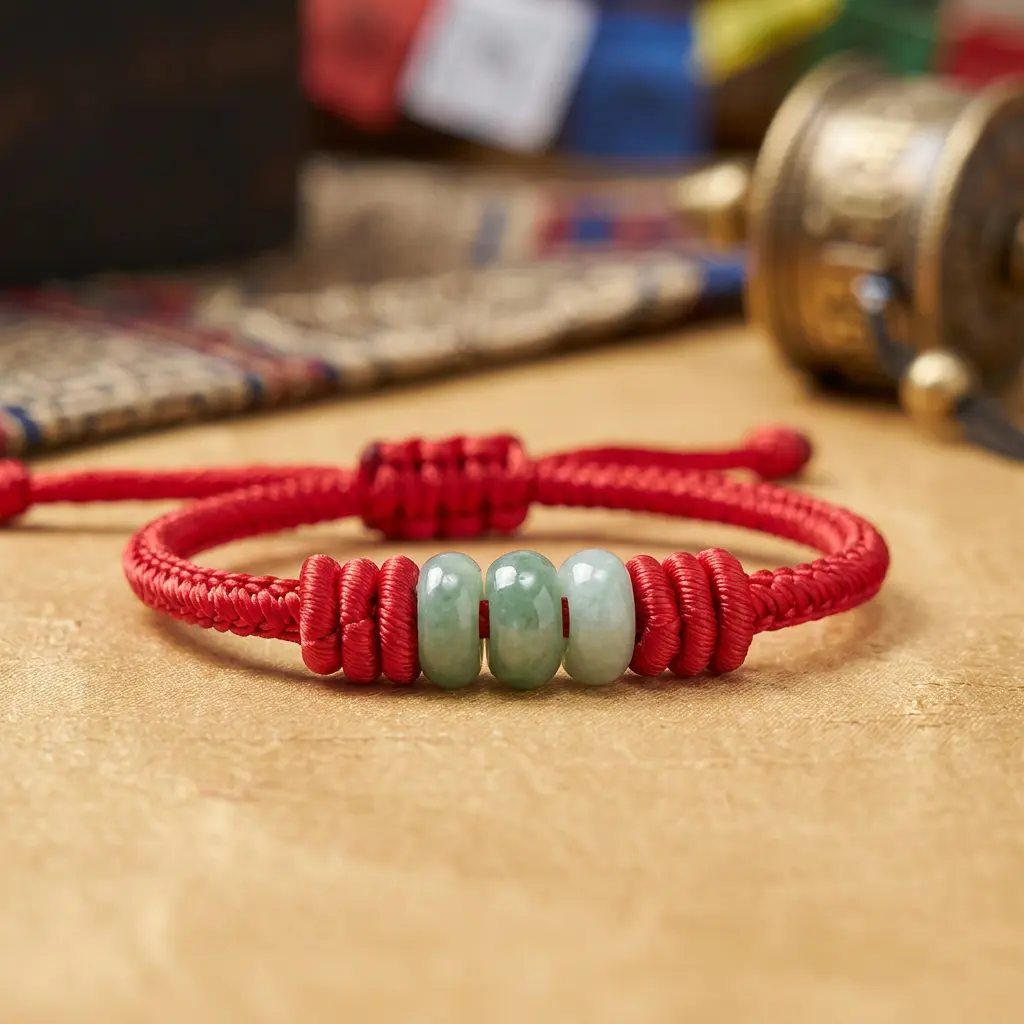
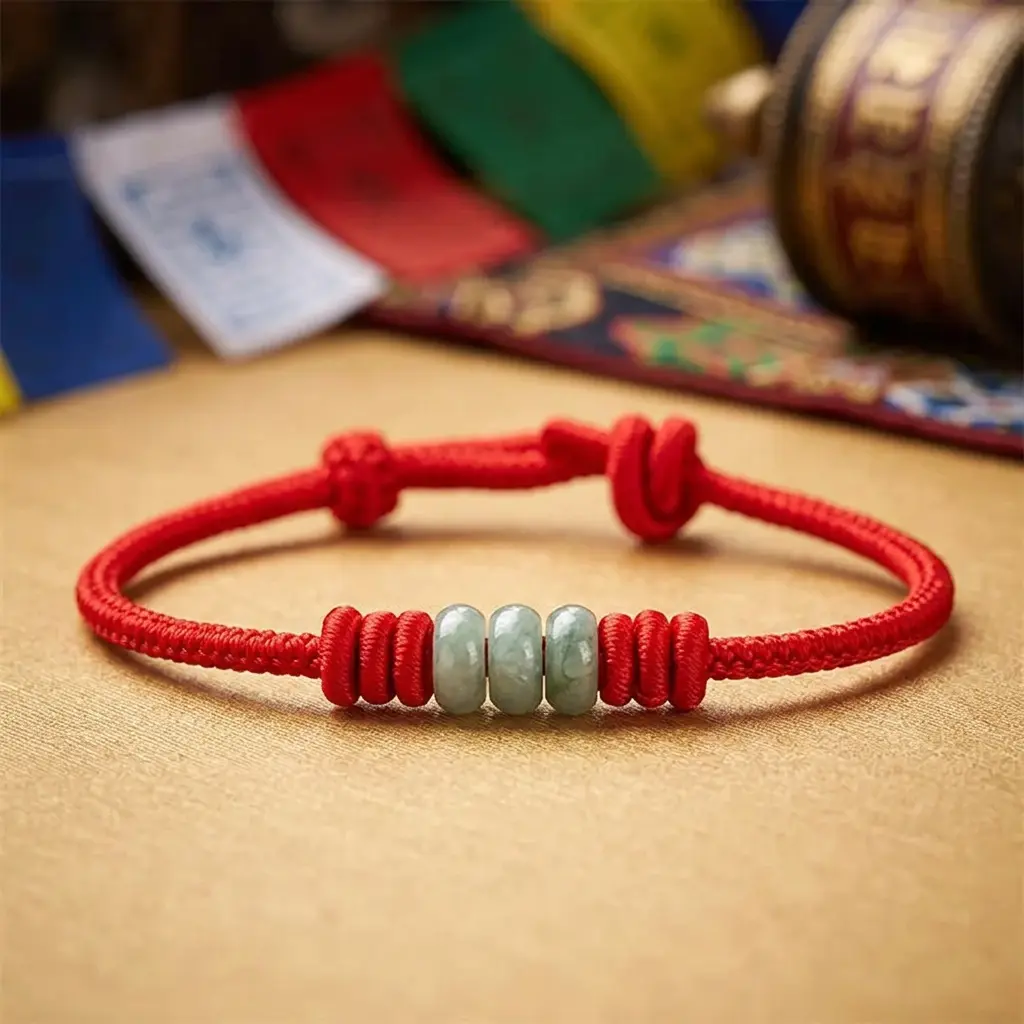
Our red-string money bag charm bracelet carries a charm just 0.6 × 0.4 in (1.5 × 1.1 cm) in rose-gold-plated 316L stainless steel, small enough to wear to the office unnoticed. Our copper Om Mani Padme Hum vajra pendant hangs on a 17.7- to 19.7-inch (45 to 50 cm) stainless steel chain with a rotating mantra bead and a vajra point. If the mantra itself draws you, our guide to Om Mani Padme Hum mantra jewelry for protection explains its meaning and pronunciation.
Can a Charm Be a Pendant?
Yes. A charm becomes a pendant the moment it hangs alone on a necklace as the main piece, so the difference is role, not the object itself. Just check that the charm’s jump ring fits your chain or cord.
Pros and Cons of Buddhist Charms
Charms are affordable, low-key, and easy to layer, but their small size leaves little room for detailed deity art or sealed contents.
- Pros: a lower-cost entry point, work-friendly, and easy to swap.
- Cons: limited detail, rarely hold mantras or relics, and cords fray with daily wear.
Pros and Cons of Buddhist Pendants
Pendants give you room for fine iconography and, in gau form, sacred contents, but they are more visible and ask for more mindful handling.
- Pros: room for detailed deity art, the option to hold sacred contents, and a place at chest height. A rotating mantra bead, like the one on our vajra pendant, gives your fingers something to turn when you need a moment to pause.
- Cons: a higher price, more weight, and more visibility.
Size and placement explain how the two forms look. They don’t explain why some pieces are treated as sacred, and that is where blessing comes in.
Why Blessing, Not Size, Is the Real Dividing Line
In Buddhist practice, what turns a pendant or charm into an amulet is not its size. It is whether the piece has been consecrated, what it contains, and the intention you bring to it. A 3-inch Buddha pendant can be pure decoration, while a tiny blessed charm can be treated as sacred.
The Three-Question Test: Blessed, Filled, or Intended?
Ask these three questions about any piece before you buy it.
- Blessed: Was it consecrated by a monk or lama, and can the seller name where it happened?
- Filled: Does it hold sacred contents, such as a mantra scroll, a tsatsa, or blessed pills?
- Intended: Will you wear it as a reminder of a practice, such as compassion or patience?
Three yeses point to an amulet in the traditional sense. Zero yeses means well-made jewelry with a Buddhist design, which is fine as long as you know it. The most common mistake we see is trusting a vague “monk blessed” label. A seller who works with a real monastery can usually tell you which one.
What Consecration Means in Tibetan Tradition
Consecration, called rab gnas in Tibetan, is the ritual that invites a deity to dwell in an image. The Rubin Museum describes practices such as dotting an image’s eyes, visualizing the deity’s descent, and placing mantras or sacred texts inside a statue. In the Tibetan Vajrayana tradition, a full rab gnas blessing is performed over three days by a group of ordained monks.
To be honest about the limits, no seller can guarantee spiritual effects, and a blessing is a matter of faith rather than something anyone can measure. What we can offer is provenance documentation for pieces sourced through Sera Jhe and Kopan, so you know where yours came from.
How Thai, Japanese, and Tibetan Traditions Differ
Three regional traditions answer the “charm or pendant” question in different ways.
- Thai phra khruang: small votive tablets, often set in protective cases, worn on a necklace, and widely collected.
- Japanese omamori: brocade pouches from temples and shrines, carried on bags or keys and traditionally never opened.
- Tibetan gau: wearable reliquaries that hold sacred objects, which the Rubin Museum groups with stupas as key Himalayan reliquary forms.
For the seven main Tibetan protection amulets and the deities behind them, read our guide to Tibetan Buddhist amulets for protection and their meanings.
Gau Box vs Open Pendant: Wearing a Shrine or a Symbol
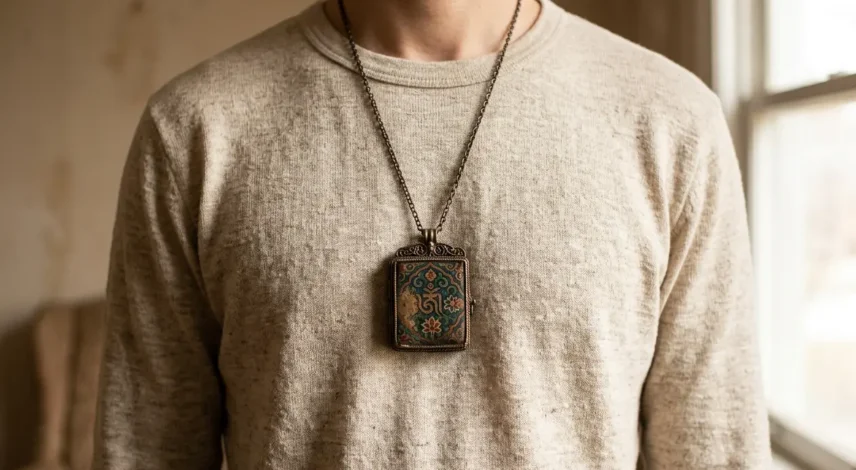
A gau box (pronounced “gow”) is a small Tibetan amulet case worn as a pendant. Unlike an open Buddha pendant, its protective role traditionally comes from the sacred contents sealed inside, which makes it a portable shrine rather than a symbol.
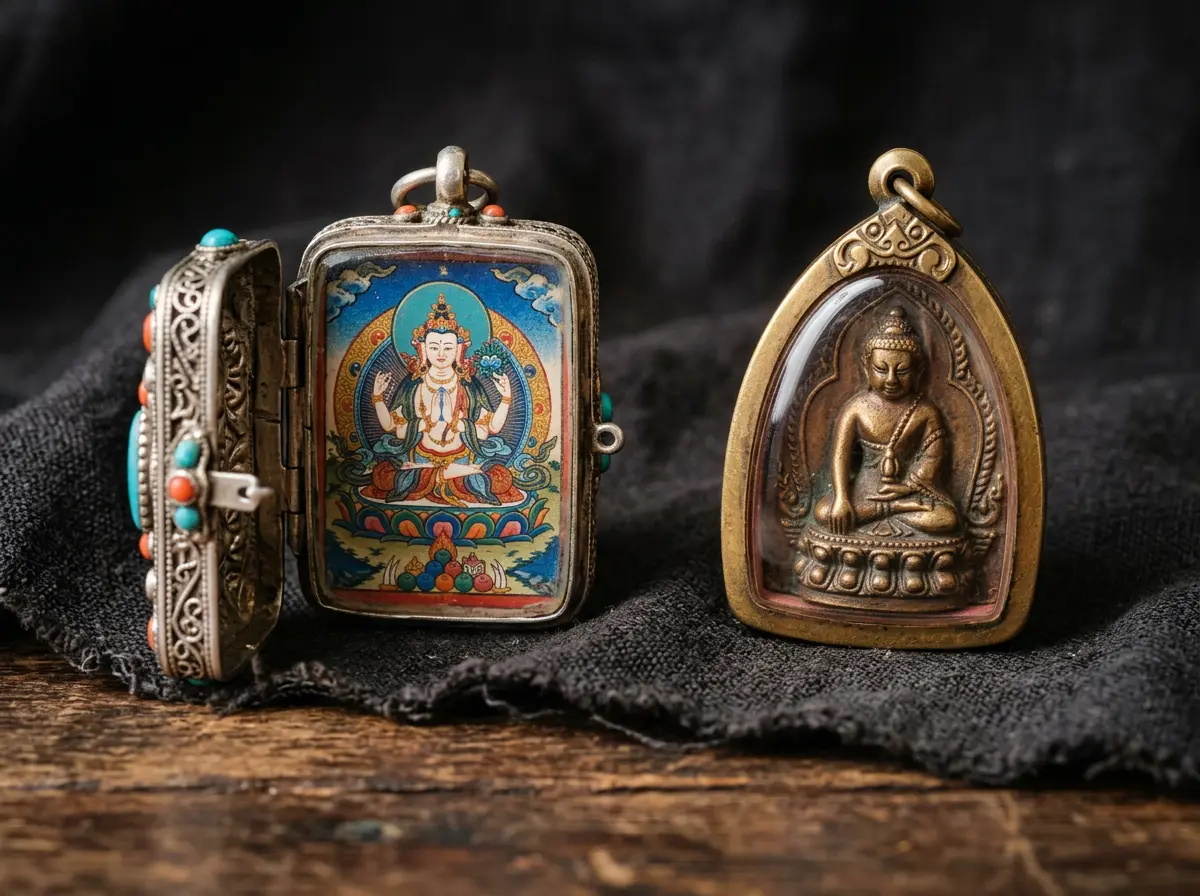
Image slot 2
File name: tibetan-gau-box-open-contents.jpg
Alt text: An open Tibetan gau box pendant showing a hand-painted deity inside, next to an open-style Buddha pendant
What Traditionally Goes Inside a Gau
According to the Rubin Museum, a gau can hold images of deities, mantras and dharanis (longer protective formulas), relics, tsatsas (small molded clay images), and medicinal pills. Tibetans call these contents ten, meaning “receptacle,” because they are believed to hold the blessings, or jinlab, of buddhas and revered lamas. Traditionally, a gau is filled and sealed under a teacher’s guidance, not assembled at home.
The Pitt Rivers Museum at Oxford notes that Tibetans of every social class wore protective amulets, from gem-studded silver boxes to simple woven pouches on a cord.
Size, Weight, and Everyday Comfort Compared
| Piece | Size | Weight | Daily comfort |
|---|---|---|---|
| Rubin Museum gau (Kathmandu, early 21st century) | 3.5 × 3.1 × 1.5 in (9 × 8 × 4 cm) | Not listed | Ceremonial scale |
| 19th-century round gau (antique dealer record) | 3.1 in long, 2.75 in across (8 × 7 cm) | 3.1 oz (87 g) | Heavy for all-day wear |
| Modern gau-style pendants | 1.5 to 3 in | Varies by case | Everyday friendly |
| Citrine Guardian Buddha (open pendant) | 2 × 1.2 in (5 × 3 cm) | 2.1 oz (60 g) with chain | Everyday friendly |
Rubin Museum scholar James Gentry notes that gau boxes worn by men range from about 1 inch to more than 14 inches tall. A 3-ounce box swings and taps against your chest when you walk, so a lighter open pendant is often the easier choice for everyday wear.
Who Should Choose a Gau Box, and Who Shouldn’t
Choose a gau if you want a wearable shrine for travel, retreats, or daily practice. Choose an open pendant if you want the symbol visible, lightweight, and easy to wear with work clothes.
If you want the gau experience in a lighter form, our hand-painted Thangka Buddha pendant in a leather gawu box opens to reveal a 3D Thangka painting of the deity you choose, with 16 deities available. The case protects the painting, so you can carry a small shrine and open it for a quiet minute on your commute. Opening one feels less like jewelry and more like carrying a pocket temple. It is $68.95 at the time of writing and arrives in a gift box.
Which One Fits You? A Gift and Self-Wear Decision Matrix
Pick a pendant if you want one meaningful piece worn daily over the heart. Pick a charm if you would rather start small, stay subtle, or build a collection over time.
| Scenario | Best fit | Why | Example (USD) |
|---|---|---|---|
| First Buddhist piece | Small open pendant | Low commitment, easy to wear | Citrine Guardian Buddha, $32.95 |
| Holiday gift | Pendant in a gift box | Arrives complete and ready to give | Thangka Buddha pendant, $68.95 |
| Travel, traditional protection | Gau-style pendant | Follows the wearable shrine tradition | Leather gawu pendant, $68.95 |
| Subtle and work-friendly | Wrist charm | Barely visible under a sleeve | Money bag charm bracelet, $30.95 |
| Daily meditation | Wrist mala plus a small pendant | A counting tool plus a reminder | See our mala guide below |
Best for Gifts: Holidays, Graduations, and New Beginnings
For a gift, a pendant usually wins because it arrives complete, with chain, box, and meaning. You don’t want to hand someone a loose charm that needs a bracelet they don’t own. With Black Friday on 11/27/2026 and the holidays close behind, order early enough to add a short note explaining the deity’s meaning.
For a first piece, our citrine Guardian Buddha pendant necklace is a gentle starting point at $32.95. The 2 × 1.2-inch pendant weighs 2.1 oz (60 g) with its chain, heavy enough to feel present and light enough for all-day wear.
If you are buying for someone going through a hard season, such as an illness or a loss, choose the piece as a gesture of care, not a cure. For newborns, our guide to blessed charms and amulets as protective baby gifts covers how to give them safely.
Best for Daily Wear, Work, and Travel
For everyday wear, weight and visibility matter most. A 2-inch pendant tucks under a collar, and a single wrist charm works in most US workplaces. If you are torn between symbols, our comparison of how dorje, vajra, and prayer wheel pendants differ matches each design to an intention. If a counting tool suits your practice better than a pendant, see our breakdown of the 108-bead mala necklace vs 27-bead wrist mala.
Can I Wear a Buddhist Necklace If I’m Not Buddhist?
Yes. Across most Buddhist cultures, non-Buddhists wearing Buddha imagery is accepted as long as the piece is treated with respect. The Tibetan Nuns Project, for example, notes that you don’t have to be Buddhist to wear a mala.
How to Wear and Care for Buddhist Charms and Pendants
Treat a Buddhist pendant or charm the way you would treat a small shrine: keep it at waist height or above, take it off for the shower and bed, and never set it on the floor. These habits also help your jewelry last longer.
Wearing Etiquette: 5 Simple Rules
- Wear it above the waist. Buddha images belong on the upper body, never on an anklet.
- Take it off to shower and sleep. This shows respect and protects cords and paint from water.
- Keep it off the floor. Set it on a clean cloth, a shelf, or a small altar.
- Store it on its own. A soft pouch keeps metal pieces from scratching painted or leather ones.
- Follow your tradition on restrooms. Some practitioners remove sacred pieces first, while others tuck them inside clothing.
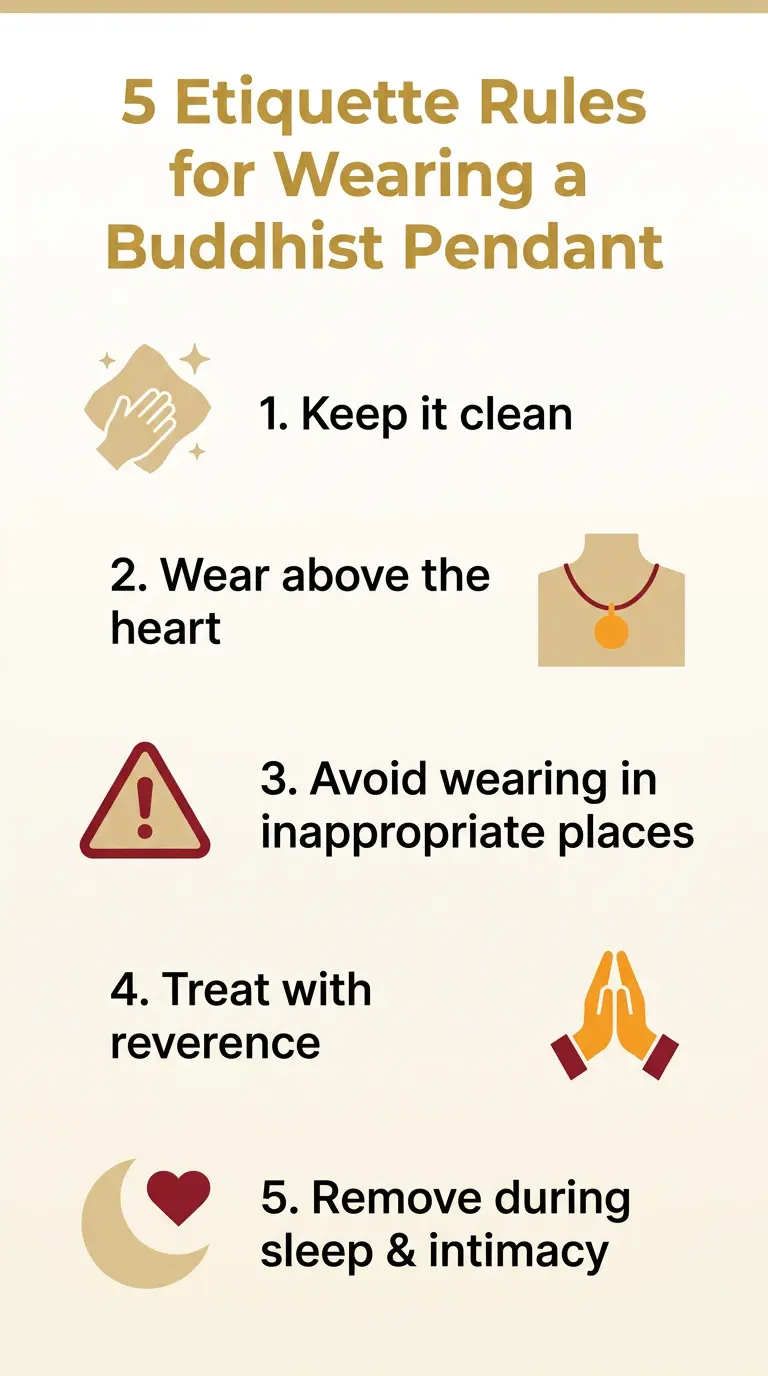
Image slot 3
File name: buddhist-pendant-wearing-etiquette-infographic.png
Alt text: Infographic of five etiquette rules for wearing a Buddhist pendant or charm respectfully
Care Differences: Metal, Stone, Leather, and String
- Copper and brass: darken naturally over months. Wipe with a dry cloth, and polish only if you prefer the bright look.
- 316L stainless steel: resists tarnish. Rinse off sweat and dry it after the gym.
- Leather gawu cases: keep dry and wipe with a soft dry cloth, because water can warp leather and lift paint.
- Citrine and other stones: many gem guides advise keeping citrine out of long periods of direct sun to protect its color.
- Red string: cords fray with daily wear. Folk belief holds that a string that breaks has done its work, so replace it rather than knotting it back together.
In summary: the difference between Buddhist charms and pendants starts with size and placement and ends with blessing. Choose an open pendant for a first piece, a gau box for a portable shrine, and a charm to stay low-key. Either way, the piece matters less than what it reminds you to practice, whether that is compassion, clarity, or calm. To go deeper, explore the seven Tibetan protection amulets and their deities.
Find the Buddhist pendant that fits your intention
Every piece in PotalaStore’s collection is listed with its size, material, and traditional meaning. Pieces sourced through Sera Jhe and Kopan come with provenance documentation.Shop Tibetan Buddhist pendants
Common Questions from First-Time Buyers
What is the difference between a Buddhist pendant and a Buddhist amulet?
A pendant is defined by how it’s worn, hanging from a necklace as a symbol. It becomes an amulet when it has been traditionally consecrated or holds sacred contents such as a mantra scroll. That gives it a protective role in Buddhist belief.
Does a Buddhist pendant need to be blessed to work?
If you wear it as a reminder of compassion or wisdom, no blessing is required. In Tibetan tradition, though, consecration by monks is believed to invite the deity’s presence into the image. That is why many practitioners look for monastery-blessed pieces.
Is it bad luck to buy a Buddhist necklace for yourself?
No. Buying a Buddhist pendant or charm for yourself is common and is not considered unlucky in Tibetan practice. What tradition emphasizes is the intention you bring and the respect you show the piece.
How do I choose my first Buddhist pendant?
Start with the quality you want to cultivate, such as compassion (Guanyin), wisdom (Manjushri), or the clarity to cut through obstacles (vajra). Then pick a size you will wear every day; a 1- to 2-inch pendant on an 18-inch chain is the easiest start. Compare sizes and prices side by side in our Tibetan pendant necklace collection.
How we wrote this: sourcing details reflect PotalaStore’s own supplier relationships, museum facts are linked in the References below, and prices were checked on 09/28/2026.
📚 References
- Amulet Box (Gau) with Its Contents: James Gentry’s essay on what Tibetan gau boxes hold, how they are sized, and how consecration works. Project Himalayan Art, Rubin Museum of Art
- Small Blessings, Amulet Trail: Gau, Tibet: Museum notes on gau shapes, materials, and how widely Tibetans wore protective amulets. Pitt Rivers Museum, University of Oxford
- Talisman: Encyclopedia definition of talismans and their relationship to amulets and charms. Encyclopaedia Britannica
- How to Use and Choose a Tibetan Mala: Guidance from a Tibetan Buddhist charity on wearing sacred beads, including for non-Buddhists. Tibetan Nuns Project