
The Twelve Dharmapala Goddesses: Tibet’s Ancient Guardians of Protection and Balance
 by Yang Tso
0 comments
by Yang Tso
0 comments
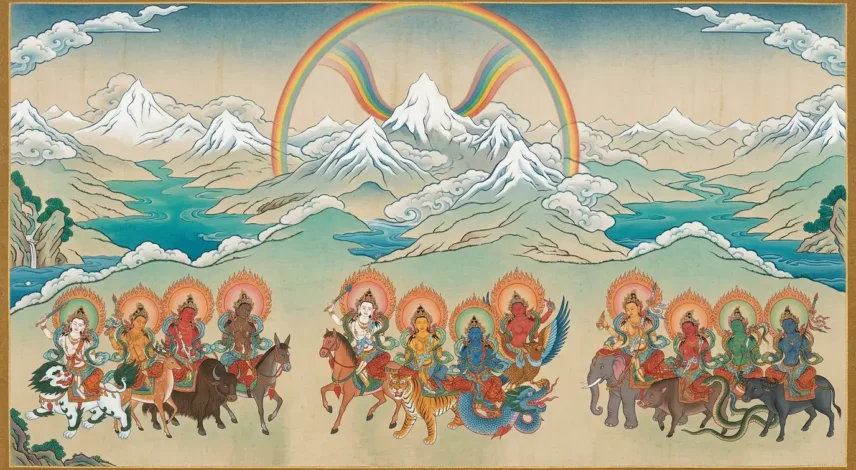
The Twelve Tenma goddesses (Tibetan bstan ma bcu gnyis, also called Tenma Chunyi) are twelve female protectors of Tibet, often called the twelve Dharmapala goddesses in English. If you have studied a Palden Lhamo thangka, you have probably seen them: a row of goddesses on different mounts along the lower edge. This guide shows you who they are, where their story comes from, and how to recognize them in Tibetan Buddhist art.
You will also see where sources disagree. The names, the cave of the oath, and even the leader of the group change from one lineage to the next. We note each difference instead of choosing one version for you.
We checked every claim against Himalayan Art Resources, Rigpa Wiki, Lotsawa House, and the Robert Beer Archive. At Potala Store, we share Tibetan art with its context. To see the tradition in paint, start with our hand-painted Tibetan thangka paintings collection.
Important note: This article describes traditional Tibetan Buddhist beliefs for educational and cultural purposes. Protective qualities described here reflect tradition, not guaranteed outcomes, and are not a substitute for medical, psychological, or legal advice.
Table of Contents
What Are the Twelve Tenma Goddesses?
The Twelve Tenma goddesses (Tibetan bstan ma bcu gnyis, also called Tenma Chunyi) are twelve female protector deities of Tibet, traditionally said to have been oath-bound by Padmasambhava in the 8th century. They form three groups of four and often appear in the retinue of Palden Lhamo.
Sources spell the name two ways. Rigpa Wiki writes bstan ma bcu gnyis, while Himalayan Art Resources and Robert Beer write brtan ma bcu gnyis and use the English form Tanma Chunyi.
Translators have rendered the name as Twelve Established Goddesses, Twelve Immovable Goddesses, and Twelve Subterranean Goddesses. Other glosses include Twelve Goddesses of the Earth.
Are the Tenma Dharmapalas or Worldly Protectors?
Most sources classify the Tenma as worldly protectors, not as members of the Eight Dharmapalas. A Dharmapala is a protector of the Buddhist teachings. Tibetan tradition separates wisdom protectors, who are wrathful forms of enlightened beings, from worldly protectors, who are local deities bound by oath.
Himalayan Art Resources places Tanma Chunyi in the worldly category. The Rangjung Yeshe Wiki calls them semi-mundane, semi-wisdom protectors. Palden Lhamo, whom the Tenma serve, is the only goddess among the Eight Dharmapalas in Alice Getty’s 1914 survey, The Gods of Northern Buddhism.
So “Twelve Dharmapala Goddesses” works as popular shorthand. Strictly, they are protectors who serve a Dharmapala. If these categories feel confusing, that is normal, because Tibetan sources use overlapping terms. Formal protector practice is traditionally undertaken with a qualified teacher, but appreciating the art requires no initiation.
For the wider picture of protective objects, see our guide to Tibetan protection amulets and the deities behind them.
What Does “Tenma” Mean in Tibetan?
Tenma is the Tibetan name for these twelve protectors, and sources spell it two ways. Spelled brtan ma, it carries the sense of “firm” or “steadfast,” which explains translations such as Established and Immovable. Spelled bstan ma, as Rigpa Wiki has it, it points to the teachings.
Both spellings name the same group of twelve. When you search for them online, try Tenma, Tanma, and Tenma Chunyi to catch every variant.
How Did Padmasambhava Bind Tibet’s Mountain Goddesses?

According to Tibetan tradition, Padmasambhava (Guru Rinpoche) subdued the twelve Tenma in the 8th century and bound them by oath to protect the Dharma. Accounts differ on where this happened: Rigpa Wiki names the Asura Cave at Pharping, Nepal, while other sources point to the Kharag Cave or Uyug in Tsang.
The story fits a larger pattern. Padmasambhava is remembered as the master who tamed local spirits and made them oath-bound guardians, meaning spirits who pledged to protect the teachings. The Tenma are among the best-known female examples.
The Asura Cave Account at Pharping
Rigpa Wiki and Wikipedia place the binding in the Asura Cave near Pharping, in Nepal. The Asura Cave is a sacred site for Vajrayana practitioners, which helps explain why this version is repeated most often.
Wikipedia records two motives. In one version, the goddesses opposed the spread of Buddhism. In another, they refused to give up their life essence because they wanted to keep protecting Tibet.
Padmasambhava is traditionally shown holding a vajra. Our guide to the dorje (vajra) Padmasambhava holds explains that symbol.
Other Accounts: Kharag Cave, Uyug, and the Khala Pass
Other sources move the oath to the Kharag Cave, to Uyug in Tsang, or to the Khala Pass. Robert Beer notes that Padmasambhava wrote sadhanas (ritual practice texts) for the Tenma and concealed them as terma (hidden teachings meant for later discovery).
| Source | Location named | What it adds |
|---|---|---|
| Rigpa Wiki, Wikipedia | Asura Cave, Pharping (Nepal) | The most widely repeated account |
| Robert Beer Archive | Kharag Cave or Uyug in Tsang | Sadhanas written and concealed as terma |
| Lotsawa House (text attributed to Chokgyur Dechen Lingpa) | Khala Pass | Padmasambhava speaks of binding the Tenma sisters there |
| Lamrim Yeshe Nyingpo, via Rigpa Wiki | Tibet’s four borders | The goddesses are entrusted with guarding the frontiers |
While preparing this guide, we found that the Pharping account dominates online, but it is not the only one in the sources. The key takeaway is that no single location is universal.
Who Are the 12 Tenma Sisters? Names and Three Groups
The twelve Tenma form three groups of four, and each group has its own class name.
- Four dümo: Dorje Kundrakma, Dorje Yama Kyong, Dorje Kuntu Zang, and Dorje Geg Kyi Tso.
- Four nöjin (yakshinis): Dorje Yudrönma, Dorje Palgyi Yum, Dorje Lumo, and Dorje Drakmo Gyal.
- Four menmo: Dorje Bö Kham Kyong, Dorje Menchikma, Dorje Zulema, and Dorje Yarmo Sil.
These names follow Ratna Lingpa’s Tukdrub Yangdü, as listed by Rigpa Wiki. Other texts use different names.

The Four Dümo, Four Nöjin, and Four Menmo
Dümo, nöjin, and menmo are old Tibetan classes of female spirits, now bound as protectors. Older writing sometimes renders dümo as “demoness.” Nöjin is the class Rigpa Wiki glosses as yakshinis, and menmo are female mountain spirits.
These labels describe what kind of spirit each goddess was before her oath. They are not moral judgments, because all twelve now serve as protectors. Dümo, nöjin, and menmo together make up the three groups of four.
Why Do the Lists Differ Between Lineages?
The lists differ because they come from different ritual texts, mostly within the Nyingma school. Robert Beer notes that these sources vary in names, dwellings, mounts, and colors.
| Text | Tradition | First goddess named | Note |
|---|---|---|---|
| Palchen Düpa | Longchen Nyingtik | Tseringma | List ends with Wuna Dorje Zulemen |
| Tukdrub Yangdü | Ratna Lingpa | Dorje Kundrakma | Three groups of four, as listed above |
Two lists, two openers, one group of twelve. That is why no single roster fits every lineage.
Who Leads the Twelve Tenma?
No single goddess leads the Tenma in every lineage. Himalayan Art Resources says Dorje Yudrönma is sometimes presented as leader, but that view likely belongs to specific traditions and cannot be applied universally. Robert Beer records a similar claim under the spelling Dorje Yubunma.
The Palchen Düpa list opens with Tseringma, while the Tukdrub Yangdü list opens with Dorje Kundrakma. If a source names one leader with total confidence, check which text it follows.
How Is Palden Lhamo Connected to These Guardian Goddesses?
The Twelve Tenma serve in Palden Lhamo’s retinue, alongside two other goddess groups.
| Group | Number | Main association | Typical place on a thangka |
|---|---|---|---|
| Twelve Tenma | 12 (three groups of four) | Tibet’s mountains, lakes, and passes | Lower section, in groups |
| Five Sisters of Long Life | 5 | Tashi Tseringma, a five-peaked Himalayan mountain, and Milarepa | Lower center |
| Queens of the Four Seasons | 4 | The four seasons | In the clouds near Palden Lhamo |
Palden Lhamo (Shri Devi) appears as Magzor Gyalmo, the “Queen Who Averts Armies,” in the form most often shown with her full retinue. Robert Beer calls her the main female protector of Vajrayana Buddhism in Tibet, tied to Lhasa and to the line of Dalai Lamas of the Gelug school.
Himalayan Art Resources traces how the Tenma joined her court. A 15th-century painting of Magzorma already shows Tseringma with twelve goddesses in one composition. After the 17th century, the Tenma appear regularly in Magzor Gyalmo’s retinue, and HAR links this spread to the Fifth Dalai Lama. Some Bön accounts instead place the Tenma with Sidpa Gyalmo.
Modern readers sometimes describe the Tenma as keepers of balance between people and the land. That is an interpretive reading, not a classical doctrinal term.
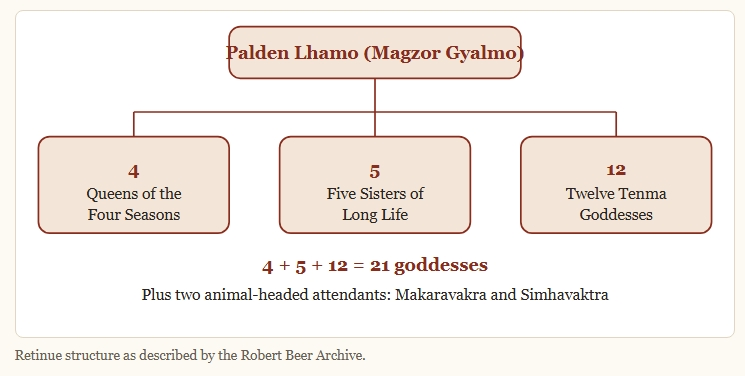
Inside Magzor Gyalmo’s Retinue of 21 Goddesses
Magzor Gyalmo’s retinue counts 21 goddesses: 4 season queens, 5 long-life sisters, and 12 Tenma. Two animal-headed attendants join them: the crocodile-headed Makaravakra and the lion-headed dakini Simhavaktra.
Tenma vs. the Five Sisters of Long Life vs. the Queens of the Seasons
The Five Sisters of Long Life are a separate group led by Tashi Tseringma, closely tied to Milarepa. Robert Beer says their five-peaked mountain is usually identified with the Everest massif or the Gaurishankar range.
Because Tseringma also appears in some Tenma lists, such as the Longchen Nyingtik one, the two groups are easy to confuse. The Queens of the Four Seasons form a third group, usually shown in the clouds near Palden Lhamo.
How Are Tibet’s Protectresses Honored Today?
Today the Tenma are honored mainly through the landscape and through art. Tibetan tradition links each goddess to a particular mountain or lake, and in Dharamsala, India, a Tenma oracle serves as the kuten, or “physical basis,” through whom the goddesses are believed to speak.
Sacred Mountains, Lakes, and Passes

The Tenma are protectors of Tibet’s land, and Robert Beer describes them as guarding its lakes and mountain passes. Six of the twelve guard narrow passes, according to his account. Translator’s notes on Lotsawa House likewise connect the twelve goddesses with twelve different mountains and lakes.
Tsem Rinpoche’s site links Dorje Geg Kyi Tso with Yamdrok Yumtso, one of Tibet’s great lakes. Tibetan tradition treats such places as sacred, which is why the goddesses are described through geography as much as through images.
The Tenma Oracle in Dharamsala
A young Tibetan woman in Dharamsala serves as the Tenma oracle, known as the kuten. Wikipedia reports that the goddesses are believed to speak through her. Do not confuse her with the Nechung oracle, who serves as Tibet’s State Oracle.
Oracle consultation is a community and monastic practice. We describe it here for context only.
How to Spot the Tenma in a Thangka
Follow these three steps to find the Tenma on a Palden Lhamo thangka:
- Find Palden Lhamo first. She is the central figure, usually shown riding a mule.
- Look below her for Tashi Tseringma. In many compositions she sits at lower center on a white lion, with the Five Sisters nearby.
- Count the groups on varied mounts. The Tenma appear in three groups of four, each goddess on her own animal.
Layouts vary by painter and lineage, so treat these steps as a starting point. The Robert Beer Archive page on Palden Lhamo and her retinue walks through one painting figure by figure. Beer describes it as an accurate copy of an early twentieth-century thangka once kept in the Potala Palace.

If you want a small, wearable piece of thangka art, our hand-painted Tibetan thangka pendant necklace carries a miniature painted image. It depicts a Buddha figure rather than the Tenma, and we have not listed a Tenma-specific piece at the time of writing (10/04/2026).
How Can You Honor Tibetan Protector Imagery Respectfully at Home?
You do not need to be a practitioner to appreciate Tenma or protector art, but Tibetan etiquette asks for care. Place images somewhere clean and elevated, learn who is depicted, and remember that formal protector practice is traditionally undertaken with a qualified teacher.
Simple Etiquette for Displaying Protector Images

Keep protector images high, clean, and identified. Wanting to get this right is already a respectful start.
- Choose a high, clean surface. A shelf or altar works better than the floor or a bathroom.
- Know who is depicted. Check the deity’s name before you display or gift an image.
- Skip the shortcuts. A picture is not an empowerment, and an image does not replace guidance from a teacher.
These are common courtesies. Ask a qualified teacher about the customs of your own tradition. The same placement logic applies to Buddha figures, and our guide to Buddha statue poses and mudra meanings shows how to read them.
Choosing Thangka-Inspired Art and Jewelry Honestly
Choose pieces that name the deity, describe the materials, and make no guarantees. Before: you admire protector art but worry about a mistake. After: you display it with context. The bridge is simply knowing who is depicted and why.
A small hand-painted piece, such as a miniature thangka pendant, can serve as a daily reminder of a tradition you have studied, without needing a full altar. Treat any seller who promises protection as a warning sign. Traditionally, protection is understood within practice and teacher guidance, not as a built-in guarantee from an object.
To compare protective jewelry traditions before you buy, read our guide to Evil Eye vs Tibetan protection jewelry.
Frequently Asked Questions About the Twelve Tenma Goddesses
No. Palden Lhamo is the only goddess among the Eight Dharmapalas, and the Twelve Tenma serve in her retinue. Himalayan Art Resources classifies them as worldly protectors, meaning local deities oath-bound to guard the Dharma.
Tashi Tseringma leads the Five Sisters of Long Life, a separate group closely tied to Milarepa. Both groups appear in Palden Lhamo’s retinue, and some Tenma lists also include a goddess named Tseringma, which causes frequent confusion.
In Dharamsala, India, a young Tibetan woman serves as the medium, or kuten, of the Tenma goddesses. Tibetan tradition holds that the goddesses speak through her. She is not the same as the Nechung oracle, Tibet’s State Oracle.
Look at the lower section of a Palden Lhamo (Magzor Gyalmo) thangka. Himalayan Art Resources also hosts an online gallery of Tanma Chunyi paintings. For thangka-inspired art for your own space, explore Potala Store’s thangka paintings collection.
In summary, the Twelve Tenma goddesses are oath-bound worldly protectors of Tibet, grouped as four dümo, four nöjin, and four menmo, who serve Palden Lhamo. The key takeaway is that lineages differ on names, leaders, and the cave of the oath, so read each source with that in mind.
If this guide has made you curious about protector imagery, you can carry the tradition with care. Browse Potala Store’s Tibetan Buddhist spiritual rings and read each description for the deity or symbol shown.
Sources and Editorial Notes
References
- Worldly protector classification, 15th-century and 17th-century history, and the leader question: Himalayan Art Resources, “Buddhist Worldly Protector: Tanma Chunyi.” himalayanart.org
- Spellings, three groups, two name lists, and the Asura Cave account: Rigpa Wiki, “Twelve Tenma Sisters.” rigpawiki.org
- Magzor Gyalmo’s retinue, guardian roles, and list variation: The Robert Beer Archive, “Palden Lhamo and her Retinue.” tibetanart.com
- Khala Pass account and the link to twelve mountains and lakes: Lotsawa House, “The Wish-Fulfilling Tree.” lotsawahouse.org
Cross-checked against: Wikipedia, “Tenma goddesses” (motives, oracle, Bön accounts); Tsem Rinpoche, Yamdrok Yumtso (Dorje Geg Kyi Tso); Alice Getty, The Gods of Northern Buddhism (1914), on Wisdomlib (Eight Dharmapalas).
Editorial note and version history
Written by the Potala Store editorial team. Where sources disagree, we say so rather than choose one version. Version 1.0, first published and last updated 10/04/2026. If you spot an error, please tell us through our Contact page and we will correct it and log the change here.